vog blog::vlog
This is one of my favourite descriptions of the feeling of helplessness faced with the Norwegian weather. Ever since the birth of my children - that's the last 15 years - I have felt restrained when walking in the winter. Either I'll slip and get out of balance, and my pelvis will give me excruciating pain, or I will walk like an old lady, and the tension in my back will become equally painful, just a bit more slowly.
My one consolation is walking uphill: it's easier to stay in control. Which is why I loved to read Adrian's post, vividly visualising him sliding slowly backwards. OK, so I read it with a touch of malicious pleasure, but when every step I take is accompanied with pain, I'll take any pleasures I can, malicious or not.
Thursday, November 22, 2001
An other Dragoness, and a roleplayer too! I keep finding more and more female gamers, and they aren't playing around with virtual barbies, but with powerful symbols and avatars which denote strength including, but not restricted to, sex.
Wednesday, November 21, 2001
Some electronic books will definitely have more traffic than others. This link is only useful for scandinavians. It tells you how to be a great lover, and what women should do to satisfy men. The author admits what we all knew though, that men are simple and that some encouragement helps. Wish I had a counter on that download, though....
Why do I think computer viruses are games? I have been thinking a little about that since I idly mentioned it yesterday. I often get questions like "why do people hack computers or make viruses", and while I can't really say, the same way as I have no idea why some people like to play football, I can look at why I think it's a game. So me and google.com set out to find some material about that.
Let's look at Huizinga's categories in homo ludens: First of all, they are restricted to a certain arena: the computer. The computer is perfectly suited to be a gaming environment, it's separate from the "real world" without needing to erect stadiums, it gives an equally good view both for the players and the spectators, and you have a ritualistic approach to entering the arena - you even have a secret pass-word.
Viruses are definitely superflous. Nobody needs a virus. They are a result of too much time, energy and occasionally imagination on the part of the creator. They don't belong in "real life" - even if they impact reality (as does soccer, being a huge industry), their function is beyond the ordinary use of the computer. Although there are viruses which are taken very seriously, Huizinga points out that "Any game can at any time wholly run away with the players."
Viruses are limited in time and space, like a game. They are created, distributed, isolated and stopped. The periodic nature of virus outbreaks has its own rhythm, like certain games - or like the bug they are named for. But where the flu isn't created with intent (we hope), several computer viruses are. Viruses are, in their own way, a different order, and they are an important part of creating a hierarchy in some social groups:
While research shows a lot of virus writers act from boredom, Evan says there are a variety of reasons: "It was some credibility in front of my hacker peers to say, 'hey, I can write a virus and you can't.' There's almost even an aspect of 'make them afraid of you,' albeit, no real threat here, but there was the mystique that 'hey, don't mess with that guy, he'll give you a virus.'"
Viruses claim fame and a place in the history books through elegance and effectiveness.
Virus creation and hacking gives access to a world-spanning community. And like sports, it's healthy, because it keeps the skills of the wider computer community honed.
Even the secrecy and mystery of dress-up is well taken care of in the hacking community, particularly when it comes to sending out virus emails. Disguised through several layers of proxy servers, using automatons or 'bots to launch the virus remotely on certain dates, the hacker also often communicates through dramatic, romantic aliases signifying the lone ranger, the dark hero of the digital frontier.
All of this confirms that making a virus and spreading it is play, but is it a game?
I'd say yes to that as well. Hacking has its own "score-sheet" with hits and misses, and that score-sheet has reached the news. It also has the professional antigonists and established "enemies", somebody to measure skills and abilities against. Hacking Nasa, Pentagon or Microsoft ranks high up there, like an olympic gold medal. There is a game-play nature to hacking and virus-writing which is mirrored in other games to play with computers, popularly called computer games.
Tuesday, November 20, 2001
Lifestyle
by way of Lisbeth: technofemme. Just so you all know what will make me happy come christmas.
Salon Technology | 21st Challenge No. 24: Results
How to make people open those virus attachments? This is a kind of game as well.
Monday, November 19, 2001
"But the fourth World War is elsewhere. It is that which haunts every global order, every hegemonic domination; -if Islam dominated the world, terrorism would fight against it. For it is the world itself which resists domination."
From Jean Baudrillard's "The Spirit of Terrorism"
Flickwerk
Anja Rau has started a blog! She starts out with replying to the comments on her review of Caitlin Fisher's The Waves, commenting on the instant attention given to her direct style of reviewing.
It's interesting to note that there is obviously a need for academic discourse outside the formalised genres, a need for a voice which is not restricted by the demands of reviewed publishing. With the academic community spanning continents, the net carries the opinions which we like to imagine happen informally where scholars are gathered physically. The web is now where we are gathered, and it's not a virtual conversation which takes place. The exchanges of ideas, the comments on each others' opinions, all of this is real, and influences our research, teaching and lives.
Welcome to this corner of reality Anja.
Sunday, November 18, 2001
I had planned to drink cider, but Jill made me taste her beers, and after sipping eight different beers, drinking cider and being offered wine quite generously, a lot of Friday night had become a blur of laughter, more-or-less successful schemes in order to lose Jill and Lisbeth in the labyrinth beneath the University, and some serious attempts at rating and determining the origin of the aforementioned beers. However, I still remember Jills eyes shining as she used Norwegian and thus excluded Adrian but included Lisbeth, discussing how she should use Baudrillard, and talking about this article she has just read about terrorism. She promised to put the link on her blog for us to reach, and yes, she did.
Friday, November 16, 2001
Yesterday, Jill and I finished the abstract for our paper for the upcoming SKIKT conference. We are proposing a paper on blogging. Jill got the idea of writing the papers on science theory about blogging. I'll spend the afternoon in a library, for the first time in a while feeling good about writing down new ideas and thoughts.
Tuesday, November 13, 2001
Sometimes, the fear of living overwhelms me, and I need to sit down and count my blessings painstackingly, one by one. Some of them are easy: that my kids are brilliant geniuses and my husband a paragon of patience is obvious. Some of them have to be looked for very carefully. Lately I have been trying to figure out if I actually know anything. Almost four years and 200 pages devoted to one topic, and do I know anything? Or will the final accessor on the day of doom look at the fruits of my labours and say: you write brilliantly. But you have no content!
So what have I learned, from these years of enjoying myself with a topic I (used to) love?
I have learned to search for knowledge.
I have met some wonderful people and made some new friends.
I have become a very good online roleplayer.
I have read a LOT of theory, and found a lot which is not relevant to the topic.
I have learned to argue beyond logic and exhaustion (thank you Espen).
Will any of this carry me through the last months between me and my PhD? Stay tuned for more thrills from the life of an exhausted scholar!
Klastrup's Cataclysms
Lisbeth is worried she is watched by Big Brother, but I'd like to point to Jill's discovery of the archive system the US government started after sept. 11th, where it's possible to alert the archivists that a site is relevant to what happened on sept. 11th.
Most likely somebody with a "note this" function have found something she wrote interesting in this context, and hit "note this" as they were reading, surrendering her website to - Big Brother. It might even have been Jill or me.
Aftenposten Interaktiv - Politikk - Klemte ikke til mot Clemet
The new government, which has been profiled heavily towards education, doesn't think the students are important in that process. They cut the proposed increase in free student support, maintaining 30%.
I wonder what they would save just for students by erasing all student debts (including mine of course), dissolving Statens Lånekasse and taking seriously the proposal of the Prime Minister to give all Norwegian Citizens 100 000 n kr in "wages", independently of what they do for a living. They'd probably save a lot on administration of several social benefits, although the definition of "poverty" would have to be edited.
Hilde: I tend not to lock the door when I go out. And I have all that fresh air, a beautiful view, and I come from a working-class background where poverty (yes, I think I can use that word) would have kept me from studying if I lived in the United States. My parents have made full use of the health-system and well-fare system, and I have used it enough that I don't resent paying taxes. Do I live in heaven? Compared to the life I, with my social and economic background, would have lived in many other countries, I think so.
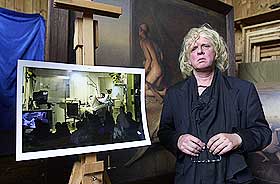
Nerdrum lovpriser Schau
Kristopher Schau has been eating junk food, sleeping badly and refusing to take a shower for a week, doing this in a window in one of the larger stores in Oslo. It's an experiment, or just a crazy stunt, which he named "forfall" or "decay". Schau is known from radio programs where he has been drinking delicacies like pizza, mayonnaise and cola mixed in a blender, and this is right up there with raw-fish-and-icecream-shakes.
The fun part is that serious artists who are more or less self-proclaimed guru's of the Norwegian "avant garde" have been asked to comment on this, and Knut Nerdrum says that this is great art. According to Nerdrum the criteria for good art is that the artist should not think a single complete thought, he should approach the task with irony and he should have no skills connected to the craft.
This sounds like the Norwegian ideal of the romantic artist, and in the name of outdated postmodern irony, I agree with Nerdrum. Oh, he happens to be a very classically educated painter - he has the skills of the craft. I guess he can never be an artist, right?
Subscribe to:
Posts (Atom)


 Posts

