The last few weeks have been filled with concerns about where we will live when my husband and I are both here and the house in Norway has been emptied and sold. I have already lived longer in the tiny, but posh apartment in the city than planned, and we have to find new place. Like good geeks, the internet was our main tool searching, and Boliga.dk is an extremely useful site. By now we have been all over the place, looking at apartments in 8tallet (extremely tempting, but way out and no storage space what so ever), several different apartment co-ops as well as fully owned apartments in Amager, Østerbro, Fredriksberg, Nørrebro (the famous, or infamous, Jægersborggade) and the city, as well as houses, regular and in garden co-ops. I spent every week-end for 6 weeks riding my bike around to see houses and apartments, and I have the muscles to prove it! However, when we finally decided to bid, it was for an apartment in the street where I already live. Smaller than planned, not that cheap, but I get to stay in the City.
So we keep living in a street with five (perhaps six?) restaurants and cafés, at least two of them extremely good and the rest pretty decent. There's a baker around the corner, as well as a gourmet deli. The street has a cleaner, a designer furniture store and a very trendy hairdresser - and it's just two blocks long. To get to anything like what I find in this street would include airplane tickets if I started out in Volda - or at least a 2 hour drive, including the ferry trip.
Buying property in Copenhagen is however a very different process from doing the same in Norway. Here it's not just adviced to have a lawyer, they actually do stuff that's practical and useful, and it's expected that they particpate in the process. Since one is as good as another, we counted on advertising to help out, and contacted one that advertised on Boliga. But apart from a lawyer, I need a very good relationship to a bank, since they want to money to be guaranteed and secured well in advance. Coming from the Norwegian system where only a small preliminary sum changes hands in advance, and then the real transfer happens with the transfer of the property, it's unexpected that they want a guarantee for the whole sum 45 days in advance, and the final payment to be available 15 days in advance.
Also, we are foreigners. That's not really a big deal, since we're both Scandinavian, I work here and we're both planning to live here. If I had planned to stay mainly in Norway and commute during the week, as some colleagues do, I'd have a lot more of a problem. Danish rules for who can own property are pretty strict.
The process is slowly rolling along though. And then we'll be living in Copenhagen. This week-end was a typical example of what we can do and experience in the city. Friday, after visiting the lawyer, we walked across the street into Illum Bolighus, ready to spend half an hour dreaming about designer furniture. And look, they serve wine too! What's better than free wine, lovely furniture and a head full of plans for a new place to live?
So there we were, happily sipping and enjoying the exhibition, when a very nice and enthusiastic man paused and asked us "you like that table, don't you?" We told him exactly what we thought about it - lovely, but too low for us. That made him disappear to come back with a small side-table, and while we watched he demonstrated how the tables could have different heights by ordering new legs, and several other things about the material. All the while he was talking about the design in a very proprietary fashion. "I thought it looked better with a metal finish. I wanted some variety." No, he did not sound like your regular eager salesman, and I peered at his name tag. It was one of the designers! It turned out that Illum had a special exhibition for the launch of some of the new designs in the Naver collection, and our fascination with good carpentry and light, elegant designs had caught the attention of one of the designers, as he saw us caressing his table.
Now, you might think that I could never have met a designer like that back in Norway? Think again, he has designed both for Hjellegjerde and Ekornes, furniture factories from Sunnmøre, the part of Norway where you find Volda. Still, I have to admit that with the following late night of discussions of design and architecture with a friend who's an architecture student, then a trip to Arken with another friend, who happens to be an artist and designer (a topic to this week-end, I think), to be followed up with restaurant trips to take advantage of the Copenhaven Restaurant Week, we felt very far from the quiet weekends in Norway, with long walks in the mountains and friendly togetherness in front of the fireplace, when we didn't work. And I also have to admit - I love the change.
Showing posts with label moving. Show all posts
Showing posts with label moving. Show all posts
Monday, March 28, 2011
Tuesday, September 07, 2010
CPH p.2: So you think you can ride?
Moving to Copenhagen meant bringing my bike - of course. After all, Copenhagen has a strong bicycle culture and an eager biker population, with their special interest advocates, such as Mikael at Copenhagenize.com. I used to ride my bike to school in the summer half of high school, rushing past the stuck cars at home, I went biking around the fjords and mountains for fun (and love - strong motivator, that) during the summers, and I rode my bike to work down the steep Bergen hills - and back up, to regain strength after a car accident. When I went to Umeå as a visiting scholar, I brought my bike, riding through the winter on spiked tires. I thought I knew about riding a bicycle. It's a motor skill you don't really forget, right?
Well, Copenhagen has revealed several of my bad habits.
At first glance, it's extremely easy to ride a bike in Copenhagen. There are the famous Copenhagen lanes separating cars from bikes and pedestrians, and the cutest little traffic lights with red, yellow and green bikes to tell you when to go and when to pause. You go to the tourist information or your hotel or the parking authorithy, and you ask for a bicycle map to find all the best biking routes, and you have donned your helmet - preferably, since you're as vain as me, some fashionable version camouflaged as an elegant hat or a fancy cap, or a smooth helmet painted to match your bike or your outfit. After all, biking in the city, you want to look chic.
Now, off you go - and suddenly you discover the Copenhagen bikers' glare. Danes are pretty polite, and tolerant of tourists, but do mind that glare. Did you pause in the wrong side of the lane? There will be a tingling bell - and a glare. Did you forget to signal your slow-down and stop? There's that glare. Did you turn the wrong direction? A muttered "shit" and that glare, again. Slowly, you'll be getting it: you're doing something wrong, and it's time to figure out what before something happens.
First: signals. If you like me learned about traffic safety and biking in school, then you know about using your hands to signal right and left. However, Copenhagen has a third signal: stop. It's used for stopping at the curb, for turning off to the side to wait for the crossing light, for having reached your destination and stopping to park your bike. You lift a hand (optional which) and hold it straight up, either open or as a fist, doesn't matter. And you preferably do it early, or somebody will hit your from behind, and you'll get a lot more than a glare.
Next: attention. At the beginning you're happy to avoid being hit by cars. Then you start congratulating yourself that you don't hit any pedestrians. Then you discover all the bikers glaring at you, and you realise it's time to look out for other bikers. This is when you learn to look before you turn. You see, the lanes are not one-track lanes, but two and sometimes three or four-track lanes. It works just like with cars, slow to the right, faster to the left. Once you have passed your obstacle, you fall in to the right again. Unless you're chatting with your friend at your side. Danes can talk and bike at the same time. Astounding capacity. When you're at that level, you stop caring about the glare, because you're riding with that easy balanced arrogance that comes with knowing you're looking better and getting stronger and more healthy with every turn of the wheel. Yeah, they look good.
Anyway, about that attention. Don't let those good looks distract you. What you're looking for is traffic, and you need to learn how to anticipate it. See that group of people and the bus just pulling in? They will pass through the bike lane in a second. See those tourists messing around, waiting to cross? They don't know about the bike lane, and they will block you. And behind you - catch that faint hum? You're being overtaken, and you need to check for that if you plan to shift out to pass the biker in front of you. And DO mind the red lights. Biking like a maniac to the next light just to have to stop is a waste of energy. Ease up slowly, and hope it shifts to green before you have to stop. It's not like there's always a railing to hang on to. But you're learning.
Soon you'll discover the more subtle signs of Danish biking culture. Like the turned up or tucked in right pant-leg. In the summer half of the year it's mostly turned up, to avoid getting the pants into the chain. That's when you'll notice another little subtle thing: when you wear sandals and your pants are short or tucked up, your ankle tattoo will show! That is, of course, given that you have biked around in Christiania or downtown for long enough to decide you really want a nice little decoration on your right ankle. I have never before seen that many ankle tattoos as I saw this summer, tucked neatly between the shoe and the short or turned-up pants.
Now you're ready for another difficult biking exercize: finding a parking spot. I know people who don't bike in Copenhagen because it's such a hazzle to park. Yeah. But don't despair - despite the many angry glares you'll get if you put your bike in front of shop windows, there are thousands of designated parking spots all over town. And some of them are pretty damn good. Like the ITU basement, which is to a large extent dedicated to parking bicycles.
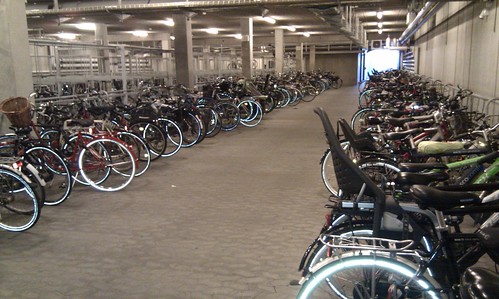
And yes, my bike is there, today as most days. Sometimes sore, sometimes soaked, sometimes just happy to have gotten here on time - but I live 10 minutes away by bike, and I love it.
Well, Copenhagen has revealed several of my bad habits.
At first glance, it's extremely easy to ride a bike in Copenhagen. There are the famous Copenhagen lanes separating cars from bikes and pedestrians, and the cutest little traffic lights with red, yellow and green bikes to tell you when to go and when to pause. You go to the tourist information or your hotel or the parking authorithy, and you ask for a bicycle map to find all the best biking routes, and you have donned your helmet - preferably, since you're as vain as me, some fashionable version camouflaged as an elegant hat or a fancy cap, or a smooth helmet painted to match your bike or your outfit. After all, biking in the city, you want to look chic.
Now, off you go - and suddenly you discover the Copenhagen bikers' glare. Danes are pretty polite, and tolerant of tourists, but do mind that glare. Did you pause in the wrong side of the lane? There will be a tingling bell - and a glare. Did you forget to signal your slow-down and stop? There's that glare. Did you turn the wrong direction? A muttered "shit" and that glare, again. Slowly, you'll be getting it: you're doing something wrong, and it's time to figure out what before something happens.
First: signals. If you like me learned about traffic safety and biking in school, then you know about using your hands to signal right and left. However, Copenhagen has a third signal: stop. It's used for stopping at the curb, for turning off to the side to wait for the crossing light, for having reached your destination and stopping to park your bike. You lift a hand (optional which) and hold it straight up, either open or as a fist, doesn't matter. And you preferably do it early, or somebody will hit your from behind, and you'll get a lot more than a glare.
Next: attention. At the beginning you're happy to avoid being hit by cars. Then you start congratulating yourself that you don't hit any pedestrians. Then you discover all the bikers glaring at you, and you realise it's time to look out for other bikers. This is when you learn to look before you turn. You see, the lanes are not one-track lanes, but two and sometimes three or four-track lanes. It works just like with cars, slow to the right, faster to the left. Once you have passed your obstacle, you fall in to the right again. Unless you're chatting with your friend at your side. Danes can talk and bike at the same time. Astounding capacity. When you're at that level, you stop caring about the glare, because you're riding with that easy balanced arrogance that comes with knowing you're looking better and getting stronger and more healthy with every turn of the wheel. Yeah, they look good.
Anyway, about that attention. Don't let those good looks distract you. What you're looking for is traffic, and you need to learn how to anticipate it. See that group of people and the bus just pulling in? They will pass through the bike lane in a second. See those tourists messing around, waiting to cross? They don't know about the bike lane, and they will block you. And behind you - catch that faint hum? You're being overtaken, and you need to check for that if you plan to shift out to pass the biker in front of you. And DO mind the red lights. Biking like a maniac to the next light just to have to stop is a waste of energy. Ease up slowly, and hope it shifts to green before you have to stop. It's not like there's always a railing to hang on to. But you're learning.
Soon you'll discover the more subtle signs of Danish biking culture. Like the turned up or tucked in right pant-leg. In the summer half of the year it's mostly turned up, to avoid getting the pants into the chain. That's when you'll notice another little subtle thing: when you wear sandals and your pants are short or tucked up, your ankle tattoo will show! That is, of course, given that you have biked around in Christiania or downtown for long enough to decide you really want a nice little decoration on your right ankle. I have never before seen that many ankle tattoos as I saw this summer, tucked neatly between the shoe and the short or turned-up pants.
Now you're ready for another difficult biking exercize: finding a parking spot. I know people who don't bike in Copenhagen because it's such a hazzle to park. Yeah. But don't despair - despite the many angry glares you'll get if you put your bike in front of shop windows, there are thousands of designated parking spots all over town. And some of them are pretty damn good. Like the ITU basement, which is to a large extent dedicated to parking bicycles.
And yes, my bike is there, today as most days. Sometimes sore, sometimes soaked, sometimes just happy to have gotten here on time - but I live 10 minutes away by bike, and I love it.
Thursday, June 10, 2010
It feels final
It isn't, really, because I have a two year leave, leaving myself the option to turn around and come back to this hideout between the mountains. This hole, my sister so lovingly describes Volda as, and she's right, it is a hole in which to hide, a sudden green spot in between black mountains. And I have been crawling back into it over and over again over the last 19 years, hiding in between my expeditions into the world.
Somehow, living in Volda, the distinction between "real" and "virtual" world feels meaningless. What's real about living here? It's so secluded, so filled with its own rules, concerns and moving by its own rythm that living in the flesh world of Volda is like living in a virtual world. The insane beauty of the place, combined with the ruthless weather, the heavy darkness and the dreariness of the third month of rain and sleet, it turns Volda into something on the flip-side of other flesh world realities. At the same time - this is it. This is the reality, because reality is made up of a million little spots like this, places of heartbreaking beauty and equally numbing mundaneity, spread like random handfuls of marbles all over the planet.
The distinction between places is more than anything, a state of mind, and somehow I suspect the Volda state of mind won't stay behind. There's a tale in Norway, about the man who got into a fight with his house "nisse", the otherworld power living on his farm, traditionally bound to the land. At the end he gave up, sold the farm and moved. Among his stuff, however, the nisse was happily singing "we're moving today."
There are parts of Volda I hope I'll never leave behind. The easy assumption that people care, the sudden closeness in times of need, the long-term strategies to protect and care for the community, those are all some of the best qualities of small-town life. And there is a nisse I really hope doesn't come with me: the pettiness, the lack of generousity towards that which is unknown, the selfish scheming, the xenophobia. Sadly, I suspect that I'll find that wherever I go, that part of human nature was there before me.
As for the college? I have loved and hated this place for 19 years. I really need to work somewhere else, at least for a while, if I want to stretch and develop beyond my own comfort zone. But I am not fleeing. I am making a strategic move, keeping the lines of retreat open. Yep, sounds much better that way.
And now the bookshelves are slowly emptying. As I write, I have barely finished F. I have quite a few boxes to go. I'll get there though, and then me and my boxes and my past will move from this early-70ies built-quickly-and-cheaply crooked box into the glass-and-steel high modernity of ITU. Oh my.
Subscribe to:
Posts (Atom)


 Posts

