I have been a grandmother for more than 6 months. The girl in question is very much the child of a modern family: the daughter of my daughter's wife, legally my daughter's daughter, emotionally, socially and in every possible way a child of this family. She smiles like my daughter, looks like my daughter-in-law, and explores the world like her unique self.
Sadly, she's in Bergen and I am in Copenhagen. That's however nothing new. My kids were born and lived in Bergen, while their grandparents lived in Ålesund and Oslo, a similar distance and a much longer travel time. I fly to Bergen for 400,- nkk and in 90 minutes. We used to pay what felt like a lot more while we had a lot less, to spend a night either on a train or on the coastal steamer, to get from Bergen in the days when we travelled with kids.
The real difference is in the day to day communication. My daughter keeps skyping us when she wants company - and we keep insisting that she skypes us. Or use google hang-out, or what ever other technology we have available. Sometimes it's my husband from one place, my daughter with her family, and me. And occasionally the uncle, our son, looking in from a fourth location. And then we chat, wave at each other, admire recent tricks and I sing, very badly, to the admiring audience who is my daughter's daughter. Internet, be happy you don't have to be part of those hang-outs.
The closest thing in the eighties was long and expensive phone-calls. The cost was a constant drain on a student economy, and the grandparents weren't all that interested in paying their end of it, so it would happen perhaps once a month. Then there would be the occasional letter. These were mainly in order to send pictures back and forth, and those were really expensive: film, process and copied, so there would be enough pictures for both set of grandparents, and then a hand-written letter in there. Yes, so much more exclusive and so much more labour-intensive, if you want to feel that communication matters. But also so rare, and so formal.
Now, I can watch that darling baby, as she listens to out-of-tune scales sung to her, and she tries to respond. It's almost enough to make me go pick up a little flute, to see her face when I play to her. It's a little marvel, and I get to enjoy it instantly. But it doesn't end there. My daughter and daughter-in-law got themselves a pretty good digital camera, and they use it frequently for little movies and a lot of pictures, posted to their pass-word protected weblog. I check my email only slightly more often. I get to see her grow, sometimes day to day, always once or twice a week, and I can comment, and then I get comments on the comments. All my colleagues know this, because it offers another benefit: I am ruthlessing making them admire the day-to-day development of this miracle of normal extraordinarity which is a grand-child.
I am still not sure if she actually responds to the person on the screen as a human being, or just odd sounds and images, but when I visit, she isn't afraid. It may be because I sound so much like my daughter, or she may actually get it - I am something familiar and non-threatening. It certainly makes me feel very close to them, to my children, their friends and loved ones, and now this little miracle of a girl. Not to mention the cat. It isn't the internet without a cat.
Of course, a lot of other things have changed too, from our parents' time to us. We are generally healthier and more fit. We have more education, and expect to be able to keep learning new things all the time. Education never ends these days, and communication technology changes so quickly, a constant stream of something new is the stable normality. Not all of the changes are necessarily to the better. It's important to learn to protect ourselves from the anxiety born of potentially constant connection. But when I log on to the little darling's blog and see a new picture of her crawling, chasing the tail of their cat, information technology is nothing but wonderful. I am a grandmother in the age of the Internet, and I love it.
Showing posts with label Communication. Show all posts
Showing posts with label Communication. Show all posts
Wednesday, July 03, 2013
Wednesday, October 14, 2009
Email issues
If you have sent me an email to the hivolda.no address and not gotten a response, that's because for some reason when using webmail from the University of Urbino's network I only get to look at mails there for about 60 seconds, then I get kicked and need to relog. Although I can't just relog, I have to restart the browser, then relog. This means that for every minute spent reading mail, I spend two - three relogging. So, if it's really important, make sure to mark the mail urgent or, if you're one of the people who know my gmail address, please use that.
Friday, October 24, 2008
Blogfest in Urbino
I have just learned that Fabio Giglietto and Luca Rossi are a great team when it comes to cooking up original, entertaining and intellectually challenging events. They are also great fun to hang out with, but I knew that.
As a lot of the Academic BarCamp lectures during the Festival dei Blog were in Italian, I didn't get it all, all the time. But the open-source schedule was pretty full:

A BarCamp is supposedly all about self-organisation, which meant that if you wanted to go here and give a lecture, you could. But they had made sure to get some people who were actually prepared, by both using invitations and online scheduling. Still, I had to be quick at the board to keep my original time and place for the lecture.
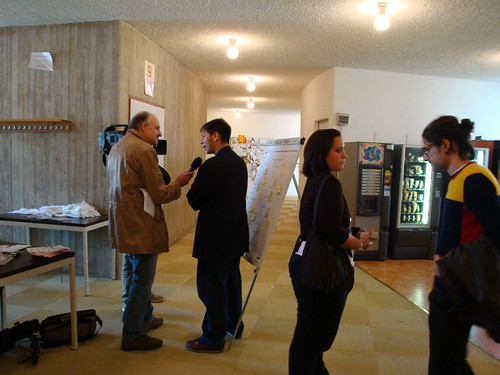
One of the most interesting observations was how important this event was to Italian media. Fabio mostly, but also Luca, were chased by people with cameras all over Urbino. I only saw Fabio stand still when in front of a camera:
Another interesting aspect was how much the "play" part counted for the festival. It's a cliche how much more spontaneous and playful Italians are than us steady, slow Norwegians, but sometimes those stereotypes do fit. The Italian blogosphere is a lot more interested in meeting, making out, and playing, than our rather slow and carefully considered bloggers. Would we have been able to organise a Twitter game in the middle of a Norwegian small town Sunday at noon? I think not. First, nobody would be there. Second, if a stranger wanted to tie a black thread around a strangers wrist and parade him or her in front of a judge to prove they had found a "follower", it would have been considered weird at best, threatening and offensive would have been more likely.
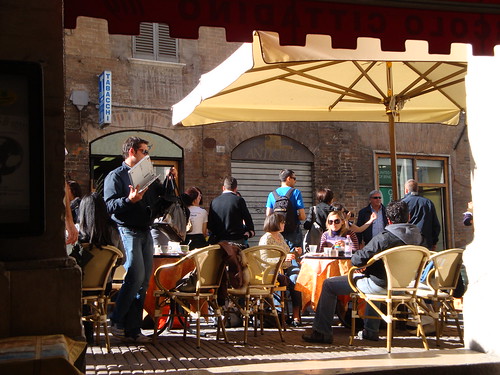
This was just part of an event where the participants also had to run around in Urbino guided by coordinates and google map from point to point. This is when the second stereotype about Italians decided to strike, and the entire net in that part of Italy collapsed. No fear though. True geeks have satelite links, or girlfriends with 'net connections. So when the "Blog olympics" were done, it was time for prizes. And of course, the media documented this extremely important sports event:

And then there were just a few more interviews, before the event could be wrapped up:

And if you still would like to see my lecture, it is on this site, but you have to pick "barcamp" on the tags over the initial movie, then scroll down on the right to my name, and then cross your fingers that it will eventually show up.
As a lot of the Academic BarCamp lectures during the Festival dei Blog were in Italian, I didn't get it all, all the time. But the open-source schedule was pretty full:
A BarCamp is supposedly all about self-organisation, which meant that if you wanted to go here and give a lecture, you could. But they had made sure to get some people who were actually prepared, by both using invitations and online scheduling. Still, I had to be quick at the board to keep my original time and place for the lecture.
One of the most interesting observations was how important this event was to Italian media. Fabio mostly, but also Luca, were chased by people with cameras all over Urbino. I only saw Fabio stand still when in front of a camera:
Another interesting aspect was how much the "play" part counted for the festival. It's a cliche how much more spontaneous and playful Italians are than us steady, slow Norwegians, but sometimes those stereotypes do fit. The Italian blogosphere is a lot more interested in meeting, making out, and playing, than our rather slow and carefully considered bloggers. Would we have been able to organise a Twitter game in the middle of a Norwegian small town Sunday at noon? I think not. First, nobody would be there. Second, if a stranger wanted to tie a black thread around a strangers wrist and parade him or her in front of a judge to prove they had found a "follower", it would have been considered weird at best, threatening and offensive would have been more likely.
This was just part of an event where the participants also had to run around in Urbino guided by coordinates and google map from point to point. This is when the second stereotype about Italians decided to strike, and the entire net in that part of Italy collapsed. No fear though. True geeks have satelite links, or girlfriends with 'net connections. So when the "Blog olympics" were done, it was time for prizes. And of course, the media documented this extremely important sports event:
And then there were just a few more interviews, before the event could be wrapped up:
And if you still would like to see my lecture, it is on this site, but you have to pick "barcamp" on the tags over the initial movie, then scroll down on the right to my name, and then cross your fingers that it will eventually show up.
Monday, May 14, 2007
Crowdsourcing
Sticking your head in the virtual quick-sand which is World of Warcraft is a good way of not really catching up with the latest in other trends, or at least the vocabulary, like Crowdsourcing. The wikipedia entrance I linked to there is an interesting example of the concept: first, wikipedia is a result of crowdsourcing: large amounts of people cooperating openly and individually to improve information and make more available. The entry is also obviously under revision, it's flagged as too short, too many references, not reliable, needs rework, needs more references, poor quality - it's obvious that a lot of people have been at work picking the original entry(ies) apart.
Personally, I have always believed in Crowdsourcing, and I believe in it in the way the cooperative power of self-organised interest groups is described in the Swedish book Samverkansspiralen. Here it offers voluntair work and cooperative action as a way to gain more knowledge and empower the participants towards more action - like for instance political activism.
I believe opportunities for open participation and contribution can go somewhere good, if you get caught up in a good circle, a positive spiral.
I found the concept itself, Crowdsourcing, in a paper which was surprisingly good. Dagbladet, one of the larger tabloids in Norway, has been going downhill for years. It used to be a very good magazine with interesting reportage, knowledgeable critical journalism and ambitions to cover Norwegian and international culture in depth, not just through sensation reporting. Saturday was an all time low for the paper, as the front page was all about who have which well-known figure on their "friends" list on facebook. It was about 10 minutes research and perhaps 30 minutes of getting the pictures "just right" behind that classic piece of journalism. The first time a Norwegian newspaper used all of the front page on just one case was in 1980-81, I think in February 1981, if I remember correctly. Of course, I can google it. Yep, February 22, 1981.
This event was a shocking piece of news in Norway at the time. Two members of a neo-nazi group, "Norges Germanske Armé", were executed by their leaders, as they were considered to be a danger for the organisation after a weapons theft. One of them had however already talked to the police, and the police was on to that something was going on. They couldn't prevent the double murder, but they did get the ones guilty immediately. This event had everything: drama, deep historical roots, controversy and important political consequences for a country forever deeply branded by Hitler's plans for a master race. Today Norwegian banners and national symbols are used as a substitution for forbidden nazi symbols. It's a past which is always with us.
Fastforward from a front page (not even in this paper, but their main competitor, this paper was still full format and filled with words, not pictures in 1981) dramatically displaying this tragic and stunning event, to pictures of Norwegian "stars" and speculation about who knows who on facebook. Yes, I keep losing illusions about the progress of journalism on paper.
So what did I learn. I learned that there is a word for the viral spread of knowledge, the anthill of collaboration which creates rhizomic growths with the virtual function of anything from tumors to castles online. I had to check zero.newassignment.net, a journalistic experiment for crowds.
For years, I have been telling journalists they don't need to be worried about their jobs, because the individual personal publishers of blogs, wikis and other direct publishing systems are not journalists. Now, considering what looks like a steady decline of print and television journalism, organised, cooperative journalism may be a good reason to start worrying.
(BTW: From the front page of this not-worst-case paper: "Abused online", with a picture of a well known Norwegian actress. Turns out somebody have made TWO fake profiles in her name on facebook. The horror, the horror!)
Personally, I have always believed in Crowdsourcing, and I believe in it in the way the cooperative power of self-organised interest groups is described in the Swedish book Samverkansspiralen. Here it offers voluntair work and cooperative action as a way to gain more knowledge and empower the participants towards more action - like for instance political activism.
I believe opportunities for open participation and contribution can go somewhere good, if you get caught up in a good circle, a positive spiral.
I found the concept itself, Crowdsourcing, in a paper which was surprisingly good. Dagbladet, one of the larger tabloids in Norway, has been going downhill for years. It used to be a very good magazine with interesting reportage, knowledgeable critical journalism and ambitions to cover Norwegian and international culture in depth, not just through sensation reporting. Saturday was an all time low for the paper, as the front page was all about who have which well-known figure on their "friends" list on facebook. It was about 10 minutes research and perhaps 30 minutes of getting the pictures "just right" behind that classic piece of journalism. The first time a Norwegian newspaper used all of the front page on just one case was in 1980-81, I think in February 1981, if I remember correctly. Of course, I can google it. Yep, February 22, 1981.
This event was a shocking piece of news in Norway at the time. Two members of a neo-nazi group, "Norges Germanske Armé", were executed by their leaders, as they were considered to be a danger for the organisation after a weapons theft. One of them had however already talked to the police, and the police was on to that something was going on. They couldn't prevent the double murder, but they did get the ones guilty immediately. This event had everything: drama, deep historical roots, controversy and important political consequences for a country forever deeply branded by Hitler's plans for a master race. Today Norwegian banners and national symbols are used as a substitution for forbidden nazi symbols. It's a past which is always with us.
Fastforward from a front page (not even in this paper, but their main competitor, this paper was still full format and filled with words, not pictures in 1981) dramatically displaying this tragic and stunning event, to pictures of Norwegian "stars" and speculation about who knows who on facebook. Yes, I keep losing illusions about the progress of journalism on paper.
So what did I learn. I learned that there is a word for the viral spread of knowledge, the anthill of collaboration which creates rhizomic growths with the virtual function of anything from tumors to castles online. I had to check zero.newassignment.net, a journalistic experiment for crowds.
For years, I have been telling journalists they don't need to be worried about their jobs, because the individual personal publishers of blogs, wikis and other direct publishing systems are not journalists. Now, considering what looks like a steady decline of print and television journalism, organised, cooperative journalism may be a good reason to start worrying.
(BTW: From the front page of this not-worst-case paper: "Abused online", with a picture of a well known Norwegian actress. Turns out somebody have made TWO fake profiles in her name on facebook. The horror, the horror!)
Thursday, May 03, 2007
Be nice - it's good for you
From the journal Human Communication Research, vol 33, number2, April 2007, "Affectionate Writing Reduces Total Cholesterol: Two Randomized Controlled Trials" by Kory Floyd, Alan C. Mikkelson, Colin Hesse and Perry M. Pauley.
Imagine the implications. In the risk group for high cholesterol? Sit down and write about somebody you love and care for. Consider the good things in human relationships. Look for the things that, literally, heals your heart. It also gives a new meaning to the idea that a broken relationship can mean a broken heart. It can, really.
Now excuse me, I am off to spend 20 minutes writing about my favourite people, and why they are so special.
In two 5-week trials, healthy college students were randomly assigned either to experimental or control groups. Participants in the experimental groups wrote about their affection for significant friends, relatives, and/or romantic partners for 20 minutes on three separate occasions; on the same schedule, those in the control groups wrote about innocuous topics. Total cholesterol was assessed via capillary blood at the beginning of the trials and again at the end. Participants in the experimental groups experienced statistically significant reductions in total cholesterol. Control participants in the first study experienced a significant increase during the same period, whereas those in the second study did not. Cholesterol changes were largely unmoderated by linguistic features of the writing produced in the intervention. Potential therapeutic implications are discussed.
Imagine the implications. In the risk group for high cholesterol? Sit down and write about somebody you love and care for. Consider the good things in human relationships. Look for the things that, literally, heals your heart. It also gives a new meaning to the idea that a broken relationship can mean a broken heart. It can, really.
Now excuse me, I am off to spend 20 minutes writing about my favourite people, and why they are so special.
Subscribe to:
Posts (Atom)


 Posts
Posts

