I have been a grandmother for more than 6 months. The girl in question is very much the child of a modern family: the daughter of my daughter's wife, legally my daughter's daughter, emotionally, socially and in every possible way a child of this family. She smiles like my daughter, looks like my daughter-in-law, and explores the world like her unique self.
Sadly, she's in Bergen and I am in Copenhagen. That's however nothing new. My kids were born and lived in Bergen, while their grandparents lived in Ålesund and Oslo, a similar distance and a much longer travel time. I fly to Bergen for 400,- nkk and in 90 minutes. We used to pay what felt like a lot more while we had a lot less, to spend a night either on a train or on the coastal steamer, to get from Bergen in the days when we travelled with kids.
The real difference is in the day to day communication. My daughter keeps skyping us when she wants company - and we keep insisting that she skypes us. Or use google hang-out, or what ever other technology we have available. Sometimes it's my husband from one place, my daughter with her family, and me. And occasionally the uncle, our son, looking in from a fourth location. And then we chat, wave at each other, admire recent tricks and I sing, very badly, to the admiring audience who is my daughter's daughter. Internet, be happy you don't have to be part of those hang-outs.
The closest thing in the eighties was long and expensive phone-calls. The cost was a constant drain on a student economy, and the grandparents weren't all that interested in paying their end of it, so it would happen perhaps once a month. Then there would be the occasional letter. These were mainly in order to send pictures back and forth, and those were really expensive: film, process and copied, so there would be enough pictures for both set of grandparents, and then a hand-written letter in there. Yes, so much more exclusive and so much more labour-intensive, if you want to feel that communication matters. But also so rare, and so formal.
Now, I can watch that darling baby, as she listens to out-of-tune scales sung to her, and she tries to respond. It's almost enough to make me go pick up a little flute, to see her face when I play to her. It's a little marvel, and I get to enjoy it instantly. But it doesn't end there. My daughter and daughter-in-law got themselves a pretty good digital camera, and they use it frequently for little movies and a lot of pictures, posted to their pass-word protected weblog. I check my email only slightly more often. I get to see her grow, sometimes day to day, always once or twice a week, and I can comment, and then I get comments on the comments. All my colleagues know this, because it offers another benefit: I am ruthlessing making them admire the day-to-day development of this miracle of normal extraordinarity which is a grand-child.
I am still not sure if she actually responds to the person on the screen as a human being, or just odd sounds and images, but when I visit, she isn't afraid. It may be because I sound so much like my daughter, or she may actually get it - I am something familiar and non-threatening. It certainly makes me feel very close to them, to my children, their friends and loved ones, and now this little miracle of a girl. Not to mention the cat. It isn't the internet without a cat.
Of course, a lot of other things have changed too, from our parents' time to us. We are generally healthier and more fit. We have more education, and expect to be able to keep learning new things all the time. Education never ends these days, and communication technology changes so quickly, a constant stream of something new is the stable normality. Not all of the changes are necessarily to the better. It's important to learn to protect ourselves from the anxiety born of potentially constant connection. But when I log on to the little darling's blog and see a new picture of her crawling, chasing the tail of their cat, information technology is nothing but wonderful. I am a grandmother in the age of the Internet, and I love it.
Showing posts with label blogging. Show all posts
Showing posts with label blogging. Show all posts
Wednesday, July 03, 2013
Tuesday, March 20, 2012
Journalism and precision - again
Yesterday I was interviewed by DR ,Danmark Radio, about Bitterfissen Bethany, the blogger I wrote about yesterday. The article that showed up at DR's page was however not exactly what I thought I had responded in the interview. That teaches me to insist on seeing the material before it's published.
Anyway.
DR has picked only the things I said which fit with the journalist's opinions. According to him I consider her real identity to be a disappointment, while I really felt it would be a disappointment to some, to discover that they were being offended by your ordinary housewife. After all, not everybody are in a position to really offend, and an assistant in an office shouldn't really be in a position to take on well-known media personalities. Still, she did.
Further on, I apparently think it's a bad thing to write anonymously, until you're in danger of your life. That is something I distinctly remember to have modified, when the journalist tried that on, by saying that people criticising an otherwise open society may also need to be anonymised. Of course, modifications look less impressive, but keeping that is on your editing, dear journalist, not on me.
Also in the same interview, I pointed out that the main reason why this blogger got so much attention is because she attacked the media, and the media love to write about themselves. She used the media's self-absorption to hit them hard and play around with them, until she had written her book and could use them again, to get free PR for the publication. For some reason that, which I consider to be a vital part of this whole event, was not mentioned by the media. They only mention that through quoting her (in character and rather wicked) address to the media, where she jokes about how she has been playing them. The truth is: she has played the Danish media. By being focused on their own "front", the journalists chasing her have played into her game.
Yes, I think her not being somebody famous has disappointed a lot of people. It didn't disappoint me though. I am still giggling and saving links, for future study, while I take note that journalists still listen with their agendas more than their ears.
Anyway.
DR has picked only the things I said which fit with the journalist's opinions. According to him I consider her real identity to be a disappointment, while I really felt it would be a disappointment to some, to discover that they were being offended by your ordinary housewife. After all, not everybody are in a position to really offend, and an assistant in an office shouldn't really be in a position to take on well-known media personalities. Still, she did.
Further on, I apparently think it's a bad thing to write anonymously, until you're in danger of your life. That is something I distinctly remember to have modified, when the journalist tried that on, by saying that people criticising an otherwise open society may also need to be anonymised. Of course, modifications look less impressive, but keeping that is on your editing, dear journalist, not on me.
Also in the same interview, I pointed out that the main reason why this blogger got so much attention is because she attacked the media, and the media love to write about themselves. She used the media's self-absorption to hit them hard and play around with them, until she had written her book and could use them again, to get free PR for the publication. For some reason that, which I consider to be a vital part of this whole event, was not mentioned by the media. They only mention that through quoting her (in character and rather wicked) address to the media, where she jokes about how she has been playing them. The truth is: she has played the Danish media. By being focused on their own "front", the journalists chasing her have played into her game.
Yes, I think her not being somebody famous has disappointed a lot of people. It didn't disappoint me though. I am still giggling and saving links, for future study, while I take note that journalists still listen with their agendas more than their ears.
Wednesday, December 01, 2010
Pink bloggers
One of the most popular Norwegian girl bloggers at the moment is a young lady who calls herself Linnea, and writes the blog "All you know is wrong" (Alt du vet er feil). At first glance you expect to encounter a typical fashion blog, as the top picture is of a very good looking girl with nice earrings, a fashionable top and a cheeky smile. The "About me" section gives a warning though, as she writes:
Then you start reading, and you realise that this is not your average fashion blogger. Linnea writes a wonderful stream-of-consciousness type posts, all about herself, her experiences, feelings and, yes, clothes. Where your average fashion blogger would show herself off in handsome clothes, Linnea posts a picture of herself, on the floor of a gym, the result of a fall because she was just slipped going down one step. Not only did she fall, most ungraciously, she did so while wearing a thermo-suit, which is standard winter workwear for anybody working outside. So, not your standard fashionable one-piece; it's utility clothing for the most unfashionable (but extremely important) jobs.
This particular post, titled "I don't know," discusses exactly her position as a blogger, and particularly a "pink" blogger. She is outraged at being characterised as a pink blogger, and I can very well understand that. Her writing is sometimes as delicate as if she had puked all over the screen, as her stream-of-consciousness often appears to not have been subject to any editing at all. There's nothing polite, sweet or candy-scented in her texts, and pink is definitely not a colour that comes to mind.
What this random, meandering and carefully not-edited post still manages to say is: "Look, I am not cute or graceful or strong or smart, and I am still the most popular and potentially influental blogger in Norway." And I have to say: I can see why. Linnea is the girl who doesn't have a grip, her closet is a mess, her life is filled with inner conflict and struggle, and she is intolerant and angry - your normal, average girl, who happens to be able to write and use a mobile camera. She speaks for the bitch in all girls who are sick of trying to blend and be gracious, and she reveals her total lack of taste quite ruthlessly.
If Linnea has a colour to her blog, I think it's orange. It's warm and angry and temperamental and contrary, and it picks you up and makes you feel cheery, even if it's obnoxious and hard to tolerate in too large doses.
Jeg er over gjennomsnittet bitter, og liker stort sett ingen andre enn meg selv. OBS: Man lærer ingenting her inne.Translated: I am more than averagely bitter, and don't like anybody but myself. Note: You learn nothing here.
Then you start reading, and you realise that this is not your average fashion blogger. Linnea writes a wonderful stream-of-consciousness type posts, all about herself, her experiences, feelings and, yes, clothes. Where your average fashion blogger would show herself off in handsome clothes, Linnea posts a picture of herself, on the floor of a gym, the result of a fall because she was just slipped going down one step. Not only did she fall, most ungraciously, she did so while wearing a thermo-suit, which is standard winter workwear for anybody working outside. So, not your standard fashionable one-piece; it's utility clothing for the most unfashionable (but extremely important) jobs.
This particular post, titled "I don't know," discusses exactly her position as a blogger, and particularly a "pink" blogger. She is outraged at being characterised as a pink blogger, and I can very well understand that. Her writing is sometimes as delicate as if she had puked all over the screen, as her stream-of-consciousness often appears to not have been subject to any editing at all. There's nothing polite, sweet or candy-scented in her texts, and pink is definitely not a colour that comes to mind.
What this random, meandering and carefully not-edited post still manages to say is: "Look, I am not cute or graceful or strong or smart, and I am still the most popular and potentially influental blogger in Norway." And I have to say: I can see why. Linnea is the girl who doesn't have a grip, her closet is a mess, her life is filled with inner conflict and struggle, and she is intolerant and angry - your normal, average girl, who happens to be able to write and use a mobile camera. She speaks for the bitch in all girls who are sick of trying to blend and be gracious, and she reveals her total lack of taste quite ruthlessly.
If Linnea has a colour to her blog, I think it's orange. It's warm and angry and temperamental and contrary, and it picks you up and makes you feel cheery, even if it's obnoxious and hard to tolerate in too large doses.
Monday, November 22, 2010
Blogging - is it journalism?
Accidentally, as I was following up on other topics, I found that there is a wonderful drama playing out in the Norwegian blogosphere, complete with a sobbing bride, nasty, greybearded men and a handsome football-player. OK, the football-player has very little to do with it, but he's a very good-looking accessory.
So, what happened here?
A young and beautiful woman works part-time as a journalist in an online paper, and is fashion editor and co-owner of an online magasine. At the same time she is making money on her fashion/lifestyle weblog: Fotballfrue - football wife (yeah, that's where the handsome man comes in).
So, somebody reads that she has income from a lot of different sources, and they question her ethics (and they do it while she is on a honeymoon, how rude!) in an article about fashion weblogs.
There are a lot of bloggers who have very high hit numbers, and use this commercially. Fashion blogging is "in" at the moment, and so the companies pay the young and the beautiful to let others know what they wear and use. The principle is nothing new, it's pretty much the same as sponsoring skaters while they were the "cool", or athletes, for that matter. Ohh, again, almost a reference to the handsome husband who never really enters the story!
Anyway: Some fashion bloggers do it to make money, some do it to create a name for themselves, to build their street cred. However, being a good fashion blogger takes a lot of money, in order to keep up their fresh front they need to be seen in the most interesting, newes and fanciest outfits available - and what is better than getting paid to do this, alternatively getting the products directly and free from the producers?
So far so good. But what if you are trying to build not just street cred, but actually become a journalist and an editor of a magasine? What should the smart fashion blogger do? Oh, and by the way, "journalist" isn't a title you get by getting an education and a license, like "medical doctor" or "lawyer," it's something you become if you practice journalism. So if you don't practice journalism, you are not a journalist, no matter how much education you have.
The whole issue with the football wife isn't really that she writes on order for companies. The issue is that she at the same time calls herself a journalist and an editor. She acts as a marketing officer, without making that obvious in the different posts, while also trying to build the trust and reputation she needs in order to be taken seriously as a journalist. And when she is criticised she claims that blogging isn't journalism, and so she can do what she likes.
She is, in a way, right. On "fotballfrue" she is her own editor, owner and writer. As long as she doesn't harass anybody, she can write what she likes. If her business strategy is to promote objects or trends for whoever pays her (are those fake louboutins, or real?) then she can do that to her heart's content on her blog. She will gain a lot of treet cred among other fashion bloggers, and probably among her followers as well. And she is right, her blog isn't journalism.
Does that mean blogging isn't journalism? No, because if she wrote according to the standards of journalism, her blog would be journalism. Again, journalism is a practice, not a license or a stamp put on only some organisations.
Back to the drama.
The pretty young lady is a part-time stand-in for Side2.no. So she is, at best, part-time freelancing as a journalist. It's not really anybody's business how she spends her time when she's not working for them, and Side2.no can stop using her when ever they like.
And that's what really should come out of this story: she doesn't have a job, she has a pretty face, a fashion blog, and ambitions to become an editor. In a case like that, what is the smart strategy?
I find myself firmly on the side of the grey-bearded evil, which isn't so odd, since I am turning pretty grey as well. She should clean up her blogging act, and stop selling her opinions to the highest bidder. People who write commercials for pay are not welcome in the journalism union in Norway, and when journalists change jobs and go into marketing, they need to swap unions. It's how it goes. If she wants to go that way, she needs to adjust to the standards, or she will have no journalistic credibility.
However... she might not want or need it. She's young, she's pretty, and people are paying her to wear beautiful clothes. Why should she worry about journalism? But then I'd recommend that she removes the "journalist" title from her webpage. If you don't practice journalism, you aren't a journalist. If you claim you are, you will be criticised. I am sorry, really, and it's horrible that people are letting you know this while you're on your honey-moon, but that's how it is.
Oh, and have a wonderful time. Your life looks like a slice of marketing heaven.
----
Corrected due to Undre's comment, thanks.
So, what happened here?
A young and beautiful woman works part-time as a journalist in an online paper, and is fashion editor and co-owner of an online magasine. At the same time she is making money on her fashion/lifestyle weblog: Fotballfrue - football wife (yeah, that's where the handsome man comes in).
So, somebody reads that she has income from a lot of different sources, and they question her ethics (and they do it while she is on a honeymoon, how rude!) in an article about fashion weblogs.
There are a lot of bloggers who have very high hit numbers, and use this commercially. Fashion blogging is "in" at the moment, and so the companies pay the young and the beautiful to let others know what they wear and use. The principle is nothing new, it's pretty much the same as sponsoring skaters while they were the "cool", or athletes, for that matter. Ohh, again, almost a reference to the handsome husband who never really enters the story!
Anyway: Some fashion bloggers do it to make money, some do it to create a name for themselves, to build their street cred. However, being a good fashion blogger takes a lot of money, in order to keep up their fresh front they need to be seen in the most interesting, newes and fanciest outfits available - and what is better than getting paid to do this, alternatively getting the products directly and free from the producers?
So far so good. But what if you are trying to build not just street cred, but actually become a journalist and an editor of a magasine? What should the smart fashion blogger do? Oh, and by the way, "journalist" isn't a title you get by getting an education and a license, like "medical doctor" or "lawyer," it's something you become if you practice journalism. So if you don't practice journalism, you are not a journalist, no matter how much education you have.
The whole issue with the football wife isn't really that she writes on order for companies. The issue is that she at the same time calls herself a journalist and an editor. She acts as a marketing officer, without making that obvious in the different posts, while also trying to build the trust and reputation she needs in order to be taken seriously as a journalist. And when she is criticised she claims that blogging isn't journalism, and so she can do what she likes.
She is, in a way, right. On "fotballfrue" she is her own editor, owner and writer. As long as she doesn't harass anybody, she can write what she likes. If her business strategy is to promote objects or trends for whoever pays her (are those fake louboutins, or real?) then she can do that to her heart's content on her blog. She will gain a lot of treet cred among other fashion bloggers, and probably among her followers as well. And she is right, her blog isn't journalism.
Does that mean blogging isn't journalism? No, because if she wrote according to the standards of journalism, her blog would be journalism. Again, journalism is a practice, not a license or a stamp put on only some organisations.
Back to the drama.
The pretty young lady is a part-time stand-in for Side2.no. So she is, at best, part-time freelancing as a journalist. It's not really anybody's business how she spends her time when she's not working for them, and Side2.no can stop using her when ever they like.
And that's what really should come out of this story: she doesn't have a job, she has a pretty face, a fashion blog, and ambitions to become an editor. In a case like that, what is the smart strategy?
I find myself firmly on the side of the grey-bearded evil, which isn't so odd, since I am turning pretty grey as well. She should clean up her blogging act, and stop selling her opinions to the highest bidder. People who write commercials for pay are not welcome in the journalism union in Norway, and when journalists change jobs and go into marketing, they need to swap unions. It's how it goes. If she wants to go that way, she needs to adjust to the standards, or she will have no journalistic credibility.
However... she might not want or need it. She's young, she's pretty, and people are paying her to wear beautiful clothes. Why should she worry about journalism? But then I'd recommend that she removes the "journalist" title from her webpage. If you don't practice journalism, you aren't a journalist. If you claim you are, you will be criticised. I am sorry, really, and it's horrible that people are letting you know this while you're on your honey-moon, but that's how it is.
Oh, and have a wonderful time. Your life looks like a slice of marketing heaven.
----
Corrected due to Undre's comment, thanks.
Tuesday, February 16, 2010
Blogging the blogged Ph D about blogging
I just want to point you all towards Lilia Efimova's wonderful thesis Passion at work: blogging practices of knowledge workers, which was submitted last year. It is, of course, online, so: Enjoy!
Monday, February 01, 2010
Knitting the revolution
When ever anybody makes a statement about gender in weblogs which indicates that women don't blog, I ask them to go start reading knitting blogs. It's one of my secret addictions, to surf knitting blogs, reading about all the things I could have made if I just put the computer away and picked up some yarn instead. Lucky for me, there are women out there who are both computer literate and knitting smart!
One of these has the weblog Med pinner (with sticks, sticks meaning knitting-needles). On her weblog, which is full of really beautiful patterns and experiences with knitting (yes, it's legal to take a picture of clothes people are wearing while outside in a public place, no, it's not permitted to publish recognisable pictures of people without their permission unless they are part of a parade or a performance or something similar where it's obvious that they are there in order to be seen. This picture doesnt' show the face though, so it should be ok.), she has a button. The text says: The revolution is being hand made, and it links to an exhibition of crafted goods in Sweden.
I had to google that though, to see if I there might be a movement behind it, and what I found was:
An artists' collective named Handmade Revolution.
Two volunteers organising markets in the UK for handmade goods.
Canadian events for selling and buying handmade goods in the "Make It" fairs.
And an angry rant against the idea that the revolution can be hand made.
On the one hand: No, knitting does not remove the fact that my entire life is supported by unsustainable technology. The only times when I get anywhere close to sustainability is when I live in the cabin with simple technology, fishing and growing most of the food, and cooking on a fire made of wood we cut clearing the garden and land around the houses. But even then I am very aware that it's just a matter of days before I turn on the electricity, get into the car and go shopping.
Still, there's another way to think about a hand-made revolution.
If we are to have a systemic change, which is what we need, it will mean that everybody must expect lifestyle changes. We may for instance have to move back to the lifestyle of the fifties, giving up on twice-daily showers, and moving into areas which will allow us to walk or ride a bike or bus to work. We can't drive to malls, and the huge cities need to change very radically, in order to allow for local produce and local markets. And each and every step of the way will mean more direct, hands-on and personal engagement with the comforts of our lives.
One pair of hand-knitted mittens is just one less pair of mittens produced by Indian child slaves sold. But the knowledge and skill it takes to make those mittens can be the key to changing society, if it's used at all levels of life: Knowing how to cook your food from scratch, knowing how to grow it, knowing how to pick and find it, knowing how to use the resources that surround you, knowing how to build a house, row a boat, repair a bike, redress your furniture, repair your clothes and care for a well of fresh water - all this is knowledge that needs a hands-on approach. Technology may save us through some new, sustainable solution, but it's the hands-on knowledge of how our comforts are brought to be that can make us accept this as important.
So start knitting, now.
One of these has the weblog Med pinner (with sticks, sticks meaning knitting-needles). On her weblog, which is full of really beautiful patterns and experiences with knitting (yes, it's legal to take a picture of clothes people are wearing while outside in a public place, no, it's not permitted to publish recognisable pictures of people without their permission unless they are part of a parade or a performance or something similar where it's obvious that they are there in order to be seen. This picture doesnt' show the face though, so it should be ok.), she has a button. The text says: The revolution is being hand made, and it links to an exhibition of crafted goods in Sweden.
I had to google that though, to see if I there might be a movement behind it, and what I found was:
An artists' collective named Handmade Revolution.
Two volunteers organising markets in the UK for handmade goods.
Canadian events for selling and buying handmade goods in the "Make It" fairs.
And an angry rant against the idea that the revolution can be hand made.
On the one hand: No, knitting does not remove the fact that my entire life is supported by unsustainable technology. The only times when I get anywhere close to sustainability is when I live in the cabin with simple technology, fishing and growing most of the food, and cooking on a fire made of wood we cut clearing the garden and land around the houses. But even then I am very aware that it's just a matter of days before I turn on the electricity, get into the car and go shopping.
Still, there's another way to think about a hand-made revolution.
If we are to have a systemic change, which is what we need, it will mean that everybody must expect lifestyle changes. We may for instance have to move back to the lifestyle of the fifties, giving up on twice-daily showers, and moving into areas which will allow us to walk or ride a bike or bus to work. We can't drive to malls, and the huge cities need to change very radically, in order to allow for local produce and local markets. And each and every step of the way will mean more direct, hands-on and personal engagement with the comforts of our lives.
One pair of hand-knitted mittens is just one less pair of mittens produced by Indian child slaves sold. But the knowledge and skill it takes to make those mittens can be the key to changing society, if it's used at all levels of life: Knowing how to cook your food from scratch, knowing how to grow it, knowing how to pick and find it, knowing how to use the resources that surround you, knowing how to build a house, row a boat, repair a bike, redress your furniture, repair your clothes and care for a well of fresh water - all this is knowledge that needs a hands-on approach. Technology may save us through some new, sustainable solution, but it's the hands-on knowledge of how our comforts are brought to be that can make us accept this as important.
So start knitting, now.
Monday, November 09, 2009
Meta-blog post, since it's been a while
I am no longer blogging as actively as I did, and I am glad of it. As Alex Halavais predicted, in five years we'd be embarassed by having been really active bloggers. Well, it's not that bad, but I see that both my own writing and the structure from the technology has changed since 2001.
I blog more about events now, travels, conferences, meetings, and less commentary and opinions, also, a lot less from my private life. Oh, it's all still there, but it has changed, become toned down. Partly this is caused by a couple of rather upsetting events, where the weblog became focus for actions that spilled over into other media, and led to an overwhelming feeling of professional and personal isolation here, at this small college. I still don't think it was possible to avoid what happened, but I might have been able to do some more damage control. Or not. Who knows.
Also, my personal life is a lot more boring now. What do I do? I work, travel to conferences and occasionally on a vacation, and spend the evenings working, doingchores or playing WoW. Yes, I still do that. I tried to swap to Age of Conan, but the lag killed my interest. I just ordered Dragon Age, perhaps playing single-player games for a while will help. Also, I am healthier, the result of watching what I eat, working out and not obsessively writing a book or thesis, and plain health is boring. I don't even have anything to whine about. From January I'll also be free of the administration of the PR, communication and media education (new name since this autumn), which will hopefully lead to more time for reflection and creativity around the topic of social media. The dean wants me to plan a couple of courses as a start. I'd like that, to be able to teach what I research.
And I think facebook has changed my blogging, too. A lot of the general commenting and tracking has moved from here to there. Oh, and then there's the forskning.no weblog, where I put the more researched blogposts on games. It's in Norwegian, so I don't double post it. Now, considering, that's too bad. I should at least link those posts.
Anyway, that's what's going on here. I am not going to promise the posting will pick up. I am actually quite happy with my online/offline balance at the moment.
I blog more about events now, travels, conferences, meetings, and less commentary and opinions, also, a lot less from my private life. Oh, it's all still there, but it has changed, become toned down. Partly this is caused by a couple of rather upsetting events, where the weblog became focus for actions that spilled over into other media, and led to an overwhelming feeling of professional and personal isolation here, at this small college. I still don't think it was possible to avoid what happened, but I might have been able to do some more damage control. Or not. Who knows.
Also, my personal life is a lot more boring now. What do I do? I work, travel to conferences and occasionally on a vacation, and spend the evenings working, doingchores or playing WoW. Yes, I still do that. I tried to swap to Age of Conan, but the lag killed my interest. I just ordered Dragon Age, perhaps playing single-player games for a while will help. Also, I am healthier, the result of watching what I eat, working out and not obsessively writing a book or thesis, and plain health is boring. I don't even have anything to whine about. From January I'll also be free of the administration of the PR, communication and media education (new name since this autumn), which will hopefully lead to more time for reflection and creativity around the topic of social media. The dean wants me to plan a couple of courses as a start. I'd like that, to be able to teach what I research.
And I think facebook has changed my blogging, too. A lot of the general commenting and tracking has moved from here to there. Oh, and then there's the forskning.no weblog, where I put the more researched blogposts on games. It's in Norwegian, so I don't double post it. Now, considering, that's too bad. I should at least link those posts.
Anyway, that's what's going on here. I am not going to promise the posting will pick up. I am actually quite happy with my online/offline balance at the moment.
Thursday, October 01, 2009
What's up in Volda?
What's worth blogging, one asks oneself once in a while. And hey, let's admit it, the world won't stop spinning if I don't blog. I do however find that something else stops spinning, and that's those wheels in my brain. I am, as the blog indicates, a person who thinks while writing. Or, that's not true: I am a person who needs to write in order to organise my thoughts.
I find that I ramble more and more to my students. Their stunned looks when I pause in an attempt to trace down the core of the thought I had, the idea I want to communicate to them, indicates that I have been off on some totally undisciplined tangent, and bombarded them with apparently unrelated facts. This happens because I have deliberately stopped writing out my lectures. There was a day when I refused to face students without 20 pages, double space, 12 points. That's 45X45 minutes of pretty steady talking, in case you wondered. But no more. I put down the most important facts, I find some ways to illustrate those, and then I try to connect the dots. It's those connections that occasionally get a little - fragile.
But I am still writing. I am just about to finish up an article I write with Luca, Rene and Kristine. I have to download and bring with me the material from my project this spring, in order to write it up, not yet in article form then at least in a form that lets me access the material easily. I have to rewrite an article for a collection Esther asked if I could contribute to. I have a research grant sketch on my machine. I have a plan for a much larger research grant based off the material from the "Gamer's Space" project. Basically, I can spend the time from now until Christmas writing, and still not be done. I have two weeks in which to do it.
And in the mean time, I write and play other stuff. Last night I made an experiment to see if people would/could come to my farm-town toons' wedding. I had a few guests, it was, as Rene stated, an intimate wedding. Which is just as well, as they revealed quite a bit of the future development of the drama on the farm. Yes, I am creating a drama on there, and I am trying to track the use of the game in order to do it. Right now, for instance, I need to gain a new level before I can get on with the story, because I need a greenhouse. Once that is in place betrayal, tragedy and the final plot twist will follow.
Also, I have been asked to reveal the secrets of my aubergine, tomatoes and cheese course from last week's game researcher dinner. But that deserves a blogpost all of it's own.
I find that I ramble more and more to my students. Their stunned looks when I pause in an attempt to trace down the core of the thought I had, the idea I want to communicate to them, indicates that I have been off on some totally undisciplined tangent, and bombarded them with apparently unrelated facts. This happens because I have deliberately stopped writing out my lectures. There was a day when I refused to face students without 20 pages, double space, 12 points. That's 45X45 minutes of pretty steady talking, in case you wondered. But no more. I put down the most important facts, I find some ways to illustrate those, and then I try to connect the dots. It's those connections that occasionally get a little - fragile.
But I am still writing. I am just about to finish up an article I write with Luca, Rene and Kristine. I have to download and bring with me the material from my project this spring, in order to write it up, not yet in article form then at least in a form that lets me access the material easily. I have to rewrite an article for a collection Esther asked if I could contribute to. I have a research grant sketch on my machine. I have a plan for a much larger research grant based off the material from the "Gamer's Space" project. Basically, I can spend the time from now until Christmas writing, and still not be done. I have two weeks in which to do it.
And in the mean time, I write and play other stuff. Last night I made an experiment to see if people would/could come to my farm-town toons' wedding. I had a few guests, it was, as Rene stated, an intimate wedding. Which is just as well, as they revealed quite a bit of the future development of the drama on the farm. Yes, I am creating a drama on there, and I am trying to track the use of the game in order to do it. Right now, for instance, I need to gain a new level before I can get on with the story, because I need a greenhouse. Once that is in place betrayal, tragedy and the final plot twist will follow.
Also, I have been asked to reveal the secrets of my aubergine, tomatoes and cheese course from last week's game researcher dinner. But that deserves a blogpost all of it's own.
Wednesday, February 25, 2009
Dead blogs
There are a lot of dead blogs out there, and some of them are in otherwise live newspapers. The norwegian paper Dagens Næringsliv - a wannabe Financial Times, right down to the pink paper - has an impressive list of bloggers. Sadly, the last blogpost was written in 2007.
This makes me wonder, again, about the weblog and its function in the public debate. In this case the high-profile, eminently competent people who were asked to blog obviously did not find it worth while to follow up the task. This, while others are still blogging in many a little corner of the universe, calmly talking from much lower soap-boxes in more remote corners of the online public sphere. Is the weblog the commoners' medium? Is the prestige gone out of blogging with the hype, now that the big agencies are all thinking about how to twist the power of facebook to their service?
Hmmm.
This makes me wonder, again, about the weblog and its function in the public debate. In this case the high-profile, eminently competent people who were asked to blog obviously did not find it worth while to follow up the task. This, while others are still blogging in many a little corner of the universe, calmly talking from much lower soap-boxes in more remote corners of the online public sphere. Is the weblog the commoners' medium? Is the prestige gone out of blogging with the hype, now that the big agencies are all thinking about how to twist the power of facebook to their service?
Hmmm.
Tuesday, January 27, 2009
Electronic Frontier foundation
I am a little late to the party for blogging about this, as Electronic Frontier Foundation has been around for ten years. But the website is an extremely interesting resource for anybody interested in online freedom of speech, and I particularly recommend their list of legal cases.
Tuesday, December 30, 2008
About research blogging
This autumn there was a slight stir in the Norwegian blog arena, as the forskning.no, the web site associated with the Norwegian Research Council, started a blogg with invited guest bloggers. Jill criticised the style and approach, while I said "yes please, and can I bring some friends?" when I was approached and asked if I wanted to blog for them.
It's the "bring some friends" part I am the most happy about, and it's also starting to spread on the blog. At first we (Ragnhild Trondstad, Kristine Jørgensen and me) were the only ones who blogged under a common name - spillforskerne, "the game researchers." Now there are more groups popping up, such as the sports researchers and the welfare researchers.
At the beginning, the blogs were an odd mix of too long and too heavy articles which could just as well have been printed in a journal, and too light articles which looked like "sex-in-the-city-goes-to-university." Now, a few months into the project, most of the bloggers have learned. Today's blogger is a typical and very good example. He's the dean of the medical faculty in Trondheim, but just before Christmas he slipped on the ice, fell, and broke 4 ribs. This leads to reflection on his field - medicine. A personal experience combines with his expertise to a process of contemplation and reflection which leads to sharing with others.
While this is not exactly blogging about ongoing research, it definitely communicates research. He links to other people's research, he puts it into a larger context, and he personalises it through sharing his thought process. By doing this he also describes how integrated research and reflection is in the life of researchers. He opens up to the process. Instead of spending his time dwelling on his considerable pain, he searches for a distraction through his job. Most researchers recognize this feeling. It's why we work until we get repetitive stress injuries, until we burn out, or until we are numbed with pains from the neck to the butt.
Also, he answers the question "when do you get time to work?" We get time to work all the time. Most of the researchers who publish regularly, who search for new projects and are active in their fields display a deep and abiding interest in the field, and can work while having a conversation with their children, going for a walk, or reconvalescing after accidents.
Of course, this means that we never really get to work. When you have the job pulling at you constantly, you're also constantly interrupted. The child does not want to listen to your lecture, your partner needs to talk about his own things while walking, the painkillers takes away your ability to really focus. Not to mention the distractions during the work hours. Students, lectures, meetings, colleagues, phones, assessments, reviews, deadlines, budgets, equipment - where are the ivory towers when we need one?
All of this is very nicely displayed on forskning.no. The system used for blogging is still not the best, and the approval process is comparably slow. But it has a good balance between the personal and the professional, it presents the people behind the research, and it's the most popular page on an already quite popular website.
It's the "bring some friends" part I am the most happy about, and it's also starting to spread on the blog. At first we (Ragnhild Trondstad, Kristine Jørgensen and me) were the only ones who blogged under a common name - spillforskerne, "the game researchers." Now there are more groups popping up, such as the sports researchers and the welfare researchers.
At the beginning, the blogs were an odd mix of too long and too heavy articles which could just as well have been printed in a journal, and too light articles which looked like "sex-in-the-city-goes-to-university." Now, a few months into the project, most of the bloggers have learned. Today's blogger is a typical and very good example. He's the dean of the medical faculty in Trondheim, but just before Christmas he slipped on the ice, fell, and broke 4 ribs. This leads to reflection on his field - medicine. A personal experience combines with his expertise to a process of contemplation and reflection which leads to sharing with others.
While this is not exactly blogging about ongoing research, it definitely communicates research. He links to other people's research, he puts it into a larger context, and he personalises it through sharing his thought process. By doing this he also describes how integrated research and reflection is in the life of researchers. He opens up to the process. Instead of spending his time dwelling on his considerable pain, he searches for a distraction through his job. Most researchers recognize this feeling. It's why we work until we get repetitive stress injuries, until we burn out, or until we are numbed with pains from the neck to the butt.
Also, he answers the question "when do you get time to work?" We get time to work all the time. Most of the researchers who publish regularly, who search for new projects and are active in their fields display a deep and abiding interest in the field, and can work while having a conversation with their children, going for a walk, or reconvalescing after accidents.
Of course, this means that we never really get to work. When you have the job pulling at you constantly, you're also constantly interrupted. The child does not want to listen to your lecture, your partner needs to talk about his own things while walking, the painkillers takes away your ability to really focus. Not to mention the distractions during the work hours. Students, lectures, meetings, colleagues, phones, assessments, reviews, deadlines, budgets, equipment - where are the ivory towers when we need one?
All of this is very nicely displayed on forskning.no. The system used for blogging is still not the best, and the approval process is comparably slow. But it has a good balance between the personal and the professional, it presents the people behind the research, and it's the most popular page on an already quite popular website.
Wednesday, November 19, 2008
Twitter and blogger
I have been playing around with twitter for a while, and it's slowly growing on me. The conversations, the quick messages back and forth, the chance to see what's going on with friends: it's nice. What I can't do is reconciliate that with blogger. I will remove the twitter window from the blog because of that.
When I put the twitter window in, I was planning to use it to talk about Age of Conan experiences. Then I moved from Umeå and back to the rather crappy desk-top computer I still use at the college in Volda (no way am I even going to try to put it on the lap-top), and I haven't been able to play since June. I am supposed to get a new desk-top machine, but that was in August, and now it's November. Months of play-time lost, and months of having to rethink the twitter window.
I find that by displaying twitter to my blog, I show the short end of conversations. It feel silly, and also pretty intrusive as it displays my responses to other people, in a context where they do not talk to me. It's a break of the conventions of polite conversation, which is along the same line as hearing only one half of a phone conversation. You hear/see responses that indicate and reveal intimate information about the other party, while the other party is not there and is not even aware of in which context their information is revealed. It has overtones of gossip, outing and betrayal, which may be a reason why some find it so incredibly offensive to listen to cell-phone conversations in public places where they can't escape, like busses and trains.
Anyway, I don't want to be the one who shouts out intimate information about friends in the public square, while they aren't there. So down it goes, that twitter window. Not that I have been all that active in it, anyway.
When I put the twitter window in, I was planning to use it to talk about Age of Conan experiences. Then I moved from Umeå and back to the rather crappy desk-top computer I still use at the college in Volda (no way am I even going to try to put it on the lap-top), and I haven't been able to play since June. I am supposed to get a new desk-top machine, but that was in August, and now it's November. Months of play-time lost, and months of having to rethink the twitter window.
I find that by displaying twitter to my blog, I show the short end of conversations. It feel silly, and also pretty intrusive as it displays my responses to other people, in a context where they do not talk to me. It's a break of the conventions of polite conversation, which is along the same line as hearing only one half of a phone conversation. You hear/see responses that indicate and reveal intimate information about the other party, while the other party is not there and is not even aware of in which context their information is revealed. It has overtones of gossip, outing and betrayal, which may be a reason why some find it so incredibly offensive to listen to cell-phone conversations in public places where they can't escape, like busses and trains.
Anyway, I don't want to be the one who shouts out intimate information about friends in the public square, while they aren't there. So down it goes, that twitter window. Not that I have been all that active in it, anyway.
Friday, October 24, 2008
Blogfest in Urbino
I have just learned that Fabio Giglietto and Luca Rossi are a great team when it comes to cooking up original, entertaining and intellectually challenging events. They are also great fun to hang out with, but I knew that.
As a lot of the Academic BarCamp lectures during the Festival dei Blog were in Italian, I didn't get it all, all the time. But the open-source schedule was pretty full:

A BarCamp is supposedly all about self-organisation, which meant that if you wanted to go here and give a lecture, you could. But they had made sure to get some people who were actually prepared, by both using invitations and online scheduling. Still, I had to be quick at the board to keep my original time and place for the lecture.
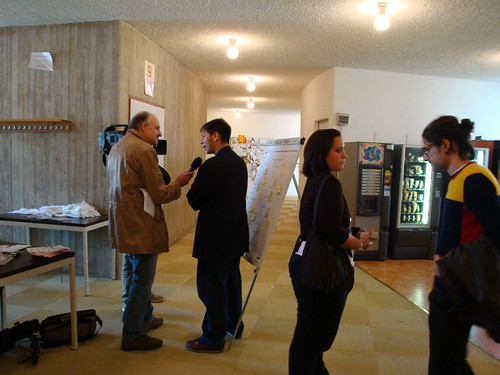
One of the most interesting observations was how important this event was to Italian media. Fabio mostly, but also Luca, were chased by people with cameras all over Urbino. I only saw Fabio stand still when in front of a camera:
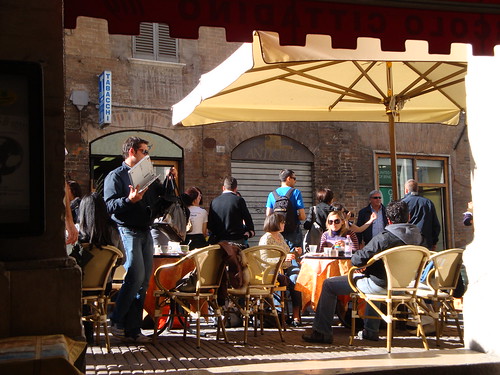
Another interesting aspect was how much the "play" part counted for the festival. It's a cliche how much more spontaneous and playful Italians are than us steady, slow Norwegians, but sometimes those stereotypes do fit. The Italian blogosphere is a lot more interested in meeting, making out, and playing, than our rather slow and carefully considered bloggers. Would we have been able to organise a Twitter game in the middle of a Norwegian small town Sunday at noon? I think not. First, nobody would be there. Second, if a stranger wanted to tie a black thread around a strangers wrist and parade him or her in front of a judge to prove they had found a "follower", it would have been considered weird at best, threatening and offensive would have been more likely.
This was just part of an event where the participants also had to run around in Urbino guided by coordinates and google map from point to point. This is when the second stereotype about Italians decided to strike, and the entire net in that part of Italy collapsed. No fear though. True geeks have satelite links, or girlfriends with 'net connections. So when the "Blog olympics" were done, it was time for prizes. And of course, the media documented this extremely important sports event:

And then there were just a few more interviews, before the event could be wrapped up:

And if you still would like to see my lecture, it is on this site, but you have to pick "barcamp" on the tags over the initial movie, then scroll down on the right to my name, and then cross your fingers that it will eventually show up.
As a lot of the Academic BarCamp lectures during the Festival dei Blog were in Italian, I didn't get it all, all the time. But the open-source schedule was pretty full:
A BarCamp is supposedly all about self-organisation, which meant that if you wanted to go here and give a lecture, you could. But they had made sure to get some people who were actually prepared, by both using invitations and online scheduling. Still, I had to be quick at the board to keep my original time and place for the lecture.
One of the most interesting observations was how important this event was to Italian media. Fabio mostly, but also Luca, were chased by people with cameras all over Urbino. I only saw Fabio stand still when in front of a camera:
Another interesting aspect was how much the "play" part counted for the festival. It's a cliche how much more spontaneous and playful Italians are than us steady, slow Norwegians, but sometimes those stereotypes do fit. The Italian blogosphere is a lot more interested in meeting, making out, and playing, than our rather slow and carefully considered bloggers. Would we have been able to organise a Twitter game in the middle of a Norwegian small town Sunday at noon? I think not. First, nobody would be there. Second, if a stranger wanted to tie a black thread around a strangers wrist and parade him or her in front of a judge to prove they had found a "follower", it would have been considered weird at best, threatening and offensive would have been more likely.
This was just part of an event where the participants also had to run around in Urbino guided by coordinates and google map from point to point. This is when the second stereotype about Italians decided to strike, and the entire net in that part of Italy collapsed. No fear though. True geeks have satelite links, or girlfriends with 'net connections. So when the "Blog olympics" were done, it was time for prizes. And of course, the media documented this extremely important sports event:
And then there were just a few more interviews, before the event could be wrapped up:
And if you still would like to see my lecture, it is on this site, but you have to pick "barcamp" on the tags over the initial movie, then scroll down on the right to my name, and then cross your fingers that it will eventually show up.
Saturday, October 11, 2008
Web stream from Urbino
Not live, but as soon as it's coded my talk, which startet 15.30, will be on this site.
At 16.18 what you can see there is Fabio Giglietto introducing the Blogfest, together with Maz Hardey.
At 16.18 what you can see there is Fabio Giglietto introducing the Blogfest, together with Maz Hardey.
Tuesday, October 07, 2008
Thursday, September 25, 2008
European Parliament and bloggers - 2.0
As I mentioned Tuesday, there has been a suggestion for a report on Concentration and pluralism in the media in the European Union presented to the EU Parliament this week. This happened Monday, and several amendments have been made to the original report by Marianne Mikko. Most significantly for bloggers, the current report (document 002-002) reads:
This is a pretty radical change from the original plan for a registry of bloggers. But perhaps the most interesting amendment is not in the suggestions, but in the list or "whereas" - the reasons and the background for the suggestions:
This is quite a turn about, from a document that was asking for a registry og bloggers in order to combat spam, desinformation and pollution of the internet, to an aknowledgement that weblogs contribute to the freedom of expression.
So, despite the somewhat omnious encouragement for debate on the status of weblogs (read: we're not done with you yet, bloggers!), this document is a lot more uplifting than the earlier documents. This is however not the only direction in which the document has been changed.
From being a fairly direct attack on media ownership structures, it is now an even more direct endorsement and encouragement of public broadcasting as an alternative in order to retain or regain media diversity. For instance, on how new technology is embraced in the name of pluralism:
And in the suggestions:
However, the perhaps most interesting point comes tucked in almost at the end, as suggestion number 48:
Suddenly there is an added point about social networking sites, search engines, email providers, and their use and potential abuse of the information we, as participants upload to them. I have to say that this starts getting interesting. Organisations such as Google, Yahoo, Microsoft and other of the main actors in this field have become so big that it takes a union of nations to be able to ask them vital questions such as: What do you do with the information you are collecting about us all?
This is a very different and much more interesting document than the original one, and while I am both repelled and fascinated by the style and language of these documents, they are proof that group processes and the machinery of democracy sometimes do lead to better results
22. Encourages an open discussion on all issues relating to the status of weblogs;
This is a pretty radical change from the original plan for a registry of bloggers. But perhaps the most interesting amendment is not in the suggestions, but in the list or "whereas" - the reasons and the background for the suggestions:
AD. whereas weblogs represent an important new contribution to freedom of expression and are increasingly used by media professionals as well as by private persons,
This is quite a turn about, from a document that was asking for a registry og bloggers in order to combat spam, desinformation and pollution of the internet, to an aknowledgement that weblogs contribute to the freedom of expression.
So, despite the somewhat omnious encouragement for debate on the status of weblogs (read: we're not done with you yet, bloggers!), this document is a lot more uplifting than the earlier documents. This is however not the only direction in which the document has been changed.
From being a fairly direct attack on media ownership structures, it is now an even more direct endorsement and encouragement of public broadcasting as an alternative in order to retain or regain media diversity. For instance, on how new technology is embraced in the name of pluralism:
R. whereas, however, respect for pluralism of information and diversity of content is not automatically guaranteed by technological advances, but must come about through an active, consistent and vigilant policy on the part of the national public authorities,
And in the suggestions:
4. Calls, therefore, both for a balance between public and private broadcasters - in those Member States where public broadcasters presently exist - and for the interlinking of competition and media law to be guaranteed in order to strengthen the plurality of the media; emphasises that public media broadcasters are also increasingly driven by profit-making, often raising questions relating to the appropriate use of public funds;
5. Believes that the main objectives of public authorities should be to create conditions that ensure a high level of media quality (including those of the public media), secure media diversity and guarantee the full independence of journalists;
However, the perhaps most interesting point comes tucked in almost at the end, as suggestion number 48:
48. Calls for greater transparency with respect to personal data and information kept on users by Internet search engines, email providers and social networking sites;
Suddenly there is an added point about social networking sites, search engines, email providers, and their use and potential abuse of the information we, as participants upload to them. I have to say that this starts getting interesting. Organisations such as Google, Yahoo, Microsoft and other of the main actors in this field have become so big that it takes a union of nations to be able to ask them vital questions such as: What do you do with the information you are collecting about us all?
This is a very different and much more interesting document than the original one, and while I am both repelled and fascinated by the style and language of these documents, they are proof that group processes and the machinery of democracy sometimes do lead to better results
Tuesday, September 23, 2008
European bloggers and the freedom of speach
In June there was a lot of discussion all over the blogosphere, and in some newspapers as well, about a draft report fom the Committee on Culture and Education, written by Marianne Mikko. This report was discussed yesterday, as the European Parliament is currently in session. This is taken from the short draft of the main topics for this week's session.:
Obviously something like this gets picked up by the bloggers, and there was apparently quite an outrage when this was first discussed in June this year. Some think this outrage was more than a little misplaced. Jon Worth at the Euroblog delivers a quite sober analysis of the case.
Still, there is reason for concern and to follow what is happening right now closely. The draft does suggest certain changes which may impact bloggers in Europe in probably not exactly well-thought-out ways.
This is the premise for the suggestions in the report (which is written in a fascinating legaleese) which most directly concerns bloggers:
Several of the suggestions respond to this:
This doesn't look so bad, does it?
The problem particularly with point 9 is that it does not really reflect an understanding of who the bloggers are. It assumes that all bloggers are adults who blog on topics of public interest and which does not disclose potentially harming information about the individual. Or that they all should be. It does not take into consideration how much time and energy is currently being used by parents and teachers to teach kids and teen-agers NOT to disclose everything about themselves, including name, address and their economic situation, to random strangers online. It absolutely counters the work for internet smartness and safety. It also ensures that people will stop discussion sensitive issues, which may be everything from the many grief-sites written by parents who have lost their children, by way of tentative artistic expressions and self-published art and poetry, to discussions of culturally stimatising sexual behaviour.
The assumption that full disclosure is good for all is probably correct for much of the news, academic and politics blogging which happens in Europe. But those are not the main mass of bloggers. Underage bloggers talking about hobbies, games, interests, loves, sexuality, fears, personal experiences or exchanging pictures of their cats comprise a large blogging group, and blogging is an important part of their learning process, in aquiring increased media literacy. Now, of course, the draft says "voluntairy" and "economic interests", and those with no economic interests can just stay unenclosed, can't they? Or should this group stop blogging alltogether?
Marianne Mikko says:
Are blogs with cat images "pollution"? Are blogs with information which counters the official line "pollution"? Are blogs that criticise and disagree with EU in general and Marianne Mikko in particular "pollution"?
Some of the points in this draft are really good. I'd be interested in a full disclosure of ownership structures in European media. I suspect the Norwegian media ownership structure is no worse than the rest of Europe, in which case a very few owners control almost the entire organised publishing sphere. There will be a few alternatives, and Europe still has a fairly strong structure of national public broadcasting organisations, which offer some plurality. But a European map of the commercial news organisations was pretty bleak already in the eighties. Axel Springer Verlag introduced a model which has become quite effective and dominant, with Michael Murdock as a good follow-up. Wikipedia has an interesting article on media concentration, and I don't know the details well enough to say how precise it is. The many frames in this article asking for assistance in the clean-up and expansion indicate that this is a matter of concern and conflict. If the European Union managed to map the media conglomerates of Europe, that would be quite a feat.
But with the ownership of registered, organised media as hard to track as it is, how can anybody ask for full disclosure from all bloggers? First of all: What is a blog? Any homepage can be a blog. And blog software can be used to create pages and sites which don't look like blogs at all. To try to remove all "spam" from the Internet by removing blogs means to revoke the public's right to publish online without a license. In Norway at the beginning of the 19th century there was a death penalty to start a newspaper without a license from Copenhagen and the king. With no further comparison: is the Committee of Culture and Education really suggesting that all people who want to use the Internet for anything but email should register in a database and disclose all their personal information, including their economic connections?
The suggestion must fall on its own lack of reason.
First: It's impossible to define blogs in a way that will single out this group, and not include all the other communication strategies common online.
Second: Short of closing down the 'net, there's no way to control all communication through it. Amusingly, the report indicates voluntairy registration, which is an appeal to the community spirit which has built so many useful and good resources online.
Third: There's no way EU can argue against information control in China, and try to impose the Chinese vision of full public control of online communication on the European citizens without running into some really unpleasant clashes with their own ideals.
With the example of the milk scandal in China running at full force at the moment, the potential for abuse of a weblog registry should be obvious. Also full disclosure would make whistle-blowing a lot more problematic. Certain things are more reliable when told by an anonymous source, this is why sources need to be protected from disclosure.
But, anyway, the draft report is not a law. It's a suggestion which may or may not influence European media policy. And it's an example of how hidebound it's easy to become, when all you read are the blogs that concern your own field. Read a little wider, Marianne Mikko. Start your own blog. Who knows, you might like to be able to talk back, and not feel such an urge towards regulation. If the spam bothers you - start working for developing a European based, independent search engine to challenge the hegemony of the few US based ones. How that would be interesting.
Call to defend media pluralism, but questions over blogging
Parliament will vote on draft resolution tabled by the Culture Committee that calls for steps to be taken to ward off threats to media freedom and diversity from owners, shareholders and governments. At the same time the committee voices concern about the uncontrolled nature of blogs and other on-line media. The own-initiative report, drafted by Marianne MIKKO (PES, ET), argues that "the unrestricted concentration of ownership jeopardises pluralism and cultural diversity" and that there is a "considerable risk" that concentration of ownership and the private media's pursuit of profit can compromise its ability to act as a watchdog for democracy
Obviously something like this gets picked up by the bloggers, and there was apparently quite an outrage when this was first discussed in June this year. Some think this outrage was more than a little misplaced. Jon Worth at the Euroblog delivers a quite sober analysis of the case.
Still, there is reason for concern and to follow what is happening right now closely. The draft does suggest certain changes which may impact bloggers in Europe in probably not exactly well-thought-out ways.
This is the premise for the suggestions in the report (which is written in a fascinating legaleese) which most directly concerns bloggers:
whereas weblogs are an increasingly common medium for self-expression by media professionals as well as private persons, the status of their authors and publishers, including their legal status, is neither determined nor made clear to the readers of the weblogs, causing uncertainties regarding impartiality, reliability, source protection, applicability of ethical codes and the assignment of liability in the event of lawsuits,
Several of the suggestions respond to this:
4. Stresses the need to institute monitoring and implementation systems for media pluralism based on reliable and impartial indicators;
7. Proposes the introduction of fees commensurate with the commercial value of the usergenerated content as well as ethical codes and terms of usage for user-generated content in commercial publications;
8. Welcomes the dynamics and diversity brought into the media landscape by the new media and encourages responsible use of new channels such as mobile TV;
9. Suggests clarifying the status, legal or otherwise, of weblogs and encourages their voluntary labelling according to the professional and financial responsibilities and interests of their authors and publishers;
11. Encourages the disclosure of ownership of the media outlets to help to understand the aims and background of the publisher;
This doesn't look so bad, does it?
The problem particularly with point 9 is that it does not really reflect an understanding of who the bloggers are. It assumes that all bloggers are adults who blog on topics of public interest and which does not disclose potentially harming information about the individual. Or that they all should be. It does not take into consideration how much time and energy is currently being used by parents and teachers to teach kids and teen-agers NOT to disclose everything about themselves, including name, address and their economic situation, to random strangers online. It absolutely counters the work for internet smartness and safety. It also ensures that people will stop discussion sensitive issues, which may be everything from the many grief-sites written by parents who have lost their children, by way of tentative artistic expressions and self-published art and poetry, to discussions of culturally stimatising sexual behaviour.
The assumption that full disclosure is good for all is probably correct for much of the news, academic and politics blogging which happens in Europe. But those are not the main mass of bloggers. Underage bloggers talking about hobbies, games, interests, loves, sexuality, fears, personal experiences or exchanging pictures of their cats comprise a large blogging group, and blogging is an important part of their learning process, in aquiring increased media literacy. Now, of course, the draft says "voluntairy" and "economic interests", and those with no economic interests can just stay unenclosed, can't they? Or should this group stop blogging alltogether?
Marianne Mikko says:
Ms Mikko told us "the blogosphere has so far been a haven of good intentions and relatively honest dealing. However, with blogs becoming commonplace, less principled people will want to use them".
Asked if she considered bloggers to be "a threat", she said "we do not see bloggers as a threat. They are in position, however, to considerably pollute cyberspace. We already have too much spam, misinformation and malicious intent in cyberspace". She added, "I think the public is still very trusting towards blogs, it is still seen as sincere. And it should remain sincere. For that we need a quality mark, a disclosure of who is really writing and why. "
Are blogs with cat images "pollution"? Are blogs with information which counters the official line "pollution"? Are blogs that criticise and disagree with EU in general and Marianne Mikko in particular "pollution"?
Some of the points in this draft are really good. I'd be interested in a full disclosure of ownership structures in European media. I suspect the Norwegian media ownership structure is no worse than the rest of Europe, in which case a very few owners control almost the entire organised publishing sphere. There will be a few alternatives, and Europe still has a fairly strong structure of national public broadcasting organisations, which offer some plurality. But a European map of the commercial news organisations was pretty bleak already in the eighties. Axel Springer Verlag introduced a model which has become quite effective and dominant, with Michael Murdock as a good follow-up. Wikipedia has an interesting article on media concentration, and I don't know the details well enough to say how precise it is. The many frames in this article asking for assistance in the clean-up and expansion indicate that this is a matter of concern and conflict. If the European Union managed to map the media conglomerates of Europe, that would be quite a feat.
But with the ownership of registered, organised media as hard to track as it is, how can anybody ask for full disclosure from all bloggers? First of all: What is a blog? Any homepage can be a blog. And blog software can be used to create pages and sites which don't look like blogs at all. To try to remove all "spam" from the Internet by removing blogs means to revoke the public's right to publish online without a license. In Norway at the beginning of the 19th century there was a death penalty to start a newspaper without a license from Copenhagen and the king. With no further comparison: is the Committee of Culture and Education really suggesting that all people who want to use the Internet for anything but email should register in a database and disclose all their personal information, including their economic connections?
The suggestion must fall on its own lack of reason.
First: It's impossible to define blogs in a way that will single out this group, and not include all the other communication strategies common online.
Second: Short of closing down the 'net, there's no way to control all communication through it. Amusingly, the report indicates voluntairy registration, which is an appeal to the community spirit which has built so many useful and good resources online.
Third: There's no way EU can argue against information control in China, and try to impose the Chinese vision of full public control of online communication on the European citizens without running into some really unpleasant clashes with their own ideals.
With the example of the milk scandal in China running at full force at the moment, the potential for abuse of a weblog registry should be obvious. Also full disclosure would make whistle-blowing a lot more problematic. Certain things are more reliable when told by an anonymous source, this is why sources need to be protected from disclosure.
But, anyway, the draft report is not a law. It's a suggestion which may or may not influence European media policy. And it's an example of how hidebound it's easy to become, when all you read are the blogs that concern your own field. Read a little wider, Marianne Mikko. Start your own blog. Who knows, you might like to be able to talk back, and not feel such an urge towards regulation. If the spam bothers you - start working for developing a European based, independent search engine to challenge the hegemony of the few US based ones. How that would be interesting.
Friday, September 19, 2008
Research blogging and blog norms
Forskning.no, the news portal associated with The Research Council of Norway, has just started a blog. It's a site where researchers contribute to a national project of making research easier accessible and visible in Norway. Apart from their normal journalistic work, they have cooperated in many different ways with research and educational communities in universities and colleges. My own students have for instance in many different periods written for forskning.no, and had their articles edited, commented on and published by specialists - an extremely useful exercize for students of Public Information.
Jill Walker Rettberg, probably the most highly profiled blogger in Norwegian academia, is however not happy with the blog as it's organised. She wants technical changes, more specialised blog-tools and different behaviour from the bloggers. I agree with her comments on form (we agree on a lot of stuff, as long-time readers of our blogs know), and have already communicated much the same to forskning.no, making it clear that our blog will not look quite like what they have published so far. But it's going to take a little while yet until I get on with blogging there and get to see how much of her criticism of the tool and of NFR's policy of blogging that is too-the-point, and how much is just a matter of letting a new group and a new publisher get some time to settle into their role.
As for the comments on payment - one of the responsibilities of a publicly paid academic is to participate in the public debate. Yes, there should be ways to register blogging in a way that would give us "points" when counting publications, and I am certain this would propel Norwegian academics into a blogging frenzy all over the country. However, we are already paid to be part of a public exchange of thoughts and ideas. No, I wouldn't turn down the money if forskning.no paid me for this. But yes, I am willing to do it because it's part of what I am supposed to do.
And what am I going to do?
What is taking a little time to organise is a group-blog within the framework of forskning.no. Three other Norwegian game researchers are joining me, and we will be blogging on game research. The first post on this blog is circulating among the bloggers as we speak. I promise, the first blogpost will be about establishing the blog, its topic and style, as well as introducing the bloggers and saying a fw words about game research. After the first post it's free for all: to engage with the field of game research according to the preferences of each blogger. We will produce at least one post every second week, which means a minimum of one post every two months as we are four. This is not an unreasonable amount of text. Most likely we will produce more, long and short posts, and forskning.no will pick a post to feature on the front page when they see something they like.
Will we adhere to Jill's style demands? Sometimes. Will it be a brilliant blog by experienced bloggers? Sometimes. But blogging is about more than one style. Blogging is about freedom of expression, of the potential of the writer and the tool, and about the choices made in a process, not according to some already set norm. If it was not about breaking norms of publishing and experimenting with form, blogging would not have developed much in the first place, would it?
Jill Walker Rettberg, probably the most highly profiled blogger in Norwegian academia, is however not happy with the blog as it's organised. She wants technical changes, more specialised blog-tools and different behaviour from the bloggers. I agree with her comments on form (we agree on a lot of stuff, as long-time readers of our blogs know), and have already communicated much the same to forskning.no, making it clear that our blog will not look quite like what they have published so far. But it's going to take a little while yet until I get on with blogging there and get to see how much of her criticism of the tool and of NFR's policy of blogging that is too-the-point, and how much is just a matter of letting a new group and a new publisher get some time to settle into their role.
As for the comments on payment - one of the responsibilities of a publicly paid academic is to participate in the public debate. Yes, there should be ways to register blogging in a way that would give us "points" when counting publications, and I am certain this would propel Norwegian academics into a blogging frenzy all over the country. However, we are already paid to be part of a public exchange of thoughts and ideas. No, I wouldn't turn down the money if forskning.no paid me for this. But yes, I am willing to do it because it's part of what I am supposed to do.
And what am I going to do?
What is taking a little time to organise is a group-blog within the framework of forskning.no. Three other Norwegian game researchers are joining me, and we will be blogging on game research. The first post on this blog is circulating among the bloggers as we speak. I promise, the first blogpost will be about establishing the blog, its topic and style, as well as introducing the bloggers and saying a fw words about game research. After the first post it's free for all: to engage with the field of game research according to the preferences of each blogger. We will produce at least one post every second week, which means a minimum of one post every two months as we are four. This is not an unreasonable amount of text. Most likely we will produce more, long and short posts, and forskning.no will pick a post to feature on the front page when they see something they like.
Will we adhere to Jill's style demands? Sometimes. Will it be a brilliant blog by experienced bloggers? Sometimes. But blogging is about more than one style. Blogging is about freedom of expression, of the potential of the writer and the tool, and about the choices made in a process, not according to some already set norm. If it was not about breaking norms of publishing and experimenting with form, blogging would not have developed much in the first place, would it?
Thursday, September 18, 2008
Festival of blogs
I have been invited by the wonderful people at the University of Urbino "Carlo Bo" to join them for the blogfest in October 10th - 12th. I have promised to contribute to the barcamp, and am looking wildly forwards to it.
I am planning to talk about topics which will become the main focus for my research for the next year or so: the playing of the web. One of my very early hypotheses, and the reason why I started studying computer games, was that the new technology invites an approach which is more playful than mundane. In order to understand this hunch, I had to explore games and theory around games. Well, with one thing and the other, I have been doing that for a while. Now it's time to lift my nose out of the virtual worlds and start drawing the lines from the game-projects I have been involved in, and to larger contexts.
While Italy looks like a counter-productive place to start discussing these topics, as I am afraid I won't be able to get as much out of the general activities as I would in a place where I could understand all of the language, I am looking forwards to hang out with Luca and Fabio and the rest of the crowd from Urbino, and I'll ruthlessly make them listen to me, as well as translate what I don't "get".
I am planning to talk about topics which will become the main focus for my research for the next year or so: the playing of the web. One of my very early hypotheses, and the reason why I started studying computer games, was that the new technology invites an approach which is more playful than mundane. In order to understand this hunch, I had to explore games and theory around games. Well, with one thing and the other, I have been doing that for a while. Now it's time to lift my nose out of the virtual worlds and start drawing the lines from the game-projects I have been involved in, and to larger contexts.
While Italy looks like a counter-productive place to start discussing these topics, as I am afraid I won't be able to get as much out of the general activities as I would in a place where I could understand all of the language, I am looking forwards to hang out with Luca and Fabio and the rest of the crowd from Urbino, and I'll ruthlessly make them listen to me, as well as translate what I don't "get".
Wednesday, September 10, 2008
Secret blogs
Once upon a time I had a secret blog. Many others did as well, and some were shared: For a while several of your established blogging researchers shared one. Some of these secret blogs were not all that secret, as we told each other about them. It was blogs about things too personal to share under our own names, but sometimes too painful or too exiting to hide. I have deleted most of those secret blogs, but some are still out there, even beyond my control. Life moves on, the immediately urgent topic is not so urgent any more, things change and passwords get lost. The ones that are now lost are not particularly personal though, so I don't fear to be tracked own and have to face them.
When I thought about these secret blogs now, it is because I suddenly intensely miss having one. I wish there was a spot in the blogosphere where I could write about personal grief and anger, in such a way that it would not harm me or anybody else, but I could still voice it. By writing it, giving words to my frustration, I could release it, forget the password and move on. But I have no more secret blogs, and I don't believe in that kind of exorcism for this. It creates no bonds and no protection against shifts in priorities, guilt, anger and the desire to rewrite history.
Still, I know the attraction of the secret blog. I'd write about it there, my anger, my disappointment, my grief. Instead I have to rewrite and sublimate it all into a metapost, a post about the usefullness of a certain type of blogs.
When I thought about these secret blogs now, it is because I suddenly intensely miss having one. I wish there was a spot in the blogosphere where I could write about personal grief and anger, in such a way that it would not harm me or anybody else, but I could still voice it. By writing it, giving words to my frustration, I could release it, forget the password and move on. But I have no more secret blogs, and I don't believe in that kind of exorcism for this. It creates no bonds and no protection against shifts in priorities, guilt, anger and the desire to rewrite history.
Still, I know the attraction of the secret blog. I'd write about it there, my anger, my disappointment, my grief. Instead I have to rewrite and sublimate it all into a metapost, a post about the usefullness of a certain type of blogs.
Subscribe to:
Posts (Atom)


 Posts
Posts

