Searching for a new cellphone, I spent some time drooling over the specifications of Nokia's N90. So, since I had just watched a program on google, I googled it (OK, I'd have googled it anyway, but I wanted to link that program, thanks Erling). And what did I find? The N90 blog-watch by Nokia!
Rather than creating their own blog to promote the product, Nokia has some clever marketing person watching the blogs for mentions of N90. And look, they have negative reviews as well! OK, boing boing can hardly be neglected by any internet-wise company, but I am still impressed by the ingenuity of this. After all, if they don't warn customers of the bad parts about this phone, they will just have a lot more dissatisfied customers. Not many marketing departments actually get that.
Still, their marketing strategy is clever: send a gadget to a geek, ask the geek to tell the world how the gadget works, and to be honest about it, geek gets to play with gadget no matter what geek says. Then link geek's comments. Money can't buy that kind of advertising, but fun gadgets can. You have to be pretty sure of your product, this would be disastrous if no geek liked it. If they do - well, you have a screen full of the kind of testimonials that readers trust a lot more than your marketing department.
Clever, clever Nokia. Now send me a 8800, and I'll put it to rigorous tests on several continents.
Wednesday, January 25, 2006
Tuesday, January 24, 2006
Did you think it was free?
In Norway, two newspapers are competing to attract the writings of Norwegian bloggers. These are Dagbladet and Verdens Gang, VG - "the daily paper" and "how the world moves" is an approximate translation. The many derogatory rip-offs of their names are untranslatable.
One of these papers is a little more openly commercial than the other. After heavy marketing for weblogs, free areas to make the blog in, lots of small print that signs the content of your weblog over to the newspaper for ever, and subsequent free content for the net edition of their paper, they have now found a new angle on making money off weblogs. You may pay for your blog. If you want one that looks a little different from the others, you can pick a blogskin, and have a "pro" blog. So, for about 9 US$ a month, you may donate your content to VG in a somewhat more stylish wrapping.
I don't know if I want to thank Thomas for the link, it was too depressing.
One of these papers is a little more openly commercial than the other. After heavy marketing for weblogs, free areas to make the blog in, lots of small print that signs the content of your weblog over to the newspaper for ever, and subsequent free content for the net edition of their paper, they have now found a new angle on making money off weblogs. You may pay for your blog. If you want one that looks a little different from the others, you can pick a blogskin, and have a "pro" blog. So, for about 9 US$ a month, you may donate your content to VG in a somewhat more stylish wrapping.
I don't know if I want to thank Thomas for the link, it was too depressing.
Monday, January 23, 2006
Library surprise
This year I am doing something I have not done before, I am teaching the students how to plan their academic papers. It's not a big deal, I have a very small, exclusive group of last year students, and I am working very closely with them - also to develop some new teaching strategies. They have been my guinea pigs for two years, and a teacher couldn't have a nicer group to experiment with.
Today we are going to look at how they can find their own literature. They have to find up to 600 pages of independent literature, and I have not given them a suggested reading list for that. This is for their final paper, and after three years they should be able to use the library and different online sources. At least: so I have always thought. The last-minute calls from desperate students going: "Torill, I need to find some literature, what should I pick?" indicates it's not that easy. And the recent news about bad research articles doesn't make it easier...
But be that as it is: Today I am going to do two things. First, we will lookat how BibSys (Norwegian library system) works, and how different parameters brings very different hits, and then we will physically WALK to the library. This is the blessing of a small campus, a small group of students and a nice library: I'll go over, and we will look at the actual books in the shelves, and I'll talk to the students about what to look for while searching through shelves.
In a physical library you have the chance of being surprised in ways you don't have online. While the responses to a search can be pretty surprising, the actual books on shelves can catch your eye according to very different rules. Walking past shelves is a very different experience from fetching information from a data base, and the physical arrangement of a library can lead your attention astray - or perhaps where you should really be going?
I think I am going to enjoy today's class!
Today we are going to look at how they can find their own literature. They have to find up to 600 pages of independent literature, and I have not given them a suggested reading list for that. This is for their final paper, and after three years they should be able to use the library and different online sources. At least: so I have always thought. The last-minute calls from desperate students going: "Torill, I need to find some literature, what should I pick?" indicates it's not that easy. And the recent news about bad research articles doesn't make it easier...
But be that as it is: Today I am going to do two things. First, we will lookat how BibSys (Norwegian library system) works, and how different parameters brings very different hits, and then we will physically WALK to the library. This is the blessing of a small campus, a small group of students and a nice library: I'll go over, and we will look at the actual books in the shelves, and I'll talk to the students about what to look for while searching through shelves.
In a physical library you have the chance of being surprised in ways you don't have online. While the responses to a search can be pretty surprising, the actual books on shelves can catch your eye according to very different rules. Walking past shelves is a very different experience from fetching information from a data base, and the physical arrangement of a library can lead your attention astray - or perhaps where you should really be going?
I think I am going to enjoy today's class!
Research and glory
Not long ago a Norwegian medical resercher, working on oral cancer, was found to have fabricated data published in an article in a prestigeous scientific journal. He had a long list of co-authors, and the Norwegian department of resarch and education are now investigating not just the researcher, but all his co-authors as well. This morning it was on the news that he had confessed to have fabricated data for several more articles. It was his lawyer on the morning news, describing the personal tragedy of this man, a man who received and spent 10 million US$ on research which was, it turned out, plain bad.
The lawyer spoke of the pressure in academia, how publications in certain journals is the measuring staff for your success, not your real achievements, and how important it is to have results which can catch the attention of the research community. He is right, of course: to not have found is not a finding - particularly not as long as what you do not find has been not found already.
If you do what I do, and google cancer research fraud, you will get several articles pointing out how all current cancer research is a fraud. I am not entirely sure of how seriously I should take Chris Gupta, a man propagating do-it-yourself electromedicine, but he refers to some interesting views on the connection between cancer research and environmental issues.
Since 1997, when that last article was published, we have achieved a greater understanding of the connection between the environment and cancer. We are still, however, spending research resources on solving the cancer riddle - because the answer is not accepted from the powers that be. If it was possible to isolate a virus that causes cancer, fighting that virus could become an industry. Fighting pollution, food additives, lifestyle choices, general health ignorance and social gaps does not lead to a marketable product, and so, while it might possibly cause 80% of the cancer problems today, it is a non-issue. And researchers know what they have to deliver, even Norwegian researchers in these days of increasingly grant-driven research:
By having a teaching position which includes research, in a field that does not generate the kind of money that the heavier industries does (when did hollywood, fox news or microsoft bother to buy up a Norwegian media researcher?) I feel pretty safe and non-prostituted. But this is the reality of a market-driven research community. Luckily Norway is still fairly innocent, hence we are still surprised when something like this happens, and it makes the morning news. Perhaps somebody will manage to point to some of our more recent changes in the financing and evaluation system of academic achivement, and say something like "hey, can't this system cause even more of this very embarassing situation?"
Let us hope, and dream of free academic thought, while there is still room for anything but black sarcasm.
The lawyer spoke of the pressure in academia, how publications in certain journals is the measuring staff for your success, not your real achievements, and how important it is to have results which can catch the attention of the research community. He is right, of course: to not have found is not a finding - particularly not as long as what you do not find has been not found already.
If you do what I do, and google cancer research fraud, you will get several articles pointing out how all current cancer research is a fraud. I am not entirely sure of how seriously I should take Chris Gupta, a man propagating do-it-yourself electromedicine, but he refers to some interesting views on the connection between cancer research and environmental issues.
Since 1997, when that last article was published, we have achieved a greater understanding of the connection between the environment and cancer. We are still, however, spending research resources on solving the cancer riddle - because the answer is not accepted from the powers that be. If it was possible to isolate a virus that causes cancer, fighting that virus could become an industry. Fighting pollution, food additives, lifestyle choices, general health ignorance and social gaps does not lead to a marketable product, and so, while it might possibly cause 80% of the cancer problems today, it is a non-issue. And researchers know what they have to deliver, even Norwegian researchers in these days of increasingly grant-driven research:
This point is similarly expressed by Dr. Sydney Singer: "Researchers are like prostitutes. They work for grant money. If there is no money for the projects they are personally interested in, they go where there is money. Their incomes come directly from their grants, not from the universities. And they want to please the granting source to get more grants in the future. Their careers depend on it." (10)
By having a teaching position which includes research, in a field that does not generate the kind of money that the heavier industries does (when did hollywood, fox news or microsoft bother to buy up a Norwegian media researcher?) I feel pretty safe and non-prostituted. But this is the reality of a market-driven research community. Luckily Norway is still fairly innocent, hence we are still surprised when something like this happens, and it makes the morning news. Perhaps somebody will manage to point to some of our more recent changes in the financing and evaluation system of academic achivement, and say something like "hey, can't this system cause even more of this very embarassing situation?"
Let us hope, and dream of free academic thought, while there is still room for anything but black sarcasm.
Thursday, January 19, 2006
Once a warlock...
In the researcher's guild, we now have three players whose main characters are warlocks. Two of them have created warlock characters, the third made a priest - because we REALLY need healers - but plays as if he was a warlock, only with the occasional heal tossed in when the other players' health drop too low.
As far as I know, all the rest of the guild have created new classes. Well, perhaps one of our warriors used to be a warrior, but I am just giving up on the female-game-researcher-and-warriors-romance... more than 1/3 of the guild are now women playing warriors.
What I am thinking about now, though, is class loyalty. Why do you want to keep playing the same class? I feel that I become a better shaman by playing a warrior, etc, I don't feel like I should perfect my shaman-play by being a shaman in more than one character. Are warlocks different?
As far as I know, all the rest of the guild have created new classes. Well, perhaps one of our warriors used to be a warrior, but I am just giving up on the female-game-researcher-and-warriors-romance... more than 1/3 of the guild are now women playing warriors.
What I am thinking about now, though, is class loyalty. Why do you want to keep playing the same class? I feel that I become a better shaman by playing a warrior, etc, I don't feel like I should perfect my shaman-play by being a shaman in more than one character. Are warlocks different?
Tuesday, January 17, 2006
Out of touch
This week and next, modern technology will strike back with a vengeance here. Today and possibly also tomorrow, the phones are all down. Thursday and Friday our email servers will be offline. Monday there are software updates. If you don't hear from me or can't reach me this week, this is why. If you have very important things to tell me, try to hold them a week - or try to find some other means to reach me. Looking for me on Moonglade might work...
Monday, January 16, 2006
Pathetic - or social?
From the next room I hear WoW sounds, and it annoys me. Why? Because it's my son playing, not me. He is even playing for me, offering his levelling services so I can get a buffer character fast. Yep, I am buying a personal trainer. I am still annoyed.
I try to figure out why I feel like this. I know I am not addicted. I don't stay home from work to play - it's not even the play I miss! And I think that is the clue to my annoyance. I want to talk to some of the people I play with. It's actually getting increasingly urgent, and if I just hang out in Kalimdor for an hour or two, most of them will drop by. I can sip tea, have my feet up and hang out, waiting for friends and colleagues to drop in and say hello.
It is an addiction to the social, not to the technical. It's a particularly fun social, yes, but games have always been a very important part of human social life, so what's new?
I try to figure out why I feel like this. I know I am not addicted. I don't stay home from work to play - it's not even the play I miss! And I think that is the clue to my annoyance. I want to talk to some of the people I play with. It's actually getting increasingly urgent, and if I just hang out in Kalimdor for an hour or two, most of them will drop by. I can sip tea, have my feet up and hang out, waiting for friends and colleagues to drop in and say hello.
It is an addiction to the social, not to the technical. It's a particularly fun social, yes, but games have always been a very important part of human social life, so what's new?
WoW and sound
I have found that I a lot of the time play WoW by ear. I am not always conscious of this, but I notice immediately if I for some reason can't have the sound on. If a party member is behind me, I notice the attack by the sound. If somebody tries to reach me, I hear the little ding announcing their whisper. If there is a rogue in the vicinity, I listen for the sound of the rogue fading in and out of stealth.
Right now I am fishing on the other computer. I don't need to watch it, because when the bobber jumps, I also get a sound warning - a splash. so far I have leveled my fishing ten points - five just during this post.
Right now I am fishing on the other computer. I don't need to watch it, because when the bobber jumps, I also get a sound warning - a splash. so far I have leveled my fishing ten points - five just during this post.
Friday, January 13, 2006
Sure, no pressure
Last night I went into Zul'Gurub with a group formed mostly by a guild I have raided with before. Their guild leader is one of my favourite role-players on Argent Dawn, and there was some question about letting me enter the guild. So, of course, one orc chick with a different flag and 19 of the same clan, who do you think they were watching?
I didn't screw up too badly. I almost got all killed right upon entering, by hitting a magma totem. Bad. I had not considered how crowded the entrance to that instance would be, and the totem ruined the mages' efforts at keeping the enemies sheeped. I was also too busy figuring things out to remember to transform it to a firetongue, or even frost resistance totem. Well, when I died it disappeared, so suicide was an option.
I managed to do a couple of close-up-to-fighting resurrections. Being a mail-clad healer has advantages, and the raid system allows one group to be in combat while another is not. Only time I have done in-combat resurrections, but it worked!
Ctra is a great MOD, but I need to work more on how to use it. At the moment the use I have for it is to find out who are the targets of main tank and main assist. I don't heal much and I don't lead, so I don't need to know who has a soulstone available and who doesn't.
Did some right things at the first boss-fight, and role-played a little while waiting for it. My friend wanted me to interact with the others, overcome my fear of spamming the different channels and become visible to the rest of the group. Since hunters in game are as proud of their pets as hunters in real life, that was not too hard. Then next boss fight, and I was feeling that I had started to learn how this worked. Kill small bats, then kill bigger bats. Spam with frostshock. Get out of the way when people yell "clear". Don't touch the jinxed vodoo piles. I also managed not to mistakenly claim any loot - not even the nice purple-lettered hauberk - or spam the different channels.
The group only got through two bosses. At the next bossfight - called "bat lady" - we got wiped. Not my fault this time, nobodies' fault, just bad luck. I reincarnated, and started resurrecting other characters. But have you tried to pick out a singular corpse on a battledfield? They say it's hard. I believe them. The rule is: res ressers first, but who are the shamans and priests? CTra can probably be modified to show class on the screen without opening another window, but on my screen they all just said DEAD. After a couple of mistakes, resurrecting a hunter I thought was a druid and then the druid I was looking for, rather than a priest or a shaman, I started to get the hang of it. I had to check in the normal raid window, then look around for the person I needed to res, then do the same again. Trying to target them through clicking their icon didn't work, as they were mostly at the opposite end of the battlefield from me. I kept getting "that target is too far away" - of course after a 4 second casting period.
This was second try at the boss, I was feeling like a complete idiot, and I started getting whispers saying: "People are forming opinions about you. Roleplay!" When I watch sports events, journalists push their microphones into the faces of athletes at all the worst moment, expecting them to be eloquent. I had just done a tricky task in a half-assed way, the situation was spammed with OOC comments and actions, and if I really was Agirra, the most realistic thing to do would be to pee in my pants or something similarly non-heroic. Anyway, gathering my rp-wits about me I wrote one emote, trying to sum things up in a satisfactory common-sense manner. Lo and behold, the whispers changed. Talk about back-channel pressure.
Too bad the others weren't there when I did the kind of stuff I really like - role-play with plenty of time to enjoy what goes on. The guild-leader and Agirra went off to a balcony above Orgrimmar after the battle, to drink and talk. Agirra went from philosophical to argumentative to happy to sappy and then to falling down drunk. I have to say: I'd never have hired a half-assed, drunken mercenary, but the guildleader player and I were giggling on our backchannel.
I realised that I don't need the pressure of perfect performance and reputation. I have got a lot to learn about how to play my character, need to gather a whole new set of equipment, and certainly need lots of experience in dieing in new ways before I become a good endgame player. But the fun part was getting drunk while totally bewildering one of the forsaken with Agirra's wild passionate orc nature.
I didn't screw up too badly. I almost got all killed right upon entering, by hitting a magma totem. Bad. I had not considered how crowded the entrance to that instance would be, and the totem ruined the mages' efforts at keeping the enemies sheeped. I was also too busy figuring things out to remember to transform it to a firetongue, or even frost resistance totem. Well, when I died it disappeared, so suicide was an option.
I managed to do a couple of close-up-to-fighting resurrections. Being a mail-clad healer has advantages, and the raid system allows one group to be in combat while another is not. Only time I have done in-combat resurrections, but it worked!
Ctra is a great MOD, but I need to work more on how to use it. At the moment the use I have for it is to find out who are the targets of main tank and main assist. I don't heal much and I don't lead, so I don't need to know who has a soulstone available and who doesn't.
Did some right things at the first boss-fight, and role-played a little while waiting for it. My friend wanted me to interact with the others, overcome my fear of spamming the different channels and become visible to the rest of the group. Since hunters in game are as proud of their pets as hunters in real life, that was not too hard. Then next boss fight, and I was feeling that I had started to learn how this worked. Kill small bats, then kill bigger bats. Spam with frostshock. Get out of the way when people yell "clear". Don't touch the jinxed vodoo piles. I also managed not to mistakenly claim any loot - not even the nice purple-lettered hauberk - or spam the different channels.
The group only got through two bosses. At the next bossfight - called "bat lady" - we got wiped. Not my fault this time, nobodies' fault, just bad luck. I reincarnated, and started resurrecting other characters. But have you tried to pick out a singular corpse on a battledfield? They say it's hard. I believe them. The rule is: res ressers first, but who are the shamans and priests? CTra can probably be modified to show class on the screen without opening another window, but on my screen they all just said DEAD. After a couple of mistakes, resurrecting a hunter I thought was a druid and then the druid I was looking for, rather than a priest or a shaman, I started to get the hang of it. I had to check in the normal raid window, then look around for the person I needed to res, then do the same again. Trying to target them through clicking their icon didn't work, as they were mostly at the opposite end of the battlefield from me. I kept getting "that target is too far away" - of course after a 4 second casting period.
This was second try at the boss, I was feeling like a complete idiot, and I started getting whispers saying: "People are forming opinions about you. Roleplay!" When I watch sports events, journalists push their microphones into the faces of athletes at all the worst moment, expecting them to be eloquent. I had just done a tricky task in a half-assed way, the situation was spammed with OOC comments and actions, and if I really was Agirra, the most realistic thing to do would be to pee in my pants or something similarly non-heroic. Anyway, gathering my rp-wits about me I wrote one emote, trying to sum things up in a satisfactory common-sense manner. Lo and behold, the whispers changed. Talk about back-channel pressure.
Too bad the others weren't there when I did the kind of stuff I really like - role-play with plenty of time to enjoy what goes on. The guild-leader and Agirra went off to a balcony above Orgrimmar after the battle, to drink and talk. Agirra went from philosophical to argumentative to happy to sappy and then to falling down drunk. I have to say: I'd never have hired a half-assed, drunken mercenary, but the guildleader player and I were giggling on our backchannel.
I realised that I don't need the pressure of perfect performance and reputation. I have got a lot to learn about how to play my character, need to gather a whole new set of equipment, and certainly need lots of experience in dieing in new ways before I become a good endgame player. But the fun part was getting drunk while totally bewildering one of the forsaken with Agirra's wild passionate orc nature.
Tuesday, January 10, 2006
Wow Europe researcher's guild
Tonight is a founding meeting, it's not too late to send me an email to introduce yourself and learn the names of some of the characters, borrow your newphew's wow account (he'll hate you later when you start arguing over playing time, so perhaps just get your own?) and log into Moonglade, Horde side, by 10 pm to be there from the start.
A lot of my favourite researchers are there already, mixed with some I am looking forwards to learn to know better. Some have characters in the 20ies, but don't worry, we also have characters which just started. All classes except warrior would be good - the way it looks now we will never need to go without a tank.
See you in Orgrimmar tonight?
***Update: we managed to get enough people online to create the guild. And we still miss one class: hunters.
A lot of my favourite researchers are there already, mixed with some I am looking forwards to learn to know better. Some have characters in the 20ies, but don't worry, we also have characters which just started. All classes except warrior would be good - the way it looks now we will never need to go without a tank.
See you in Orgrimmar tonight?
***Update: we managed to get enough people online to create the guild. And we still miss one class: hunters.
Monday, January 09, 2006
It's cold!
This morning the central issue on our morning meeting was not how to further democracy through training better journalists or how to support communicative rationality and ethics - it was something closer and dearer to everybodies' hearts. It's cold.
In the middle of a long, stable cold period, the college has changed the system for heating our offices. This is an attempt to save energy by lowering the temperature when there are not a lot of people in the offices: after hours and in the week-ends. It also turns the temperature up in time to have the rooms comfortably heated when we arrive Monday morning. But this means that the control of our immediate environment - the temperature in our offices - has been taken away from us.
The morning was spent discussing different strategies for gaining the control back. One inventive strategy was taking the thermo-controller down from the wall where it is mounted, and put in the fridge. Others included removing batteries from the same thing, or hacking the control system.
Lately I have been interested in such alternative strategies in games: how players exploit loopholes in order to play the game in unexpected ways. And here I get the pleasure of observing the exploit options discussed in a heated discussion and with high stakes: our personal comfort depends on it.
In the middle of a long, stable cold period, the college has changed the system for heating our offices. This is an attempt to save energy by lowering the temperature when there are not a lot of people in the offices: after hours and in the week-ends. It also turns the temperature up in time to have the rooms comfortably heated when we arrive Monday morning. But this means that the control of our immediate environment - the temperature in our offices - has been taken away from us.
The morning was spent discussing different strategies for gaining the control back. One inventive strategy was taking the thermo-controller down from the wall where it is mounted, and put in the fridge. Others included removing batteries from the same thing, or hacking the control system.
Lately I have been interested in such alternative strategies in games: how players exploit loopholes in order to play the game in unexpected ways. And here I get the pleasure of observing the exploit options discussed in a heated discussion and with high stakes: our personal comfort depends on it.
Wednesday, January 04, 2006
Jesper Juul visits Volda
But my exitement was short: the Jesper Juul in question is a family therapist born in 1948, and not our Jesper Juul, the gamer born in 1970.
I am certain that the gentleman from jesperjuul.com is as brilliant as the somewhat younger gentleman from jesperjuul.net, but I suspect he couldn't care less about gamestudies.
I am certain that the gentleman from jesperjuul.com is as brilliant as the somewhat younger gentleman from jesperjuul.net, but I suspect he couldn't care less about gamestudies.
Less is more
When asked about my new-year's resolutions, I was taken by surprise, and answered with a cliche: "I want to work less." Later I started thinking about it. Did I really want to work less? Underneath the reply resonated the response and addition supplied from a colleague - "and live more." I think that is what I really want to do.
I love my work. No, I don't love every minute of it. I hate the way stress short-circuits my short-term memory, leaving me stranded in front of the door to the room with printers, office supplies and mail, wondering what I am doing there. At times of high pressure I carry little notes to myself when I embark on trips outside the office: "printer, copy prints, drop off". Then when I have been diverted by the colleague in the office between here and the printer, the three students looking for another colleague in the hallway between the printer and the copying machine, the statements I have to sign when I get close to the mailbox and the dean who was on his way out for a coffee - I can look at the note and check where it all started and go back to start the whole dance over again.
Point is: when I do less of that, less aimless wandering with a sticky note glued to my fingers, I can do a lot more. I can do the part I live for. I can learn, I can connect the dots of scholarship through research, I can write the connections out and I can share what I learned with students and colleagues. I reduce the stress factor and increase efficiency.
I think I agree with myself and my colleague, I want to work less and live more.
I love my work. No, I don't love every minute of it. I hate the way stress short-circuits my short-term memory, leaving me stranded in front of the door to the room with printers, office supplies and mail, wondering what I am doing there. At times of high pressure I carry little notes to myself when I embark on trips outside the office: "printer, copy prints, drop off". Then when I have been diverted by the colleague in the office between here and the printer, the three students looking for another colleague in the hallway between the printer and the copying machine, the statements I have to sign when I get close to the mailbox and the dean who was on his way out for a coffee - I can look at the note and check where it all started and go back to start the whole dance over again.
Point is: when I do less of that, less aimless wandering with a sticky note glued to my fingers, I can do a lot more. I can do the part I live for. I can learn, I can connect the dots of scholarship through research, I can write the connections out and I can share what I learned with students and colleagues. I reduce the stress factor and increase efficiency.
I think I agree with myself and my colleague, I want to work less and live more.
Efficient morning
Another "Oh I am so busy busy busy I hardly have time to... post"
But it's not true. I do have time. I have had time to finish planning the schedule for a course (I am responsible for 2 out of 3 this semester), settle one appointment for travels, start scheduling two more, ignore a journalist (Jill, come back to Norway so I can channel some of that to you, please?) and finish the preliminary grading of a stack of papers. And it's still not 10 am.
To-do list for the next two months has hardly been dented though (regular teaching and administration exempted):
More Game Studies editing
Write a wow article
Start up the researcher's guild formally
Plan game research
Lecture in Bergen on weblogs
Lecture in Bergen on games
Meeting in Bergen on large community communication project
Game studies bibliography
Outline book on computer games
Outline Blog Hui lecture
My life is so full of interesting tasks, no fear of feeling unwanted any time soon.
And now, back to the regularly scheduled teaching - which starts today.
But it's not true. I do have time. I have had time to finish planning the schedule for a course (I am responsible for 2 out of 3 this semester), settle one appointment for travels, start scheduling two more, ignore a journalist (Jill, come back to Norway so I can channel some of that to you, please?) and finish the preliminary grading of a stack of papers. And it's still not 10 am.
To-do list for the next two months has hardly been dented though (regular teaching and administration exempted):
More Game Studies editing
Write a wow article
Start up the researcher's guild formally
Plan game research
Lecture in Bergen on weblogs
Lecture in Bergen on games
Meeting in Bergen on large community communication project
Game studies bibliography
Outline book on computer games
Outline Blog Hui lecture
My life is so full of interesting tasks, no fear of feeling unwanted any time soon.
And now, back to the regularly scheduled teaching - which starts today.
Monday, January 02, 2006
2006 version 1.1
As I grow older, new years don't feel so new any more. Take this year for instance, it is totally packed with teaching and other tasks until the 10th of February. In the first 7 weeks of the semester I will be doing all my teaching this semester and next (until 1st of October). I have known this since August, nothing new about it.
That's why I have decided to make a few adjustments to 2006, so it fits my life better.
New Year will be celebrated properly 11th of February, without a stack of papers to grade hovering in the corner.
My birthday, which is normally at the end of a looong line of other birthday celebrations, is moved to give the family a chance to recover before celebration. I have moved it a month, but this year March 6th disappears, so I have to move my birthday a month and a day to make it fit.
6th of March disappears due to international time-zone crossings. There is no March 6th in 2006. Sorry everybody.
March 19th has been expanded. I hope for everybody's sake that it is a good day, because it will last approximately 40 hours.
Since summer failed last year, it's being stretched this year. Summer starts 15th of May and lasts until 15th of September. Midsummer will still be in place, but on that particular date the coastline of Norway invades every other spot on the northern hemisphere. There is nowhere prettier than by the North Atlantic on the shortest of nights, and this should be shared. I have booked exellent weather, if the temperature falls below 19+, talk to your insurance company and demand a refund. Autumn lasts from 15th of September until 23rd of December, when a light snow is scheduled, with a quick and pittoresque winter.
Christmas is not permitted to be surprisingly early this year. Therefore the 24th of each of the months September, October and November are set aside for "cold runs". These are days for panick shopping for relatives on surprise visits and last-minute searches through the house (and in electricity stores) for lightbulbs for the Christmas tree. It is also good dates for testing out different menues and particularly for testing wine, beer and booze.
I am sure that I will be able to think of other improvements. We still have time though, as the start of the year has been moved out. This may make the year shorter, but I am opting for quality over quantity.
So, more than a month in advance: Happy New Year
That's why I have decided to make a few adjustments to 2006, so it fits my life better.
New Year will be celebrated properly 11th of February, without a stack of papers to grade hovering in the corner.
My birthday, which is normally at the end of a looong line of other birthday celebrations, is moved to give the family a chance to recover before celebration. I have moved it a month, but this year March 6th disappears, so I have to move my birthday a month and a day to make it fit.
6th of March disappears due to international time-zone crossings. There is no March 6th in 2006. Sorry everybody.
March 19th has been expanded. I hope for everybody's sake that it is a good day, because it will last approximately 40 hours.
Since summer failed last year, it's being stretched this year. Summer starts 15th of May and lasts until 15th of September. Midsummer will still be in place, but on that particular date the coastline of Norway invades every other spot on the northern hemisphere. There is nowhere prettier than by the North Atlantic on the shortest of nights, and this should be shared. I have booked exellent weather, if the temperature falls below 19+, talk to your insurance company and demand a refund. Autumn lasts from 15th of September until 23rd of December, when a light snow is scheduled, with a quick and pittoresque winter.
Christmas is not permitted to be surprisingly early this year. Therefore the 24th of each of the months September, October and November are set aside for "cold runs". These are days for panick shopping for relatives on surprise visits and last-minute searches through the house (and in electricity stores) for lightbulbs for the Christmas tree. It is also good dates for testing out different menues and particularly for testing wine, beer and booze.
I am sure that I will be able to think of other improvements. We still have time though, as the start of the year has been moved out. This may make the year shorter, but I am opting for quality over quantity.
So, more than a month in advance: Happy New Year
Newspaper ducks
Did you ever hear about the crocodiles in the London Sewers? Fat, thriving and dangerous? Years ago I read an interview with a reporter who had worked as a summer intern in a large London paper, editing letters to the editor. One of these asked what would happen if a baby crocodile was flushed down the toilet in London. The intern thought this was a fun little problem, brought it to a local reptile expert, and found out that theoretically a baby crocodile should be able to survive. After the article had been picked up by a newsagency and it had startet its trip around the world, the crocodiles grew - until they became a menace to the workers maintaining the London sewer system. This taps into a rich tradition of crocodile myths, from several larger cities.
Urban legends, myths and hoaxes can live on because they confirm how we feel about the reality around us. The sewer system in major cities is something we would rather not think about, but we all know it has to be very sophisticated - and filled up with strange things. This makes it a land of mystery, terror and also fascination: the world below us which we cannot control.
A contemporary area we cannot control is the US homeland security. Since the 11th of september 2001 anecdotes of security gone bad have popped up with increasing frequencey. The most recent one is not yet totally debunked - I am talking about the story about the student who wanted to read Mao's little red book, and got a visit from Department of Homeland Security instead.
This was a very bloggable piece of news and as such may indicate that bloggs are the tools of media legends, but if you look at the boing boing discussion, you'll soon see that bloggers were working as actively to check on the story as they worked to spread it in the first place. At the end the student broke down and cried, and admitted it was a lie.
This is in itself a fascinating story, but as interesting is the general will to believe something like that. Why can we believe that an agency mainly concerned with national security would be interested in what a student reads?
For a foreigner it's easy to answer. Since 2001 it has become increasingly difficult to enter US. Firms of high repute and impeccable standards are unable to get work-permits for their foreign expert employees - not to mention the problems Universities face if they want to take on a visiting scholar. Normal travellers submit more and more information with each crossing of the borders, and the interrogations... I have occasionally written "business" on my visa waiver when I go to USA for conferences or similar events. Unless you want to keep the line waiting at immigration - don't do that. You will be interrogated about where you work, what you do, why you are there, details about your topics, tired, hungry and dizzy from 8 hours of travel you have to stand there and answer politely, clearly and correctly for 10 minutes. Say "pleasure", pretend your main goal is Bloomingdales, and you'll be fine.
Americans feel this increasing pressure towards more control every day. They need to carry some kind of identification all the time, identify themselves in order to get into the most mundane buildings, submit to having their picture taken and stored in order to meet a colleague or friend for lunch - the land of the free is becoming the land of the very carefully watched.
The world just beyond sight, the metaphorical sewer, is expressed as Homeland Security. In the name of protection, things we would rather not think about may grow, develop and suddenly leap out of nowhere to attack us. Innocent functions become strange and threatening, the pipes below your home, the information given to the library - who knows where it can lead?
Urban legends, myths and hoaxes can live on because they confirm how we feel about the reality around us. The sewer system in major cities is something we would rather not think about, but we all know it has to be very sophisticated - and filled up with strange things. This makes it a land of mystery, terror and also fascination: the world below us which we cannot control.
A contemporary area we cannot control is the US homeland security. Since the 11th of september 2001 anecdotes of security gone bad have popped up with increasing frequencey. The most recent one is not yet totally debunked - I am talking about the story about the student who wanted to read Mao's little red book, and got a visit from Department of Homeland Security instead.
This was a very bloggable piece of news and as such may indicate that bloggs are the tools of media legends, but if you look at the boing boing discussion, you'll soon see that bloggers were working as actively to check on the story as they worked to spread it in the first place. At the end the student broke down and cried, and admitted it was a lie.
This is in itself a fascinating story, but as interesting is the general will to believe something like that. Why can we believe that an agency mainly concerned with national security would be interested in what a student reads?
For a foreigner it's easy to answer. Since 2001 it has become increasingly difficult to enter US. Firms of high repute and impeccable standards are unable to get work-permits for their foreign expert employees - not to mention the problems Universities face if they want to take on a visiting scholar. Normal travellers submit more and more information with each crossing of the borders, and the interrogations... I have occasionally written "business" on my visa waiver when I go to USA for conferences or similar events. Unless you want to keep the line waiting at immigration - don't do that. You will be interrogated about where you work, what you do, why you are there, details about your topics, tired, hungry and dizzy from 8 hours of travel you have to stand there and answer politely, clearly and correctly for 10 minutes. Say "pleasure", pretend your main goal is Bloomingdales, and you'll be fine.
Americans feel this increasing pressure towards more control every day. They need to carry some kind of identification all the time, identify themselves in order to get into the most mundane buildings, submit to having their picture taken and stored in order to meet a colleague or friend for lunch - the land of the free is becoming the land of the very carefully watched.
The world just beyond sight, the metaphorical sewer, is expressed as Homeland Security. In the name of protection, things we would rather not think about may grow, develop and suddenly leap out of nowhere to attack us. Innocent functions become strange and threatening, the pipes below your home, the information given to the library - who knows where it can lead?
Tuesday, December 27, 2005
Christmas presents
The College gives us a present every year. We have had a long list of useful items, all with an outdoorsy theme: backpacks, thermo-bottles, flashlights, a special bag for maps and a compas - well, you get the drift. Of course, each of these have become the source of jokes among the staff: they want us to get out more, they want us to know what we are doing and where we are going, make the ground fit the map, they want us to be able to shine some light into dark corners... you know, the usual type of jokes.
This year the college is shaken by some extremely controversial decisions. Trust has been betrayed, corners cut, texts twisted - you can say both the staff and the leadership is bleeding. So what did we get? A booklet called "10 years of Volda College" - and a first aid kit with the college logo.
Bless whoever had enough self-irony to make that the official gift this year.
This year the college is shaken by some extremely controversial decisions. Trust has been betrayed, corners cut, texts twisted - you can say both the staff and the leadership is bleeding. So what did we get? A booklet called "10 years of Volda College" - and a first aid kit with the college logo.
Bless whoever had enough self-irony to make that the official gift this year.
Evil is always the other side
Terra Nova has an interesting discussion on matter of choosing sides: Horde/Alliance in WoW. Castranova asks why do people choose to play evil beings, like undead, prompted by the fact that he discovered that he scares his three-year-old son by it. The post got so many responses I gave up on them, but I did get interested.
I can't answer for Edward Castranova, I can only say what I have learned about conflict in role-play, through playing and through research. And yes, I do know about the issues concerning my own rationalisations, read the parts of my thesis about reflexivity, don't think I haven't faced those questions. But back to the Horde/Alliance conflict.
1) Games need a conflict in order to expand. They need "the other side". Yes, orcs, undead and trolls indicate evil, but if nobody played them, the game would collapse, just like democracy would collapse if nobody dared to represent the opposition.
2) Democracy is based on the right to diversity. OK, so the diversity in WoW is a little extreme and the diet of the undead not exactly compatible with the diet of the taurens, but there are a lot of things I don't eat, too. And I have eaten whale meat, which I guess by some are considered the equivalent of the dead bodies of humanoid enemies. So playing the dark side is, to many of the players, a real moral choice: the choice of representing the alternative, the option to the traditionally accepted "good" side.
3) I have a son too. He is 17 years old and had played WoW for months before I started a character. He sat next to me while I learned how to play my orc, and told me how to deal with the game. His main character is a night-elf priest, and he started to play at the alliance side because he thought they were the heroes. The disappointment when he discovered that he went straight into a long tradition of betrayal, in normal human "God is with us" style, was enough to make him roll a tauren, for some serious tree-hugging.
4) Blizzard is playing with the stereotypes. Yes, the names and imagery of the different races play up to stereotypes. Stereotypes strike both ways, they restrict as well as set free.
5) My personal demons: I can't play humans. My version of hell is a pretty, well-organised human society where the deviant are wiped out. Just logging in as a human character, against that sunny, pretty background, I feel uncomfortable. Give me the graveyeard of the undead any time, chaotic, falling apart and openly rotten/rotting. I might be able to play a gnome if I loaded up enough irony, or a nightelf with a heavy dose of selfrighteousness and detachment, but otherwise the stereotypes just get me: ordinary human organisation is the source of real evil. Sadly and very realistically, people don't see evil in what looks more like themselves.
6) One of the commenters on Terra Nova pointed out that the horde-side players go out of their way to be polite and helpful. While I agree on that on certain servers, I think that is more server-based than side-based. What we get are different cultures on different servers. Moonglade (rp-server) horde-side has a very different dynamic from Argent Dawn (rp-server), more like Alliance side on Runetotem (normal server). The players appear to be younger and used to normal servers or pvp servers, and get rude and unpleasant when they are exposed to role-play. I'd like to say that horde-players are nicer, but after a couple of weeks on a new server, I am really not sure. On the other hand - Moonglade is a young server, it has very few high-level characters (the price on light hide is ridiculously low and it still doesn't sell), and no strong, agenda-setting guilds. Moonglade can still shed the "fuk u" responses to role-play and grow up. Culture can develop and become different.
My conclusion to this is: The reason I like WoW is that Blizzard acknowledges the stereotypes Castranova points out, and then plays with them. The backstory of the game does what the game invites the players to do: play with assumptions.
I can't answer for Edward Castranova, I can only say what I have learned about conflict in role-play, through playing and through research. And yes, I do know about the issues concerning my own rationalisations, read the parts of my thesis about reflexivity, don't think I haven't faced those questions. But back to the Horde/Alliance conflict.
1) Games need a conflict in order to expand. They need "the other side". Yes, orcs, undead and trolls indicate evil, but if nobody played them, the game would collapse, just like democracy would collapse if nobody dared to represent the opposition.
2) Democracy is based on the right to diversity. OK, so the diversity in WoW is a little extreme and the diet of the undead not exactly compatible with the diet of the taurens, but there are a lot of things I don't eat, too. And I have eaten whale meat, which I guess by some are considered the equivalent of the dead bodies of humanoid enemies. So playing the dark side is, to many of the players, a real moral choice: the choice of representing the alternative, the option to the traditionally accepted "good" side.
3) I have a son too. He is 17 years old and had played WoW for months before I started a character. He sat next to me while I learned how to play my orc, and told me how to deal with the game. His main character is a night-elf priest, and he started to play at the alliance side because he thought they were the heroes. The disappointment when he discovered that he went straight into a long tradition of betrayal, in normal human "God is with us" style, was enough to make him roll a tauren, for some serious tree-hugging.
4) Blizzard is playing with the stereotypes. Yes, the names and imagery of the different races play up to stereotypes. Stereotypes strike both ways, they restrict as well as set free.
5) My personal demons: I can't play humans. My version of hell is a pretty, well-organised human society where the deviant are wiped out. Just logging in as a human character, against that sunny, pretty background, I feel uncomfortable. Give me the graveyeard of the undead any time, chaotic, falling apart and openly rotten/rotting. I might be able to play a gnome if I loaded up enough irony, or a nightelf with a heavy dose of selfrighteousness and detachment, but otherwise the stereotypes just get me: ordinary human organisation is the source of real evil. Sadly and very realistically, people don't see evil in what looks more like themselves.
6) One of the commenters on Terra Nova pointed out that the horde-side players go out of their way to be polite and helpful. While I agree on that on certain servers, I think that is more server-based than side-based. What we get are different cultures on different servers. Moonglade (rp-server) horde-side has a very different dynamic from Argent Dawn (rp-server), more like Alliance side on Runetotem (normal server). The players appear to be younger and used to normal servers or pvp servers, and get rude and unpleasant when they are exposed to role-play. I'd like to say that horde-players are nicer, but after a couple of weeks on a new server, I am really not sure. On the other hand - Moonglade is a young server, it has very few high-level characters (the price on light hide is ridiculously low and it still doesn't sell), and no strong, agenda-setting guilds. Moonglade can still shed the "fuk u" responses to role-play and grow up. Culture can develop and become different.
My conclusion to this is: The reason I like WoW is that Blizzard acknowledges the stereotypes Castranova points out, and then plays with them. The backstory of the game does what the game invites the players to do: play with assumptions.
Wednesday, December 21, 2005
Tuesday, December 20, 2005
The new battleground
The Women in Games conference in February triggered a frantic comment discussion at joystiq. While there isn't much news ("I get hazzled so I prefer to play with other girls." "You play with only girls! That is so sexist, if I said 'I get hazzled so I only play with guys' you'd flame me for it." "Would not!" "Would so!"), I find it very interesting to see how many of the regular "women should shut up about sexism" crowd hangs out around gaming sites.
link by way of Netwoman.
link by way of Netwoman.
Researchers' guild
We now have these types of characters:
undead priest
mage
troll rogue
troll warrior
orc warrior
orc warrior
one future warlock
one tauren shaman
So if you want to join the researcher's guild, make a (shaman), druid, (warlock) or hunter - but preferably not another warrior just yet - at Moonglade, European server, horde side, and email me with your information.
undead priest
mage
troll rogue
troll warrior
orc warrior
orc warrior
one future warlock
one tauren shaman
So if you want to join the researcher's guild, make a (shaman), druid, (warlock) or hunter - but preferably not another warrior just yet - at Moonglade, European server, horde side, and email me with your information.
Neminism
And if you are a Norwegian reader of comics, you probably already know Nemi, and will be able to relate to Neminism.
For everybody else: Nemi is a goth girl in a wonderful comic series. She is oppositional and make very alternative choices in her life, but is at the same time deeply sensitive and warm. She is not particularly successful at anything but living - but she enjoys life with an enthusiasm which is contagious. In Nemi's world it's OK to enjoy candlelight, poetry, chocolate, rock (metal, preferably), sunsets, politics, beer, dragons and sex. Contradictions are her friend, and style is both surface and lifestyle.
So what is Neminism? It's the power of Nemi. She is becoming a cult figure and role model for girls and teaches that they are allowed to be different. It's OK not to be perfect, formatted like everybody else, or constantly consistent and successful. It's OK to be strong and soft at the same time, to make your own choices about what is important and to neglect others. It's not OK to desert your true friends, hurt those who are too weak to protect themselves, or to kill the dragons.
But Nemi also appeals to much older people, and cross genders. The issue where they discussed the eternity engine was a hit at the Norwegian Council of Research, communications of natural sciences program. My husband the Norwegian language and literature teacher confiscates all issues with Andre Bjerke in them. Bjerke was a Norwegian author and poet, whom Nemi and her writer Lise Myhre greatly admires. There are other sharply critical and funny series in Norway, perhaps more elegantly drawn or with a sharper edge, but while Nemi is always defending the underdog and attacking the establishment, she does it with such a delightful self-irony that even the harshest attack becomes - not weak, but human.
And seeing what I have written, I guess I am a Neminist. I'll even dress in black for Christmas.
For everybody else: Nemi is a goth girl in a wonderful comic series. She is oppositional and make very alternative choices in her life, but is at the same time deeply sensitive and warm. She is not particularly successful at anything but living - but she enjoys life with an enthusiasm which is contagious. In Nemi's world it's OK to enjoy candlelight, poetry, chocolate, rock (metal, preferably), sunsets, politics, beer, dragons and sex. Contradictions are her friend, and style is both surface and lifestyle.
So what is Neminism? It's the power of Nemi. She is becoming a cult figure and role model for girls and teaches that they are allowed to be different. It's OK not to be perfect, formatted like everybody else, or constantly consistent and successful. It's OK to be strong and soft at the same time, to make your own choices about what is important and to neglect others. It's not OK to desert your true friends, hurt those who are too weak to protect themselves, or to kill the dragons.
But Nemi also appeals to much older people, and cross genders. The issue where they discussed the eternity engine was a hit at the Norwegian Council of Research, communications of natural sciences program. My husband the Norwegian language and literature teacher confiscates all issues with Andre Bjerke in them. Bjerke was a Norwegian author and poet, whom Nemi and her writer Lise Myhre greatly admires. There are other sharply critical and funny series in Norway, perhaps more elegantly drawn or with a sharper edge, but while Nemi is always defending the underdog and attacking the establishment, she does it with such a delightful self-irony that even the harshest attack becomes - not weak, but human.
And seeing what I have written, I guess I am a Neminist. I'll even dress in black for Christmas.
Christmas Calendar
A little late, but you can always go back and click the rest of December. The Christmas Calendar at Oslo Central Station is both an online project and a decoration at the station. It's made by Ingrid Toogood Hovland.
I am not entirely certain what the girl with the matches (H. C. Andersen's sad Christmas tale) has to do with flying horses and minarets, but, well, Christmas is not the time to be picky about mixed imagery, and at least it's a politically correct mix. And 2005 is the H. C. Andersen year - in Denmark.
I wish I could have seen this at the station though. It looks like it is much better there than on the website.
By way of Nye Eventyr.
I am not entirely certain what the girl with the matches (H. C. Andersen's sad Christmas tale) has to do with flying horses and minarets, but, well, Christmas is not the time to be picky about mixed imagery, and at least it's a politically correct mix. And 2005 is the H. C. Andersen year - in Denmark.
I wish I could have seen this at the station though. It looks like it is much better there than on the website.
By way of Nye Eventyr.
Never playful again
From the Onion, a review of a game designed to not harm, exite or interest anybody.
By way of the ICA game mailing list.
Note: for people who don't know the Onion, put your tongue firmly in cheek and beware of irony, sarcasm and downright silliness.
By way of the ICA game mailing list.
Note: for people who don't know the Onion, put your tongue firmly in cheek and beware of irony, sarcasm and downright silliness.
Friday, December 16, 2005
Work vs play
Make tea not war (wonderful name) in Wellington comments on our effort to make a researcher's guild on Wow. Mostly it is a musing at how some people make their hobbies into their job.
This is interesting, because it says something about work as opposed to play, and positions itself in a discourse where certain assumptions are accepted as truth.
1) Playing because it is work can not really be fun.
2) A hobby has to become less interesting if you learn so much about it that it starts to appear to be work.
3) Work is something we do for the sake of duty, enjoying it makes it suspect unless the pleasure is tied to ambition, duty or hard-earned skill.
4) All study of something people do at their leisure is suspect, as the researcher appears to have found an excuse to spend more time with their hobbies than other people.
Luckily, there is more to work and play than this.
This is interesting, because it says something about work as opposed to play, and positions itself in a discourse where certain assumptions are accepted as truth.
1) Playing because it is work can not really be fun.
2) A hobby has to become less interesting if you learn so much about it that it starts to appear to be work.
3) Work is something we do for the sake of duty, enjoying it makes it suspect unless the pleasure is tied to ambition, duty or hard-earned skill.
4) All study of something people do at their leisure is suspect, as the researcher appears to have found an excuse to spend more time with their hobbies than other people.
Luckily, there is more to work and play than this.
Thursday, December 15, 2005
The false arch druid
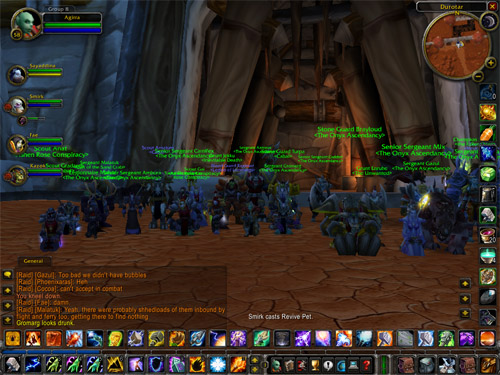
Tonight a friend whispered Agirra on Argent Dawn, and suddenly I was part of a 40 man raid group. The goal was to kill a faction leader, Archdruid Staghelm, in Teldrassil. That is deep in Alliance country, and not exactly an easy place to get in. A few players had managed to sneak in and find a quiet place to wait. They summoned the rest until the whole group was in. Then they snuck into position, pulled the Archdruid to where the main force was waiting, and started killing. It was intense, quick, and then out before the Alliance could get in and do something about it. The Onyx Ascendancy, who were filling out most spots in the raid, posted the story about the event. Afterwards there were celebrations in Orgrimmar, and a group photo outside:
Wednesday, December 14, 2005
Horde vs Alliance
It looks like we are leaning towards the Horde side, although I suspect the "I guess trolls and orcs are cool..." email I had this morning was not entirely convincing ;) One reason for it is that the Horde side appears generally more civil and adult, and so I also hope, more robust when it comes to accidental grouping with people who discuss research questions. Also, most of the Joi Ito group are on the Alliance side, and since that list is full of people in comparable fields (including our own Jill), establishing our characters on the horde side will be a stroke for diversity. But the Terra Nova WoW players are on the Horde-side too, so I can't really use that argument for my favourite faction, can I?
So I'll just say: For the Horde! and see if I am zerged. And shamans are way more fun than paladins, too ;)
So: Moonglade, Europe, Horde side. We want the first group to contain:
1) healer (preferably priest or healer-specced druid) (have one undead priest)
2) warrior, main tank, because meat-shields are a must to a good group (have one orc warrior)
3) mage-type for range and damage (mage or warlock) (have one mage)
4 and 5) hunter for range, other assist type: shaman, rogue - or just one more warrior, not specced for defense. This can also include for instance feral specced druids or shadow priests. (have one troll rogue)
We need 10 people to make a guild, which means 5 more.
No name yet. Any ideas?
So I'll just say: For the Horde! and see if I am zerged. And shamans are way more fun than paladins, too ;)
So: Moonglade, Europe, Horde side. We want the first group to contain:
1) healer (preferably priest or healer-specced druid) (have one undead priest)
2) warrior, main tank, because meat-shields are a must to a good group (have one orc warrior)
3) mage-type for range and damage (mage or warlock) (have one mage)
4 and 5) hunter for range, other assist type: shaman, rogue - or just one more warrior, not specced for defense. This can also include for instance feral specced druids or shadow priests. (have one troll rogue)
We need 10 people to make a guild, which means 5 more.
No name yet. Any ideas?
Tuesday, December 13, 2005
Wow-europe researcher's guild
Jill, Hilde and I would like to found a researcher's guild in World of Warcraft, on the European servers. It is something I have wanted for a long time, and with the number of researchers playing WoW it should be doable. We are still discussing things like which server (I am all for Moonglade, a new RP server), which side (where I am of course, partial to the horde, if we go alliance I will insist that we work on building a team which can beat the horde in Arathi Basin. I really want to see it done.), and even name and story.
The OOC purpose of the guild will be to meet to discuss game research informally, to do pilot studies to test out research strategies and to learn how the different aspects of the game interlinks through playing in groups and discussing with other researchers.
The IC purpose if the guild will be... Well, depends on what side we are on, really. It needs to fit well enough into the role-play structure of Moonglade that we don't violate the rules of an RP server, and be sufficiently conform that we don't change the server too much through our presence. It should not be so peaceful we can't experiment with all the different play-modes of the game, and not so violent we spend our time ganking and be ganked. That in itself will be a study of the role of the researcher in a delicate online research environment.
If you are interested in being part of this, to learn more and to give shape to the guild early, get in touch with me, Jill or Hilde. Emails will do, until we have decided on the details. We need six more to be able to start the guild, so once we are nine a lot will be settled quickly.
The OOC purpose of the guild will be to meet to discuss game research informally, to do pilot studies to test out research strategies and to learn how the different aspects of the game interlinks through playing in groups and discussing with other researchers.
The IC purpose if the guild will be... Well, depends on what side we are on, really. It needs to fit well enough into the role-play structure of Moonglade that we don't violate the rules of an RP server, and be sufficiently conform that we don't change the server too much through our presence. It should not be so peaceful we can't experiment with all the different play-modes of the game, and not so violent we spend our time ganking and be ganked. That in itself will be a study of the role of the researcher in a delicate online research environment.
If you are interested in being part of this, to learn more and to give shape to the guild early, get in touch with me, Jill or Hilde. Emails will do, until we have decided on the details. We need six more to be able to start the guild, so once we are nine a lot will be settled quickly.
Monday, December 12, 2005
It's not appropriate
Danah Boyd writes about how men and women can't have business dinners without being perceived as being on a date. There's a long long list of other things which are hard to do. While I challenge them frequently, that does not make them go away. I guess all women who work with men at a fairly equal and regular basis can make lists. I have tried to put a few things on mine, but doing so made me realise how much I miss having more female colleagues.
Digital vs paper
I was delighted when I discovered that I could update my Diffusion of Innovations copy with a digital copy of the fifth edition through amazon.com. So now I am cursing at the system which will not let me copy it. I have tried to activate the account which should let me make back-ups of the book to other computers, but does that mean other computers by way of fetching it from amazon? It certainly does not let me copy it to a CD for backup. I could however move the whole "my ebooks" archive from the computer hard-disk to the college server, which gives me much better backup and a chance to get at books even if I change computers (which I tend to do frequently). That means, however, that I only have access to any digital books I put there for as long as I work at this college.
I tried to activate the system (an unholy alliance between Adobe and msn) which is supposed to let me copy the books from one machine to another, but when I tried to figure out how to download the whole thing to another machine, I started a new download. I have no idea if I have to pay for that or not. Most likely I now have two digital copies of the book, billed twice. Fun.
Anyway - this is an innovation, and it will take time before slow old ladies like me feel safe using the new technology. I may be a fairly early user of certain things, but the adaption process is not as quick as my practice...
Update: putting the book on the college server does not make it easier to share the book with my colleagues, for such things as for instance planning the reading lists for students or making exam questions. Installing my adobe DRM activator at another machine, which supposedly should let me move the document between machines, did not work. This makes digital editions pretty useless for professors except as last desperate call when it is impossible to find the book anywhere and we really need that citation. In that case 13$ (which this cost me) is way too much. The way digital books apparently are organised through Amazon at present they make books only consumer goods, not tools to work with. Not good enough.
I tried to activate the system (an unholy alliance between Adobe and msn) which is supposed to let me copy the books from one machine to another, but when I tried to figure out how to download the whole thing to another machine, I started a new download. I have no idea if I have to pay for that or not. Most likely I now have two digital copies of the book, billed twice. Fun.
Anyway - this is an innovation, and it will take time before slow old ladies like me feel safe using the new technology. I may be a fairly early user of certain things, but the adaption process is not as quick as my practice...
Update: putting the book on the college server does not make it easier to share the book with my colleagues, for such things as for instance planning the reading lists for students or making exam questions. Installing my adobe DRM activator at another machine, which supposedly should let me move the document between machines, did not work. This makes digital editions pretty useless for professors except as last desperate call when it is impossible to find the book anywhere and we really need that citation. In that case 13$ (which this cost me) is way too much. The way digital books apparently are organised through Amazon at present they make books only consumer goods, not tools to work with. Not good enough.
Understanding delayed
I don't know her name any more, but a friend in junior high school (whose name I remember) dragged me with her to visit this old lady in some of the lunch breaks. My friend was sent by her family, I was cajoled into accompanying her while doing her daughterly duty.
After the first few visits, I was not hard to ask. This was a woman who lived in a house filled with books. There was a piano my friend played for a few minutes each visit, but what I cared for were the books: all the walls in that large, old house covered with them. The lady was almost blind, but she rejoiced at the technology of the casette player, because she could listen to books! There was a magnifying glass in each room, and she wrote letters. Not just your regular "hello, how are you" letter, but intellectual discussions with authors and professors all over the country, and one of them was a quite famous fellow student. She had studied with Inger Hagerup, who was a well known poet, political activist and one of the few early female intellectuals. This old lady was no famous poet, but she was something else - a woman who had chosen her passion for academic and intellectual pursuits over other, more common activities for girls of nice families. And seeing she was a contemporary of Inger Hagerup - well, she had to be one of the very few other intellectual Norwegian women, right?
I suspect she came from an old, well-off family where the daughters could afford the luxury of education. The house she lived in was no common little shack, it was withdrawn, like a manor, into a large garden in the more exclusive area of town. But her choice still touched even my 14 year old self. At the time I had no idea what I was looking at, what kind of woman who served me oatmeal cookies with brown cheese and chocolate milk, but over the last years, while the words "Inger Hagerup early pioneer female liberation" have been sinking in, I have realised and grieved at the lack of understanding my younger self had. How could I understand? Her accomplisment through a life of scholarly labour was so far from the experience of a wild barbarian girl as it could be.
Still... I always wanted to just stay behind and read, quietly, in one of her large leather chairs.
After the first few visits, I was not hard to ask. This was a woman who lived in a house filled with books. There was a piano my friend played for a few minutes each visit, but what I cared for were the books: all the walls in that large, old house covered with them. The lady was almost blind, but she rejoiced at the technology of the casette player, because she could listen to books! There was a magnifying glass in each room, and she wrote letters. Not just your regular "hello, how are you" letter, but intellectual discussions with authors and professors all over the country, and one of them was a quite famous fellow student. She had studied with Inger Hagerup, who was a well known poet, political activist and one of the few early female intellectuals. This old lady was no famous poet, but she was something else - a woman who had chosen her passion for academic and intellectual pursuits over other, more common activities for girls of nice families. And seeing she was a contemporary of Inger Hagerup - well, she had to be one of the very few other intellectual Norwegian women, right?
I suspect she came from an old, well-off family where the daughters could afford the luxury of education. The house she lived in was no common little shack, it was withdrawn, like a manor, into a large garden in the more exclusive area of town. But her choice still touched even my 14 year old self. At the time I had no idea what I was looking at, what kind of woman who served me oatmeal cookies with brown cheese and chocolate milk, but over the last years, while the words "Inger Hagerup early pioneer female liberation" have been sinking in, I have realised and grieved at the lack of understanding my younger self had. How could I understand? Her accomplisment through a life of scholarly labour was so far from the experience of a wild barbarian girl as it could be.
Still... I always wanted to just stay behind and read, quietly, in one of her large leather chairs.
Just call me Cassandra
Some of you know that last year I was working on a plan for reorganising the college. Friday the board decided to what extent the college should be reorganised. They threw out everything we suggested and went in the opposite direction, except for one little bit where we had said that this was one possible way of organising things (hiring instead of electing deans).
I foresee years of saying "this was exactly what we wanted to avoid".
---------------
Or, if I am not Cassandra, perhaps I am Dr. Kathryn Railly.
I foresee years of saying "this was exactly what we wanted to avoid".
---------------
Or, if I am not Cassandra, perhaps I am Dr. Kathryn Railly.
Thursday, December 08, 2005
Non-sense of Gender
I just added a link to the article I wrote with Hilde Corneliussen for the Women in Games Conference in Dundee this august: The Non-sense of Gender in Neverwinter Nights. I have been waiting for the organisers to publish the proceedings online, but as this seems to take a little while, here is our article. Yes, I have permission, as long as I cite them properly.
I can't wait
So I pre-ordered Aphra Kerr's book The Business and culture of Digital Games.
From what I have heard in her presentations the last year, this book will address quite a few of those lose assumptions which have been bandied around lately, such as "computer games are more important than the Hollywood film production." So, yes, I am waiting eagerly, Aphra!
From what I have heard in her presentations the last year, this book will address quite a few of those lose assumptions which have been bandied around lately, such as "computer games are more important than the Hollywood film production." So, yes, I am waiting eagerly, Aphra!
One step up
If you're in Oslo 10th of January 2006, there is a conference on women in Academia at Håndverkeren. It's arranged by the comitee for integration - women in research (kvinner i forskning), and speakers are Professor Virginia Valian, Professor Teresa Reese and professor Kari Melby.
Wednesday, December 07, 2005
Hubris
In a conference far far away and a long time ago, a professor bought me a whiskey and told me, smilingly, that I have too much hubris. "The gods love punishing people like you" he added, and drank happily to my expected demise.
I don't think he meant it as a warning or in any way a negative comment, because if I am the hero filled with hubris, daring the retribution of the gods, he is the helper who tries to make the dreams and the wild plans possible. But his observation still made me pause and question my behaviour, what made him say something like that?
I have slowly come to the conclusion that it is because I am a woman. A man could not get away with talking about grand plans and world domination the way I do (metaphorically, of course), because those things would be possible to a man. He would simply be a dangerous maniac who might do some real damage. A woman who aspires to the role of evil overlord is filled with hubris, overconfident and certain to be destroyed.
On the one hand, this should make me seriously angry: Why shouldn't I be able to run the universe as well as any man? On the other hand, it gives me more freedom to fail gracefully and tragically, and not because I am stupid, but because the gods are against me and no mortal can outwit the gods. There is a certain security in that, it is comforting to know that I can blame something else, somebody else.
But that thought brings me to another male who used to return to the claim that women are always using equal opportunity work and gender prejudice as an excuse for not qualifying themselves academically. "The gods are against me, I can't finish my Ph D..." Oh, wait, I did!
So what am I trying to say? I think this sums it up:
1. Women are allowed to try things men can not, because we are expected to fail.
2. When we fail, we are expected to be bitter, angry and blame everything but our own incompetence.
Luckily there is a point three:
3. Some people know about both opinion 1 and 2, but insist on listening to other expectations, continuing to offer support and advice and the occasional glass of whiskey.
So here's to hubris, to naive over-confidence and the belief that we don't have to live our lives like stereotypes. (Not even that of a tragic hero.)
I don't think he meant it as a warning or in any way a negative comment, because if I am the hero filled with hubris, daring the retribution of the gods, he is the helper who tries to make the dreams and the wild plans possible. But his observation still made me pause and question my behaviour, what made him say something like that?
I have slowly come to the conclusion that it is because I am a woman. A man could not get away with talking about grand plans and world domination the way I do (metaphorically, of course), because those things would be possible to a man. He would simply be a dangerous maniac who might do some real damage. A woman who aspires to the role of evil overlord is filled with hubris, overconfident and certain to be destroyed.
On the one hand, this should make me seriously angry: Why shouldn't I be able to run the universe as well as any man? On the other hand, it gives me more freedom to fail gracefully and tragically, and not because I am stupid, but because the gods are against me and no mortal can outwit the gods. There is a certain security in that, it is comforting to know that I can blame something else, somebody else.
But that thought brings me to another male who used to return to the claim that women are always using equal opportunity work and gender prejudice as an excuse for not qualifying themselves academically. "The gods are against me, I can't finish my Ph D..." Oh, wait, I did!
So what am I trying to say? I think this sums it up:
1. Women are allowed to try things men can not, because we are expected to fail.
2. When we fail, we are expected to be bitter, angry and blame everything but our own incompetence.
Luckily there is a point three:
3. Some people know about both opinion 1 and 2, but insist on listening to other expectations, continuing to offer support and advice and the occasional glass of whiskey.
So here's to hubris, to naive over-confidence and the belief that we don't have to live our lives like stereotypes. (Not even that of a tragic hero.)
Tuesday, December 06, 2005
Working Norway/USA?
Your cooperation is from the 9th of December regulated by an agreement (PDF in Norwegian) between Norway and the United States concerning research and scientific cooperation. The agreement covers all kinds of research and unless there are other agreements, is the default position for cooperation. It will not change a lot in our regular cooperation, but there are a few interesting points:
- People who might otherwise have problems leaving USA due to for instance security concerns, are to be allowed travel in order to facilitate cooperation. Not such a big deal for most game researchers I know, but for those who work in the more regulated areas of computing, it may be.
- All participants have equal rights to publish material which is the result of cooperation. This has been a real issue at times, as the rules concerning citation, copyright and what the document calls "immaterial rights" are different in Norway and the US. While these are quite lenient in Norway, the restrictions on the US side could make publication elsewhere problematic.
- Both nations are to allow for research equipment both to enter and leave their territory. While I mostly imagine huge research ships slowly crossing from international to national waters when reading those words, it may also mean something as simple as carrying with us a computer or just a disc filled up with cutting edge software. Before this agreement, we could have been either refused to enter or stopped leaving with this information, now we can all relax and steer our research ships happily past those serious-looking borderguards.
OK, so my life won't change on the 9th, but it is nice to know that somebody works to facilitate the free flow of information and research.
- People who might otherwise have problems leaving USA due to for instance security concerns, are to be allowed travel in order to facilitate cooperation. Not such a big deal for most game researchers I know, but for those who work in the more regulated areas of computing, it may be.
- All participants have equal rights to publish material which is the result of cooperation. This has been a real issue at times, as the rules concerning citation, copyright and what the document calls "immaterial rights" are different in Norway and the US. While these are quite lenient in Norway, the restrictions on the US side could make publication elsewhere problematic.
- Both nations are to allow for research equipment both to enter and leave their territory. While I mostly imagine huge research ships slowly crossing from international to national waters when reading those words, it may also mean something as simple as carrying with us a computer or just a disc filled up with cutting edge software. Before this agreement, we could have been either refused to enter or stopped leaving with this information, now we can all relax and steer our research ships happily past those serious-looking borderguards.
OK, so my life won't change on the 9th, but it is nice to know that somebody works to facilitate the free flow of information and research.
Saturday, December 03, 2005
Role play games seminar
In Tampere, at the Game Research Lab, they are arranging a seminar on Playing Roles in March, 23-24th 2006. Sadly I am either somewhere between Wellington and Europe or Los Angeles and New York at the time, neither option which permits a trip to Tampere (which I would have loved, never been there). But hopefully a lot of other people can be there, and will, it looks interesting.
*** NOTE: update from Markus Montola, who arranges this seminar, in an email:
*** NOTE: update from Markus Montola, who arranges this seminar, in an email:
There have been some minor scheduling problems with the Tampere role-playing seminar, and we've been forced to postpone it by one week. Due to this we have also postponed the submission deadlines. The new seminar date is 30.-31. of March.
Elinor and DAC
Friday night there was a reading of electronic poetry organised by elinor, the nordic electronic poetry organisation started by several of the DAC regulars. I have tried to find the program online today, but no such luck.
My impression was of a religious sermon devoted to the word, this time electronically conveyed. Swedish, Danish, Finnish and American artists presented their work to a silent, reverent group of Scandinavians and some baffled-by-the-seriousness non-scandinavians.
Three examples of the revered word, by three different creators:
----------
See also Grand Text Auto for more about the reading.
My impression was of a religious sermon devoted to the word, this time electronically conveyed. Swedish, Danish, Finnish and American artists presented their work to a silent, reverent group of Scandinavians and some baffled-by-the-seriousness non-scandinavians.
Three examples of the revered word, by three different creators:
----------
See also Grand Text Auto for more about the reading.
Thursday, December 01, 2005
Rules all the way down
Daring in this company, Andreas Gregersen applies his paper to the discussion of Ludology in relation to Narratology and Semiology. In his understanding ludology is about rules, and ludology is rules all the way down.
First, I think he (and Zimmerman and Salen in his quote) is forgetting another limiting aspect of games, which is the arena. While code is interpreted as law in some contexts, here code is interpreted as rule, but rules the players can not consent to.
If we compare this to playing fields, that means that the field itself is "rule". In the Huizinga definition of play, the field is considered the arena. Certain rules state how the arena is to be: how long, how large goals, etc, but still as all players of games know, one arena is not the same as the other. Physical laws which the game rules can not adjust influences the arena - as for instance when they golf on the ice on Svalbard, carrying a rifle with the clubs, or there are ski-jumping competition on different snow simulations. So what is the rule and what is the arena in computer games?
First, I think he (and Zimmerman and Salen in his quote) is forgetting another limiting aspect of games, which is the arena. While code is interpreted as law in some contexts, here code is interpreted as rule, but rules the players can not consent to.
If we compare this to playing fields, that means that the field itself is "rule". In the Huizinga definition of play, the field is considered the arena. Certain rules state how the arena is to be: how long, how large goals, etc, but still as all players of games know, one arena is not the same as the other. Physical laws which the game rules can not adjust influences the arena - as for instance when they golf on the ice on Svalbard, carrying a rifle with the clubs, or there are ski-jumping competition on different snow simulations. So what is the rule and what is the arena in computer games?
Debunking myths
Henry Jenkins (not at DAC that I know, simply a link that showed up while writing the previous post) addresses 8 popular myths about video games. Very useful, good sources. My favourite statement is the first one:
1. The availability of video games has led to an epidemic of youth violence.
According to federal crime statistics, the rate of juvenile violent crime in the United States is at a 30-year low. Researchers find that people serving time for violent crimes typically consume less media before committing their crimes than the average person in the general population. It's true that young offenders who have committed school shootings in America have also been game players. But young people in general are more likely to be gamers — 90 percent of boys and 40 percent of girls play. The overwhelming majority of kids who play do NOT commit antisocial acts. According to a 2001 U.S. Surgeon General's report, the strongest risk factors for school shootings centered on mental stability and the quality of home life, not media exposure. The moral panic over violent video games is doubly harmful. It has led adult authorities to be more suspicious and hostile to many kids who already feel cut off from the system. It also misdirects energy away from eliminating the actual causes of youth violence and allows problems to continue to fester.
Exergaming and physical engagement
One of the members of my clan constantly complains about the state of his keyboard. He plays a fury warrior - a warrior who can act at extreme speed. The player himself refuses to drink alcohol before or during challenging game sessions, as it slows down his reaction time, and his play is so vigurous and physical that he keeps breaking the keyboard.
Ian Bogost is speaking about exergaming and the physical analogies used in these games, and how such physically oriented games are not all that fit for private homes. His talk is connected, I find, with the thoughts expressed in Henry Jenkins' article "Complete freedom of movement", which connects to and expresses some of the opinions I have on why games are so popular - our society needs to control excess physicality, and leisure is defined as being still. Resting means vedging out on the couch rather than changing mental modes by going from no physical activity but heavy mental activity to more physical activity and less mental activity.
What does it have to do with WOW? Well, everything has to do with WOW these days, but the real connection is in the physicality: how playing a game well does not only connect to the mental activity, but as much to the physical body: ability to endure strain, react quickly, think clearly and cooly, navigate in the virtual space.
Ian Bogost is speaking about exergaming and the physical analogies used in these games, and how such physically oriented games are not all that fit for private homes. His talk is connected, I find, with the thoughts expressed in Henry Jenkins' article "Complete freedom of movement", which connects to and expresses some of the opinions I have on why games are so popular - our society needs to control excess physicality, and leisure is defined as being still. Resting means vedging out on the couch rather than changing mental modes by going from no physical activity but heavy mental activity to more physical activity and less mental activity.
What does it have to do with WOW? Well, everything has to do with WOW these days, but the real connection is in the physicality: how playing a game well does not only connect to the mental activity, but as much to the physical body: ability to endure strain, react quickly, think clearly and cooly, navigate in the virtual space.
Tuesday, November 29, 2005
Where is Torill?
For the benefit of students and others who occasionally wonder why I am not at the office, and then have figured out that the blog is a good way to find me:
I leave for Copenhagen and DAC 2005 tomorrow morning - staying in Denmark until Sunday.
Monday the Information and media faculty are away from the college and in a meeting all day.
Tuesday more faculty meetings, in Volda but unavailable.
Don't panic until Wednesday.
I'll probably blog the conference, so there will be signs of life.
I leave for Copenhagen and DAC 2005 tomorrow morning - staying in Denmark until Sunday.
Monday the Information and media faculty are away from the college and in a meeting all day.
Tuesday more faculty meetings, in Volda but unavailable.
Don't panic until Wednesday.
I'll probably blog the conference, so there will be signs of life.
Gamestudies in Italian
I often wish I could speak Italian - particularly when I am eager or angry, it sounds so much more passionate than being angry in hesitant, slow Norwegian. But there's another reason for it as well, a publisher who works mainly with game studies: Ludologica.
Link in response to my frustrated outburst below, from Luca Rossi, who laughed with me in wicked black humour.
Link in response to my frustrated outburst below, from Luca Rossi, who laughed with me in wicked black humour.
Monday, November 28, 2005
Please, PLEASE stop
Don't write the sentence "There has been very little research done on games" in any more papers or articles or theses and essays UNLESS you also have a full bibliography that cites those few existing works. I don't care how many authorities you cite who may have written those words quite recently. Because yes, gamestudies is a new field, and therefore does not have entire library shelves to themselves, like literary studies. However, if the amount of articles and books you have to read to be able to understand the width of the field is so small, it is pretty lazy scholarly work - sloppy craft, simply - not to have read them all.
So: Either STOP claiming it's a field empty of research, or start citing and listing what exists. Please. Pretty please with sugar on.
Now back to reading paper submissions for a conference.
Oh, and an afterthought: some words to put in here so this post may show up on a search done by your anonymous lazy scholar:
Games, game studies, gamestudies, game scholarship, game bibliography, studying games, computergame study, videogame study, video games, computer games, game media studies, game sociology, game literature, game psychology, game feminism, games and gender, game technology
Please email me with more suggestions.
So: Either STOP claiming it's a field empty of research, or start citing and listing what exists. Please. Pretty please with sugar on.
Now back to reading paper submissions for a conference.
Oh, and an afterthought: some words to put in here so this post may show up on a search done by your anonymous lazy scholar:
Games, game studies, gamestudies, game scholarship, game bibliography, studying games, computergame study, videogame study, video games, computer games, game media studies, game sociology, game literature, game psychology, game feminism, games and gender, game technology
Please email me with more suggestions.
Friday, November 25, 2005
Cyber dissidents
By way of Doctor Daisy, a link to a pdf with a handbook for cyber-dissidents. Practical how-to for getting around media sensorship by using the net.
Thursday, November 24, 2005
Blogging the college
I have been looking at the front page of Volda College for years, and never even thought about it. But the information department (with some occasional assistance from media students) keeps a very frequently updated news-service right smack in the middle of the front page, with news relevant to the college. It is so frequently and easily updated, and the news are so important to the community feeling of the college, that one might fit it into the definition of a blog. The posts are unique, easy to link to, it's posted in opposite chronological order, and the posting happens quickly.
I am so proud of the information department, they have just been doing it, no fuzz, no flaunting of fancy new words, but they were right up there before the mainstream discovered blogs.
I am so proud of the information department, they have just been doing it, no fuzz, no flaunting of fancy new words, but they were right up there before the mainstream discovered blogs.
Wednesday, November 23, 2005
sex, cancer and viruses
This is why I love blogs. At the Norwegian meta blog last week the leap was made from publications on weblogs to oral cancer from sex in just one comment. I was impressed with the ability of bloggers to think about sex in all contexts.
Anyway. That made me google "sex cancer virus", and the top story was really disturbing. Now, this may look farfetched, but let me explain: there is a connection between cervical cancer and sex. The human papilloma virus can lead to changes in the cells of the cervix which again develops into cancer. This virus is transferred through sexual intercourse, but can develop very slowly and as the virus is very, very common everybody who have had sex can be carrying it. In most cases it goes away, like any cold or flu. Occasionally it lingers and causes cancer. The study referred to in bloggblogg was a version of this - the virus seems to cause oral cancer as well. This is of course a lot more tittilating, so that makes news.
The sexual practices of adult gay men are, to be frank, not more of my concern than the sexual practices of teenage girls. What shocked me was that there is a vaccine against this virus, but people argue against making it available to the public. Why? Because it may encourage teen-age sex.
Cancer is the big scare today, it is one of the few things for which there is no easy cure. Once it is established in the body it can spread, and your own body becomes your enemy. The imagery is close to horror story material: the alien growing in your body, killing you from within. This ought to keep teenagers morally sound: if social ostracation, economic concerns in the case of unwanted parenthood, physical aggression against abortion clinics and other delightful expressions of the drive to control teenage sex (or any non-conforming sex) was not enough. The way to maintain teenage morals is by refusing to make a vaccine that can save lives - including unborn, future lives - available.
I can't imagine what the insides of the heads of people who make that type of arguments look like. I don't want to know either. That is where the real cancer dwells.
Anyway. That made me google "sex cancer virus", and the top story was really disturbing. Now, this may look farfetched, but let me explain: there is a connection between cervical cancer and sex. The human papilloma virus can lead to changes in the cells of the cervix which again develops into cancer. This virus is transferred through sexual intercourse, but can develop very slowly and as the virus is very, very common everybody who have had sex can be carrying it. In most cases it goes away, like any cold or flu. Occasionally it lingers and causes cancer. The study referred to in bloggblogg was a version of this - the virus seems to cause oral cancer as well. This is of course a lot more tittilating, so that makes news.
The sexual practices of adult gay men are, to be frank, not more of my concern than the sexual practices of teenage girls. What shocked me was that there is a vaccine against this virus, but people argue against making it available to the public. Why? Because it may encourage teen-age sex.
Cancer is the big scare today, it is one of the few things for which there is no easy cure. Once it is established in the body it can spread, and your own body becomes your enemy. The imagery is close to horror story material: the alien growing in your body, killing you from within. This ought to keep teenagers morally sound: if social ostracation, economic concerns in the case of unwanted parenthood, physical aggression against abortion clinics and other delightful expressions of the drive to control teenage sex (or any non-conforming sex) was not enough. The way to maintain teenage morals is by refusing to make a vaccine that can save lives - including unborn, future lives - available.
I can't imagine what the insides of the heads of people who make that type of arguments look like. I don't want to know either. That is where the real cancer dwells.
Tuesday, November 22, 2005
Self-flaggelation
I am supervising students who have to finish their 20 page papers by Thursday. As the only woman in a teaching position I get a lot of girls among those students. Some boys with blog and world of warcraft interests, but otherwise it's girls. Brilliant, hard-working, intense and dedicated girls*. They are definitely not me as I was at their age, they are smarter, prettier and more dedicated, and I find myself reminding them that they need to breathe. Deep belly breaths, while they look away from the subject they are analysing, and tell themselves this is fine, it will work, and the world will not fall apart if they stop hurting themselves for 10 minutes.
Self-flagellation may seem like an academic olympic sport, but after a certain point it doesn't really make your research or your writing better. Hurting yourself constantly over academic writing can lead the other way: that you remove what made your writing special, different and more interesting. Unless you really like the pain, indulge in your favourite sustenance, lean back and breathe, while you find something to focus on that makes you smile and notice good things. It may let you notice the good things in your own work too.
* The boys are as brilliant as the girls, but for some reason they are not as much into self-punishment and doubt. Good for them!
Self-flagellation may seem like an academic olympic sport, but after a certain point it doesn't really make your research or your writing better. Hurting yourself constantly over academic writing can lead the other way: that you remove what made your writing special, different and more interesting. Unless you really like the pain, indulge in your favourite sustenance, lean back and breathe, while you find something to focus on that makes you smile and notice good things. It may let you notice the good things in your own work too.
* The boys are as brilliant as the girls, but for some reason they are not as much into self-punishment and doubt. Good for them!
Do it like a pro
Johnathan Wendel has a job which gives him a flow experience, puts him "in the zone". He is a professional gamer, and the obvious pleasure he gets from doing what he likes is fascinating - as is the reporter's surprise at how a man who makes money on something as cheesy as playing computer games can live a simple or even austere life dedicated to his passion.
Still, the reporter describes a basement room lined with networked computers and filled with other gamers. What is austere about that? To a gamer, that is opulence. Expensive furniture is uninteresting, unless it supports you well through 5 hours of intensive gaming, but a really good monitor - now that is art. It's just a different culture with different values. It may not be the revolution, but something is changing.
Link courtesy of my NYC connection.
Still, the reporter describes a basement room lined with networked computers and filled with other gamers. What is austere about that? To a gamer, that is opulence. Expensive furniture is uninteresting, unless it supports you well through 5 hours of intensive gaming, but a really good monitor - now that is art. It's just a different culture with different values. It may not be the revolution, but something is changing.
Link courtesy of my NYC connection.
Monday, November 21, 2005
The Main Tank
OK, I admit it, I play more characters than Agirra, the whimpy shaman orc girl. She's my research character, so she will be the public front. The others will remain nameless here. But one of them is a warrior.
The warrior was created as a companion to a friend who plays a cloth-wearer. For those of you not in the know, that is priest, mage or warlock. A cloth-wearer needs a warrior playing the role of tank to function well: the tank holds the aggression and endures the beating of the NPCs or even PCs for long enough that the magical type people can get their spells organised and do some serious damage. In a team with healers and damage dealers the tank's role is to keep the attention and the aggression focused on her while the rest works, particularly the healer. If the tank dies, frequently the rest of the group will be wiped. The same is true the other way around though: if the healer dies the tank is doomed in 19 cases out of 20.
This leads to a very intense and close interplay between the tank and healer. A good tank needs to be able to not only attack and slash indiscriminately, but also to understand how the aggressive characters will move, where and when. If one or more move to the healer, the tank needs to be there immediately to draw the attention away. If the healer is attacked the healer can't heal, and so the tank dies. The rule is: die before your healer. Die because the mana to keep you alive runs out, not because you ignored your healer. As the guild warriors say it, when I in shaman role have tried to be both healer and hero: "Leave the dieing to the professionals." The warrior is supposed to take the damage, and die if needed. This of course means you have to trust the healer to be there for you, while you are recklessly slashing away.
Similar relationships exist between the tank and the damage dealers: killing a mob quickly with hard-hitting spells is another way to keep the tank alive, and so the group is interdependent. Still, it feels good to be the tank. The tanking warrior is the hero, the front character, the one who saves the day. Turning around even before the healer has time to type "on me" to taunt the mobs attacking and draw them away, distracting as wide a field as possible and living to tell about it: I am starting to understand why the warriors are loud, bossy, yelling players. Last night I was loud and bossy and self-centered, and when I tried to be a democratic leader and asked the others what to do about a certain attack, the reply was "You're the main tank. You decide." It felt good.
At the same time I found myself hopelessly annoyed with the shamans. I have always thought of the shaman as a type of character that only functions well when it serves a group. Totems give abilities to all within range: healing, protection, extra attacks - but you need a group to take advantage if it is to work properly. And so you need to study how the group functions. As a shaman I normally put up a mana totem for the other magical folks at the back, an earth-bind or stoneskin totem to help the tanks, yet another totem to give more or stronger attacks: I play on the strengths of the group and enhance them rather than try to be everything from tank to healer at the same time. But since shamans can be good solo characters, they tend to play selfishly, defining themselves as tanks, healers or mages but with themselves as back up for themselves. This means that as tank, a shaman will mainly focus on doing massive damage, not on saving the healer - because the shaman can heal and even resurrect alone. As a healer the shaman will not worry so much about the tank, as she can be her own tank if needed. The shaman can attack at a distance and distract upcoming aggression through totems, why should a shaman even care about the group?
Playing the warrior has made me a much better shaman, because from this position I see the group interdependence more clearly. It makes it easier for me to take up the healing role without complaints: shamans can be good healers because they are less vulnerable than both priests and druids, and a somewhat inexperienced tank has more time before the shaman is dead than with a priest. It also makes it easier to see how I can use the shaman to tank, it forces me to consider the nature of the spells and weapons in a different context: what will pull aggression, how can I hold it, how can I distract casters, how can I turn the flow of the battle?
But all that intellectual chit-chat aside, I find that I like playing a warrior. I love the way my character throws her head back and yells, and all the enemies turn around and come running. I enjoy pulling them all to me, and physically feel the tension of the quick play needed to control the aggression - the aggro - as well as the relief of a cloth-wearer who finally has time to cast a spell.
The warrior was created as a companion to a friend who plays a cloth-wearer. For those of you not in the know, that is priest, mage or warlock. A cloth-wearer needs a warrior playing the role of tank to function well: the tank holds the aggression and endures the beating of the NPCs or even PCs for long enough that the magical type people can get their spells organised and do some serious damage. In a team with healers and damage dealers the tank's role is to keep the attention and the aggression focused on her while the rest works, particularly the healer. If the tank dies, frequently the rest of the group will be wiped. The same is true the other way around though: if the healer dies the tank is doomed in 19 cases out of 20.
This leads to a very intense and close interplay between the tank and healer. A good tank needs to be able to not only attack and slash indiscriminately, but also to understand how the aggressive characters will move, where and when. If one or more move to the healer, the tank needs to be there immediately to draw the attention away. If the healer is attacked the healer can't heal, and so the tank dies. The rule is: die before your healer. Die because the mana to keep you alive runs out, not because you ignored your healer. As the guild warriors say it, when I in shaman role have tried to be both healer and hero: "Leave the dieing to the professionals." The warrior is supposed to take the damage, and die if needed. This of course means you have to trust the healer to be there for you, while you are recklessly slashing away.
Similar relationships exist between the tank and the damage dealers: killing a mob quickly with hard-hitting spells is another way to keep the tank alive, and so the group is interdependent. Still, it feels good to be the tank. The tanking warrior is the hero, the front character, the one who saves the day. Turning around even before the healer has time to type "on me" to taunt the mobs attacking and draw them away, distracting as wide a field as possible and living to tell about it: I am starting to understand why the warriors are loud, bossy, yelling players. Last night I was loud and bossy and self-centered, and when I tried to be a democratic leader and asked the others what to do about a certain attack, the reply was "You're the main tank. You decide." It felt good.
At the same time I found myself hopelessly annoyed with the shamans. I have always thought of the shaman as a type of character that only functions well when it serves a group. Totems give abilities to all within range: healing, protection, extra attacks - but you need a group to take advantage if it is to work properly. And so you need to study how the group functions. As a shaman I normally put up a mana totem for the other magical folks at the back, an earth-bind or stoneskin totem to help the tanks, yet another totem to give more or stronger attacks: I play on the strengths of the group and enhance them rather than try to be everything from tank to healer at the same time. But since shamans can be good solo characters, they tend to play selfishly, defining themselves as tanks, healers or mages but with themselves as back up for themselves. This means that as tank, a shaman will mainly focus on doing massive damage, not on saving the healer - because the shaman can heal and even resurrect alone. As a healer the shaman will not worry so much about the tank, as she can be her own tank if needed. The shaman can attack at a distance and distract upcoming aggression through totems, why should a shaman even care about the group?
Playing the warrior has made me a much better shaman, because from this position I see the group interdependence more clearly. It makes it easier for me to take up the healing role without complaints: shamans can be good healers because they are less vulnerable than both priests and druids, and a somewhat inexperienced tank has more time before the shaman is dead than with a priest. It also makes it easier to see how I can use the shaman to tank, it forces me to consider the nature of the spells and weapons in a different context: what will pull aggression, how can I hold it, how can I distract casters, how can I turn the flow of the battle?
But all that intellectual chit-chat aside, I find that I like playing a warrior. I love the way my character throws her head back and yells, and all the enemies turn around and come running. I enjoy pulling them all to me, and physically feel the tension of the quick play needed to control the aggression - the aggro - as well as the relief of a cloth-wearer who finally has time to cast a spell.
How far would you go?
To hear me speak, that is? I asked my daughter if she'd go to New Zealand for a chance to listen to me. Daughters are very good reality checks. Her reply was "Why should I? I can hear you speak as much as I like when ever I like." But like a real nerdy networked family member, she said this from where she is currently studying, on skype, as we were searching through open office manuals in Norwegian in order to figure out how she could use it to draw text-boxes and arrows for one of her papers - which needs to be electronically submitted, and so she needs the boxes to look the same in the receiving end as in her end.
The skype/open office part is an aside though, an attempt to modestly play down the fact that I have been invited to Blog Hui on New Zealand in March 2006. I am absolutely delighted with the thought of going to a place which has a 12 hour time difference - an indication of being at the opposite side of the planet.
So how far would somebody go to speak about their favourite topics? I don't think I can go any further than this and still stay on the planet.
(If I get extra-terrestial invitations, I don't know if I will dare blog it - at least not in advance. And afterwards... well, I guess the implants will tell me what I should or should not do.)
The skype/open office part is an aside though, an attempt to modestly play down the fact that I have been invited to Blog Hui on New Zealand in March 2006. I am absolutely delighted with the thought of going to a place which has a 12 hour time difference - an indication of being at the opposite side of the planet.
So how far would somebody go to speak about their favourite topics? I don't think I can go any further than this and still stay on the planet.
(If I get extra-terrestial invitations, I don't know if I will dare blog it - at least not in advance. And afterwards... well, I guess the implants will tell me what I should or should not do.)
Friday, November 18, 2005
Afraid of the dark
My grandmother died when I was seven years old. I had met her once that I could remember: an old woman at the hospital in Oslo. She had a weak heart, and the whole family had been stuffed into the 8-seater Volkswagen to drive down to Oslo in a hurry and visit her. I threw up more than once on that trip, both my parents smoked and my older sisters were knitting, chatting and complaining about the stops needed for me to puke.
That whole trip burned into my memory, but only in weird, broken freeze-frames. I must have been perhap 5-6 years old, and I still remember the smell of the car, teasing my sister who was trying the count the stitches of her knitting, the curlers my mother and sister had put into my hair in order to make me look nice. I was the ugly child, and they wanted to show the relatives in Oslo that I could be cute - with just a little bit of work. I lost a tooth, and got five krone for it, after leaving it in a glass of water over night. We visited some of my mother's aunts, and I got a large, lovely doll with a wonderful purple dress, one I was told to treat carefully and gently. I think her name was Magdalena. My younger sister finished that poor thing off 10 years later.
And in all of this, all I remember of my grandmother was a small, old woman in a hospital bed. She gave me a necklace, a string of wooden pearls. It's the only present I remember to have received from any of my grandparents, and I think those pearls are somewhere in my drawers still. She made very little impression on me, except as a curiosity, the pearls a souvenir from the journey to grandmother, kept to remind myself that I was there, I saw her, she was real.
Grandmother died not long after. She is buried at the same graveyard where her husband rests, and now also my father and one uncle. This meant that the funeral had to be somewhere close, and it was natural that the center of the whole event was her house, which today belongs to my mother and one of her sisters. A lot of people I had never met before and would never meet again were there: she came from a large family, and her in-laws were numerous as well. And so I met uncles who were not my uncles, but those of my mother.
One of them was very good with children. No, this is not a bad story, it is not about abuse or perversion. He was good with children. He loved being with us, the brood running around in that large wild garden around my grandmother's house, and he loved telling stories. I fell in love with him immediately. And in the shadows of the cherry trees he told about trolls and witches, about wolves and bears, about ghosts and the little people. I was fascinated, taken up with his stories, my mind was wide open and my imagination like a sponge. When he left I was unhappy, despite coming from a family of excellent story-tellers he was better. Perhaps that is why I recognized his mastery? It is a nice thought, that I was a discerning consumer of stories at 7. I am not sure though, it may have been just an adult who took time to be with the children while everybody else were grieving and arguing over the inheritance.
After he left, I could no longer be out in the dark. Until that moment the dark had never scared me. Suddenly it was filled with shapes lingering just beyond what I could see. There was life everywhere around me, potential events, things to fear but also to explore. The dark had been populated. My parents were livid with anger at that uncle. I defended him - already then I defended the stories. I told them it was not the stories that had scared me, but the context: the funeral, the dark garden, the isolation from the other adults. That much is certain: at seven years old I was willing to defend the stories that had populated my universe with mystery rather than put blame on any one single thing for my own problems.
I remembered this story today because of the warnings against the newest Harry Potter movie. It seems like children can be traumatised by the movie. I guess they can. But children can be as easily traumatised by loving, well-meaning uncles who choose to spend time caring about the forgotten horde while the others fight and cry. Or they can be traumatised by the fighting and the crying. Or by a mysterious far-away death and a coffin surrounded by grief. Are we to outlaw them all: Uncles, grandmothers, death, funerals, grief and well-told stories?
I am no longer afraid of the dark. I have faced the demons my imagination conjured for me, fought through the maze and seen that there is a way out. There may be new demons, but none of them come from my uncle's stories. I miss that. I wish what waits in my metaphorical dark was that lovely, that exciting and that simple.
That whole trip burned into my memory, but only in weird, broken freeze-frames. I must have been perhap 5-6 years old, and I still remember the smell of the car, teasing my sister who was trying the count the stitches of her knitting, the curlers my mother and sister had put into my hair in order to make me look nice. I was the ugly child, and they wanted to show the relatives in Oslo that I could be cute - with just a little bit of work. I lost a tooth, and got five krone for it, after leaving it in a glass of water over night. We visited some of my mother's aunts, and I got a large, lovely doll with a wonderful purple dress, one I was told to treat carefully and gently. I think her name was Magdalena. My younger sister finished that poor thing off 10 years later.
And in all of this, all I remember of my grandmother was a small, old woman in a hospital bed. She gave me a necklace, a string of wooden pearls. It's the only present I remember to have received from any of my grandparents, and I think those pearls are somewhere in my drawers still. She made very little impression on me, except as a curiosity, the pearls a souvenir from the journey to grandmother, kept to remind myself that I was there, I saw her, she was real.
Grandmother died not long after. She is buried at the same graveyard where her husband rests, and now also my father and one uncle. This meant that the funeral had to be somewhere close, and it was natural that the center of the whole event was her house, which today belongs to my mother and one of her sisters. A lot of people I had never met before and would never meet again were there: she came from a large family, and her in-laws were numerous as well. And so I met uncles who were not my uncles, but those of my mother.
One of them was very good with children. No, this is not a bad story, it is not about abuse or perversion. He was good with children. He loved being with us, the brood running around in that large wild garden around my grandmother's house, and he loved telling stories. I fell in love with him immediately. And in the shadows of the cherry trees he told about trolls and witches, about wolves and bears, about ghosts and the little people. I was fascinated, taken up with his stories, my mind was wide open and my imagination like a sponge. When he left I was unhappy, despite coming from a family of excellent story-tellers he was better. Perhaps that is why I recognized his mastery? It is a nice thought, that I was a discerning consumer of stories at 7. I am not sure though, it may have been just an adult who took time to be with the children while everybody else were grieving and arguing over the inheritance.
After he left, I could no longer be out in the dark. Until that moment the dark had never scared me. Suddenly it was filled with shapes lingering just beyond what I could see. There was life everywhere around me, potential events, things to fear but also to explore. The dark had been populated. My parents were livid with anger at that uncle. I defended him - already then I defended the stories. I told them it was not the stories that had scared me, but the context: the funeral, the dark garden, the isolation from the other adults. That much is certain: at seven years old I was willing to defend the stories that had populated my universe with mystery rather than put blame on any one single thing for my own problems.
I remembered this story today because of the warnings against the newest Harry Potter movie. It seems like children can be traumatised by the movie. I guess they can. But children can be as easily traumatised by loving, well-meaning uncles who choose to spend time caring about the forgotten horde while the others fight and cry. Or they can be traumatised by the fighting and the crying. Or by a mysterious far-away death and a coffin surrounded by grief. Are we to outlaw them all: Uncles, grandmothers, death, funerals, grief and well-told stories?
I am no longer afraid of the dark. I have faced the demons my imagination conjured for me, fought through the maze and seen that there is a way out. There may be new demons, but none of them come from my uncle's stories. I miss that. I wish what waits in my metaphorical dark was that lovely, that exciting and that simple.
Wednesday, November 16, 2005
Digital Diary Volda/Anadolu
10 students from two college/universities have been visiting each others' countries and schools, and written about the experience. Here's their digital diary.
The Horde wins
I have been in a losing team twice with the Horde, months ago, and all the rest have been wins. Some have been close. I have developed a real aversion to rogues and stealthed night elves and am now making it my business to produce as much cat's eye potion as possible, to last me and some select team-mates through sap-ing and backstabbing while on innocent, peaceful guard duty.
But I am not the only one who is surprised. The long, long streak of wins with the Horde on Argent Dawn has been the cause of discussion in the forums. Some claim the Alliance just does not cooperate with each other, some blame the habit of zerging*, while others claim it's all in the attitude. The posts that most people agree on are the ones concerning tactices.
But Sunday I read a post on the European forums that I have desperately tried to find all morning. It was started by a Tauren who had played Alliance, got tired of seeing the Alliance lose all the time, and switched to Horde to see for himself if the Horde side really was overpowered. His conclusion was that it was all about the way the Horde thinks. The Horde refuses to lose, his words as I remember them "we are bigger, badder and we just have to win". Another comment in that direction was from a female priest, who also plays on both sides and in this case same class: "As a human I heal as an undead I melt faces. Nuff said."
There are a lot of discussions about horde being favoured, overpowered shamans and shadow resistance. There's a certain writer at Terra Nova who spent a quite a bit of energy at State of Play explaining to me why the Horde will always win, all things being equal. The Guild members who have level 60 characters at the Alliance side do not agree with him - I'd love to see them get involved in a number-crunching discussion about who can do what where when... - I'd get a cup of tea and lean back with a tape-recorder running for later reference.
But no level of imbalance explains why most of the time I find more Alliance players at the top of the kills list, with most Horde players at the bottom. The Horde dies more than the Alliance, and kills less. Still the Horde gets the bases and the points, and thus the wins. It's getting weird - and interesting.
*To zerg: when all swarm over the area in one huge group rather than strategic split forces or using players on defense
But I am not the only one who is surprised. The long, long streak of wins with the Horde on Argent Dawn has been the cause of discussion in the forums. Some claim the Alliance just does not cooperate with each other, some blame the habit of zerging*, while others claim it's all in the attitude. The posts that most people agree on are the ones concerning tactices.
But Sunday I read a post on the European forums that I have desperately tried to find all morning. It was started by a Tauren who had played Alliance, got tired of seeing the Alliance lose all the time, and switched to Horde to see for himself if the Horde side really was overpowered. His conclusion was that it was all about the way the Horde thinks. The Horde refuses to lose, his words as I remember them "we are bigger, badder and we just have to win". Another comment in that direction was from a female priest, who also plays on both sides and in this case same class: "As a human I heal as an undead I melt faces. Nuff said."
There are a lot of discussions about horde being favoured, overpowered shamans and shadow resistance. There's a certain writer at Terra Nova who spent a quite a bit of energy at State of Play explaining to me why the Horde will always win, all things being equal. The Guild members who have level 60 characters at the Alliance side do not agree with him - I'd love to see them get involved in a number-crunching discussion about who can do what where when... - I'd get a cup of tea and lean back with a tape-recorder running for later reference.
But no level of imbalance explains why most of the time I find more Alliance players at the top of the kills list, with most Horde players at the bottom. The Horde dies more than the Alliance, and kills less. Still the Horde gets the bases and the points, and thus the wins. It's getting weird - and interesting.
*To zerg: when all swarm over the area in one huge group rather than strategic split forces or using players on defense
Wednesday, November 09, 2005
Recording WoW
A problem we (Hilde, Jill and I) have discussed at times is how to record the gameplay sessions in WoW. This was easy with MUDs, but so far we have not known a better strategy than taking screenshots. But, look, people are making movies with WoW! How do they do that?
In a WoW forum there is a step-by-step make you own WoW movie post. The post is great for those who want to make movies, but it also tells n00bs in that field - like me - how you can record what happens in the game.
I wonder if the family will sell my clothes and books and rent out my space in the home if I start another year-long period of game-recording from a work-based machine...
In a WoW forum there is a step-by-step make you own WoW movie post. The post is great for those who want to make movies, but it also tells n00bs in that field - like me - how you can record what happens in the game.
Fraps (http://www.fraps.com)I think this is brilliant. Now, storing all the material you need for research will crowd a regular harddisk in no time, but thats why the goddes made separate harddisks. I haven't had time to try this out yet, and won't be able to until the weekend, but I will be back with more information once I know. I also don't know how much this may make the computer lag. It may be time for a dedicated game research machine set up somewhere convenient and comfortable.
Fraps is a good video capture program, with some nice features. The free version is limited to only 30 seconds of recording (including sound) but the full version is purchasable at their website, enabling unlimited recording.
Gamecam (http://www.planetgamecam.com)
Gamecam, like Fraps, is a nifty little capturing program available in two doses, normal and "lite". I'd suggest downloading the lite version, as you get rid of all the pointless bulk that the normal one has. The free version includes quality adjustments and limitless recording, but with no sound and hindered configuration. Setting up takes a bit more effort, too, but a guide on the site explains it easily.
I tried both these out, and found that gamecam was more performance friendly framerate wise, as it kept my FPS intact. Fraps, i think requires a more powerfull computer. Correct me if I'm wrong there.
I wonder if the family will sell my clothes and books and rent out my space in the home if I start another year-long period of game-recording from a work-based machine...
Monday, November 07, 2005
Sergeant
Agirra is a sergeant now. She is big and buff and rides a wolf. When fighting in the Arathi Basin last night Agirra alone would draw 5-6 enemy players in order to kill her - anything less and there would be tactical retreats. I have to admit there would be tactical retreats on both sides, not to speak of evasions and a certain preference for hunting down lone vulnerable stragglers, but you know, that's the game.
The real rush, but also the most draining experience in last night's PVP was however leading the raid. Suddenly I was promoted, the raid started and I was commander. Ooops - a promotion in the field, that one. A quick standard order, fixing the groups, and I could start to look at how the battle was flowing. Any member of a raid can see where the other members are on the map. Arathi Basin has a simple lay-out, and simple objectives, and the strategic options are not that many. The Alliance tends to fight in large groups: once they have taken an area they leave it and attack the next massively. The one time I was in there and the Horde kept losing was when the Alliance left stealthed rogues behind. Clever move, really. Got to remember that one.
Anyway, this leaves their areas vulnerable, and a couple of determined Hordes can attack easily. Even if we lose the place the moment they turn around, it means they can no longer respawn as close to the fighting any more, as you only spawn at graveyards in areas you control. This wins us more precious seconds. Perhaps a whole minute.
We managed to keep them back, grabbed 4/5 areas and got the resources needed almost too quickly. I could resign from my position as commander in chief with my honour intact. We won 5 of the 6 raids I was in last night, and when I submitted the honour badges Agirra gained a level and was no longer eligible to play within that level range. Now she will be playing with more experienced players and powerful characters. I guess I will relearn the position of the graveyards through the next 6-7 levels.
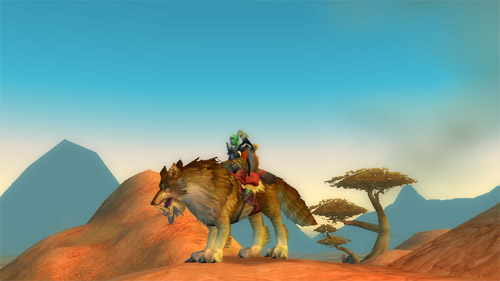
The real rush, but also the most draining experience in last night's PVP was however leading the raid. Suddenly I was promoted, the raid started and I was commander. Ooops - a promotion in the field, that one. A quick standard order, fixing the groups, and I could start to look at how the battle was flowing. Any member of a raid can see where the other members are on the map. Arathi Basin has a simple lay-out, and simple objectives, and the strategic options are not that many. The Alliance tends to fight in large groups: once they have taken an area they leave it and attack the next massively. The one time I was in there and the Horde kept losing was when the Alliance left stealthed rogues behind. Clever move, really. Got to remember that one.
Anyway, this leaves their areas vulnerable, and a couple of determined Hordes can attack easily. Even if we lose the place the moment they turn around, it means they can no longer respawn as close to the fighting any more, as you only spawn at graveyards in areas you control. This wins us more precious seconds. Perhaps a whole minute.
We managed to keep them back, grabbed 4/5 areas and got the resources needed almost too quickly. I could resign from my position as commander in chief with my honour intact. We won 5 of the 6 raids I was in last night, and when I submitted the honour badges Agirra gained a level and was no longer eligible to play within that level range. Now she will be playing with more experienced players and powerful characters. I guess I will relearn the position of the graveyards through the next 6-7 levels.
Visual memory
Do an experiment today: write down the posters, pictures, statues or other decorative elements in a place where you go frequently. For instance the corridor leading to your office, the square you run through to get to the bus station, the pub where you like to have a beer, the bank - what ever place where it's natural that there are decorative elements. Then go there and check. How much did you remember? Would you have noticed if one was removed? Would you be able to tell if it was?
Today we were four professors staring at a blank space at the wall. A picture is gone. When did it go away? None of us could tell.
Today we were four professors staring at a blank space at the wall. A picture is gone. When did it go away? None of us could tell.
Friday, November 04, 2005
Supplies
I knew there had to be somewhere to go to for supplies when I need it. Turns out I have to remember to go shopping while in Brooklyn.
By way of Neil Gaiman's blog
By way of Neil Gaiman's blog
Blog your way to the front page
And while we are talking about the media industry's interest in blogging:
A week ago I was asked a few questions about weblogs by a journalist in VG, the Norwegian "popular" news paper. He treated my replies fairly well, for those who can't read Norwegian what I am saying (or think I am saying) is that I am not surprised a lot of Norwegians publish online, as such a high percentage of the population has access, I say that a blog is a part of your personality (ugh - that is not something I would have said if he had let me use more than two lines) and that if you want to make a good blog, write about something that interests you and use links to other people.
But what is really interesting about this are the final lines:
1) Free content for the paper.
2) Some editor will decide what is good.
Where's the challenge?
A week ago I was asked a few questions about weblogs by a journalist in VG, the Norwegian "popular" news paper. He treated my replies fairly well, for those who can't read Norwegian what I am saying (or think I am saying) is that I am not surprised a lot of Norwegians publish online, as such a high percentage of the population has access, I say that a blog is a part of your personality (ugh - that is not something I would have said if he had let me use more than two lines) and that if you want to make a good blog, write about something that interests you and use links to other people.
But what is really interesting about this are the final lines:
Ifølge Magne Antonsen, som er ansvarlig for blogg-tjenesten på VG Nett, kommer de til å fremheve de beste bloggene på nettavisens forside.What they say here is that weblogs can be a challenge to traditional journalism, and if people write good blogposts, they will be put on the front page of the online paper.
- Dette kan utfordre måten aviser vanligvis drives på. Skriver folk gode blogg-innlegg, legger vi dem gjerne på forsiden, sier han.
1) Free content for the paper.
2) Some editor will decide what is good.
Where's the challenge?
Not all that hot
With all the buzz about blogging as the new hot thing, it's interesting to see that when you really start asking people if they care about blogs - or even know what blogging is - they confuse it with things like "dogging", which appears to be watching people have sex in cars. I had no idea that activity had a word. Nor that "happy slapping" means assulting innocent bystanders while your friends catch the incident on video and then post the video online.
Sadly, I can't link to the article they cite as the link seems to be broken, but it's quoted by royby and Rob Irwin. Another article which looks pretty identical is posted here.
What really amused me was this quote:
When it comes to weblogs, it is certainly true. How many of the weblogs in the world compete with, or even care about, the newsmedia? Still those are the weblogs journalists write about, and that is the way news media define blogs. A small, newsmedia-related part of the universe is taken to represent the whole.
media industry bubble?
Sadly, I can't link to the article they cite as the link seems to be broken, but it's quoted by royby and Rob Irwin. Another article which looks pretty identical is posted here.
What really amused me was this quote:
A shaken DDB London planning director, Sarah Carter, admitted: "Our research not only shows that there is no buzz about blogging and podcasting outside of our media industry bubble, but also that people have no understanding of what the words mean. It's a real wake-up call."Oh wow. Do media people talk mainly to each other and live in their own little constructed world of topics which have been able to get over the news treshold. Who'd have thought. Oh, wait a minute, Galtung and Ruge pointed out in 1965 - that's 40 years ago for us who can still do simple calculations - that foreign news do not depend on the actual events in the world and their importance at an objective scale, but on what reporters think is important according to a certain set of criteria. More recent research only confirms that this is true all the way down to the local newspaper.
When it comes to weblogs, it is certainly true. How many of the weblogs in the world compete with, or even care about, the newsmedia? Still those are the weblogs journalists write about, and that is the way news media define blogs. A small, newsmedia-related part of the universe is taken to represent the whole.
media industry bubble?
Wednesday, November 02, 2005
DAC 2005
It is in Copenhagen, and the registration closes November 4th. Did you remember to register? Go, register, and I'll see you in Copenhagen.
Now what?
(If I used categories, this would be under "internal professorial weirdness" or something.)
I thought I hated finishing things because it is hard work. I am starting to wonder if I just hate finishing things because the creative process is so much more inspiring and interesting than the empty feeling of "now what?"
First time I had that feeling was after I finished the master - hovedfag - back in the last milennium some time. I came out after getting the final grade, and looked around for the "The End" sign. Nothing. Just an intense feeling of emptiness, so strong I started to cry. Everybody thought I had failed. I was just so spent, I could barely stand up, and crying.
I have finished things since then. I have a habit of finishing stuff, even if I have to do it in spite of my own sabotage strategies, but it still is intensely uncomfortable. Yesterday I finished one more thing. Suddenly I discovered that I am not writing any articles for anybody at the moment! Of course, I am giving a lecture next week, waiting for the papers for a hiring comittee I am on for another college, considering a small article for a magazine, planning reviews of the education, teaching, been appointed to a comittee working to find better solutions for educational qualification work for the college staff, planning a seminar for my fellow teachers and planning a book on computer games, but that's just "stuff". All the things which were pressing me all last year are gone. I have finished them or they have been delegated to others.
I realised this after I started asking myself why I was suddenly so intensely unhappy yesterday afternoon. Once I figured that out, my mood changed in seconds. It feels good to have finished something. Good, good, good.
I thought I hated finishing things because it is hard work. I am starting to wonder if I just hate finishing things because the creative process is so much more inspiring and interesting than the empty feeling of "now what?"
First time I had that feeling was after I finished the master - hovedfag - back in the last milennium some time. I came out after getting the final grade, and looked around for the "The End" sign. Nothing. Just an intense feeling of emptiness, so strong I started to cry. Everybody thought I had failed. I was just so spent, I could barely stand up, and crying.
I have finished things since then. I have a habit of finishing stuff, even if I have to do it in spite of my own sabotage strategies, but it still is intensely uncomfortable. Yesterday I finished one more thing. Suddenly I discovered that I am not writing any articles for anybody at the moment! Of course, I am giving a lecture next week, waiting for the papers for a hiring comittee I am on for another college, considering a small article for a magazine, planning reviews of the education, teaching, been appointed to a comittee working to find better solutions for educational qualification work for the college staff, planning a seminar for my fellow teachers and planning a book on computer games, but that's just "stuff". All the things which were pressing me all last year are gone. I have finished them or they have been delegated to others.
I realised this after I started asking myself why I was suddenly so intensely unhappy yesterday afternoon. Once I figured that out, my mood changed in seconds. It feels good to have finished something. Good, good, good.
An ongoing struggle
Almost 20 years ago, a female American tourist asked me what Norwegians thought of the abortion issue. It was rather surprising, because I was working as a guide in a museum at the moment, and we had been discussing the relationship between the Scandinavian countries, the "400-year night", unions with Denmark and later Sweden, and had stopped around 1905. I did not see that question coming.
I answered then, as I would have answered now: Women in Norway have the right to choose if they want to carry a fetus to term or not. I also added then, and this would have had a stronger emphasis now: Norway has good support systems for single mothers, if you want to keep your child you can still do that and have education and a career, and thus be able to support yourself and your children as a single parent.
But it made me aware that not all the world is like that. Even America, which all Norwegians in the 60ies were brought up to think of as the ultimate free democratic society of the self-made wealthy and happy masses, had blind spots.
One blogger who exposes those blind spots relentlessly is a favourite of mine. If you are interested in these issues, go read Bitch PhD's post about current planned parenthood politics in the US.
I answered then, as I would have answered now: Women in Norway have the right to choose if they want to carry a fetus to term or not. I also added then, and this would have had a stronger emphasis now: Norway has good support systems for single mothers, if you want to keep your child you can still do that and have education and a career, and thus be able to support yourself and your children as a single parent.
But it made me aware that not all the world is like that. Even America, which all Norwegians in the 60ies were brought up to think of as the ultimate free democratic society of the self-made wealthy and happy masses, had blind spots.
One blogger who exposes those blind spots relentlessly is a favourite of mine. If you are interested in these issues, go read Bitch PhD's post about current planned parenthood politics in the US.
Next week in Trondheim
I will be speaking at a conference for Norwegian Librarians thursday November 10th. The topic is Myter, misforståelser og moro med dataspill - "Myths, misunderstanding and fun with computer games" - and I'll talk about media panics, the current state of research and the player experience in online multi user games. And I am certain I will be showing scenes from WOW.
But I am starting to feel I should play more online games. Perhaps WOW will work like that on more people, and be a locomotive to pull new groups into online gaming? That would be fun, and the opposite of the muttered concerns that WOW is bad for the industry because it takes all the potential customers. That, however, is not on the agenda for Trondheim.
But I am starting to feel I should play more online games. Perhaps WOW will work like that on more people, and be a locomotive to pull new groups into online gaming? That would be fun, and the opposite of the muttered concerns that WOW is bad for the industry because it takes all the potential customers. That, however, is not on the agenda for Trondheim.
Tuesday, November 01, 2005
Journalism and bloggers again
Go read Lisbeth's post from the Online News Association's conference. She says what I have been trying to say, only she says it better and with passion:
Hear, hear!
Citizen journalists, be it bloggers, activists, independent reporters or Mr. Smith with a mobcam in his hand, are not the major threat to the world of news, though the content they contribute can certainly be a very interesting supplement to the news produced by the media themselves. The major threat (in my humble opinion as an academic, who is a sucker for quality content on the web) is the conservatism and lack of boldness of traditional media when moving into the new media scene. What I don't get is that if all the big players on, for instance the US newsscene, are so afraid of the bloggers and corporations like Yahoo and Google stealing away the text-based (cum video)online newsscene, why don't they use some more of their money to hire dedicated webjournalists and programmers who can produce unique, interactive news and commentary for the web combined with the solidity of documenting and reporting, that I still believe trained journalists' are the best at doing?
Hear, hear!
We won!
I never cared much for team sports. I enjoyed to play in bands and orchestras, to work with others to create music - perfectly happy to play second cornet or trumpet and be woven into the fabric of sound and harmony growing around me. Competitions were just not my thing.
This may be why I am not really into PVP (player versus player) in WOW (World of Warcraft). But last night I went into Arathi basin, ended up by some fun quirk of fate in a group with nothing but shamans, and was part of a raid group that really kicked Alliance #¤¤ (as the profanity filter says it). We won four sets before I was exhausted. And you know what? I loved it. It may be because Agirra is now level 49 and it was a 40-49 group, but I felt like I had made progress and made a difference to the whole raid group.
This is of course exactly what team sports and games are supposed to teach. It works online, too!
This may be why I am not really into PVP (player versus player) in WOW (World of Warcraft). But last night I went into Arathi basin, ended up by some fun quirk of fate in a group with nothing but shamans, and was part of a raid group that really kicked Alliance #¤¤ (as the profanity filter says it). We won four sets before I was exhausted. And you know what? I loved it. It may be because Agirra is now level 49 and it was a 40-49 group, but I felt like I had made progress and made a difference to the whole raid group.
This is of course exactly what team sports and games are supposed to teach. It works online, too!
Subscribe to:
Posts (Atom)


 Posts
Posts


