It wasn't an experiment. I don't know where I picked up the bug that started it all, but I had been unusually active that autumn, working out, studying hard, living in an old, cold building and eating cheaply and badly. I was a skinny, poor student in a cold rainy city, and while I considered it a good life, my body didn't have the resources needed to fight the bug when it reached me.
We were planning to go away for a few days, but we had to give up that thought, because I was throwing up and had a fever. When my boyfriend - now husband - came back from the university, I was weak, had fever fantasies and spots. I couldn't remember to have had measles, so we assumed that was it, and we settled down to wait for it to pass. At some point during the night, I got a headache that felt like it was about to kill me. I managed to make my boyfriend go call a doctor. This was before cell-phones, and even before it was common for a poor student to have a phone at home, so he walked to the nearest phone-booth and called a doctor.
The doctor was there almost before him, came in, looked at me, and immediately started banging on the neighbour's door to borrow their phone. Yes, doctors didn't have cellphones either. Three minutes later I was on a stretcher in an ambulance, on the way to the hospital. Eight minutes later they were hooking me up to just about everything. Fifteen minutes later I was in a coma.
I don't know what happened for the next two days. I am told I fought the doctors and nurses and had to be restrained, or I'd pull the needles out of my body. I am told they paraded entire classes of medical students past me to see and take note of my symptoms, threatening the students that if they ever ignored such, they could just hand in their licenses right then and there. They tapped as much blood from me as they safely could, for diagnosis and study. When I finally woke up I was in a strange room, black and blue and hurting from the amount of needles and the harsh medication that had hit my veins, and there was a nurse stationed by my side in case something happened. I was alive, but nobody really knew how alive I was yet.
I was not well. Mainly, I didn't notice what I was saying. I would think one thing and say another. To this day I have a slight case of aphasia, of not having the right word, of feeling language slip away from me. Or maybe I don't, perhaps I am just more aware of it now, after that experience. I can fake it well enough, it just means I have to double-check if I want to lecture. I overprepare, just to make sure all the words are there, and I know what they mean. They may be gone in a moment's notice, to return at odd times.
But I healed up, slowly. I was young, 22 years old, fit and strong after all. I did lose some hearing, but not enough to be a problem in everyday life. I did however get half a year worth of study wiped, which hit me hard during next term's exam. I hadn't known that it was lost, and so I hadn't known to go back and repeat it. For the first month after I was not allowed to focus. I couldn't read, watch television, listen to the radio. I went home to my parents, walked the dog, rested, learned to eat again, had involved and silly conversations with my boyfriend.
Most of all though, I was cherishing being alive. After I was out of isolation and moved to another room in the hospital, a doctor came in, sat down in the chair next to me and grinned. "You are born again," he told me. "You should be dead. But you live. This is a whole new life for you." That man was dr Alfred Halstensen, at the time working on his Ph D on meningococcal disease. For the next couple of years he kept tapping as much blood as he safely could when ever he summoned me to the hospital.
I was one of the few that autumn of 1983 who survived meningitis at Haukeland Hospital, and I was an adult who could describe carefully what had happened, and who had been strong enough to insist on medical attention before it was too late. I got a spot on his graph for his Ph. D. all to myself, as the 100% survivor of being admitted in the middle of the night, and his plan for all that blood was to use it in the effort to create a vaccine. Today there is a vaccine against some types of meningitis. It isn't one of the mandatory vaccines, but it is used to protect people in cases when epidemics are about to break out. With a disease that had, at the time, more than a 50% mortality rate, and which also tends to create mini-epidemics in otherwise healthy communities, you want that protection if there is a case at a pre-school or a military camp near you.
Now, a vaccine resister could use parts of my story to say that it's healthy for the body to battle disease. For years after that very close brush with death, I didn't even get a sore throath. My immune system was working overtime to keep me healthy, something dr Halstensen had said would happen. That vaccine resister can sadly not tell that to another Torill. At about the same time as I battled meningitis and kind of won, in another hospital another woman my age, with the same name, lost. The mortality rate was 50%. For once I was on the right side of those percentages.
This event changed my life in a myriad different ways, some to the better, some to the worse. I suspect quite a few health issues can be traced back to the enormous doses of antibiotics they used to save my life. They claimed to have "whitewashed" my body, killed all bacteria they could, to make sure they got the ones that were killing me. That is not only a good thing, no matter what a miracle modern antibiotics are. The alternative is much worse though. On the up side, I lost the fear of death. I am on my second life. How many people get a second chance? I walk through life with that as a backdrop: Every moment I have here is a miracle - a miracle of modern science. When things get dark and dreary, I consider the alternative, and enjoy the fact that I am actually here, feeling angry, frustrated or depressed. When things are bright they are twice as bright, just because I am here to experience it.
The people who resist vaccines can never have been on that side of life - over the line to death, and then dragged back by expertice and drugs. They can never have felt the extreme pain, the pain that made me wish I was dead, if the headache would just end, the pain that made me kick and fight and finally black out into a two-day coma. I don't ever want another person to feel that, to experience that. I would have given dr Halstensen and the research crew at the hospital all the blood he asked for, without much thought of personal safety, to make certain that no child would ever need to feel the pain I felt that night. Luckily he was a responsible professional, an ethical researcher, and I was protected, informed and educated through the process.
I am writing this story because of the anti-vaccination movement. They are using emotional arguments against rational arguments, using fear and pictures of babies to reach hearts, while the rational arguments of scientists aim for the heads. But where do the vaccines come from? From people like me, the blood of survivors of bitter battles, living despite the odds to become a lover, a mother, a wife, a grandmother, a scholar, a researcher. I am both heart and head, and both parts of me appreciate being alive, thanks to the doctors that work to develop vaccines to save the world from the pain I went through, the pain that made it possible for me to be of some, tiny little bit of help.
Showing posts with label research. Show all posts
Showing posts with label research. Show all posts
Wednesday, June 11, 2014
Friday, March 16, 2012
Quiet time to do research
Denmark, like most countries, has an ongoing debate about how Universities are to get as much as possible out of the Universities. Due to very good economic support for students, many young people try to ride out the crisis by taking an education. That is not the worst way to go, and I am all for offering education as an alternative to unemployment.
However: the Universities expected to deliver this education get very little extra funding for it, no new positions and also a change of policy which rewards externally funded research, and takes teaching for granted (link in Danish, it's about the demand for more teaching in the Universities.) Now, professors are not stupid (if we were, that would indeed be a sad state of affairs), even if they sometimes are idealistic. And so, when the government says: get more research funding - well, we get more research funding, putting researchers on the case, while finding ways to keep the teaching rolling at the side.
This leads to teaching which is not research based, because all the professors are busy doing research for external funding, just like the government ordered! In order to fix this, the government insists that students need to have more classes, and these classes have to be with the professors who actually do research: research based teaching.
I am very much in favour of this, so I have no problems with the demand for more research based teaching. It's the one benefit Universities have over private research organisations: I get to meet students. Over the years, students have challenged me, pushed me and rewarded me in ways no other part of my job does. But they challenge me into doing research. Without research, which gives me something new and interesting to share and each, facing the students become a repetitive chore.
At the same time, research appears to be viewed as a time of "quiet", of "peace". "We need to give the staff quiet, calm times to do research," professor Sune Auken from the blog Forskningsfrihed says. The error in this is how it puts teaching, apparently a stressful, draining chore, up against research, a calm, peaceful, contemplative activity. In my experience, this is wrong. Of course, included in research is long hours of reading, days of checking for literature, months of analysing data, sometimes years of organising and writing up theories and findings. It may look peaceful. Still, if you're doing research worth the paper it's printed on, it's stressful, tense, fraught with doubt and built on meticulous, tedious fact-checking and proofing, in all possible ways.
Research isn't a time of calm or quiet, it's a time of immersion, introspection and tension, put up against a time of activity, communication and attention to others. In universities these two positions do not oppose each other, they play together and rejuvenate each other. The teacher needs long stretches of time protected from teaching in order to immerse herself into research. The researchers needs to come out of the immersion and communicate, be challenged and be pushed, in order to have something new to bring into her time of immersion.
Of these activities, teaching is the one that it is possible to hire others for though. Entry-level teaching can easily be done by somewhat more advanced teachers, that's not where researchers really have to engage. And so in order to meet the demands for research, universities look at the teaching hours, and move the researchers from the least demanding classes - which also happen to be the most populated. It's a matter of trying to work more efficient - as the government constantly insist the Universities should do. This way some students will get research-based teaching. Hiring non-teaching researchers to do the research while the professors teach means NO students will get research based teaching, as their professors will always be teaching, and never researching.
In order to create a good policy of teaching and research, the government needs to remember that it's the same people who have to do both. It's impossible to drain the university brains into externally funded research, and expect the same heads to have time to teach. And it's impossible to demand research based teaching, and not give the teachers time and opportunity to do research. There are only two answers to this: Fewer students, or more professors. Barring some groups in different organisations - there are always some groups that have more slack than they really ought to have, I have no idea where, but they exist, it's the law of organisations - that is the only way the government can have both more teaching for each student, and more research for each professor. I am sorry. There are no easy ways to split the professorial heads, and neither research based teaching, research itself happens without effort.
However: the Universities expected to deliver this education get very little extra funding for it, no new positions and also a change of policy which rewards externally funded research, and takes teaching for granted (link in Danish, it's about the demand for more teaching in the Universities.) Now, professors are not stupid (if we were, that would indeed be a sad state of affairs), even if they sometimes are idealistic. And so, when the government says: get more research funding - well, we get more research funding, putting researchers on the case, while finding ways to keep the teaching rolling at the side.
This leads to teaching which is not research based, because all the professors are busy doing research for external funding, just like the government ordered! In order to fix this, the government insists that students need to have more classes, and these classes have to be with the professors who actually do research: research based teaching.
I am very much in favour of this, so I have no problems with the demand for more research based teaching. It's the one benefit Universities have over private research organisations: I get to meet students. Over the years, students have challenged me, pushed me and rewarded me in ways no other part of my job does. But they challenge me into doing research. Without research, which gives me something new and interesting to share and each, facing the students become a repetitive chore.
At the same time, research appears to be viewed as a time of "quiet", of "peace". "We need to give the staff quiet, calm times to do research," professor Sune Auken from the blog Forskningsfrihed says. The error in this is how it puts teaching, apparently a stressful, draining chore, up against research, a calm, peaceful, contemplative activity. In my experience, this is wrong. Of course, included in research is long hours of reading, days of checking for literature, months of analysing data, sometimes years of organising and writing up theories and findings. It may look peaceful. Still, if you're doing research worth the paper it's printed on, it's stressful, tense, fraught with doubt and built on meticulous, tedious fact-checking and proofing, in all possible ways.
Research isn't a time of calm or quiet, it's a time of immersion, introspection and tension, put up against a time of activity, communication and attention to others. In universities these two positions do not oppose each other, they play together and rejuvenate each other. The teacher needs long stretches of time protected from teaching in order to immerse herself into research. The researchers needs to come out of the immersion and communicate, be challenged and be pushed, in order to have something new to bring into her time of immersion.
Of these activities, teaching is the one that it is possible to hire others for though. Entry-level teaching can easily be done by somewhat more advanced teachers, that's not where researchers really have to engage. And so in order to meet the demands for research, universities look at the teaching hours, and move the researchers from the least demanding classes - which also happen to be the most populated. It's a matter of trying to work more efficient - as the government constantly insist the Universities should do. This way some students will get research-based teaching. Hiring non-teaching researchers to do the research while the professors teach means NO students will get research based teaching, as their professors will always be teaching, and never researching.
In order to create a good policy of teaching and research, the government needs to remember that it's the same people who have to do both. It's impossible to drain the university brains into externally funded research, and expect the same heads to have time to teach. And it's impossible to demand research based teaching, and not give the teachers time and opportunity to do research. There are only two answers to this: Fewer students, or more professors. Barring some groups in different organisations - there are always some groups that have more slack than they really ought to have, I have no idea where, but they exist, it's the law of organisations - that is the only way the government can have both more teaching for each student, and more research for each professor. I am sorry. There are no easy ways to split the professorial heads, and neither research based teaching, research itself happens without effort.
Monday, February 13, 2012
Feeling stupid lately?
I keep getting all these questions, as if people expect me to have been drinking from the fountain of knowledge, or eating the apples of wisdom as a regular diet. Of course, the University tap-water does come directly from mimisbrunnr, but what that has made me good at isn't giving answers, but asking questions. That is what Deep Thought and most scholars and researchers have in common, and it is why feeling stupid isn't always such a curse.
(Of course, being stupid is a curse, but those who are stupid mostly feel like they know everything, so the curse is on the rest of the world.)
(Of course, being stupid is a curse, but those who are stupid mostly feel like they know everything, so the curse is on the rest of the world.)
Tuesday, December 06, 2011
An endless loop of repetition
Another research meta study was published today, about games and violence. This time it was the Swedish media council that published the study of all articles written on video games and violence 2000 - 2011. They conclusion was, as usual: No, there is no proof of a causal connection between games and violence.
A lot of the research is quite flawed, as it uses dubious methodologies and measures violence by standards that are unconnected to the context. Also, most of them ignore other possible connections. Those who do look at anything except games as causes of violence, find that among the strongest causal connections to violence are family background and psychic health.
There is a slight connection between games and violence in the sense that people with a previous interest in violence tend to pick violent games. The causality is however the opposite of the traditional view: an interest in violence leads to violent games, not the other way around.
It is quite amazing that 10 years of research deliberately aimed at proving that games create violence so far has not been able to create any good, solid evidence. Perhaps it's time to start trusting the research and settle for the fact that games do not create insane killers. Once we have that settled, let's get down to creating good, interesting, engaging games that can enhance creativity in other ways. Imagine if some of those research budgets had been devoted to studying games as an arena for promoting fair play and moral choices? Now, wouldn't that be a novel idea for all those organisations that worry about our children...
A lot of the research is quite flawed, as it uses dubious methodologies and measures violence by standards that are unconnected to the context. Also, most of them ignore other possible connections. Those who do look at anything except games as causes of violence, find that among the strongest causal connections to violence are family background and psychic health.
There is a slight connection between games and violence in the sense that people with a previous interest in violence tend to pick violent games. The causality is however the opposite of the traditional view: an interest in violence leads to violent games, not the other way around.
It is quite amazing that 10 years of research deliberately aimed at proving that games create violence so far has not been able to create any good, solid evidence. Perhaps it's time to start trusting the research and settle for the fact that games do not create insane killers. Once we have that settled, let's get down to creating good, interesting, engaging games that can enhance creativity in other ways. Imagine if some of those research budgets had been devoted to studying games as an arena for promoting fair play and moral choices? Now, wouldn't that be a novel idea for all those organisations that worry about our children...
Monday, December 06, 2010
The weirdest people
By way of the Danish videnskab.dk, a pointer to an article by Canadians that concludes with how a lot of American research about human behaviour is wrong. Well, it may conclude that European and Asian research is wrong too, but since they haven't really checked that, who knows.
The important thing with this article is how it talks about generalisation. So much of the research done in the United States is done on first year students. This means it's done on a very narrow group of people, with very specific views and cultural background. An example they give is the relationship to death. Americans have, according to the researchers cited at videnskab.dk, a fundamentally different approach to death than Europeans and people in other cultures. The fear of death is much higher, something which influences the entire society.
When I have stayed in the United States I have felt that very clearly: The sense of being in an alien culture. I thought I would find something familiar, due to language and how we all feel we "know" USA, but oh dear, I was so wrong. An English friend who worked out of New York in a highly international firm told me how Americans are more xenophobic than even the Japanese, and how in their line of business they were quite reluctant to hire Americans due to this.
This kind of connects to my thoughts about English as a "lingua franca" for research, something which of course makes it very easy for American research to spread through the world, but put all non-English speaking people at a distinct disadvantage when going in the other direction. It is a mechanisms that helps maintaining the illusion that we are all similar, because we have to learn how to communicate not only in a language Americans can ready, but also through concepts understandable in an English language culture.
An experience which was an eye-opener to me was when I published this article. I had originally used class to describe differences which would create communication problems within a culture, but I was told that I should not use class but ethnicity, because class wasn't really relevant (in the US). I compromised by using gender, which worked, but the experience was quite shocking. I never thought (and still don't think) there can be a culture where class isn't relevant. For instance, I suspect that a lot of ethnic conflict is also a struggle of class, and the strive for acceptance and respect isn't only about skin colour, but also about making a class journey. This is a fundamental paradigm for anybody who have grown up in an academic tradition heavily influenced by marxism, and while I may be wrong, it highlights the differences between Scandinavia and the USA.
On this background "the weirdest people" is a very important contribution to the discussion of western research, and I guess I should go looking to see if there's a library near me with access to Behavioral and Brain Sciences at Cambridge journals.
The important thing with this article is how it talks about generalisation. So much of the research done in the United States is done on first year students. This means it's done on a very narrow group of people, with very specific views and cultural background. An example they give is the relationship to death. Americans have, according to the researchers cited at videnskab.dk, a fundamentally different approach to death than Europeans and people in other cultures. The fear of death is much higher, something which influences the entire society.
When I have stayed in the United States I have felt that very clearly: The sense of being in an alien culture. I thought I would find something familiar, due to language and how we all feel we "know" USA, but oh dear, I was so wrong. An English friend who worked out of New York in a highly international firm told me how Americans are more xenophobic than even the Japanese, and how in their line of business they were quite reluctant to hire Americans due to this.
This kind of connects to my thoughts about English as a "lingua franca" for research, something which of course makes it very easy for American research to spread through the world, but put all non-English speaking people at a distinct disadvantage when going in the other direction. It is a mechanisms that helps maintaining the illusion that we are all similar, because we have to learn how to communicate not only in a language Americans can ready, but also through concepts understandable in an English language culture.
An experience which was an eye-opener to me was when I published this article. I had originally used class to describe differences which would create communication problems within a culture, but I was told that I should not use class but ethnicity, because class wasn't really relevant (in the US). I compromised by using gender, which worked, but the experience was quite shocking. I never thought (and still don't think) there can be a culture where class isn't relevant. For instance, I suspect that a lot of ethnic conflict is also a struggle of class, and the strive for acceptance and respect isn't only about skin colour, but also about making a class journey. This is a fundamental paradigm for anybody who have grown up in an academic tradition heavily influenced by marxism, and while I may be wrong, it highlights the differences between Scandinavia and the USA.
On this background "the weirdest people" is a very important contribution to the discussion of western research, and I guess I should go looking to see if there's a library near me with access to Behavioral and Brain Sciences at Cambridge journals.
Monday, September 06, 2010
Is there a rythm to gaming?
All who have played games know there is a rythm to them, an ebb and flow of activity and energy, back and forth, sometimes like a tango where the participants are evenly matched and push, give and counter with intense focus, sometimes like the inexorable march of the invading feet as the stronger participants lay waste to all opposition. From the lighthearted singsong of easy togetherness to the complex concert of a well-rehearsed team, yes, there is a rythm to play and to games.
But to gaming, as a phenomenon? Is there a flow and counter, an emerging patterns of back and forth, intensity and slack? I don't know, but Tom Apperley is looking for it. In his quite new and fresh book Gaming Rhythms: Play and Counterplay from the Situated to the Global the topic appears to be an assumption of interconnectedness of gaming practices, globally.
It is an extremely interesting thought, and I am looking forwards to seeing there Tom Apperley takes it.
But to gaming, as a phenomenon? Is there a flow and counter, an emerging patterns of back and forth, intensity and slack? I don't know, but Tom Apperley is looking for it. In his quite new and fresh book Gaming Rhythms: Play and Counterplay from the Situated to the Global the topic appears to be an assumption of interconnectedness of gaming practices, globally.
It is an extremely interesting thought, and I am looking forwards to seeing there Tom Apperley takes it.
Thursday, April 08, 2010
Brainwashed
There's a program on NRK these days called Hjernevask or "Brainwashing." It's creating quite a stir, as a Norwegian comedian is having it out with his old professors, particularly any who have been doing gender research and claimed that gender is cultural, not natural.
The program has caused a lot of good and interesting debate, and I don't really feel the need to expand on it here. But for those who have been following the debate, here's Evolutionary Psychology Bingo:

By way of TL - thanks!
The program has caused a lot of good and interesting debate, and I don't really feel the need to expand on it here. But for those who have been following the debate, here's Evolutionary Psychology Bingo:
By way of TL - thanks!
Tuesday, February 16, 2010
Blogging the blogged Ph D about blogging
I just want to point you all towards Lilia Efimova's wonderful thesis Passion at work: blogging practices of knowledge workers, which was submitted last year. It is, of course, online, so: Enjoy!
Monday, December 07, 2009
Thinking with your brain
An interesting piece of research, studying the Buddhist brain, shows that meditation works on the brain sufficiently to change the electromagnetic activity. This is very interesting, and while I have never managed to meditate (I fall asleep the moment my thoughts start calming down), it might be a much better alternative for children with attention dysfunctions than drugs.
The research is, of course, questioned, the way research should be. Wired has an interesting report of the almost religious mood when Dalai Lama addresses the scientists involved in the project or interested in the project.
This is a very real project, leaning heavily on technology and established neuro science. Mind & Life institute in Boulder describes it among their research grants, where the research is taking place in two different laboratories, situated in Wisconsin and Paris.
One of the leaders of the project is a Richard J. Davidson, and while I am not a neuroscientist, his list of publications implies updated participation in relevant research, with publications on his work in relevant journals.
So, what if the Mind & Life institute works to integrate Buddhism and science? I find it fascinating and uplifting when mysticism is not defensive, but opens up to science - and the other way around.
The research is, of course, questioned, the way research should be. Wired has an interesting report of the almost religious mood when Dalai Lama addresses the scientists involved in the project or interested in the project.
This is a very real project, leaning heavily on technology and established neuro science. Mind & Life institute in Boulder describes it among their research grants, where the research is taking place in two different laboratories, situated in Wisconsin and Paris.
One of the leaders of the project is a Richard J. Davidson, and while I am not a neuroscientist, his list of publications implies updated participation in relevant research, with publications on his work in relevant journals.
So, what if the Mind & Life institute works to integrate Buddhism and science? I find it fascinating and uplifting when mysticism is not defensive, but opens up to science - and the other way around.
Tuesday, November 17, 2009
All you need is to have no life
Jonas Linderoth at the University of Gothenburg published an article in "Digital Læring" or Nordic Journal of Digital Literacy on the value of games for learning. The title "It is not hard, it just requires having no life - Computer games and the illusion of learning" positions the article as a stumbling block right in the middle of the over-enthusiastic rush towards games as a solution for modern education.
I had heard about and disagreed with this article several times before publishing, but reading it I am almost inclined to agree with it. Linderoth points out that there are two ways to gain skills in games. One is by learning to jump better, learning to think more tactically than the opponent or in some other way use the resources at hand better. The other way to gain skills in games is by doing repetitive tasks until you are rewarded with a level, an object or some other affordance that makes your avatar stronger. In short: he makes a clear distinction between what you learn as a player, and what affordances your avatar gains.
So far I am with him, and I think it's a very important consideration. The general belief that games make learning easier is severely flawed. The most important flaw is however in my opinion the belief that games makes it easier to teach what is on some curriculum. I don't know about the rest of the world, but here in Norway we have certain things pupils are supposed to learn each year, and their progress as well as the success of the teachers and the educational system is measured by how well they are able to learn these particular things. Outside of those skills, what the pupil or student learns doesn't count. So if you learn how to dance salsa really well, that does nothing for your grades in mathematics.
Games tend to teach you how to salsa, when what you should have learned is to do maths. If you don't want the game to teach salsa, you have to remove all options for dancing, and only leave options for mathematics. Linderoth describes his argument of the relationship between affordances and skills:
So, to sum up the argument - somewhat brutally, I admit: in order to learn something from a game, or develop as a gamer, the game should have static affordances. No new skills with new levels, no new tools, no gold or achievements, only you and your skill. Most common games which are typical agôn games are like this. They take you to the arena, read you the rules and give you your game-piece. Then it's just you, the board and your fellow gamers, and nothing changes within that frame.
Games where you can gain affordances simply by working diligently at simple tasks are, according to Linderoth, not games from which you can learn anything.
In the light of Scott Rettberg's article on "Corporate Ideology in World of Warcraft," in Digital Culture, Play and Identity, this is an interesting claim. Rettbergs argument is that exactly the grinding aspect of World of Warcraft is what makes it an ideal training ground for capitalist work ethics (p. 32). So, on the one hand you don't learn anything from grinding, on the other hand it's perfect training for many of the positions you can expect to hold as an employee today.
Now, Rettberg's argument gives strong ideological reasons to adapt Linderoth's position on games with non-static affordances, but I am still not totally convinced. The reason is that both in World of Warcraft (Rettberg) and World of Conflict (Linderoth), personal skill is the most important feature for satisfying gaming.
Most players who play a game with levels more than once, learn how to use levelling as just another fixed affordance, and so learn to become better at it, do it quicker and with better results. You can use levelling processes to learn more about the story of the game, hence use it to gain narrative satisfaction, or you can aim at aquiring particularly useful objects which you will then not have to return for later.
The problem with Linderoth's argument, where increased skill and new tools and resources pull in different directions, is that this conflict is just skin deep. For the players who play through a game that demands leveling more than once, the apparently increasing affordances they gain access to become fixed. There are just that many quests, just that many abilities, just that many levels, and that is what you have to play with. Yes, it takes longer to reach that point, and players who think a game ends just because they have reached a certain level, may feel that it's all about grinding. But players have other experiences from games of progression. The game researcher Kristine Jørgensen at the University of Bergen recently wrote a glowing description of her experiences with the new game Dragon Age: Origins, and all who have followed her descriptions of the play process on Facebook know that she is planning to go back to old saves in order to explore the game much further.
Now, we can argue that exploring old saves does not lead to learning, as it's just about repetition of something already done. But for a game which reveales a story that's even experienced as a moral story, a fable even, replaying old saves is a way to delve deeper into the conflicts, the parables and the lessons of fiction, and hence absolutely a way to learn... even if there are levels and new skills and objects to be gained on the way.
However, Linderoth does actually say something along these lines:
But I find that he loses sight of this in his final words:
First, learning is very much about repetition. You learn how to do a certain task, and then you drill that task until you can repeat it easily and quickly. This is how you learn how to do maths, how to play instruments, how to read and write. Each repetition is simple and non-challenging.
Next, you gain new affordances all the time, as you learn. When you have repeated one piece of music until you know how to play it, you get a new set of notes. Perhaps you get to play together with people with different instruments. You get to play in some new spot. Boring repetition leads to increased skill, new affordances and new achievements. You do actually gain levels, and you are not stuck on the same limited board with the same game-pieces for the rest of your life. Rather, if you keep repeating the same things without gaining new affordances, in real life you're stuck on a corner of the game board, without looking up to see that you're just playing a tiny part of the game.
Still, I think that Linderoth's article is very important for developing pedagogic games. I just agree with him on a different premise. I agree because what educators need isn't a virtual representation of how the world really is, but a way to see how pupils perform at a certain set of tasks given limited affordances. For this the games Linderoth promotes would be just perfect.
I had heard about and disagreed with this article several times before publishing, but reading it I am almost inclined to agree with it. Linderoth points out that there are two ways to gain skills in games. One is by learning to jump better, learning to think more tactically than the opponent or in some other way use the resources at hand better. The other way to gain skills in games is by doing repetitive tasks until you are rewarded with a level, an object or some other affordance that makes your avatar stronger. In short: he makes a clear distinction between what you learn as a player, and what affordances your avatar gains.
So far I am with him, and I think it's a very important consideration. The general belief that games make learning easier is severely flawed. The most important flaw is however in my opinion the belief that games makes it easier to teach what is on some curriculum. I don't know about the rest of the world, but here in Norway we have certain things pupils are supposed to learn each year, and their progress as well as the success of the teachers and the educational system is measured by how well they are able to learn these particular things. Outside of those skills, what the pupil or student learns doesn't count. So if you learn how to dance salsa really well, that does nothing for your grades in mathematics.
Games tend to teach you how to salsa, when what you should have learned is to do maths. If you don't want the game to teach salsa, you have to remove all options for dancing, and only leave options for mathematics. Linderoth describes his argument of the relationship between affordances and skills:
What I aim to illustrate is that a game system can be designed in such a way that you can progress in the game to a certain degree without adapting yourself to the system. A system that means that a gamer can succeed without the effort of mastering gaming skills. Phrased in a more theoretical way this is an issue about how new affordances are introduced in the gaming activity (p 10).
So, to sum up the argument - somewhat brutally, I admit: in order to learn something from a game, or develop as a gamer, the game should have static affordances. No new skills with new levels, no new tools, no gold or achievements, only you and your skill. Most common games which are typical agôn games are like this. They take you to the arena, read you the rules and give you your game-piece. Then it's just you, the board and your fellow gamers, and nothing changes within that frame.
Games where you can gain affordances simply by working diligently at simple tasks are, according to Linderoth, not games from which you can learn anything.
In the light of Scott Rettberg's article on "Corporate Ideology in World of Warcraft," in Digital Culture, Play and Identity, this is an interesting claim. Rettbergs argument is that exactly the grinding aspect of World of Warcraft is what makes it an ideal training ground for capitalist work ethics (p. 32). So, on the one hand you don't learn anything from grinding, on the other hand it's perfect training for many of the positions you can expect to hold as an employee today.
Now, Rettberg's argument gives strong ideological reasons to adapt Linderoth's position on games with non-static affordances, but I am still not totally convinced. The reason is that both in World of Warcraft (Rettberg) and World of Conflict (Linderoth), personal skill is the most important feature for satisfying gaming.
Most players who play a game with levels more than once, learn how to use levelling as just another fixed affordance, and so learn to become better at it, do it quicker and with better results. You can use levelling processes to learn more about the story of the game, hence use it to gain narrative satisfaction, or you can aim at aquiring particularly useful objects which you will then not have to return for later.
The problem with Linderoth's argument, where increased skill and new tools and resources pull in different directions, is that this conflict is just skin deep. For the players who play through a game that demands leveling more than once, the apparently increasing affordances they gain access to become fixed. There are just that many quests, just that many abilities, just that many levels, and that is what you have to play with. Yes, it takes longer to reach that point, and players who think a game ends just because they have reached a certain level, may feel that it's all about grinding. But players have other experiences from games of progression. The game researcher Kristine Jørgensen at the University of Bergen recently wrote a glowing description of her experiences with the new game Dragon Age: Origins, and all who have followed her descriptions of the play process on Facebook know that she is planning to go back to old saves in order to explore the game much further.
Now, we can argue that exploring old saves does not lead to learning, as it's just about repetition of something already done. But for a game which reveales a story that's even experienced as a moral story, a fable even, replaying old saves is a way to delve deeper into the conflicts, the parables and the lessons of fiction, and hence absolutely a way to learn... even if there are levels and new skills and objects to be gained on the way.
However, Linderoth does actually say something along these lines:
The relationship between the player’s skill and progression in using tools and resources is not something fixed, but rather fluid. In one and the same game there can be moments that require more or less skill. It is not as simple as saying that just because a game introduces new tools and resources the player never has to develop her or his skill (p. 12).
But I find that he loses sight of this in his final words:
Games and education have completely different conditions. While games are designed to make players happy, educational practices are legitimate as long as they offer students the opportunity to learn something. To design educational tasks where you can succeed by just waiting and doing some extremely simple, non-challenging activities is hardly appropriate. That would be like giving someone on a diet a set of scales that showed weight loss without the person actually loosing any weight. Maybe the things that make a player motivated while playing games neither can nor should be brought into schools (p. 17).
First, learning is very much about repetition. You learn how to do a certain task, and then you drill that task until you can repeat it easily and quickly. This is how you learn how to do maths, how to play instruments, how to read and write. Each repetition is simple and non-challenging.
Next, you gain new affordances all the time, as you learn. When you have repeated one piece of music until you know how to play it, you get a new set of notes. Perhaps you get to play together with people with different instruments. You get to play in some new spot. Boring repetition leads to increased skill, new affordances and new achievements. You do actually gain levels, and you are not stuck on the same limited board with the same game-pieces for the rest of your life. Rather, if you keep repeating the same things without gaining new affordances, in real life you're stuck on a corner of the game board, without looking up to see that you're just playing a tiny part of the game.
Still, I think that Linderoth's article is very important for developing pedagogic games. I just agree with him on a different premise. I agree because what educators need isn't a virtual representation of how the world really is, but a way to see how pupils perform at a certain set of tasks given limited affordances. For this the games Linderoth promotes would be just perfect.
Thursday, October 01, 2009
What's up in Volda?
What's worth blogging, one asks oneself once in a while. And hey, let's admit it, the world won't stop spinning if I don't blog. I do however find that something else stops spinning, and that's those wheels in my brain. I am, as the blog indicates, a person who thinks while writing. Or, that's not true: I am a person who needs to write in order to organise my thoughts.
I find that I ramble more and more to my students. Their stunned looks when I pause in an attempt to trace down the core of the thought I had, the idea I want to communicate to them, indicates that I have been off on some totally undisciplined tangent, and bombarded them with apparently unrelated facts. This happens because I have deliberately stopped writing out my lectures. There was a day when I refused to face students without 20 pages, double space, 12 points. That's 45X45 minutes of pretty steady talking, in case you wondered. But no more. I put down the most important facts, I find some ways to illustrate those, and then I try to connect the dots. It's those connections that occasionally get a little - fragile.
But I am still writing. I am just about to finish up an article I write with Luca, Rene and Kristine. I have to download and bring with me the material from my project this spring, in order to write it up, not yet in article form then at least in a form that lets me access the material easily. I have to rewrite an article for a collection Esther asked if I could contribute to. I have a research grant sketch on my machine. I have a plan for a much larger research grant based off the material from the "Gamer's Space" project. Basically, I can spend the time from now until Christmas writing, and still not be done. I have two weeks in which to do it.
And in the mean time, I write and play other stuff. Last night I made an experiment to see if people would/could come to my farm-town toons' wedding. I had a few guests, it was, as Rene stated, an intimate wedding. Which is just as well, as they revealed quite a bit of the future development of the drama on the farm. Yes, I am creating a drama on there, and I am trying to track the use of the game in order to do it. Right now, for instance, I need to gain a new level before I can get on with the story, because I need a greenhouse. Once that is in place betrayal, tragedy and the final plot twist will follow.
Also, I have been asked to reveal the secrets of my aubergine, tomatoes and cheese course from last week's game researcher dinner. But that deserves a blogpost all of it's own.
I find that I ramble more and more to my students. Their stunned looks when I pause in an attempt to trace down the core of the thought I had, the idea I want to communicate to them, indicates that I have been off on some totally undisciplined tangent, and bombarded them with apparently unrelated facts. This happens because I have deliberately stopped writing out my lectures. There was a day when I refused to face students without 20 pages, double space, 12 points. That's 45X45 minutes of pretty steady talking, in case you wondered. But no more. I put down the most important facts, I find some ways to illustrate those, and then I try to connect the dots. It's those connections that occasionally get a little - fragile.
But I am still writing. I am just about to finish up an article I write with Luca, Rene and Kristine. I have to download and bring with me the material from my project this spring, in order to write it up, not yet in article form then at least in a form that lets me access the material easily. I have to rewrite an article for a collection Esther asked if I could contribute to. I have a research grant sketch on my machine. I have a plan for a much larger research grant based off the material from the "Gamer's Space" project. Basically, I can spend the time from now until Christmas writing, and still not be done. I have two weeks in which to do it.
And in the mean time, I write and play other stuff. Last night I made an experiment to see if people would/could come to my farm-town toons' wedding. I had a few guests, it was, as Rene stated, an intimate wedding. Which is just as well, as they revealed quite a bit of the future development of the drama on the farm. Yes, I am creating a drama on there, and I am trying to track the use of the game in order to do it. Right now, for instance, I need to gain a new level before I can get on with the story, because I need a greenhouse. Once that is in place betrayal, tragedy and the final plot twist will follow.
Also, I have been asked to reveal the secrets of my aubergine, tomatoes and cheese course from last week's game researcher dinner. But that deserves a blogpost all of it's own.
Thursday, August 20, 2009
2009 election
It's election year in Norway, and the race for votes has started. I am a very bad watcher of politician discussions, and I much prefer to listen to them while I do something else. Looking at people talking never stimulated Me sufficiently. Perhaps I should take up knitting again, to stay awake.
However, there are some interesting websites out there, doing analysis. One such is Stortingsvalget 2009, a website that presents the online buzz before the election. They look at weblogs, at Twitter, and at the general online existence of certain words, and come up with graphs, some of which are beautifully presented. Take a look at this model of Twitter messages, for instance:

I am not entirely certain if their method of selection is quite suited for Norwegian weblogs and online discussions though. If there is a weakness to the system, my guess is that will be it. They rely heavily on technology developed by a Norwegian firm, Integrasco, which is promising, but at the same time they pull their weblog network analysis out of Technorati.
I am not quite certain how well Technorati works for Norwegian weblogs, many of which sail below the radar of popular search engines as they link in networks which may or may not have been captured by the web crawlers. Norwegian blog portals are for instance Norske Blogger, Bloggurat and blogg.no. Blogg.no, which is a very active blogg site linking to fashion blogs and young girl blogs, has very few hits at Technorati, compared to their activity level.
Now, Stortingsvalget 2009 may be compensating for the linguistic and cultural challenges, I don't know their methods that well. What it does is to demonstrate in a very interesting manner how it's possible to harvest and represent information from already existing online sources in very compelling ways.
And thanks to my colleague Inger Knude Larsen, for this interesting link!
However, there are some interesting websites out there, doing analysis. One such is Stortingsvalget 2009, a website that presents the online buzz before the election. They look at weblogs, at Twitter, and at the general online existence of certain words, and come up with graphs, some of which are beautifully presented. Take a look at this model of Twitter messages, for instance:
I am not entirely certain if their method of selection is quite suited for Norwegian weblogs and online discussions though. If there is a weakness to the system, my guess is that will be it. They rely heavily on technology developed by a Norwegian firm, Integrasco, which is promising, but at the same time they pull their weblog network analysis out of Technorati.
I am not quite certain how well Technorati works for Norwegian weblogs, many of which sail below the radar of popular search engines as they link in networks which may or may not have been captured by the web crawlers. Norwegian blog portals are for instance Norske Blogger, Bloggurat and blogg.no. Blogg.no, which is a very active blogg site linking to fashion blogs and young girl blogs, has very few hits at Technorati, compared to their activity level.
Now, Stortingsvalget 2009 may be compensating for the linguistic and cultural challenges, I don't know their methods that well. What it does is to demonstrate in a very interesting manner how it's possible to harvest and represent information from already existing online sources in very compelling ways.
And thanks to my colleague Inger Knude Larsen, for this interesting link!
Tuesday, August 04, 2009
After Leipzig
I just returned from the GCO - Game Convention Online - in Leipzig. Invited by some of the members of the very interesting Hans Bredow Institute in Hamburg, I was fairly unprepared for the Leipzig experience.
GCO is a new convention startet as a cooperation between several actors with a vested interest in getting a larger "messe" or convention together to work, both as an attraction for the city of Leipzig, as a meeting spot for a group of game developers who are somewhat less oganised than the very established MMORPG designers, and as a place to promote and test games.
Just add academia, and you have quite a lot of different interests in the same object.
The different cultures became obvious from the first evening. In a regular academic conference I'd have been sadly overdressed for an opening, but the formal invitation where I had to write down the name of any company I wanted to bring was a hint that this wasn't a matter of a quick talk by some Headmaster before the wine and the cooling finger-food. Next to the expensive suits of the German businessmen and politicians I was still a sad, rumpled mess. What luck that I am a geek, and could wear an air of excentric distraction with authority obviously only aquired by much practice.
In the next few days the security level, the service in the speaker's lounge and the shuttle service to the hotel indicated that I was still in a culture not quite familiar. Also the sluggish internet connection at the conference grounds (totally lacking in the speakers' lounge - how did they expect us to prepare in there - free coffee does not make up for no net) and the lack of free wireless at the four-star hotel were indications that I was not in Academia any more.
The great part of the conference was however the opportunity to meet and listen to German scholars. I did spend a lot of time agreeing with Ren Reynolds that "There has been research done in this field, you know," but that's a common response in too many occasions, sadly. One of the better moments was spoiled by the speaker suddenly sorting the ludologists under "effect studies" - even after years of "please do a few google searches before you talk" that was a new one.
What I did find was where the psychologists studying games hunt. They are in Germany. According to one game researcher I talked to, most of German game research is on effects and consequences of games, with a heavy bias towards the problems games may lead to.
If we can somehow integrate the German game scholars in the European community, they might be a very valuable asset, as this is an angle which rarely is carefully discussed and explored in more game studies based English language conferences and journals. But such an integration needs to be desired by those who work within the field, and so far the lack of knowledge about what has become "common knowledge" among a fairly large group of game scholars is more a hindrance to being taken seriously than a challenge (which we need) to the hegemony of certain ideas in the game studies community.
GCO is a new convention startet as a cooperation between several actors with a vested interest in getting a larger "messe" or convention together to work, both as an attraction for the city of Leipzig, as a meeting spot for a group of game developers who are somewhat less oganised than the very established MMORPG designers, and as a place to promote and test games.
Just add academia, and you have quite a lot of different interests in the same object.
The different cultures became obvious from the first evening. In a regular academic conference I'd have been sadly overdressed for an opening, but the formal invitation where I had to write down the name of any company I wanted to bring was a hint that this wasn't a matter of a quick talk by some Headmaster before the wine and the cooling finger-food. Next to the expensive suits of the German businessmen and politicians I was still a sad, rumpled mess. What luck that I am a geek, and could wear an air of excentric distraction with authority obviously only aquired by much practice.
In the next few days the security level, the service in the speaker's lounge and the shuttle service to the hotel indicated that I was still in a culture not quite familiar. Also the sluggish internet connection at the conference grounds (totally lacking in the speakers' lounge - how did they expect us to prepare in there - free coffee does not make up for no net) and the lack of free wireless at the four-star hotel were indications that I was not in Academia any more.
The great part of the conference was however the opportunity to meet and listen to German scholars. I did spend a lot of time agreeing with Ren Reynolds that "There has been research done in this field, you know," but that's a common response in too many occasions, sadly. One of the better moments was spoiled by the speaker suddenly sorting the ludologists under "effect studies" - even after years of "please do a few google searches before you talk" that was a new one.
What I did find was where the psychologists studying games hunt. They are in Germany. According to one game researcher I talked to, most of German game research is on effects and consequences of games, with a heavy bias towards the problems games may lead to.
If we can somehow integrate the German game scholars in the European community, they might be a very valuable asset, as this is an angle which rarely is carefully discussed and explored in more game studies based English language conferences and journals. But such an integration needs to be desired by those who work within the field, and so far the lack of knowledge about what has become "common knowledge" among a fairly large group of game scholars is more a hindrance to being taken seriously than a challenge (which we need) to the hegemony of certain ideas in the game studies community.
Friday, June 19, 2009
Pointing to the side
What am I talking about at State of Play? Peek into my blog on the Gamers' space project.
Tuesday, June 09, 2009
Why we don't like cell-phones in class
Thanks to Pattie Belle Hastings for posting this link, to a study about cellphones, ringtones and recall by Jill Shelton.
Apart from being annoying, distracting and rude, ringing cellphones makes students forget what they learned before and during the ringing of the phone. If the ring tone is a popular, well-known piece of music, this is even worse.
So: That mute button? Use it!
"Many of us consider a cell phone ringing in a public place to be an annoying disruption, but this study confirms that these nuisance noises also have real-life impacts," Shelton said. "These seemingly innocuous events are not only a distraction, but they have a real influence on learning."
Titled "The distracting effects of a ringing cell phone: An investigation of the laboratory and the classroom setting," the study was conducted at Louisiana State University, where Shelton received her doctoral degree. Her co-authors in the LSU psychology department include Emily Elliott, Sharon Eaves and Amanda Exner.
Apart from being annoying, distracting and rude, ringing cellphones makes students forget what they learned before and during the ringing of the phone. If the ring tone is a popular, well-known piece of music, this is even worse.
So: That mute button? Use it!
Wednesday, April 15, 2009
Researcher's retreat for you?
My best writing is always done when away from the daily running of the department at which I have now worked for almost 18 years. While I am here, I know too much about what goes on, and I care and get distracted by it. Away it is true: Out of sight, out of mind. This means that 3 weeks at the end of a publishing process normally is all I need to write a decent article. Three weeks, somewhere peaceful to stay, an internet connection and a library.
Now, thanks to the generousity of Volda College, specifically the Media Department, others can have exactly this if they want to come to Volda! We're formalising this as soon as possible, but the outline of what the department is offering is this:
An easygoing, if sometimes very busy and focused staff, with which to have lunch and occasionally even interesting conversations. The main topics of research and teaching here are journalism, public information, animation, television documentary and new media.
An apartment, at an extremely good rate by any standards, for three weeks (time depends somewhat on how many need to use the apartment a given month).
A desk in a common office, with internet connection.
An ok library (not the largest, but with an extremely helpful and friendly staff).
For this we ask one 90-minute lecture over a topic of your choice - your speciality, the thing you would really like to share with others, the research you're most proud of. If you can't make up your mind, contact us to ask what we need, and we'll slot you into one of the many courses running here.
There's no funding for travel, and nothing to cover your work here unless you negotiate that directly with an interested party. This is an offer mainly aimed at making your own funding go a little longer than it would otherwise. It's a way to make it possible to get away from the daily grind and stay for a while in an extremely peaceful spot on the planet. Fresh air, small community, very little crime, amazing opportunities for hiking or skiing (get a map, you'll need it!), a few concerts while the students are active and organising it, otherwise just a quiet place to be while you rewrite that pesky manuscript.
Volda is far away from everything, but sometimes, that's just where you want to be.
Now, thanks to the generousity of Volda College, specifically the Media Department, others can have exactly this if they want to come to Volda! We're formalising this as soon as possible, but the outline of what the department is offering is this:
An easygoing, if sometimes very busy and focused staff, with which to have lunch and occasionally even interesting conversations. The main topics of research and teaching here are journalism, public information, animation, television documentary and new media.
An apartment, at an extremely good rate by any standards, for three weeks (time depends somewhat on how many need to use the apartment a given month).
A desk in a common office, with internet connection.
An ok library (not the largest, but with an extremely helpful and friendly staff).
For this we ask one 90-minute lecture over a topic of your choice - your speciality, the thing you would really like to share with others, the research you're most proud of. If you can't make up your mind, contact us to ask what we need, and we'll slot you into one of the many courses running here.
There's no funding for travel, and nothing to cover your work here unless you negotiate that directly with an interested party. This is an offer mainly aimed at making your own funding go a little longer than it would otherwise. It's a way to make it possible to get away from the daily grind and stay for a while in an extremely peaceful spot on the planet. Fresh air, small community, very little crime, amazing opportunities for hiking or skiing (get a map, you'll need it!), a few concerts while the students are active and organising it, otherwise just a quiet place to be while you rewrite that pesky manuscript.
Volda is far away from everything, but sometimes, that's just where you want to be.
Wednesday, April 01, 2009
Professor plans World of Warcraft book
It's big news in The Post Chronicle, that Bonnie Nardi has rceived a 100 000$ grant to study the Chinese approach to playing World of Warcraft. The article focuses on the fact that she's studying WoW - from my point of view it's more stunning that she got all that money to do it!
It's going to be interesting to read her conclusions. The attempts I have heard of to penetrate the Chinese gaming culture have so far failed, and any information about what they do will be interesting. However, considering what I am writing about currently (the community practices of gamers), I really hope that she has noticed that a lot of the mods being used by her American gamers are not created solely by Americans. A lot of the modding spring out of European communities, and if she is to play the geographic differences card, it would be a good idea to remember that Europe still hasn't been taken over by the US - even if much of it is part of NATO. Is it an English language thing? Do Europeans and Australians mod their UI as much as the Americans? What about the Russian, French and Spanish servers in Europe? The Japanese?
And that before we start talking about co-use of machines. My small survey, where I suspect not a lot of Chinese are participating, shows that more than 80% of the gamers play on their own machine. I don't think that number is much smaller for US gamers, although Europeans, particularly in the Nordic countries, have a high saturation of technology. But if you play on a machine used by any number of strangers, to modify the UI can become a real source of conflict. There's nothing as annoying as taking over an interface designed for somebody else. Yep, even in the 20 minutes since I read that little piece of news, the questions are popping up like mushrooms - which is a good thing. Nardi has hit an interesting area to question.
Anyway, Mez sent me the link to the news article, and she asked if Bonnie Nardi is a gamer. What can I say but "I sincerely hope so"? It would be too bad if 100 000$ was spent on gamer scholarship ignoring the game.
------------------------
PS: Of course, I forgot to congratulate Bonnie Nardi. I am such a barbarian, I forget simple things like that. I was too caught up in the topic and the possibilities. But here it is, a few days late: Congratulations!
It's going to be interesting to read her conclusions. The attempts I have heard of to penetrate the Chinese gaming culture have so far failed, and any information about what they do will be interesting. However, considering what I am writing about currently (the community practices of gamers), I really hope that she has noticed that a lot of the mods being used by her American gamers are not created solely by Americans. A lot of the modding spring out of European communities, and if she is to play the geographic differences card, it would be a good idea to remember that Europe still hasn't been taken over by the US - even if much of it is part of NATO. Is it an English language thing? Do Europeans and Australians mod their UI as much as the Americans? What about the Russian, French and Spanish servers in Europe? The Japanese?
And that before we start talking about co-use of machines. My small survey, where I suspect not a lot of Chinese are participating, shows that more than 80% of the gamers play on their own machine. I don't think that number is much smaller for US gamers, although Europeans, particularly in the Nordic countries, have a high saturation of technology. But if you play on a machine used by any number of strangers, to modify the UI can become a real source of conflict. There's nothing as annoying as taking over an interface designed for somebody else. Yep, even in the 20 minutes since I read that little piece of news, the questions are popping up like mushrooms - which is a good thing. Nardi has hit an interesting area to question.
Anyway, Mez sent me the link to the news article, and she asked if Bonnie Nardi is a gamer. What can I say but "I sincerely hope so"? It would be too bad if 100 000$ was spent on gamer scholarship ignoring the game.
------------------------
PS: Of course, I forgot to congratulate Bonnie Nardi. I am such a barbarian, I forget simple things like that. I was too caught up in the topic and the possibilities. But here it is, a few days late: Congratulations!
Monday, March 30, 2009
Overwhelmed by game research surveys
In my quest to find good places where to post links to my survey, I happend on gamesforum.com, which I recommend for discussions, but not for posting research questions! I posted without reading through the entire board, and the administrators received my post in a friendly manner - but noted that I'd probably not get a lot of replies, as they had been flooded with surveys lately. That's when I started reading.
If you're interested in seeing what kind of research questions the coming generations of researchers are asking, check gamesforum.com! There they are, the links, and the questions and the presentations. Finland and California, the games researchers unite in the search for good respondents. It's quite amusing as well as, of course, an extra challenge to getting my respondents. And it gives me an idea about what kind of questions students ask.
If you're interested in seeing what kind of research questions the coming generations of researchers are asking, check gamesforum.com! There they are, the links, and the questions and the presentations. Finland and California, the games researchers unite in the search for good respondents. It's quite amusing as well as, of course, an extra challenge to getting my respondents. And it gives me an idea about what kind of questions students ask.
Tuesday, March 24, 2009
The Gamers' Space
In order to understand more about the way gamers integrate digital gaming in their everyday life, I have made a survey for gamers. I am also asking for pictures of the spot where you spend most of your time playing games. More information about this project is available at The Gamers' Space, the weblog I have created to promote, administrate and keep participants informed about the development of this project. I'll also post links at the participants boards of some of the big games out there. If you would like to participate or you would like to spread the word about this project, please link to http://roomforresearch.blogspot.com
If you would like to send me a picture of your digital gaming set-up, whether it's a laptop or a monster machine with specially built chair, please send it to research dot game at gmail dot com.
If you would like to send me a picture of your digital gaming set-up, whether it's a laptop or a monster machine with specially built chair, please send it to research dot game at gmail dot com.
Tuesday, March 17, 2009
Finally here
Isn't it impressive? All black and blue with some touches of green and purple (like a bruise you'll be certain to remember for a while) Perceiving Play, the art and study of computer games.
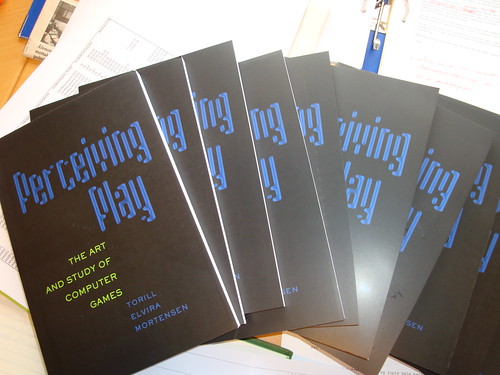
And I sincerely hope the impact if this book isn't too painful. It's a slim little thing, after all.
And I sincerely hope the impact if this book isn't too painful. It's a slim little thing, after all.
Subscribe to:
Posts (Atom)


 Posts
Posts

