Wednesday, August 22, 2007

Cormorants

During the morning's surfing trip, the tidbit that cormorant populations are picking up in the US, and that there is a colony in New York, leaped at me. One of the most interesting things about it is the perception of the birds in the culture:
Their arrival has drawn mixed reactions. Cormorants are big and black, with sharp curved bills and a habit of vomiting when threatened. When they stretch their wings out to dry, they seem to be wearing the black cloaks associated with vampires. They are also mercilessly efficient marine predators, with the ability to fly like ducks and dive like penguins, which has not endeared them to fishermen (or, for that matter, anchovies).

Dracula is the last thing I think about, when I see a cormorant in Norway. Here they are part of a magic uniquely connected to the land, and fairytales have them be mysterious sorceresses, wearing their black feathers when they fly to their secret skerries out towards the open sea. There they hoard treasures untold of, and lucky is the fisherman who is loved by a cormorant woman.

Parts of this is probably connected to what troubles the fishermen in New York: Cormorants are very efficient predators. This means that when cormorants return/arrive somewhere, it's because there is fish. So if you find out where the cormorants fish, you have found a good spot - your own secret skerry at the edge of the open ocean, where you can find wealth... a wealth if not of magical jewels and gold, then at least the silver of the ocean.

Honeymoon is fading

But the weather is still great, so it's not too bad. It's easy to be tolerant with all those little things which makes it hard to get started when the sun is shining from a pale blue scandinavian sky, when the paths through the forests are perfumed with pine, and elegant birches trail their green veils in a gentle wind.

Still, satire lingers on my tongue, pokes at my fingertips. And some time, in some dark corner, after a sufficient number of drinks, you'll be able to tease it out of me. The Norwegian love/hate of our brother nation is getting a good workout - as I am sure the Swedish equivalent does among the people who have to deal with me. Swedens smooth surfaces meets brute Norwegian stubbornness.

But things are falling into place, slowly and step by step. I guess that before I go to Australia, most will be settled, and by then it will be really good.

Friday, August 17, 2007

HUMlab in Umeå

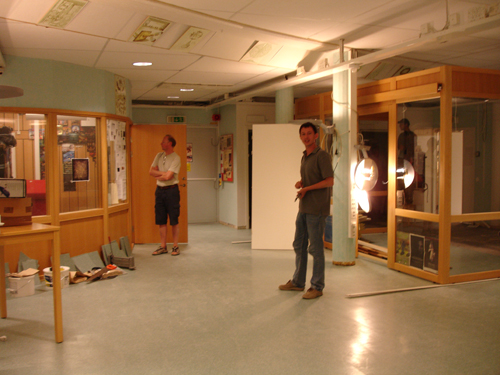
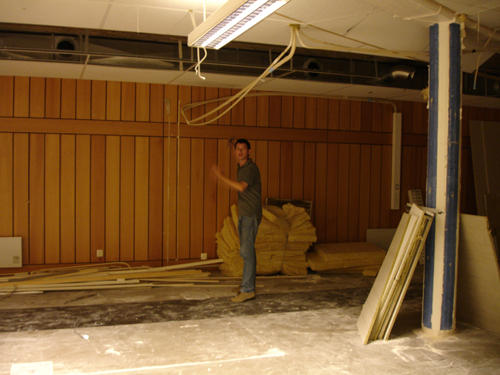
As I arrived to Umeå while it's still somewhat summery, the University is quiet and everything is semi-ready. Some parts were very far from ready. Patrik Svensson at the HUMlab took me and my husband for a walk around what will be the actual laboratory, and while his enthusiasm and vision made the future clear to my inner eye, the camera caught something different.


It will be great though. Patrik also showed me the plans for how it will be, and I am impressed. They have thought of everything: design, functionality, equipment, workareas, flexibility - I have to say, these Swedes have style! I can't wait to see it all finished, and get to work in this elegant and generous area.

Umeå living

The first thing you'll notice about Umeå is all the people biking, walking or in many diverse ways moving about by their own power. Yes, they use cars, but the bicycle is a very important means of transport. To support and encourage this the place is riddled with and surrounded by paths for bikes.

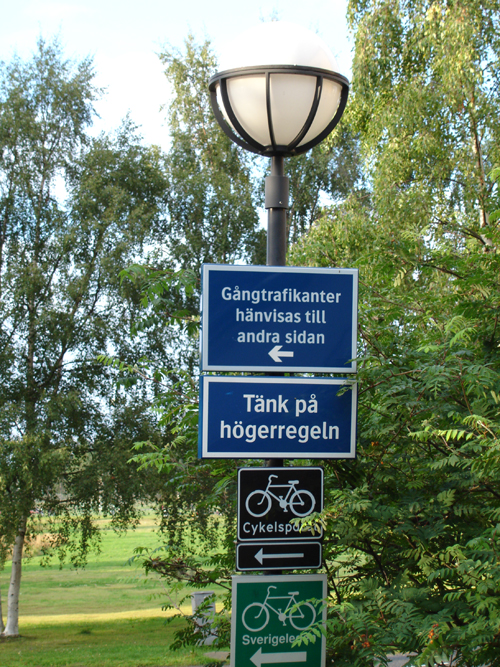
The use of bikes is so extensive that it has to be regulated. Now, Swedes don't need an excuse to regulate something, but here it's pretty well justified to put up some instructional signs.

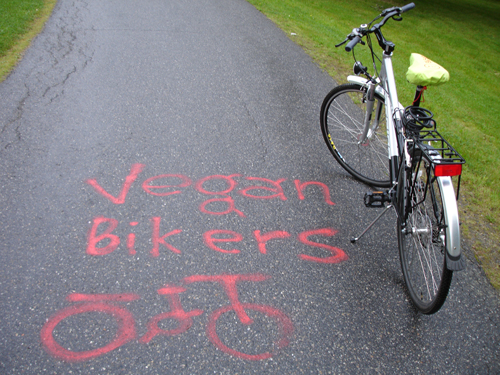
This makes Umeå a good place for one of the more original biker organisations I have seen announced, the Vegan Bikers:

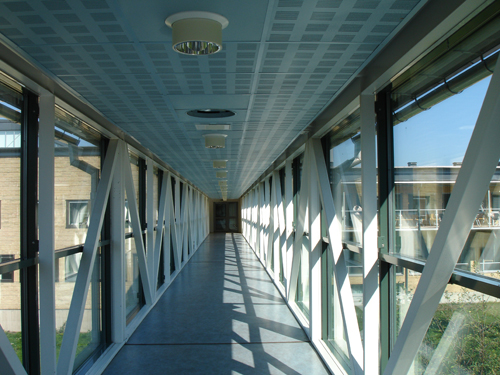
But this bikers paradise will disappear under heavy snow and low temperatures in a few months, and that's when I'll be very happy about certain architectural peculiarities at the University. They have walkways between a lot of the buildings, making it possible to walk over much of the campus without setting a foot outside.

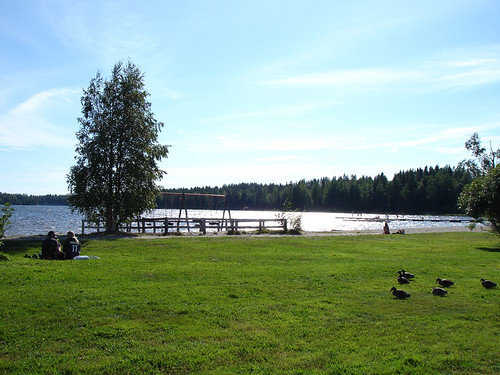
But until then I am going to enjoy the outdoors here as much as I can!

Friday, August 10, 2007

"I never said that"

Once in a while I find that I have said things I never thought I did. I try to ask to read all interviews and make sure I know what I have answered or rather - what the journalists have asked - but recently I found that a long conversation had been cut down to four sentences, two of which were like this:
Torill Elvira Mortensen tror det regulerte arbeidslivet i Norge er en hindring for veksten i bransjen.
– I USA er bransjen helt rå og skreller vekk dem som ikke takler umenneskelige arbeidsforhold. I Norge er det færre med kompetanse så det er vanskelig å være like brutal.

What the interviewer in Magasinet claims I say here is that the regulations of the workforce in Norway makes it impossible to produce games with the quality or quantity the way Americans do.

What I said was that Norway is too small to produce in the way Americans do. We can't discard talent in the same manner, we have to build it. The journalist was taken with his idea of the ruthless American labour market though, so suddenly it apepared as if I agreed. Oh well. So I sound like a right wing libertarian. No worries, I won't vote for them any time soon.

Sweden, yeah

The drive from Volda to Umeå was little more than 1000 km, and took one long and one short day. I was received wonderfully, and live in a quaint little apartment at the University's housing for visiting scholars. It's tiny, but they have promised me something bigger before the winter sets in. Otherwise the blog will be filled with pages of cabin fever - or perhaps I'll just never leave the virtual world.

I bought a new cellphone today, and so I have a Swedish number. If you already have my old one and want to know how to find me in Sweden, feel free to send me an email or a sms, and I'll let you know - eventually. I am not doing much these days except exploring, shopping for the apartment, and seeing the Botnian Bay while it's still sunny.

More later - with pictures. I promise.

Friday, August 03, 2007

"Vacation"

It's been cold, wet and rainy for three weeks. It's been crappy vacation weather. Luckily, I have not had much time to realise it's been a vacation. In those three weeks I have been finishing a little book on game studies.

It's not a big, important book. It's just the one I wished existed, every time I get an email or a call from somebody who needs help. They contact me, normally after hearing me on the radio or reading some paper, and they need help to find literature on games. They always start with the phrase "There's so little done on games", and go on with "it's impossible to find anything for my work". And so I spend the next half hour guiding them through the net, or possibly reading names and titles slowly to them.

If the publisher is happy with this book, I can now say: "Why don't you check out this book, particularly the bibliography, and then you go to a library and have some searches made on the names of the people I mention, because they are really busy publishing, and I am sure they have written a lot more by now."

That's going to save me a lot of half hours. Perhaps not three weeks of vacation worth, though. But there may be other benefits - at least I hope so! And monday the weather is supposed to be warm, and I still have a week of vacation to go, and then I'll be moving into a whole new place for a year.

Sunday, July 29, 2007

Getting real

This has been a weird year, and I have been working with a lot of stuff that might or might not get real. Two things are now crystalising out of all that potential though.

I am about to finish the second-to-last chapter of a little book on game studies, in Norwegian. The topic I am still missing in this chapter is gender research in games. I do have a lot of stuff for it, but since this is something no female games researcher can neglect: Is there a name I really should not ignore? Is there a name which is often ignored, but who deserves to be mentioned? I have written about a lot of the women and men doing gender topics in their research under other topics in the book, but you know what it's like: If I don't have a headline for it, it doesn't exist.

When this book is done, I am moving to Umeå for the winter. I received a post.doc. scholarship from HUMlab at the University of Umeå, and Volda College has generously agreed that I can take a leave from parts of my position for this. It's a great deal for me, and I am really looking forwards to this winter. Well, I am not looking forwards to a winter somewhere even darker than here, but I do like the thought of a larger academic environment, a bigger library, a bigger town, no administration (going to miss my students though) and lots of time to read, write and think.

From Umeå I will be going to Australia and Japan this fall. I am also still looking hard at the Vancouver AOIR conference, trying to figure out how to get money for it. I have a very personal reason for wanting to go to Canada this fall, and the conference, with it's great topic, is very convenient. But I have to see how things with work out with two employers, another apartment and the costs of living in two places. And it's not like I am sitting in my tiny room in Sweden sulking through all of September...

This is all painfully close and painfully real, and getting more so every day. Changes are scary - although these are scary good.

Anyway, about those gender research hints? I'd love them.

Friday, July 27, 2007

More clever spam

Can you guess I am desperate not to write what I should? Anyway, writing at the blog again, I just checked a comment I permitted. Turned out that it was the most clever of spam.

What it did was to copy a passage from another post:
I believe that there should be gold-sinks in the game; however, make the currency sink a thing of pure fluff. In the MMORPG Ultima Online, it cost 500k (a decent sum of money) just to dye your hair a fancy neon color. The hair color did not give you a statistical advantage over your opponent, it did, however, show your high status.

This was part of the content of a comment on a farily old post of mine. It looked perfectly to the point of the post, so I didn't hesitate on permitting it. But being a curious old bitch I wanted to see what exactly that comment was about, so I checked. That's when I recognized the words.

I can't help it, the cleverness and inventiveness of spammers is impressive. All this effort and energy, just to invade the blogs of strangers! I almost feel flattered.

Gamers ignoring kids

With the increasing popularity of games, in some demographic groups it will be harder to find somebody who does not play a game, than people who do. This means that everybody will be playing, the genius and the not-so-smart, the loving parent and the abusive parent. And this is the point of Halen A. S. Popkin, as she writes about the Straw couple, parents who had their children taken away due to neglect - neglect supposedly caused by their addiction to internet games.

Popkin's point, which is a refreshing view in these days of panics and witchhunts, is that when people neglect their children, they have problems, real, not-game-caused problems. A computer game may increase these problems in many ways: if you are a compulsive or obsessive personality, a computer game will play right into that. But the game didn't make you the person you are, and if the game wasn't there, something else would be. Neglect of children is, sadly, nothing new. If banning computer games would ban neglect, crime, bad grades, social insecurity and isolation, depression, suicides, war and drug abuse - then by all means, wipe those disks RIGHT NOW! It doesn't though. Telling ourselves it's caused by games is kidding ourselves, and it makes us look at the symptom, not the cause. Obsessive gaming isn't caused by games, it's caused by the problems of the people who play games. Remove the symptom, and there will just be an other one.

And now: lolcat quiz!

One of my favourite weird net phenomena of the minute are the lolcats. By way of Clancy Ratliffe I got reminded of them once more, through this lolcat quiz. Of course, I had to see which lolcat I am:

The Romance Princess

We learn at school that the feudal lords received their right to rule from higher powers. They were the chosen ones, the ones with extraordinary abilities. Well, it seems like this belief is alive and blooming in the Norwegian royal house. Princess Martha Louise has "come out" as a clairvoyant, healer and one who can see angels. She is starting a school, Astarte Education, where she teaches healing and whatnot.

Martha Louise is a well-loved figure in Norway, and people are quite tolerant of her many controversial (for a royal princess) impulses. Well, so they laugh a bit at her posturing husband and their wannabe bohemian lifestyle, but it's a rather indulgent laugh.

This time she may however have crossed some lines which are not as easily accepted. She is using her authorisation as a physiotherapist in combination with spiritual healing, something which crosses Norwegian legislation - she is flirting with "kvakksalverloven", which means she can risk becoming, legally, a quack. She has also always been quite well loved by the church, but in the Norwegian church there are no middlemen between man and God - the angels are not for conversation, if you have to talk to God, you go straight to him.

For a scholar with an interest in popular culture, this is however amazingly fascinating. Martha Louise is going - not eactly mainstream, but straight into the women's magazines. Her life is becoming a modern fairytale, or, more precisely, a romance novel. Consider this synopsis:

"Young princess who is mainly interested in horses and angry with the restrictions of her royal life, strives to overcome these restrictions and find meaning beyond her birth. She has several undesirable romances, but the family always manages to cover it up somehow and she remains in the cluthces of her position. Finally however the travelling, mediocre minstrel (journalist, writer, designer) shows up and sweeps her off her feet, convinces the parents that he truly loves the princess, and charms the nation with his devotion. His great gifts for public embarassments finally frees the princess from her burden of royal duties, as she renounces her title to be with him. With motherhood and no more public duty, tedium sets in, she is no longer in the public eye and also, there's the money issue. With the title, she also renounced the public support a royal princess is due. Used to a lifestyle no common physiotherapist can support, the princess needs a miracle, and lo and behold, just as she was getting too bored, angels come to her! She can heal, she can see, she can commune with great powers! And so, by the miracle of her exceptional birthright, she is lifted out of the dreariness of being a married mother and into her true vocation: A magically gifted healer. Peace at last for our much-tried princess."

(Sorry about getting carried away with some sarcasm at the end there - there are reasons I don't write romance novels.)

I think I have read that story already - over and over and over again, in exactly the kind of magazines that are filled with pictures of royalty, the magazines that have followed Martha Louise since her birth. That reader segment comprises her most loyal supporters, and accidentally also the most likely customer or "students" to her school. Now, if I were mean, I might suggest that this is an incredibly well-conceived scam, where the princess ruthlessly abuses her birth, her publicity and the dreams of the many who have watched, loved and celebrated her all her life, to make money off the suffering and unhappiness of those with uncurable ailments and unfullfillable dreams. I am not a mean woman though, so I suggest rather that Princess Martha Louise has come to believe in the story about herself. May the story lead to a happy ever after, for the sake of the many who share that belief.

Thursday, July 19, 2007

About the price and size of cucumbers

Warning, all links in Norwegian.

"Cucumber journalism" they call it in Norwegian, from the time when the summer temp was sent to the market to check the price and quality of fresh cucumbers. Dag Solstad (video, get an author home), a well known Norwegian author, wrote about how the broccoli was discovered by a summer temp in a local newspaper - on a marketplace in Norway.

This week it seems like the correct contemporary word for cucumber news would be "game journalism." I have had 5 phonecalls from 4 different news media on 5 different takes on games this week.

Some of those were kind of interesting. I may even buy one of the papers to see what they will be writing about political games and propaganda games. Some of the phone calls felt more like I was doing unpaid elementary education, not even in games, but in general social science.

And while we are at that: www.ssb.no is a GREAT source for statistics on Norwegian statistics, and they publish "Norsk Mediebarometer", one of the most useful sources I know about on media statistics, including game use in Norway. Did you get that? Statistisk Sentralbyrå, that boring old public institution which has been publishing facts about Norway from 1832 as part of the ministry of finance: Tabellkontoret, and then as an independent public institution since 1876. If you count the start of their work with the first Norwegian Census, that was in 1769.

No, journalists are not stupid, that's not what I am saying. I am just as always baffled by the power of the media threshold: once a topic is used by one large news agent, everybody else need to have their take on it.

Cucumbers, anyone?

Monday, July 02, 2007

so, so yesterday?

We should however be realistic: the 'blogging revolution' collided with human nature and human nature won. Most people do not like writing, even if they have something to write about. Many people do not have time to blog on an ongoing basis in a way that attracts a substantial audience.

While I agree with this statement in blog statistics and demographis in the profile from Caslon Analytics on blogging, I agreed with it in 2001. So I guess this statement is so, so yesterday? Even using the amazingly simple technology of pen and paper, not a lot of people write. For those who do, who enjoy writing and enjoy communicating online, weblogs will, in some form, continue to be part of their toolbox. But it will still be possible to survive without a blog.

PDF n00b

I just received the page proofs for an article I wrote ages ago. Apart from considerable frustration with the proofreader's automated requests - I am sorry, but if a journal doesn't have a volume number, I can't supply it!!! - You want me to write (sic!) behind something? Behind a lowercase letter? which one? Why? Where? That sentence has lowercase letters all over it!!! - they have asked me to make correction directly into the page proofs. At least that is how I understand this sentence:
When you review your proofs please read them carefully, being sure to respond to all copy editor queries, and make all corrections (including those resulting from copy editor queries) on the page proofs. The final responsibility for correcting typographical errors in proofs is yours.

I have no idea how to edit PDFs. I now understand that this can be done with the touchup text tool. The problem is that when I try that, they ask for the font. And 1) I obviously don't have it installed and 2) I have no idea what font it is, so I don't know where to get it.

As far as I am concerned, the publishers are asking me to supply information that doesn't exist, insert comments which don't make sense, and make the changes in a way which can't be done. If anybody know of a secret trick, please, please share it.

Thursday, June 28, 2007

The curse of a social being

I am trying to clear my plate, as I have a few things which require my full attention for the next month. But looking around there are huge amounts of work I have to deal with. So I set out, optimistically, thinking it's just my own lack of initiative which has caused this. I send off an email, another, another - soon I have sent off a long list of emails, and I am ready to deal with the responses and get things over with.

Nothing.

OK... let's try something else. I have more work coming up. I write a suggestion for things that needs to be done within a certain date, as that's an absolute last deadline, and bring this up at the nearest meeting. These are things that concern more than me, and if I am to be involved, the proposed schedule is important - I do know how much work both I and they have to deal with. I get a thank you for the initiative, and I settle happily back, reassured that the responsible parties will understand the importance of getting on with things.

Nothing.

Right. I am now running out of things that I can initiate. In the mean time I have not been sitting around with my hands in my lap, I have been responding to an endless stream of requests for work that urgently needs to be done, ideas that need to be discussed, decisions which need to be made, projects that need to be finished. I really have enough work, I just need to get those other things out of my life, and it's not like I can do anything until I get a response, is there? So I work my ass off (like everybody else), while waiting for some kind of response which will let me finish the stuff I feel responsible for.

Nothing.

Well - I need to finish something. I really do. If only to feel that I am not absolutely useless. So I try to get private matters in order. I have a family which needs to be part of this though, I can't just go ahead and make decisions over their heads, barging into their private space to clean up, to change, to organise, to fullfill my own needs for achievement. So I try to agree with them when to do things, what to do, in what order, how to start preparing, what they need to do and what I need to do so we can actually get those extremely mundane tasks which we all know about and we are all responsible for, done.

Nothing.

What is wrong with this? The problem is that I am so dependent on so many people, I have gotten involved in too much with too many, and I also tend to say "yes" rather than "no" when others need help. So rather than pushing, demanding attention and crying for help with my stuff, here, now, I have been waiting for others to realise that they need to involve themselves, and in the mean time been helping everywhere. Now I am totally spent, drowning in unfinished tasks, accused of being unable to finish the simplest of them, and feeling like it is true. Then somebody asks what they can do to help. The horrible thing is, with what I have gotten me into, the answer is...

Nothing.

Well, there are still some things I can do. I am taking a break now, for lunch, and then for about an hour, which will be spent cleaning the living room. If I am going to sit around all alone being stressed and miserable about things I have failed to finish, at least I can do that in a tidy room.

Sunday, June 24, 2007

Game in' Action 2007

I have been away, and then I was away. Drowning in exams, I haven't taken the time to write anything from the Game in' Action conference in Gøteborg. It was also a conference with no web access, something which was more than a little frustrating. I realised how much I rely on an available net connection, for simple things like "Are you sure your plane leaves from Landvetter?" What you mean am I sure? What is Landvetter? The airport? There's more than one airport? More than one with international flights? Help, where's the internet connection! Anyway, it was Landvetter, and I got back in time.


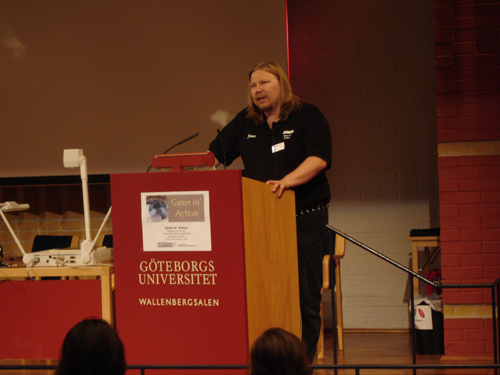
Jonas Linderoth opened the conferences, and as he is also a member of the researcher's guild, I will let him represent both sides of the conference, the academic and the social.

On the academic side, this was a very interesting conference in the way that it had some extremely established keynote speakers: Henry Jenkins, James Gee, Jonathan Dovey, Helen Kennedy and T. L. Taylor, while it had some quite inexperienced - in gaming - presenters of papers. A lot of the papers were of research just about to start, or very sketchy research with undeveloped theoretical or empirical base. Some were great though, and it is good to see that there is so much diverse activity in the game research field.

Among the good stuff I want to point to the work of Tina Lybæk and Emma Witkowski, who did not present a paper (their computer with all the things they had prepared, including all paper copies of the presentation was stolen the day before), but talked about the source for their paper: the Let's play initiative.

Another was Hilde Corneliussen, as always a very thorough reseacher who this time had made the effort to count female and male npc's and characters in WoW, and connect them to a discourse of gender and power which went beyond the issues of hypersexualisation which is so easy and so common.

For the most part I followed "The Truant Track" - the presentations made by members of the WoW researcher's guild, as I had after all gone to Gøteborg mainly to meet up with this group in the flesh. There were, as far as I was able to count, 17 members there, and the visit spawned a wicked role-play plot and a couple of new members. Following The Truant Track was no loss at all, perhaps quite the contrary, as all held interesting, stimulating presentations. I do however want to apologize to Luca Rossi for playing out an RP line behind his back on the monitor, and making all the Truants stare intently on the screen to read mine and Espen Aarseth's (who was not at the conference, and hence performed an ingame coup) comments, and not on the screen with Luca's notes. Sorry, Luca!

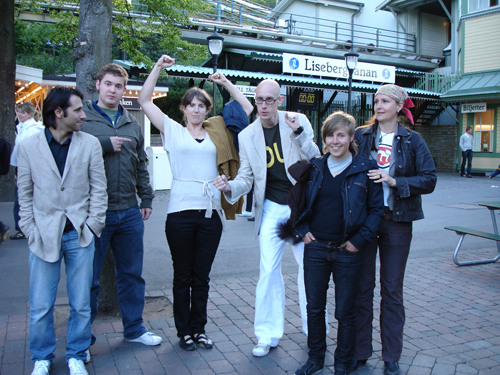
The last night of the conference there was a dinner most suitably situated at Liseberg, the Gøteborg amusement park. Here the researcher's guild kept on doing research, by bodily experiencing ilinx. Below is a brave group of game academics about to get on the roller coaster. No, I have not yet scanned the (in)famous picture taken ON the roller coaster of six game researchers in different stages of terror or joy.

Sunday, June 10, 2007

Summer, work, fun

Summer is here with the insane intensity of the north west. We yearn for it for months, starting in September as we cling to the memory, growing to desperation in May as the last snows threaten the fall of cherry petals. Then, suddenly, from one breath to the next, it's there. You leave for work wearing a wool sweater, and walk home in a T-shirt, carrying the layers of clothing in your arms. Everything looks different. The green is greener, the blue is bluer, the white is whiter and the sun is everywhere. It hammers through the windows in the unconditioned office in the afternoon, it pokes in through the north-face bedroom windows at 2 am, it seeks out the breakfast table, it burns the plants at noon.

The people change quickly. From pale and tired, the faces change through burned to brown. Light shoes makes the gait easy, and bright colours and light materials are carried as if they were flags of freedom. "You prize the summer" people greet each other, as bare shoulders and sandals replace boots and coats.

In all of this, the teachers have to work. For some perverse reason, since time immemorial, Norwegian schools have their exams in the best time of the year. When the world is remade by light and heat, students and teachers both are sweating over exams. And like any normal teacher, I do the same. Tomorrow I am off to Bergen, to assess a couple of exams.

But then I am doing something special: I am off to meet a lot of guild members at Game in Action at Gøteborg University. In the three days of the conference, there are guild members presenting every day, and one of us is the keynote on Friday. I am just going to chat, network and meet friends and colleagues. It will be great!

Monday, June 04, 2007

Seductive quest objects

Revisiting Ragnhild Tronstad's Ph D dissertation, I am reading about seductive quest objects, among those, boxes (page 166 - 168). Her exellent analysis of the different ways to interact with a box in TubMud may at first glance look trivial, but it is at the core of an important understanding of interaction, secrets, seduction and trust in games, particularly World of warcraft.

In WoW, one of my characters is a rogue, and since I am a little compulsive about these things, a rogue who has trained her lockpicking skills fully, at all times. This means I can now open all doors and all boxes I have so far encountered in the game - if they can be picked.

Rogues such as mine is in high demand for once speciality: to open boxes. There are very few other options for this in the game. Boxes drop regularly from the NPC's, and inside there is loot, everything from green, pretty nice stuff at different levels, to blue (rare) and purple (epic) loot. But without special instruments and high blacksmithing skill, only rogues can pick the locks and open those damned boxes.

This means that rogues enter into a very peculiar sevice provider system, and the level to which you trust a rogue can be seen in how you let them treat your box.

If you don't trust them, you run around until you find a helful rogue, and ask/demand/beg them to open the box for you - in which case you put the box in the "do not trade" part of the trade window, and the other person manipulates the box through this window, with no real access to the box. It is like holding on to it while the other person fiddles with the lock.

If you trust them, you may group the rogue and give them the boxes. In this case the rogue will have to empty the boxes, but it lets you transfer many boxes in one go, saving time for both parties. It's also an strong gesture of trust, as the rogue may run off with your loot. The grouping is important because it will let you see what the rogue actually takes out of the boxes, as being in the same group lets all see the loot of others as it's picked up.

The most offhand, relaxed way to treat a box when you know your rogue, is when you just mail it, and get the contents back in the mail. No control of the box, no control of the loot: you trust the rogue quite explicitly to deal with you honestly.

Why don't all just do the last thing? It's much easier than to carry the box around all the time. Two reasons, the first is the trust issue. But the second is the reason why the trust issue is important at all: The seductive nature of the locked box. This is why sometimes my rogue opens 8-10 boxes for people, collected over several levels. Even if you know the object in the box is quite likely to be useless to you, the exitement and secrecy of the locked space, opening, gaining access, being surprised is extremely attractive: it's not a rational cost-efficiency issue, it is a desire to see that which is hidden, the seduction of the mystery.

Which is why I am so delighted with the trust shown me when the guild mates send me their locked boxes - they offer for my eyes only that first glimpse into the mystery contained in the locked box, and they trust me to treat this privilege honestly. It is, indeed, a pleasure.
Friday, June 01, 2007

articles on the visual side of games

I am looking hard for articles discussing the visual impressions of games. Have I gone blind, amd I using the wrong search words, or are there hardly any serious discussions of the graphical game interface?