Monday, October 31, 2005
WOW blogg
Want to read the experiences of somebody who enjoys WOW a lot more than me? (I don't have dual wield, isn't that just so unfair? Dual wield for shamans now!) Well, read Psyae's blog, and enjoy her reports from another world.
Global neighbourhood
In the text below I point out that I didn't think the Global Village image was all that good, and I meant for the internet. What I have always done is to think of the internet more like a gobal metropol, with neighbourhoods. I guess though that a neighbourhood will have much the same functions as a village, only the penetration of information is more clustered and not as total.
The global small town
"Oh, it's you, I have read your blog!"
Most of the time that is a nice thing to hear for instance at a conference where I know noone. It makes people approach, as they feel they know me and would like to share something which they learned through this blog.
But what about when it's said with a lifted eyebrow? When it's muttered in an aside in an agry voice? When it isn't said to you, but in a conversation which you happen to overhear as you pass a door? That's when you realise that a blog isn't always a tool of communication and discourse, but as much a way to feed the gossip mongers out there.
Now, living in a small town I have learned to live with this phenomena. My life, with all it's flaws, is transparent anyway. In Volda somebody are certain to know and mention to somebody else your economic history, your medical problems, your friendly and not so friendly relationships, they will interpret your actions (did they argue last night? Did they look like they were friends?) and they will interpret the state of your house, garden, appearance, car, children, spouse, family - it is all subject to discussion and interpretation at some point by somebody.
My response to this has been to have very little to hide. If people want to look at my life and be entertained by its quirks, please. This is perhaps why blogging suits me so well. But at the same time it means that the small town expands dramatically. Marshall McLuhan's Global Village may be more relevant than I thought, and reality TV, weblogs and social software, all the things that give us access to the lives of individuals are the sources of information for the global gossipmongers.
This way there is nowhere you can hide. Diving into a large city to have the freedom of being anonymous, changing jobs and getting in touch with new people: your life is always open to those who want to check on you and know it all. If I wasn't so used to being pre-judged anyway, I would probably care a lot more about that little aspect of blogging.
Links by way of Jill.
Most of the time that is a nice thing to hear for instance at a conference where I know noone. It makes people approach, as they feel they know me and would like to share something which they learned through this blog.
But what about when it's said with a lifted eyebrow? When it's muttered in an aside in an agry voice? When it isn't said to you, but in a conversation which you happen to overhear as you pass a door? That's when you realise that a blog isn't always a tool of communication and discourse, but as much a way to feed the gossip mongers out there.
Now, living in a small town I have learned to live with this phenomena. My life, with all it's flaws, is transparent anyway. In Volda somebody are certain to know and mention to somebody else your economic history, your medical problems, your friendly and not so friendly relationships, they will interpret your actions (did they argue last night? Did they look like they were friends?) and they will interpret the state of your house, garden, appearance, car, children, spouse, family - it is all subject to discussion and interpretation at some point by somebody.
My response to this has been to have very little to hide. If people want to look at my life and be entertained by its quirks, please. This is perhaps why blogging suits me so well. But at the same time it means that the small town expands dramatically. Marshall McLuhan's Global Village may be more relevant than I thought, and reality TV, weblogs and social software, all the things that give us access to the lives of individuals are the sources of information for the global gossipmongers.
This way there is nowhere you can hide. Diving into a large city to have the freedom of being anonymous, changing jobs and getting in touch with new people: your life is always open to those who want to check on you and know it all. If I wasn't so used to being pre-judged anyway, I would probably care a lot more about that little aspect of blogging.
Links by way of Jill.
Friday, October 28, 2005
Comments and honesty
Do the comments keep the writer more honest? An example from the Norwegian language blogs indicates that there is at least a risk that you'll be publicly corrected if you, the blogger, choose to be a little liberal with truth. Particularly if you write about your friends.
Would the comments keep me more honest? No, I actually believe I am honest when I write, and I don't embellish about others. Occasionally I alter stories in order to protect the anonymity of people who might be hurt (the ex boyfriend sighting is one example - yes, there are relationships in my past which it is probably better for all involved that they ended, no, it is not a precise, verifiable description of the seedling incident), but I believe, at the time of writing, that I am right. What comments could do is give me more facts.
So put them back in or keep them out? I am still thinking. At the moment I like the no-comments strategy.
Would the comments keep me more honest? No, I actually believe I am honest when I write, and I don't embellish about others. Occasionally I alter stories in order to protect the anonymity of people who might be hurt (the ex boyfriend sighting is one example - yes, there are relationships in my past which it is probably better for all involved that they ended, no, it is not a precise, verifiable description of the seedling incident), but I believe, at the time of writing, that I am right. What comments could do is give me more facts.
So put them back in or keep them out? I am still thinking. At the moment I like the no-comments strategy.
Wednesday, October 26, 2005
Grunt
Somehow, Agirra has achieved the rank of "Grunt". The ranks reflect your player versus player (PVP) activity and your character's honour, and after a few games in Arathi Basin I found myself with as high a rank as the clan's most dedicated warrior.
Arathi Basin and Warsong Gulch are games within the game. They have different focus, Warsong I think is mainly a "catch the flag" game while Arathi Basin is about holding at least three bases for a certain time and collecting resources, but the idea is the same: inside these arenas you can expect to have your character attacked and killed, and you are expected to do the same to others. Your opponent is no longer a NPC which follows certain programmed reaction patterns, but other humans with all the unpredictable behaviour humans are capable of. NPC-killing strategies don't work, while human psychology does. NPCs are not daunted by a huge sword and plenty jumping, nor do they hold grudges. Humans do both, and the last with a vengeance.
I am not much of a PVP player. I have to admit I don't like it while doing regular play. When my character gets accidentally flagged for PVP by attacking a civilian alliance NPC I hide until it goes away. But in the Arathi Basin I like it. It's what that game is about, and the few times when my character can actually make a difference for the group, I am delighted.
But I am learning to do PVP in other contexts. The other day I was doing an escort quest with a clanmate. It was a PVP flagged quest, for some reason we could expect to become flagged for PVP by doing it. This meant that the area was dotted with Alliance looking for PVP - Horde players accidentally flagged for PVP and so open for attack. A dwarf did his best to provoke us into attacking, as we were still not flagged. We ignored him, finished the quest - THEN we attacked and killed the character. That was very satisfying. When we met again later, after we had rid ourselves of the flags, he chose to run rather than than provoke. That felt rather good as well.
Another thing this leads to is the creation of stories. I not only learned something about player versus player activities, and why it can be fun, I also gained an example of how stories grow out of playing. The little story about the infuriating dwarf is nice both IC and OOC, and can be used to explain how while games are not stories, they offer a rich environment for experiences which can easily become stories.
Arathi Basin and Warsong Gulch are games within the game. They have different focus, Warsong I think is mainly a "catch the flag" game while Arathi Basin is about holding at least three bases for a certain time and collecting resources, but the idea is the same: inside these arenas you can expect to have your character attacked and killed, and you are expected to do the same to others. Your opponent is no longer a NPC which follows certain programmed reaction patterns, but other humans with all the unpredictable behaviour humans are capable of. NPC-killing strategies don't work, while human psychology does. NPCs are not daunted by a huge sword and plenty jumping, nor do they hold grudges. Humans do both, and the last with a vengeance.
I am not much of a PVP player. I have to admit I don't like it while doing regular play. When my character gets accidentally flagged for PVP by attacking a civilian alliance NPC I hide until it goes away. But in the Arathi Basin I like it. It's what that game is about, and the few times when my character can actually make a difference for the group, I am delighted.
But I am learning to do PVP in other contexts. The other day I was doing an escort quest with a clanmate. It was a PVP flagged quest, for some reason we could expect to become flagged for PVP by doing it. This meant that the area was dotted with Alliance looking for PVP - Horde players accidentally flagged for PVP and so open for attack. A dwarf did his best to provoke us into attacking, as we were still not flagged. We ignored him, finished the quest - THEN we attacked and killed the character. That was very satisfying. When we met again later, after we had rid ourselves of the flags, he chose to run rather than than provoke. That felt rather good as well.
Another thing this leads to is the creation of stories. I not only learned something about player versus player activities, and why it can be fun, I also gained an example of how stories grow out of playing. The little story about the infuriating dwarf is nice both IC and OOC, and can be used to explain how while games are not stories, they offer a rich environment for experiences which can easily become stories.
Comments on blogs
Oh, look, just as I stop using comments on my blog Anya writes a long post about them and Mark Bernstein decides he wants them.
And I have read more blogs in the last couple of days than I normally get through in a couple of weeks. One reason may be that I have been sick and hunched up in bed with the laptop two afternoons in a row. But it may also be that I am free to look around me, rather than bound to contemplate comments or lack thereof.
We are different and react differently to the same stimuli after all.
____________________
Update, because Mark updated, and yes, this is becoming rather funny:
Mark Bernstein doesn't want comments on his blog, and Elin claims he has misled me, and if I and Mark would put comments in we could be easily corrected (perhaps by Elin). Yes, comments would have made corrections easy. But it's more fun to get those corrections this way.
And I have read more blogs in the last couple of days than I normally get through in a couple of weeks. One reason may be that I have been sick and hunched up in bed with the laptop two afternoons in a row. But it may also be that I am free to look around me, rather than bound to contemplate comments or lack thereof.
We are different and react differently to the same stimuli after all.
____________________
Update, because Mark updated, and yes, this is becoming rather funny:
Mark Bernstein doesn't want comments on his blog, and Elin claims he has misled me, and if I and Mark would put comments in we could be easily corrected (perhaps by Elin). Yes, comments would have made corrections easy. But it's more fun to get those corrections this way.
What's in a name?
I happened to find a discussion about why I am concerned with how my name is spelled, over at Dr. Joolz' snapshotz on life. When I now read my own attempt at a self-ironic tone of voice, I flinch, and I am doubly certain that I need to watch the voice in which I speak online. Irony - even self-irony - is complicated.
But why do I think names are so important?
First, it's my journalist training. Typos in names is unforgivable. You make sure you and the person you talk to agree on how the name is spelled, which names they use, and which title is the correct one. In Norway you can get away without the title, but never, ever, with a typo in the name.
Second, it's googlability :) I know the most common typos for my name, but how can I cover them all?
Third, it is the name I have grown up with and lived with and kept. My father argued with the priest over that precise spelling, to the point of not having me baptised in that church if he could not have the name JUST like that. It is one of those stories I grew up with. To my parents, that was wild defiance. It means something to me.
The post also addresses my recent lack of comments.
I never felt comfortable about comments in the first place. I put them in, and no, did not experience any of the things I feared (at least not much once I put the different barriers in). Comments are good. But I think it did things to my writing, or perhaps more so, to my reading. I become too self-centered, more taken with what people write on my blog than what they write on their own sites, and this is not something I like about myself. So I try to alter it, through different disciplines - such as removing the comments.
And so I read other people's writing, and of course, notice and write about when they write about me. Still self-conscious, indeed.
But why do I think names are so important?
First, it's my journalist training. Typos in names is unforgivable. You make sure you and the person you talk to agree on how the name is spelled, which names they use, and which title is the correct one. In Norway you can get away without the title, but never, ever, with a typo in the name.
Second, it's googlability :) I know the most common typos for my name, but how can I cover them all?
Third, it is the name I have grown up with and lived with and kept. My father argued with the priest over that precise spelling, to the point of not having me baptised in that church if he could not have the name JUST like that. It is one of those stories I grew up with. To my parents, that was wild defiance. It means something to me.
The post also addresses my recent lack of comments.
I never felt comfortable about comments in the first place. I put them in, and no, did not experience any of the things I feared (at least not much once I put the different barriers in). Comments are good. But I think it did things to my writing, or perhaps more so, to my reading. I become too self-centered, more taken with what people write on my blog than what they write on their own sites, and this is not something I like about myself. So I try to alter it, through different disciplines - such as removing the comments.
And so I read other people's writing, and of course, notice and write about when they write about me. Still self-conscious, indeed.
Monday, October 24, 2005
Noted difference
And while I don't know yet if I write differently without comments here, I notice that I certainly read differently! Rather than looking into my blog to see if I have any new comments and then staying on my own page to read and reply, I go to my blogroll and move out into other people's blogs, to see what they are up to. I like that, I think.
Juggling and doctorates
Anjo Anjewierden writes about juggling and academic work:
Hear, hear! We could also let them have the sole responsibility for a family including at least one small child for a year. Perhaps even 6 months would be enough. Afterwards they would be so relieved to get back to the relaxing task of a doctorate program nothing would feel daunting ever again.
There is a tradition that Ph.D. students get three balls and they have to learn to juggle before finishing the Ph.D. In fact, learning to juggle is supposed to contribute to the Ph.D. work. The precise relation has to be figured out by the person in question, of course.
Hear, hear! We could also let them have the sole responsibility for a family including at least one small child for a year. Perhaps even 6 months would be enough. Afterwards they would be so relieved to get back to the relaxing task of a doctorate program nothing would feel daunting ever again.
Mash-up
The world is an amazing treasure chest of cool things I never knew of. Luckily others find them, and so I can see them too. Beth Noveck points to Google, and writes about Google Map Mash-up.
Google map mash-up is, apparently, a combination of the geographical data from the map and the social data from other sources - perhaps your own? Google Maps Mania is a blog devoted to mash-ups, and you can find more about this in the New York Times article Beth Noveck refers to.
Google Maps opens up for users (note: programmers, not your everyday user, but still...) to use their maps on their own websites, and put their own information on the maps. I do this with a pen on my maps of cities I visit - now, if I just knew enough of javascript, I could put this information into my personal map on the web.
It's both fascinating and scary - the information we might get about what happens where, when, with whom.
Google map mash-up is, apparently, a combination of the geographical data from the map and the social data from other sources - perhaps your own? Google Maps Mania is a blog devoted to mash-ups, and you can find more about this in the New York Times article Beth Noveck refers to.
Google Maps opens up for users (note: programmers, not your everyday user, but still...) to use their maps on their own websites, and put their own information on the maps. I do this with a pen on my maps of cities I visit - now, if I just knew enough of javascript, I could put this information into my personal map on the web.
It's both fascinating and scary - the information we might get about what happens where, when, with whom.
Thursday, October 20, 2005
Developing public information
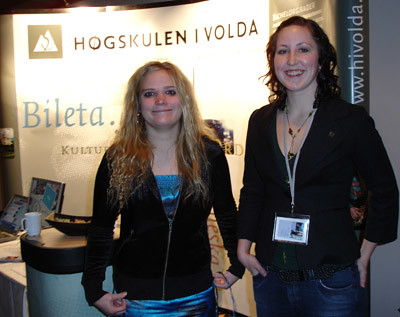
The last 5-6 years I have focused more on new media cultures such as weblogs and games, than on public information. This has given me a wider understanding of how communication models change and what the public today expects, but it has made me lose touch with the development of the profession in Norway. To be back is interesting, as it lets me see that there has been a development.
In 1991, when I started working in Volda, there were a few clear issues. The conflict between journalists and other professional communicators was pronounced, a conflict which culminated in 1997 when the Journalists Union denied access for all who had public relations, information or other similar tasks as part of their jobs. This included journalists in internal newspapers, such as the newspaper covering the largest journalistic institution in Norway, Norwegian Broadcasting, NRK.
The other issue was the positioning of public relations practitioners in the boardrooms, not in the secretarial pool: moving the job from a technical task to a strategic task.
The first was an issue pushed on the information practitioners from outside: journalists wanted to be clearly distinguishable from their very important sources. Most information and public relations practitioners did not disagree. They had no desire to be journalists, they were very clear about the fact that they know who pays their bills and it is not the newsorganisations. To the point that there was much discussion, it was about the actual tasks performed: that they were all communicating, and good communication is the same no matter who you work for. And so their exclusion went by perhaps with some personal aggravation, but no real conflict - more a shrug than a scream. The topic is still alive to a certain point, and Sigurd Allern, one of the speakers today, talks about the weaknesses of both the journalistic and the PR position. (He also points out that we - in this case I - should not use other words than Public Relations, as it does not become nicer or cleaner if it's called something else. In English this sounds ridiculous, but in Norwegian the meaning of PR has historically a different background than in English speaking world.)
The other issue was where the energy was spent, properly supported by the principles of Grunig and Hunt. Today this issue is perfectly absent. Today - while not everybody have a place in the boardroom, in most organisations PR and communication is an issue for the management.
In 1991, when I started working in Volda, there were a few clear issues. The conflict between journalists and other professional communicators was pronounced, a conflict which culminated in 1997 when the Journalists Union denied access for all who had public relations, information or other similar tasks as part of their jobs. This included journalists in internal newspapers, such as the newspaper covering the largest journalistic institution in Norway, Norwegian Broadcasting, NRK.
The other issue was the positioning of public relations practitioners in the boardrooms, not in the secretarial pool: moving the job from a technical task to a strategic task.
The first was an issue pushed on the information practitioners from outside: journalists wanted to be clearly distinguishable from their very important sources. Most information and public relations practitioners did not disagree. They had no desire to be journalists, they were very clear about the fact that they know who pays their bills and it is not the newsorganisations. To the point that there was much discussion, it was about the actual tasks performed: that they were all communicating, and good communication is the same no matter who you work for. And so their exclusion went by perhaps with some personal aggravation, but no real conflict - more a shrug than a scream. The topic is still alive to a certain point, and Sigurd Allern, one of the speakers today, talks about the weaknesses of both the journalistic and the PR position. (He also points out that we - in this case I - should not use other words than Public Relations, as it does not become nicer or cleaner if it's called something else. In English this sounds ridiculous, but in Norwegian the meaning of PR has historically a different background than in English speaking world.)
The other issue was where the energy was spent, properly supported by the principles of Grunig and Hunt. Today this issue is perfectly absent. Today - while not everybody have a place in the boardroom, in most organisations PR and communication is an issue for the management.
Wednesday, October 19, 2005
No filter
Tomorrow and Friday I will be in Ålesund, at a conference for public information and public relation workers in Norway. It is the profession I educate people to work within, and I expect to meet a lot of old friends, students, former students and contacts through internships and other cooperation between the college and the profession.
My task there will be to talk about personal publishing, and I will discuss weblogs, photo-sites and other methods of non-filtered publishing. Originally it was thought of as a workshop, but as there were as of yesterday 67 people who had registered for it, and we also have no computer lab, I have to think again. I think what I will do is turn it into a combination: a good hour or so talking and demonstrating the options, and then those who want to and have brought lap-tops can stay behind and we'll play around with the different sites I will be showing: blogger, flickr, del.icio.us, feedburner perhaps, to demonstrate the power of news feeds - and others as I work on fleshing out the presentation.
My task there will be to talk about personal publishing, and I will discuss weblogs, photo-sites and other methods of non-filtered publishing. Originally it was thought of as a workshop, but as there were as of yesterday 67 people who had registered for it, and we also have no computer lab, I have to think again. I think what I will do is turn it into a combination: a good hour or so talking and demonstrating the options, and then those who want to and have brought lap-tops can stay behind and we'll play around with the different sites I will be showing: blogger, flickr, del.icio.us, feedburner perhaps, to demonstrate the power of news feeds - and others as I work on fleshing out the presentation.
Comments
I have stopped using comments on this blog. I don't know how long this will last, or if I ever put them back. I have not seen much of the things I worried about: spam, aggression, flaming or totally irrelevant writing, this is not why I close the comments for while. I do it because I want to see how it influences my use of the weblog, and my choice of topics and focus. And so we'll see.
Game programming in Norway
There's a study started up in a college in Norway, in game programming. I don't know much about the school, study or their bachelor program yet, but if you read Norwegian I can provide you with a link to the bachelor program description.
New Issue of Game Studies
After a longer and more painful editing period than normal, Game Studies is out with a new issue. Time for celebration indeed!
Pusi
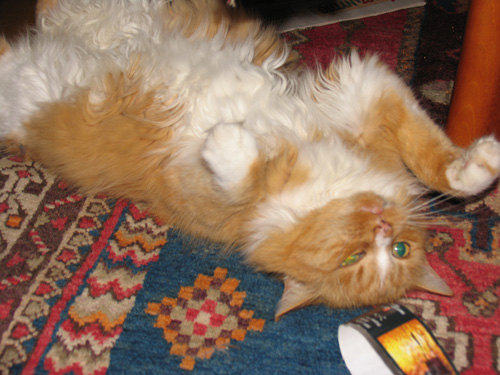
She was a scholar, studying the language of magpies, a gourmet who would only accept the most exquisite fish-cakes, and a cruel Mistress who did not fear to use her claws to teach us how she wanted things to be done. She was my personal trainer in the complicated art of napping and total relaxation, and the most playful of companions while working in the garden. The pillow next to the computer screen is painfully empty without her, and the meals in our house are taken in sad, undisturbed peace as no sudden claw strikes from below to jolt the piece of venison off a fork.
She was just three kilos of fur and bones, but the personality and self-confidence was certainly big enough. I hope the colours of cat heaven are golden brown to let her blend in, that the mice are plump and frisky, the foxes slow and the birds just a little unattentive.
Tuesday, October 18, 2005
Time to go home
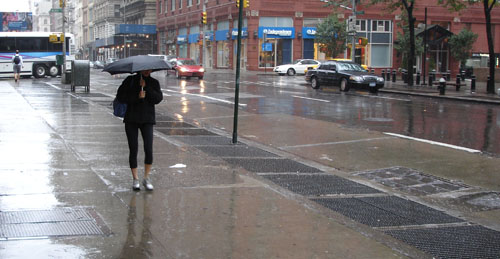
It was time to go home. Fall had reached New York, and the rain just kept on falling for a week, while I was finishing up. It was not hard at all to leave the dirty, rain-splattered streets, and go to Volda.
The trip went by in record time: I left JFK 19:00 NYC time and was in Volda after 13 hours: 14:00 Volda time. My luggage couldn't keep up though, it arrives today after a little break in London.
The trip went by in record time: I left JFK 19:00 NYC time and was in Volda after 13 hours: 14:00 Volda time. My luggage couldn't keep up though, it arrives today after a little break in London.
"What do you really do in New York?"
The question came just as I lost the connection with Oslo, from a journalist who was interviewing me about games. He called back and asked if that was such a sensitive question that I hung up on him. In the mean time I had given a long, mundane and unglamorous reply, which never made it to his tape.
I am aware that people ask this question, to me and to others about me. Some of them out of curiosity, and some out of envy. And then they read my blog, and there's pictures not of libraries, key-boards and books, but of streets, restaurants and shoes, and I write about weather and food and walks and meeting people I like and have fun with.
Well, here is what I really did this time.
The first two weeks I spent pulling my hair out with the roots trying to start writing an article. In these first painful weeks I spent at least two days getting a collection of necessary books together, was sick for two days, visited Brooklyn College, met Hanne-Lovise and visited the library with her and tried to get hold of a friend who might help with the book situation. Then I spent two weeks writing the article with very, very short breaks for shopping, cooking, walks and some polite socialising with my host. After a while I managed to get him hooked on World of Warcraft, so while he thought we were just having a blast (which we did), I got some good research time in.
I spent one week revising an article on blogs. Still not done with it, though. Then a couple of days on the conference State of Play, and then four days starting to clean up my back-logged mailbox and get some administration done. I spent at least two days during the six weeks dealing with different game-related projects in Norway, answering the phone and writing emails to people who just wanted to know if I could please..., and the same amount of time thinking on and working with questions directly related to teaching and administration in Volda. I spent one day shopping for clothes in these six weeks, and one afternoon shopping for presents. I read one non-work related book (not counting what I read on the plane), saw no movies or television, and was out with friends (including my host) five times in these six weeks.
The trip was not funded by the college. I could do it this time because tickets between Norway and NYC are cheap and I went nowhere this summer, because I had the Volda-Oslo ticket covered, because I have a friend who happily puts up with me - and plays WOW without complaint, too. I cook my own food, and groceries are cheaper in the US, the things I shop for (except food) are things I have planned to buy anyway but didn't get in Norway, as I have more options in larger cities. I have no stash of money or funding I don't reveal, no rich parents or secret income, and while I do own some shares, the collected value of them is exactly 100$.
Why do I write this? Why do I feel this need to justify my travelling, when I know it's so important to my continued existence as an academic writer and researcher? Because comments, rumours, quotes make their way back to me and convey a general "she just runs off and has a vacation" attitude. It is of course not what whoever I talk to ever was thinking, but you know...
So here it is. No, I am not a glamorous leisurely scholar who spits out articles between cocktails, dripping references like olive-pits. I have to work at it. And that's what I really do, when I don't teach or administrate or do house-work or visit my aging mother or try to occasionally have a vacation with my family - which are the main things going on in my life. Sorry if I shatter the illusion of me lounging while being fed peeled grapes, but that's a fantasy you can all apply to some sexier main protagonist than me.
I am aware that people ask this question, to me and to others about me. Some of them out of curiosity, and some out of envy. And then they read my blog, and there's pictures not of libraries, key-boards and books, but of streets, restaurants and shoes, and I write about weather and food and walks and meeting people I like and have fun with.
Well, here is what I really did this time.
The first two weeks I spent pulling my hair out with the roots trying to start writing an article. In these first painful weeks I spent at least two days getting a collection of necessary books together, was sick for two days, visited Brooklyn College, met Hanne-Lovise and visited the library with her and tried to get hold of a friend who might help with the book situation. Then I spent two weeks writing the article with very, very short breaks for shopping, cooking, walks and some polite socialising with my host. After a while I managed to get him hooked on World of Warcraft, so while he thought we were just having a blast (which we did), I got some good research time in.
I spent one week revising an article on blogs. Still not done with it, though. Then a couple of days on the conference State of Play, and then four days starting to clean up my back-logged mailbox and get some administration done. I spent at least two days during the six weeks dealing with different game-related projects in Norway, answering the phone and writing emails to people who just wanted to know if I could please..., and the same amount of time thinking on and working with questions directly related to teaching and administration in Volda. I spent one day shopping for clothes in these six weeks, and one afternoon shopping for presents. I read one non-work related book (not counting what I read on the plane), saw no movies or television, and was out with friends (including my host) five times in these six weeks.
The trip was not funded by the college. I could do it this time because tickets between Norway and NYC are cheap and I went nowhere this summer, because I had the Volda-Oslo ticket covered, because I have a friend who happily puts up with me - and plays WOW without complaint, too. I cook my own food, and groceries are cheaper in the US, the things I shop for (except food) are things I have planned to buy anyway but didn't get in Norway, as I have more options in larger cities. I have no stash of money or funding I don't reveal, no rich parents or secret income, and while I do own some shares, the collected value of them is exactly 100$.
Why do I write this? Why do I feel this need to justify my travelling, when I know it's so important to my continued existence as an academic writer and researcher? Because comments, rumours, quotes make their way back to me and convey a general "she just runs off and has a vacation" attitude. It is of course not what whoever I talk to ever was thinking, but you know...
So here it is. No, I am not a glamorous leisurely scholar who spits out articles between cocktails, dripping references like olive-pits. I have to work at it. And that's what I really do, when I don't teach or administrate or do house-work or visit my aging mother or try to occasionally have a vacation with my family - which are the main things going on in my life. Sorry if I shatter the illusion of me lounging while being fed peeled grapes, but that's a fantasy you can all apply to some sexier main protagonist than me.
Tuesday, October 11, 2005
Autumn Leaves
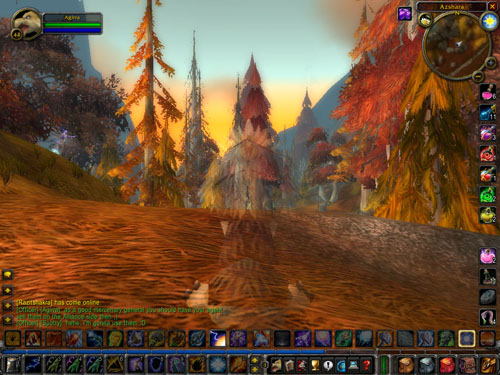
Can anybody tell me if it is actually the year turning, or if it's always autumn in Azshara? (and Hillsbrad Foothills as well.)
Subscribe to:
Posts (Atom)


 Posts
Posts