Accidentally, as I was following up on other topics, I found that there is a wonderful drama playing out in the Norwegian blogosphere, complete with a sobbing bride, nasty, greybearded men and a handsome football-player. OK, the football-player has very little to do with it, but he's a very good-looking accessory.
So, what happened here?
A young and beautiful woman works part-time as a journalist in an online paper, and is fashion editor and co-owner of an online magasine. At the same time she is making money on her fashion/lifestyle weblog: Fotballfrue - football wife (yeah, that's where the handsome man comes in).
So, somebody reads that she has income from a lot of different sources, and they question her ethics (and they do it while she is on a honeymoon, how rude!) in an article about fashion weblogs.
There are a lot of bloggers who have very high hit numbers, and use this commercially. Fashion blogging is "in" at the moment, and so the companies pay the young and the beautiful to let others know what they wear and use. The principle is nothing new, it's pretty much the same as sponsoring skaters while they were the "cool", or athletes, for that matter. Ohh, again, almost a reference to the handsome husband who never really enters the story!
Anyway: Some fashion bloggers do it to make money, some do it to create a name for themselves, to build their street cred. However, being a good fashion blogger takes a lot of money, in order to keep up their fresh front they need to be seen in the most interesting, newes and fanciest outfits available - and what is better than getting paid to do this, alternatively getting the products directly and free from the producers?
So far so good. But what if you are trying to build not just street cred, but actually become a journalist and an editor of a magasine? What should the smart fashion blogger do? Oh, and by the way, "journalist" isn't a title you get by getting an education and a license, like "medical doctor" or "lawyer," it's something you become if you practice journalism. So if you don't practice journalism, you are not a journalist, no matter how much education you have.
The whole issue with the football wife isn't really that she writes on order for companies. The issue is that she at the same time calls herself a journalist and an editor. She acts as a marketing officer, without making that obvious in the different posts, while also trying to build the trust and reputation she needs in order to be taken seriously as a journalist. And when she is criticised she claims that blogging isn't journalism, and so she can do what she likes.
She is, in a way, right. On "fotballfrue" she is her own editor, owner and writer. As long as she doesn't harass anybody, she can write what she likes. If her business strategy is to promote objects or trends for whoever pays her (are those fake louboutins, or real?) then she can do that to her heart's content on her blog. She will gain a lot of treet cred among other fashion bloggers, and probably among her followers as well. And she is right, her blog isn't journalism.
Does that mean blogging isn't journalism? No, because if she wrote according to the standards of journalism, her blog would be journalism. Again, journalism is a practice, not a license or a stamp put on only some organisations.
Back to the drama.
The pretty young lady is a part-time stand-in for Side2.no. So she is, at best, part-time freelancing as a journalist. It's not really anybody's business how she spends her time when she's not working for them, and Side2.no can stop using her when ever they like.
And that's what really should come out of this story: she doesn't have a job, she has a pretty face, a fashion blog, and ambitions to become an editor. In a case like that, what is the smart strategy?
I find myself firmly on the side of the grey-bearded evil, which isn't so odd, since I am turning pretty grey as well. She should clean up her blogging act, and stop selling her opinions to the highest bidder. People who write commercials for pay are not welcome in the journalism union in Norway, and when journalists change jobs and go into marketing, they need to swap unions. It's how it goes. If she wants to go that way, she needs to adjust to the standards, or she will have no journalistic credibility.
However... she might not want or need it. She's young, she's pretty, and people are paying her to wear beautiful clothes. Why should she worry about journalism? But then I'd recommend that she removes the "journalist" title from her webpage. If you don't practice journalism, you aren't a journalist. If you claim you are, you will be criticised. I am sorry, really, and it's horrible that people are letting you know this while you're on your honey-moon, but that's how it is.
Oh, and have a wonderful time. Your life looks like a slice of marketing heaven.
----
Corrected due to Undre's comment, thanks.
Monday, November 22, 2010
Friday, November 19, 2010
Thinking in your first language
This was supposed to be a post about cheating, and ghost-writing academic articles. However, Lisbeth connected it to educational language politics, and that started this. Read at your own peril - it's all about language and education from somebody who only knows half of it.
When ever I spend a lot of time away from Norway, my language suffers. Three - four weeks into a long stay in an English language country, and I forget all language. I am unable to formulate thoughts and ideas, numbed by the constant translation that takes place in my head, even if I do think in the language I speak. I am suffering a version of this here in Denmark, not as harsh, but more subtle and exhausting, as the constant translations in my head are concerned with subtle details. The only cure is to immerse myself, for a while, in Norwegian, to soak up the words, the music of the dialects, the structure of the sentences. I need to find the voice of my original thoughts in order to find a voice at all.
When I had this experience the first time, I never connected it to the language conflicts which gave birth to nynorsk - new Norwegian - or the political struggle for first language classes for non-Norwegian-speakers in school. But then I discovered a pattern: How not hearing or speaking my own language exhausts me, numbs me and slows me down. It doesn't replace one language with another, it takes away all languages, and I struggle in my search for words.
I guess you are now not surprised the to learn that no, I don't think there should be a lingua franca which all academics should use, from school-children up to professors. I also don't think we should force all students to write all their work in for instance English, just because it will make it easier for an American scholar to read their papers.
This doesn't mean I think we should stop communicating. I am truely grateful that I can talk to Italians, Portuguese, Koreans, Turkish, French and Finns without me having to learn 6 more languages. I'd love to, but I'd need some serious state grants to support the learning period. What I mean is that in order to be able to use our energy on thinking, language needs to take the back seat. We shouldn't insist that our students constantly struggle with words when what we want them to struggle with to be ideas, concepts, theories, hypothesis and arguments. It is enough, really. After all, if they, like me, were born to a social strata where higher education was a far away dream, not an everyday chore, then learning to be an academic is a whole new language in itself.
I would like to see two directions for language in education. First, I would like to see the language education in general strenghtened, and with it culture and literature. People who speak more than one language fluently are more empathic, think quicker, assimilate knowledge faster and in general appear to have more flexible minds. So that's a resounding yes for more emphasis on languages. However, I'd like education to contain more than two languages. We should learn to speak and regularly be encouraged to practice 3 or four languages. Why? Because if we can listen to how another person speaks in their own language, we will meet them as very different persons.
When we study, we should be allowed to learn in our own language, learn to have discourse within our own culture. With a base in the mother tongue, we should then challenge others, stretching ourselves in order to learn not only mastery of another academic tradition of discourse, but also respect for it, for the difficulties others need to overcome in order to communicate with us. It is hard to be a foreign student. It is hard to be an academic from a small country, forced to publish and cooperate internationally. But we should focus on the benefits to be had by learning not just one or two languages, so we can get by, but several: opening the world to us in a very different way.
If internationalisation is to get anywhere, we need to teach how to communicate. Even today, that means in more than one language - but it also means honouring our own while we do it.
When ever I spend a lot of time away from Norway, my language suffers. Three - four weeks into a long stay in an English language country, and I forget all language. I am unable to formulate thoughts and ideas, numbed by the constant translation that takes place in my head, even if I do think in the language I speak. I am suffering a version of this here in Denmark, not as harsh, but more subtle and exhausting, as the constant translations in my head are concerned with subtle details. The only cure is to immerse myself, for a while, in Norwegian, to soak up the words, the music of the dialects, the structure of the sentences. I need to find the voice of my original thoughts in order to find a voice at all.
When I had this experience the first time, I never connected it to the language conflicts which gave birth to nynorsk - new Norwegian - or the political struggle for first language classes for non-Norwegian-speakers in school. But then I discovered a pattern: How not hearing or speaking my own language exhausts me, numbs me and slows me down. It doesn't replace one language with another, it takes away all languages, and I struggle in my search for words.
I guess you are now not surprised the to learn that no, I don't think there should be a lingua franca which all academics should use, from school-children up to professors. I also don't think we should force all students to write all their work in for instance English, just because it will make it easier for an American scholar to read their papers.
This doesn't mean I think we should stop communicating. I am truely grateful that I can talk to Italians, Portuguese, Koreans, Turkish, French and Finns without me having to learn 6 more languages. I'd love to, but I'd need some serious state grants to support the learning period. What I mean is that in order to be able to use our energy on thinking, language needs to take the back seat. We shouldn't insist that our students constantly struggle with words when what we want them to struggle with to be ideas, concepts, theories, hypothesis and arguments. It is enough, really. After all, if they, like me, were born to a social strata where higher education was a far away dream, not an everyday chore, then learning to be an academic is a whole new language in itself.
I would like to see two directions for language in education. First, I would like to see the language education in general strenghtened, and with it culture and literature. People who speak more than one language fluently are more empathic, think quicker, assimilate knowledge faster and in general appear to have more flexible minds. So that's a resounding yes for more emphasis on languages. However, I'd like education to contain more than two languages. We should learn to speak and regularly be encouraged to practice 3 or four languages. Why? Because if we can listen to how another person speaks in their own language, we will meet them as very different persons.
When we study, we should be allowed to learn in our own language, learn to have discourse within our own culture. With a base in the mother tongue, we should then challenge others, stretching ourselves in order to learn not only mastery of another academic tradition of discourse, but also respect for it, for the difficulties others need to overcome in order to communicate with us. It is hard to be a foreign student. It is hard to be an academic from a small country, forced to publish and cooperate internationally. But we should focus on the benefits to be had by learning not just one or two languages, so we can get by, but several: opening the world to us in a very different way.
If internationalisation is to get anywhere, we need to teach how to communicate. Even today, that means in more than one language - but it also means honouring our own while we do it.
Tuesday, November 16, 2010
IR 11.0 is over - thanks all
There should have been some kind of face-to-face debrief after IR 11.0, and I will at some point in the not too far future write the AOIR board with what I think they need to know (functionality of the conference organising system f.ex.,) but for now I'll just take it here.
As some noticed, I was extremely ambivalent on facebook before I went to Gothenburg. I was ambivalent in real life as well. Although some felt that there was good reason to criticize the decisions I had made about the schedule and the responses they got to their requests before the conference, neither decisions nor responses were based on lack of consideration. I had a certain number of rooms, a certain number of contributions, and a certain number of hours, and I had to make all of that sum up to a functional conference. However, the scheduling, gruelling work that it was, was just the tip of the iceberg. It covered the last 4 months of a one-year effort, an effort that started in October 2009.
This conference removed that already elusive concept "spare time," and even cut into the sacred raiding time. Rather than settling to blog, play with photos, write friends or chat, when I picked up the computer I'd start responding to emails or work on some conference detail. I am not whining. You see - I liked that. I got to write a lot of people I have not seen for years, people I have only read (about) and some total strangers who turned out to be extremely interesting scholars. What's not to like!
However, I did get tired. The last weeks before the conference I just had to give up on raiding all together, because with teaching and administration and the conference, I was working 10-12 hour days. Not quite that long weekends, but still, it's not like I followed regulations. And so, as the conference approached I dreaded it more and more, as the workload just kept increasing.
Then it started.
Most things went right. Some went wrong, and nobody could have done anything about it. (I am still really sad about Jon Bing being ill though. I think that was the biggest low of the conference.) Some were fixed before they went really wrong. But most of all, I loved the fact that people were happy there. The compact conference site, the excellent food and the work people put into their presentations and their research - as well as into each other - made it all work out surprisingly well. And the feedback afterwards still warms me, even if I was so spent at the banquet I couldn't even say thank you politely.
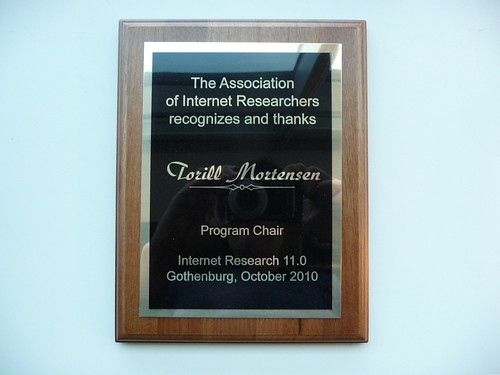
I am still proud of this plaque though, although I really don't know where to put it or how to deal with actually owning it. Makes for a fun conversation piece, and yes, it does warm, along with the praise on the aoir list and the twitter stream, now that I have realised the conference was a success!
As some noticed, I was extremely ambivalent on facebook before I went to Gothenburg. I was ambivalent in real life as well. Although some felt that there was good reason to criticize the decisions I had made about the schedule and the responses they got to their requests before the conference, neither decisions nor responses were based on lack of consideration. I had a certain number of rooms, a certain number of contributions, and a certain number of hours, and I had to make all of that sum up to a functional conference. However, the scheduling, gruelling work that it was, was just the tip of the iceberg. It covered the last 4 months of a one-year effort, an effort that started in October 2009.
This conference removed that already elusive concept "spare time," and even cut into the sacred raiding time. Rather than settling to blog, play with photos, write friends or chat, when I picked up the computer I'd start responding to emails or work on some conference detail. I am not whining. You see - I liked that. I got to write a lot of people I have not seen for years, people I have only read (about) and some total strangers who turned out to be extremely interesting scholars. What's not to like!
However, I did get tired. The last weeks before the conference I just had to give up on raiding all together, because with teaching and administration and the conference, I was working 10-12 hour days. Not quite that long weekends, but still, it's not like I followed regulations. And so, as the conference approached I dreaded it more and more, as the workload just kept increasing.
Then it started.
Most things went right. Some went wrong, and nobody could have done anything about it. (I am still really sad about Jon Bing being ill though. I think that was the biggest low of the conference.) Some were fixed before they went really wrong. But most of all, I loved the fact that people were happy there. The compact conference site, the excellent food and the work people put into their presentations and their research - as well as into each other - made it all work out surprisingly well. And the feedback afterwards still warms me, even if I was so spent at the banquet I couldn't even say thank you politely.
I am still proud of this plaque though, although I really don't know where to put it or how to deal with actually owning it. Makes for a fun conversation piece, and yes, it does warm, along with the praise on the aoir list and the twitter stream, now that I have realised the conference was a success!
Sunday, October 17, 2010
Copenhagen part 4: bikes revisited
Today about flow and control.
There's something intensely satisfying about using the bike to get around. While biker weblogs in Copenhagen worry that Danish children don't learn to play with and enjoy bicycles, I am rediscovering the sense of freedom I used to feel as a teen-ager, the agency and control the bicycle gave me.
My first bike was stolen though, and it was years until I had another bicycle of my own: at high-school I bought a Raleigh racing bike that gave me a sense of flying, as I zoomed past the cars stuck on the road into Ålesund every morning in the seventies. I used that bike for years, and I also used it to ride almost to the railway station. Now, that may not sound like such an achievement, but where I grew up that was a 2-300 kilometer ride, included crossing at least one mountain, and at the time also came with bonus sleet, the terror of brakes failing in a frozen, wet downhill trek with a heavily loaded bike, and nowhere to sleep over when I reached my destination.
Imagine my delight today, when I rode down to the railway station, zooming through the sunny, quiet Copenhagen Sunday streets, to buy tickets for the IR 11.0 conference.
Now, a regular morning or afternoon in rush traffic, biking isn't all that easy. I am learning the trick to it, and the number of rude comments yelled at me are slowly growing less, but I still have to focus. Even experienced Danes have to focus, as proven by the encounters I witness: bikers almost getting into fights as they ride side by side, disagreeing about some move that happened behind me before the two (normally male) push past me in angry competition - just to have to stand still and ignore each other at the next red light. And sometimes my biking colleagues come into the office, all shook up, talking about how they were hit - several times - by other cyclists, in the 20 minute ride through morning traffic.
Copenhagen bikers come fast and ride with intent. But on a sunny Sunday, the air crisp and clear and the sun low, throwing the glare off the water into my eyes, biking in Copenhagen is just the right balance between challenge and mastery. I own the streets. I make clever rounds in order to get at the place I want to go in the best manner, and I smile secretly at other bikers as we move smoothly from being on a vehicle to being pedestrians. We have all the options, and then some. And so I make an extra loop around the block, to come from just the right angle into the back yard, and I roll into place with a wide grin plastered all over my face. The act of biking is putting me in a flow state of mind, where I could go on and on, exploring Copenhagen just because I can.
There's something intensely satisfying about using the bike to get around. While biker weblogs in Copenhagen worry that Danish children don't learn to play with and enjoy bicycles, I am rediscovering the sense of freedom I used to feel as a teen-ager, the agency and control the bicycle gave me.
My first bike was stolen though, and it was years until I had another bicycle of my own: at high-school I bought a Raleigh racing bike that gave me a sense of flying, as I zoomed past the cars stuck on the road into Ålesund every morning in the seventies. I used that bike for years, and I also used it to ride almost to the railway station. Now, that may not sound like such an achievement, but where I grew up that was a 2-300 kilometer ride, included crossing at least one mountain, and at the time also came with bonus sleet, the terror of brakes failing in a frozen, wet downhill trek with a heavily loaded bike, and nowhere to sleep over when I reached my destination.
Imagine my delight today, when I rode down to the railway station, zooming through the sunny, quiet Copenhagen Sunday streets, to buy tickets for the IR 11.0 conference.
Now, a regular morning or afternoon in rush traffic, biking isn't all that easy. I am learning the trick to it, and the number of rude comments yelled at me are slowly growing less, but I still have to focus. Even experienced Danes have to focus, as proven by the encounters I witness: bikers almost getting into fights as they ride side by side, disagreeing about some move that happened behind me before the two (normally male) push past me in angry competition - just to have to stand still and ignore each other at the next red light. And sometimes my biking colleagues come into the office, all shook up, talking about how they were hit - several times - by other cyclists, in the 20 minute ride through morning traffic.
Copenhagen bikers come fast and ride with intent. But on a sunny Sunday, the air crisp and clear and the sun low, throwing the glare off the water into my eyes, biking in Copenhagen is just the right balance between challenge and mastery. I own the streets. I make clever rounds in order to get at the place I want to go in the best manner, and I smile secretly at other bikers as we move smoothly from being on a vehicle to being pedestrians. We have all the options, and then some. And so I make an extra loop around the block, to come from just the right angle into the back yard, and I roll into place with a wide grin plastered all over my face. The act of biking is putting me in a flow state of mind, where I could go on and on, exploring Copenhagen just because I can.
Wednesday, October 13, 2010
Copenhagen part 3: Advertising
I have watched way too much TV the last few days. The literal pain in my neck has done anything else absolutely unbearable. This means I have found myself mindlessly watching more than a few ads.
Before I left Norway, my husband noted that the trend was towards stupid men. Here, the trend is towards unreasonable, idiotic, furiously raging women. There's particularly this one television channel that annoys me at the moment, YouSee. What happens is: He, friendly, relaxed and reasonable, comes into the room, and she goes into attack mode immediately. She tells him her favourite sex in the city episode is on, and no way is she missing that rerun just so he can watch the match he has been waiting for all year. He just smiles, nods and grabs his computer. She keeps yelling, angry and obviously after a fight, but he just smiles and agrees and goes into the next room, turning on the computer. Of course, he has broadband from YouSee, and so he can get to watch all the matches he wants, without having to fight with her over it.
There are more of these, such as an ad for beer, where the women go crazy over a lovely walk-in closet in the new home of the hostess, pointing out details such as shoe-racks and large mirrors. This is all done in slightly hysterical, whiny squeals of delight. Then we hear a deep, full roar of happiness, and we see where the men have ended up in their tour of the house. They have found the important closet: the walk-in cooler for beer, where they express their delight in a manly manner, the anti-thesis to the materialistic exstacy of the squealing women.
And another: he has installed video on demand, so when she shows up with large bags full of delicacies, ready to settle down for a romantic night with dinner, a movie and some nice wine, he hasn't rented the movie he should. Instead he keeps telling her "video on demand", while she goes crazy and yells at him and walks out without him getting more than a constant repetition of those words in. He shrugs, and settles to watch the movie. Now, I am not sure who is more stupid here, he COULD have said: I have the movie, darling, I just have to put in the right codes on the TV, and we'll have a lovely evening. Instead he stands there repeating three words which obviously means nothing to her. But that's because he's so clever and "in" on what goes on, and she's a technological moron.
Somehow, I don't feel like buying YouSee, beer, or video on demand after watching those ads. I just watch the Danish Radio Culture channel (DR-K) instead. They have some extremely interesting programs on art, and artist portraits. And, most important, no ads.
Before I left Norway, my husband noted that the trend was towards stupid men. Here, the trend is towards unreasonable, idiotic, furiously raging women. There's particularly this one television channel that annoys me at the moment, YouSee. What happens is: He, friendly, relaxed and reasonable, comes into the room, and she goes into attack mode immediately. She tells him her favourite sex in the city episode is on, and no way is she missing that rerun just so he can watch the match he has been waiting for all year. He just smiles, nods and grabs his computer. She keeps yelling, angry and obviously after a fight, but he just smiles and agrees and goes into the next room, turning on the computer. Of course, he has broadband from YouSee, and so he can get to watch all the matches he wants, without having to fight with her over it.
There are more of these, such as an ad for beer, where the women go crazy over a lovely walk-in closet in the new home of the hostess, pointing out details such as shoe-racks and large mirrors. This is all done in slightly hysterical, whiny squeals of delight. Then we hear a deep, full roar of happiness, and we see where the men have ended up in their tour of the house. They have found the important closet: the walk-in cooler for beer, where they express their delight in a manly manner, the anti-thesis to the materialistic exstacy of the squealing women.
And another: he has installed video on demand, so when she shows up with large bags full of delicacies, ready to settle down for a romantic night with dinner, a movie and some nice wine, he hasn't rented the movie he should. Instead he keeps telling her "video on demand", while she goes crazy and yells at him and walks out without him getting more than a constant repetition of those words in. He shrugs, and settles to watch the movie. Now, I am not sure who is more stupid here, he COULD have said: I have the movie, darling, I just have to put in the right codes on the TV, and we'll have a lovely evening. Instead he stands there repeating three words which obviously means nothing to her. But that's because he's so clever and "in" on what goes on, and she's a technological moron.
Somehow, I don't feel like buying YouSee, beer, or video on demand after watching those ads. I just watch the Danish Radio Culture channel (DR-K) instead. They have some extremely interesting programs on art, and artist portraits. And, most important, no ads.
Tuesday, October 05, 2010
Computer games in the libraries
A very short, but very nice, press release, notifies the public that the Norwegian government suggests in the budget for 2011 to put aside 2 million Norwegian krone to buy games for libraries. "Innkjøpsordningen" is the system that secures a certain number of copies sold to public libraries of all books published from certain publishers (I don't know if self-published books count.) This will now be increased with a sum earmarked for games.
Two million krone isn't that much, but there aren't that many Norwegian language games out there. However, the most interesting part of the release was this:
Quick and dirty translation: "Computer games have become a central cultural expression and an important part particularly of the culture- and media everyday life of children and young people. The market is currently dominated by foreign games. There's a need to secure access to alternative productions with Norwegian language and content."
After years of repeating this almost every time I get asked why I think games are important and deserving of research and attention, it feels very good to see it in a public press release, as the reason for such a very sensible proposal.
And thanks to Pål, who knew I'd be very happy to see that press release!
Two million krone isn't that much, but there aren't that many Norwegian language games out there. However, the most interesting part of the release was this:
Dataspill har blitt et sentralt kulturuttrykk og er en viktig del av særlig barn og unges kultur- og mediehverdag. Markedet domineres i dag av utenlandske spill. Det er derfor behov for å sikre barn og unge tilgang til alternative produksjoner med norsk språk og innhold.
Quick and dirty translation: "Computer games have become a central cultural expression and an important part particularly of the culture- and media everyday life of children and young people. The market is currently dominated by foreign games. There's a need to secure access to alternative productions with Norwegian language and content."
After years of repeating this almost every time I get asked why I think games are important and deserving of research and attention, it feels very good to see it in a public press release, as the reason for such a very sensible proposal.
And thanks to Pål, who knew I'd be very happy to see that press release!
Tuesday, September 28, 2010
IR 11.0 program update
I am stuck in an EU ICT conference in Brüssels, which, ironically, offers an outrageously bad internet connection both at the conference center and at the hotel. This means that I can not respond to the many email I keep getting about the conference program.
The program is as finished as I can make it until I know more about who are withdrawing from the conference. This draft should have been published last week. This is the responsibility of the local chairs. I can not help you on that regard, and I am as eager to have this published as you are to see it.
All I can say is: This draft of the program should have been made public last week, and as far as I know it will be, any second.
The program is as finished as I can make it until I know more about who are withdrawing from the conference. This draft should have been published last week. This is the responsibility of the local chairs. I can not help you on that regard, and I am as eager to have this published as you are to see it.
All I can say is: This draft of the program should have been made public last week, and as far as I know it will be, any second.
Friday, September 24, 2010
Blame the woman
I am currently stuck at Kastrup, waiting on a flight to Paris which is already severely delayed. Now, this is no fun, but some people just can't take it. The lady informing the passengers was still delivering her message as a man stormed up to her and started telling her off. Another employee of Norwegian, the airline, told him they were really sorry, and the man backed off for a moment. 20 seconds later, he ran back, and started yelling about the crappy service, and how he never got an apology from Norwegian. The male Norwegian employee offered very polite apologies on behalf of the company. The complaining man brushed him off with: "I am not talking to you!" to keep yelling at the female.
What was that? It's not like they had different jobs, it just happened to be the woman on the loudspeaker, not the guy.
Having too much time to think about it, I have realised it's simple. It's a matter of "blame the woman." She is more vulnerable, even when she speaks with the voice of authority (the loudspeaker). Hence, she is the one to attack.
What was that? It's not like they had different jobs, it just happened to be the woman on the loudspeaker, not the guy.
Having too much time to think about it, I have realised it's simple. It's a matter of "blame the woman." She is more vulnerable, even when she speaks with the voice of authority (the loudspeaker). Hence, she is the one to attack.
Thursday, September 16, 2010
Hedonism in August
One of the topics I have been working on for a while concerns hedonism as a moral philosophy of gaming. This is, of course, frightfully ambitious, seeing that I am not philosopher. I am certain my arguments can be ripped apart quite easily by somebody who have actually studied philosophy, and not gaming. If so, feel free to find my article The player as hedonist in the Journal of gaming & virtual worlds. But for those of us who are more concerned with new ways of thinking about games and game research, I am trying to poke some holes in the idea that pleasure can be planned and designed for.
A counter-productive claim, if you are looking for a formula to make winner games, but if you're trying to gain insight into the wider processes of gaming it's very important to keep looking for different viewpoints. And so I have thrown one of mine out there, going out on thin ice for the sake of trying to carry an argument across.
A counter-productive claim, if you are looking for a formula to make winner games, but if you're trying to gain insight into the wider processes of gaming it's very important to keep looking for different viewpoints. And so I have thrown one of mine out there, going out on thin ice for the sake of trying to carry an argument across.

Tuesday, September 07, 2010
CPH p.2: So you think you can ride?
Moving to Copenhagen meant bringing my bike - of course. After all, Copenhagen has a strong bicycle culture and an eager biker population, with their special interest advocates, such as Mikael at Copenhagenize.com. I used to ride my bike to school in the summer half of high school, rushing past the stuck cars at home, I went biking around the fjords and mountains for fun (and love - strong motivator, that) during the summers, and I rode my bike to work down the steep Bergen hills - and back up, to regain strength after a car accident. When I went to Umeå as a visiting scholar, I brought my bike, riding through the winter on spiked tires. I thought I knew about riding a bicycle. It's a motor skill you don't really forget, right?
Well, Copenhagen has revealed several of my bad habits.
At first glance, it's extremely easy to ride a bike in Copenhagen. There are the famous Copenhagen lanes separating cars from bikes and pedestrians, and the cutest little traffic lights with red, yellow and green bikes to tell you when to go and when to pause. You go to the tourist information or your hotel or the parking authorithy, and you ask for a bicycle map to find all the best biking routes, and you have donned your helmet - preferably, since you're as vain as me, some fashionable version camouflaged as an elegant hat or a fancy cap, or a smooth helmet painted to match your bike or your outfit. After all, biking in the city, you want to look chic.
Now, off you go - and suddenly you discover the Copenhagen bikers' glare. Danes are pretty polite, and tolerant of tourists, but do mind that glare. Did you pause in the wrong side of the lane? There will be a tingling bell - and a glare. Did you forget to signal your slow-down and stop? There's that glare. Did you turn the wrong direction? A muttered "shit" and that glare, again. Slowly, you'll be getting it: you're doing something wrong, and it's time to figure out what before something happens.
First: signals. If you like me learned about traffic safety and biking in school, then you know about using your hands to signal right and left. However, Copenhagen has a third signal: stop. It's used for stopping at the curb, for turning off to the side to wait for the crossing light, for having reached your destination and stopping to park your bike. You lift a hand (optional which) and hold it straight up, either open or as a fist, doesn't matter. And you preferably do it early, or somebody will hit your from behind, and you'll get a lot more than a glare.
Next: attention. At the beginning you're happy to avoid being hit by cars. Then you start congratulating yourself that you don't hit any pedestrians. Then you discover all the bikers glaring at you, and you realise it's time to look out for other bikers. This is when you learn to look before you turn. You see, the lanes are not one-track lanes, but two and sometimes three or four-track lanes. It works just like with cars, slow to the right, faster to the left. Once you have passed your obstacle, you fall in to the right again. Unless you're chatting with your friend at your side. Danes can talk and bike at the same time. Astounding capacity. When you're at that level, you stop caring about the glare, because you're riding with that easy balanced arrogance that comes with knowing you're looking better and getting stronger and more healthy with every turn of the wheel. Yeah, they look good.
Anyway, about that attention. Don't let those good looks distract you. What you're looking for is traffic, and you need to learn how to anticipate it. See that group of people and the bus just pulling in? They will pass through the bike lane in a second. See those tourists messing around, waiting to cross? They don't know about the bike lane, and they will block you. And behind you - catch that faint hum? You're being overtaken, and you need to check for that if you plan to shift out to pass the biker in front of you. And DO mind the red lights. Biking like a maniac to the next light just to have to stop is a waste of energy. Ease up slowly, and hope it shifts to green before you have to stop. It's not like there's always a railing to hang on to. But you're learning.
Soon you'll discover the more subtle signs of Danish biking culture. Like the turned up or tucked in right pant-leg. In the summer half of the year it's mostly turned up, to avoid getting the pants into the chain. That's when you'll notice another little subtle thing: when you wear sandals and your pants are short or tucked up, your ankle tattoo will show! That is, of course, given that you have biked around in Christiania or downtown for long enough to decide you really want a nice little decoration on your right ankle. I have never before seen that many ankle tattoos as I saw this summer, tucked neatly between the shoe and the short or turned-up pants.
Now you're ready for another difficult biking exercize: finding a parking spot. I know people who don't bike in Copenhagen because it's such a hazzle to park. Yeah. But don't despair - despite the many angry glares you'll get if you put your bike in front of shop windows, there are thousands of designated parking spots all over town. And some of them are pretty damn good. Like the ITU basement, which is to a large extent dedicated to parking bicycles.
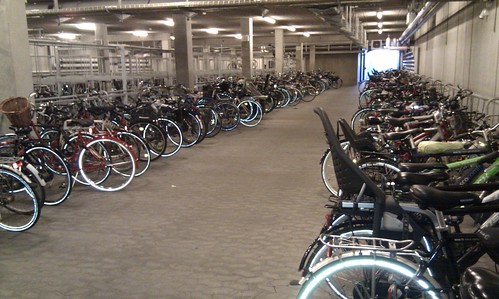
And yes, my bike is there, today as most days. Sometimes sore, sometimes soaked, sometimes just happy to have gotten here on time - but I live 10 minutes away by bike, and I love it.
Well, Copenhagen has revealed several of my bad habits.
At first glance, it's extremely easy to ride a bike in Copenhagen. There are the famous Copenhagen lanes separating cars from bikes and pedestrians, and the cutest little traffic lights with red, yellow and green bikes to tell you when to go and when to pause. You go to the tourist information or your hotel or the parking authorithy, and you ask for a bicycle map to find all the best biking routes, and you have donned your helmet - preferably, since you're as vain as me, some fashionable version camouflaged as an elegant hat or a fancy cap, or a smooth helmet painted to match your bike or your outfit. After all, biking in the city, you want to look chic.
Now, off you go - and suddenly you discover the Copenhagen bikers' glare. Danes are pretty polite, and tolerant of tourists, but do mind that glare. Did you pause in the wrong side of the lane? There will be a tingling bell - and a glare. Did you forget to signal your slow-down and stop? There's that glare. Did you turn the wrong direction? A muttered "shit" and that glare, again. Slowly, you'll be getting it: you're doing something wrong, and it's time to figure out what before something happens.
First: signals. If you like me learned about traffic safety and biking in school, then you know about using your hands to signal right and left. However, Copenhagen has a third signal: stop. It's used for stopping at the curb, for turning off to the side to wait for the crossing light, for having reached your destination and stopping to park your bike. You lift a hand (optional which) and hold it straight up, either open or as a fist, doesn't matter. And you preferably do it early, or somebody will hit your from behind, and you'll get a lot more than a glare.
Next: attention. At the beginning you're happy to avoid being hit by cars. Then you start congratulating yourself that you don't hit any pedestrians. Then you discover all the bikers glaring at you, and you realise it's time to look out for other bikers. This is when you learn to look before you turn. You see, the lanes are not one-track lanes, but two and sometimes three or four-track lanes. It works just like with cars, slow to the right, faster to the left. Once you have passed your obstacle, you fall in to the right again. Unless you're chatting with your friend at your side. Danes can talk and bike at the same time. Astounding capacity. When you're at that level, you stop caring about the glare, because you're riding with that easy balanced arrogance that comes with knowing you're looking better and getting stronger and more healthy with every turn of the wheel. Yeah, they look good.
Anyway, about that attention. Don't let those good looks distract you. What you're looking for is traffic, and you need to learn how to anticipate it. See that group of people and the bus just pulling in? They will pass through the bike lane in a second. See those tourists messing around, waiting to cross? They don't know about the bike lane, and they will block you. And behind you - catch that faint hum? You're being overtaken, and you need to check for that if you plan to shift out to pass the biker in front of you. And DO mind the red lights. Biking like a maniac to the next light just to have to stop is a waste of energy. Ease up slowly, and hope it shifts to green before you have to stop. It's not like there's always a railing to hang on to. But you're learning.
Soon you'll discover the more subtle signs of Danish biking culture. Like the turned up or tucked in right pant-leg. In the summer half of the year it's mostly turned up, to avoid getting the pants into the chain. That's when you'll notice another little subtle thing: when you wear sandals and your pants are short or tucked up, your ankle tattoo will show! That is, of course, given that you have biked around in Christiania or downtown for long enough to decide you really want a nice little decoration on your right ankle. I have never before seen that many ankle tattoos as I saw this summer, tucked neatly between the shoe and the short or turned-up pants.
Now you're ready for another difficult biking exercize: finding a parking spot. I know people who don't bike in Copenhagen because it's such a hazzle to park. Yeah. But don't despair - despite the many angry glares you'll get if you put your bike in front of shop windows, there are thousands of designated parking spots all over town. And some of them are pretty damn good. Like the ITU basement, which is to a large extent dedicated to parking bicycles.
And yes, my bike is there, today as most days. Sometimes sore, sometimes soaked, sometimes just happy to have gotten here on time - but I live 10 minutes away by bike, and I love it.
Monday, September 06, 2010
Is there a rythm to gaming?
All who have played games know there is a rythm to them, an ebb and flow of activity and energy, back and forth, sometimes like a tango where the participants are evenly matched and push, give and counter with intense focus, sometimes like the inexorable march of the invading feet as the stronger participants lay waste to all opposition. From the lighthearted singsong of easy togetherness to the complex concert of a well-rehearsed team, yes, there is a rythm to play and to games.
But to gaming, as a phenomenon? Is there a flow and counter, an emerging patterns of back and forth, intensity and slack? I don't know, but Tom Apperley is looking for it. In his quite new and fresh book Gaming Rhythms: Play and Counterplay from the Situated to the Global the topic appears to be an assumption of interconnectedness of gaming practices, globally.
It is an extremely interesting thought, and I am looking forwards to seeing there Tom Apperley takes it.
But to gaming, as a phenomenon? Is there a flow and counter, an emerging patterns of back and forth, intensity and slack? I don't know, but Tom Apperley is looking for it. In his quite new and fresh book Gaming Rhythms: Play and Counterplay from the Situated to the Global the topic appears to be an assumption of interconnectedness of gaming practices, globally.
It is an extremely interesting thought, and I am looking forwards to seeing there Tom Apperley takes it.
Wednesday, August 25, 2010
When businesses discover games
From my friend Esther Ewing, a link to some talks published in TED: When games invade real life by Jesse Schell, and The game layer on top of the world by Seth Priebatsch.
Both talks focus on how gaming is becoming the new money-maker, and how it is possible to learn from game design in order to make more and more money. In Priebatsch' presentation the main topic is the connection between farmville and facebook, and how farmville can stop the world. Schell's presentation is a pretty dystopic discussion of a totalitarian surveillance state where game strategies are used to make people serve the system - mainly the commercial system.
Although it doesn't really bring anything new to gaming, these talks are interesting for a few reasons.
First: They don't bother to mention that what we are really seeing is that game designers are using techniques used in advertising since late 1700, not "new and fantastic" strategies developed by game designers. After all, letting people know that games are just doing what PR departments have done since Barnum would not pay as well - nor play as well.
Second: They don't care about the GAME part of gaming, only about the score, grind and production part. Which means they forget what a game is. An example used by Jesse Schell is Lee Sheldon's grading levels, where he lets students level up in class. That's cool, really, the grading systems in most Universities are outdated and inflexible, and doesn't really provide detailed feedback. However, changing the grading system isn't a novel idea! In Sunday school we got gold stars if we were good, and went there to collect those stars. Well, I was bad, so I hardly ever had any, but what's the difference between a gold star and a level, and why is it novel?
Still, it's an interesting way to spend some time, to see how gaming is now an acceptable metaphor for "new ways to make people do what we want, without complaining." Enjoy.
---
Update: I tried to remember where I touch - briefly - on games as totalitarian systems, and it's in the upcoming article in one of the next issues of this year's Journal of Gaming and Virtual Worlds. There, now I pitched myself a little too.
Both talks focus on how gaming is becoming the new money-maker, and how it is possible to learn from game design in order to make more and more money. In Priebatsch' presentation the main topic is the connection between farmville and facebook, and how farmville can stop the world. Schell's presentation is a pretty dystopic discussion of a totalitarian surveillance state where game strategies are used to make people serve the system - mainly the commercial system.
Although it doesn't really bring anything new to gaming, these talks are interesting for a few reasons.
First: They don't bother to mention that what we are really seeing is that game designers are using techniques used in advertising since late 1700, not "new and fantastic" strategies developed by game designers. After all, letting people know that games are just doing what PR departments have done since Barnum would not pay as well - nor play as well.
Second: They don't care about the GAME part of gaming, only about the score, grind and production part. Which means they forget what a game is. An example used by Jesse Schell is Lee Sheldon's grading levels, where he lets students level up in class. That's cool, really, the grading systems in most Universities are outdated and inflexible, and doesn't really provide detailed feedback. However, changing the grading system isn't a novel idea! In Sunday school we got gold stars if we were good, and went there to collect those stars. Well, I was bad, so I hardly ever had any, but what's the difference between a gold star and a level, and why is it novel?
Still, it's an interesting way to spend some time, to see how gaming is now an acceptable metaphor for "new ways to make people do what we want, without complaining." Enjoy.
---
Update: I tried to remember where I touch - briefly - on games as totalitarian systems, and it's in the upcoming article in one of the next issues of this year's Journal of Gaming and Virtual Worlds. There, now I pitched myself a little too.
Tuesday, August 17, 2010
Desire, art and the metro
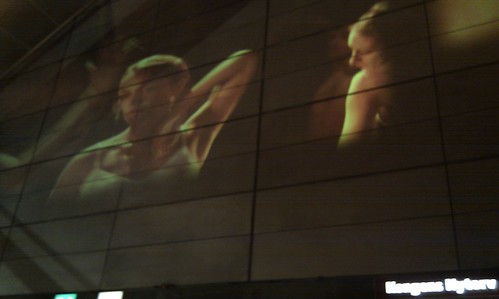
This morning it was raining in a far too familiar way, so I decided to get on the metro rather than the bicycle. Cycling is quicker, but I wanted to spend the day at the office fairly dry, so off I went. That turned out to be a really bad decision, since the metro didn't run to where I wanted to go, due to the weather. Yeah.
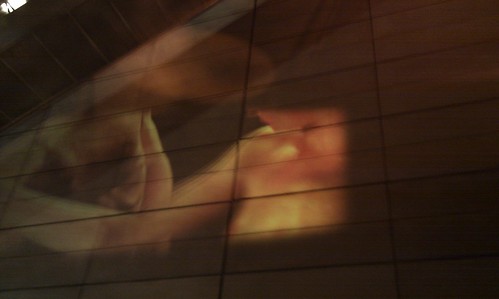
However, in a way it was a good decision. In Kongens Nytorv, my local station, there's an art installation this week by a group calling themselves Urban Forest. Through music, soft lightening and moving images, they want to turn the otherwise pretty drab and functionalistic metro station into a very different experience.
I watched the flowing images for a minute, cursing myself for leaving the camera behind, when I realised that - hey, I hadn't! After all, in my pocket recided my new übergadget, the new smartphone!
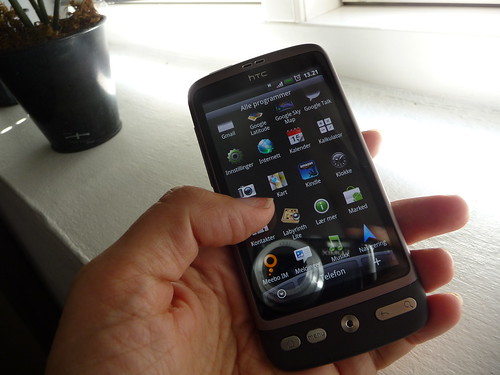
In a few seconds I was clicking away. The connection down at the bottom of the Nytorv station was however too weak to upload, and by the time I had realised my train was never coming, I had to take another and then change at the next stop, and the train at the next stop was never coming and I had to walk, well, uploading was out of my mind.
Still, it's only a few hours later, and I got to upload through the ITU wireless. The pictures were surprisingly good, considering they were taken with a phone in very low light, in the morning rush.
Sunday, August 15, 2010
Moving to Denmark - August edition 2010
In a lot of ways, the move to Denmark has been much smoother and easier than the move (for a year) to Sweden. Most important is probably that I knew both Copenhagen and ITU pretty well, while I had never been to Umeå nor Umu before I went there.
I think one of the things that has made it all much easier, is that I got a personal number, or CPR - central personal registry number (?) right away. With that I got a dancard, which appears to be THE card all danes carry, a health card, and could immediately get the correct taxes and get into the ITU salary rolls. Money is useful stuff.
Next, I knew a lot more people when I arrived to Copenhagen. I have been here a month, and will have to spend a month (well, the week-ends) just inviting people over for dinner to make up for the generousity I have met. In Copenhagen I have semi-adopted family, colleagues I am really happy to meet again after 12 years on the same conference tracks, colleagues I think of as friends and LOVE to hang with, people I have met online who turned out to be fun company, and the Copenhagen members of the guild Tooth and Claw, who showed up at my door, filled my tiny apartment until it was about to burst, and then dragged me out into fresh night air for drinks and geekery. Copenhagen has made me feel welcomed indeed.
While I loved the place I lived in Umeå, I am exstatic about this neighbourhood. I live right downtown Copenhagen, by the both famous and infamous Nyhavn, in a lovely street just busy enough that I feel I live in a city, and peaceful enough that I don't feel any of the aggravation people report from living in cities. There's life, but no mind-wrecking noise making me dream of water on pebbles - the nightly noise of Volda. Well, at least not yet.
School hasn't started yet, but I am to teach two classes, Digital Rhetorics and Digital Culture and Society. I am exited both about the topics and about the people I am to cooperate with: Lisbeth and TL are wonderful people I have always felt inspired by. It makes me want to stretch, and I am looking forwards to engaging with the topics.
There's still a lot to be done, but I now have to leave a large chunk of it to my husband. He has to finish up in Volda, before I can seriously engage with finding a place to live for us all here. Right now there's a buyer's market on property, and if we're lucky, we won't have to turn to begging to get a place we like to live in.
Now, excuse me. I have to go explore what the clapping and cheering is about, at the harbour. It does sound like fun.
I think one of the things that has made it all much easier, is that I got a personal number, or CPR - central personal registry number (?) right away. With that I got a dancard, which appears to be THE card all danes carry, a health card, and could immediately get the correct taxes and get into the ITU salary rolls. Money is useful stuff.
Next, I knew a lot more people when I arrived to Copenhagen. I have been here a month, and will have to spend a month (well, the week-ends) just inviting people over for dinner to make up for the generousity I have met. In Copenhagen I have semi-adopted family, colleagues I am really happy to meet again after 12 years on the same conference tracks, colleagues I think of as friends and LOVE to hang with, people I have met online who turned out to be fun company, and the Copenhagen members of the guild Tooth and Claw, who showed up at my door, filled my tiny apartment until it was about to burst, and then dragged me out into fresh night air for drinks and geekery. Copenhagen has made me feel welcomed indeed.
While I loved the place I lived in Umeå, I am exstatic about this neighbourhood. I live right downtown Copenhagen, by the both famous and infamous Nyhavn, in a lovely street just busy enough that I feel I live in a city, and peaceful enough that I don't feel any of the aggravation people report from living in cities. There's life, but no mind-wrecking noise making me dream of water on pebbles - the nightly noise of Volda. Well, at least not yet.
School hasn't started yet, but I am to teach two classes, Digital Rhetorics and Digital Culture and Society. I am exited both about the topics and about the people I am to cooperate with: Lisbeth and TL are wonderful people I have always felt inspired by. It makes me want to stretch, and I am looking forwards to engaging with the topics.
There's still a lot to be done, but I now have to leave a large chunk of it to my husband. He has to finish up in Volda, before I can seriously engage with finding a place to live for us all here. Right now there's a buyer's market on property, and if we're lucky, we won't have to turn to begging to get a place we like to live in.
Now, excuse me. I have to go explore what the clapping and cheering is about, at the harbour. It does sound like fun.
Tuesday, July 27, 2010
IR 11.0 and accomodations
Ted Copman has started collecting information for a wiki, with travel tips for Gothenburg and IR 11.0. Useful stuff indeed!
Thursday, July 22, 2010
First day at school!
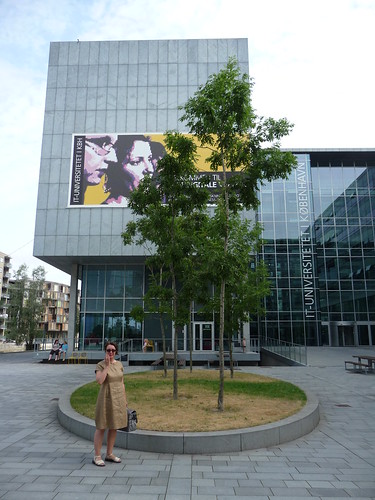
I have worked here a whole week now, but still feel a little awed by this high-tech building, trying to get into being here. The place is empty and quiet during the holidays, and it's also opressively hot. So is all of Copenhagen though, it's really different for a poor Norwegian dumped here.
The reception was wonderful. Flowers, a grand tour with our appointed guides, and introductions all around. Another colleague started at the same time: Adriana Araujo de Souza e Silva. Coming from Brazil, I suspect she's more used to the weather here right now than I am. I'll have to show off my autumn survival skills later.
I am slowly getting my head around some of all the things that need to be set. So far it's running a lot more smoothly than when I went to Sweden, but that may be because I am more prepared for the difficulties of changing countries. The Danes seem more familiar though, than the Swedes - a bit more easy-going and less formal. I am sure I'll be clobbered over the head with differences any minute now, though. I have a new phone, a new account (no money yet though), a place to live and a vague map of the place in my head. For a woman who's used to navigating by "up" and "down" this "flat" is somewhat disturbing. I lose the sense of distance, and there appear to be no limits the the sprawl of the city.
One thing is very different. I have managed to get a tan. Now, if you live in a place on the planet where most of the time is spent avoiding the sun, you have no idea how different this is. But for us who are more familiar with full-body rain wear than with sunblock, a tan is something to be desired and cherished, both for the variation (for once, not vampire wannabe) and for the health effects. Sunlight can not only cause cancer, but also protect against it. At the same time vitamin D is vital to protect against a lot of other cancers. This last article is interesting, by the way, as it's questioning one of the great dietary myths: That of the benefits of polyunsaturated fats.
Finally research is starting to see what Scandinavians have known for ever: sunlight is good for your health. And so you'll find us on the beaches, at the pools, on verandas, in gardens, stripped of as much clothing as we can for decency remove, and ready to soak up those rays.
Me, I am still trying to get some things in place before I hit the beach. I will though, believe me, I will.
Tuesday, July 06, 2010
Transition
I am not writing much these days. I wake up in the morning, and start sorting something. Everything goes into one of three categories: throw, give away, keep. Then the "keep" stack is split into pack, use, Copenhagen now.
The biggest challenge were the books. We have reduced 25 years of collecting books to one (full) book cabinet. There's no way I am throwing out the graphic novels, those are still stored here and there through the house. The books got split into keep, give away, and store in a secret location until we can't keep them there any more and need to do something about it.
I have gone through letters, clothes, drawings, several drafts to the greatest Norwegian novel in modern times, a million pictures (keep) and a seemingly endless amount of pens and pencils in the strangest places. The kids kept some of their toys, but I am keeping more... Like the little red and white cat, that had to get its head sewn back on. And the brown and grey puppy that saved the night so many times. That beautiful puzzle that was the advent gift one year. The red christmas dress she wore when she left the table to raid the bags of her aunt, eating bread with brown cheese under the table while the rest sat down for the Christmas evening dinner.
It's wonderful and sweet, and I keep letting go of so many things. The letters - it's incredible how many letters we used to write once. Ribbons, cheap jewelry, old glasses, ugly promotional mugs. When we sell the house and get rid of most of the furniture, we'll be where I planned: having reduced the clutter in my life by at least half. My husband eyes the beautiful glasses in the cabinet with an evil eye. I told him to pick one glass he could do without. He found two. When I showed him which I wanted to be without, he refused. Those were the ones he liked. He is as bad as me. I find him lost in old diaries, digging through old letters. He touches hand-knitted sweaters with a loving hand, muttering about how wonderful those were, once, how much pleasure we had from them. Old tickets, old passports, scraps saved in order to make a scrap book - he savours them, and I sneak in behind him and trash what he puts down for too long.
We are getting there, though. I have sorted out the plates and cups we don't want to keep, knives and forks, CDs and videos. We have even sorted coins. Today I packed my shoes: use, store, bring, thrash. The boy laughed, and shook his head when I tried on all the pairs. I managed to get rid of - mainly to the salvation army - 10 pairs. I didn't count how many I kept. I took pictures though, of the shoes lined up on the livingroom floor, looking like they were planning an escape through the door.
It's raining and cold. I think I'll be able to leave this place. But the roots have to be severed string by string, trashed, stored or to be brought with me.
The biggest challenge were the books. We have reduced 25 years of collecting books to one (full) book cabinet. There's no way I am throwing out the graphic novels, those are still stored here and there through the house. The books got split into keep, give away, and store in a secret location until we can't keep them there any more and need to do something about it.
I have gone through letters, clothes, drawings, several drafts to the greatest Norwegian novel in modern times, a million pictures (keep) and a seemingly endless amount of pens and pencils in the strangest places. The kids kept some of their toys, but I am keeping more... Like the little red and white cat, that had to get its head sewn back on. And the brown and grey puppy that saved the night so many times. That beautiful puzzle that was the advent gift one year. The red christmas dress she wore when she left the table to raid the bags of her aunt, eating bread with brown cheese under the table while the rest sat down for the Christmas evening dinner.
It's wonderful and sweet, and I keep letting go of so many things. The letters - it's incredible how many letters we used to write once. Ribbons, cheap jewelry, old glasses, ugly promotional mugs. When we sell the house and get rid of most of the furniture, we'll be where I planned: having reduced the clutter in my life by at least half. My husband eyes the beautiful glasses in the cabinet with an evil eye. I told him to pick one glass he could do without. He found two. When I showed him which I wanted to be without, he refused. Those were the ones he liked. He is as bad as me. I find him lost in old diaries, digging through old letters. He touches hand-knitted sweaters with a loving hand, muttering about how wonderful those were, once, how much pleasure we had from them. Old tickets, old passports, scraps saved in order to make a scrap book - he savours them, and I sneak in behind him and trash what he puts down for too long.
We are getting there, though. I have sorted out the plates and cups we don't want to keep, knives and forks, CDs and videos. We have even sorted coins. Today I packed my shoes: use, store, bring, thrash. The boy laughed, and shook his head when I tried on all the pairs. I managed to get rid of - mainly to the salvation army - 10 pairs. I didn't count how many I kept. I took pictures though, of the shoes lined up on the livingroom floor, looking like they were planning an escape through the door.
It's raining and cold. I think I'll be able to leave this place. But the roots have to be severed string by string, trashed, stored or to be brought with me.
Thursday, June 10, 2010
It feels final
It isn't, really, because I have a two year leave, leaving myself the option to turn around and come back to this hideout between the mountains. This hole, my sister so lovingly describes Volda as, and she's right, it is a hole in which to hide, a sudden green spot in between black mountains. And I have been crawling back into it over and over again over the last 19 years, hiding in between my expeditions into the world.
Somehow, living in Volda, the distinction between "real" and "virtual" world feels meaningless. What's real about living here? It's so secluded, so filled with its own rules, concerns and moving by its own rythm that living in the flesh world of Volda is like living in a virtual world. The insane beauty of the place, combined with the ruthless weather, the heavy darkness and the dreariness of the third month of rain and sleet, it turns Volda into something on the flip-side of other flesh world realities. At the same time - this is it. This is the reality, because reality is made up of a million little spots like this, places of heartbreaking beauty and equally numbing mundaneity, spread like random handfuls of marbles all over the planet.
The distinction between places is more than anything, a state of mind, and somehow I suspect the Volda state of mind won't stay behind. There's a tale in Norway, about the man who got into a fight with his house "nisse", the otherworld power living on his farm, traditionally bound to the land. At the end he gave up, sold the farm and moved. Among his stuff, however, the nisse was happily singing "we're moving today."
There are parts of Volda I hope I'll never leave behind. The easy assumption that people care, the sudden closeness in times of need, the long-term strategies to protect and care for the community, those are all some of the best qualities of small-town life. And there is a nisse I really hope doesn't come with me: the pettiness, the lack of generousity towards that which is unknown, the selfish scheming, the xenophobia. Sadly, I suspect that I'll find that wherever I go, that part of human nature was there before me.
As for the college? I have loved and hated this place for 19 years. I really need to work somewhere else, at least for a while, if I want to stretch and develop beyond my own comfort zone. But I am not fleeing. I am making a strategic move, keeping the lines of retreat open. Yep, sounds much better that way.
And now the bookshelves are slowly emptying. As I write, I have barely finished F. I have quite a few boxes to go. I'll get there though, and then me and my boxes and my past will move from this early-70ies built-quickly-and-cheaply crooked box into the glass-and-steel high modernity of ITU. Oh my.
Somehow, living in Volda, the distinction between "real" and "virtual" world feels meaningless. What's real about living here? It's so secluded, so filled with its own rules, concerns and moving by its own rythm that living in the flesh world of Volda is like living in a virtual world. The insane beauty of the place, combined with the ruthless weather, the heavy darkness and the dreariness of the third month of rain and sleet, it turns Volda into something on the flip-side of other flesh world realities. At the same time - this is it. This is the reality, because reality is made up of a million little spots like this, places of heartbreaking beauty and equally numbing mundaneity, spread like random handfuls of marbles all over the planet.
The distinction between places is more than anything, a state of mind, and somehow I suspect the Volda state of mind won't stay behind. There's a tale in Norway, about the man who got into a fight with his house "nisse", the otherworld power living on his farm, traditionally bound to the land. At the end he gave up, sold the farm and moved. Among his stuff, however, the nisse was happily singing "we're moving today."
There are parts of Volda I hope I'll never leave behind. The easy assumption that people care, the sudden closeness in times of need, the long-term strategies to protect and care for the community, those are all some of the best qualities of small-town life. And there is a nisse I really hope doesn't come with me: the pettiness, the lack of generousity towards that which is unknown, the selfish scheming, the xenophobia. Sadly, I suspect that I'll find that wherever I go, that part of human nature was there before me.
As for the college? I have loved and hated this place for 19 years. I really need to work somewhere else, at least for a while, if I want to stretch and develop beyond my own comfort zone. But I am not fleeing. I am making a strategic move, keeping the lines of retreat open. Yep, sounds much better that way.
And now the bookshelves are slowly emptying. As I write, I have barely finished F. I have quite a few boxes to go. I'll get there though, and then me and my boxes and my past will move from this early-70ies built-quickly-and-cheaply crooked box into the glass-and-steel high modernity of ITU. Oh my.
Thursday, May 27, 2010
Games: Design and Research
Next week there's a small, but ambitious conference in Volda: Games: Design and Research. It's organised by Norwegian game researchers loosely connected, mainly Kristine Jørgensen (conference chair), Ragnhild Tronstad, Faltin Karlsen, Sara Brinch and me, and financed by Volda University College, University of Bergen, and the Norwegian Research Council.
If you are in the neighbourhood, feel free to drop by for a lecture or two. This conference can not accomodate more than the people participating, but the lectures are open.
If you are in the neighbourhood, feel free to drop by for a lecture or two. This conference can not accomodate more than the people participating, but the lectures are open.
Subscribe to:
Posts (Atom)


 Posts
Posts


