It isn't, really, because I have a two year leave, leaving myself the option to turn around and come back to this hideout between the mountains. This hole, my sister so lovingly describes Volda as, and she's right, it is a hole in which to hide, a sudden green spot in between black mountains. And I have been crawling back into it over and over again over the last 19 years, hiding in between my expeditions into the world.
Somehow, living in Volda, the distinction between "real" and "virtual" world feels meaningless. What's real about living here? It's so secluded, so filled with its own rules, concerns and moving by its own rythm that living in the flesh world of Volda is like living in a virtual world. The insane beauty of the place, combined with the ruthless weather, the heavy darkness and the dreariness of the third month of rain and sleet, it turns Volda into something on the flip-side of other flesh world realities. At the same time - this is it. This is the reality, because reality is made up of a million little spots like this, places of heartbreaking beauty and equally numbing mundaneity, spread like random handfuls of marbles all over the planet.
The distinction between places is more than anything, a state of mind, and somehow I suspect the Volda state of mind won't stay behind. There's a tale in Norway, about the man who got into a fight with his house "nisse", the otherworld power living on his farm, traditionally bound to the land. At the end he gave up, sold the farm and moved. Among his stuff, however, the nisse was happily singing "we're moving today."
There are parts of Volda I hope I'll never leave behind. The easy assumption that people care, the sudden closeness in times of need, the long-term strategies to protect and care for the community, those are all some of the best qualities of small-town life. And there is a nisse I really hope doesn't come with me: the pettiness, the lack of generousity towards that which is unknown, the selfish scheming, the xenophobia. Sadly, I suspect that I'll find that wherever I go, that part of human nature was there before me.
As for the college? I have loved and hated this place for 19 years. I really need to work somewhere else, at least for a while, if I want to stretch and develop beyond my own comfort zone. But I am not fleeing. I am making a strategic move, keeping the lines of retreat open. Yep, sounds much better that way.
And now the bookshelves are slowly emptying. As I write, I have barely finished F. I have quite a few boxes to go. I'll get there though, and then me and my boxes and my past will move from this early-70ies built-quickly-and-cheaply crooked box into the glass-and-steel high modernity of ITU. Oh my.
Thursday, June 10, 2010
Thursday, May 27, 2010
Games: Design and Research
Next week there's a small, but ambitious conference in Volda: Games: Design and Research. It's organised by Norwegian game researchers loosely connected, mainly Kristine Jørgensen (conference chair), Ragnhild Tronstad, Faltin Karlsen, Sara Brinch and me, and financed by Volda University College, University of Bergen, and the Norwegian Research Council.
If you are in the neighbourhood, feel free to drop by for a lecture or two. This conference can not accomodate more than the people participating, but the lectures are open.
If you are in the neighbourhood, feel free to drop by for a lecture or two. This conference can not accomodate more than the people participating, but the lectures are open.
Thursday, May 06, 2010
The real, the unreal and the passing of time
In between semester end, student supervision, guest lecturers, seminars, exam preparation, conference papers (oh no I have more mails I need to send out about that), conference organising, moving to another country and changing jobs, I am a tad busy. However, when given a forced pause (sitting in one place, looking awake), I grabbed the chance to read Playing with one’s self: notions of subjectivity and agency in digital games, by Alec Charles in Eludamos.
I have been using Baudrillard to a certain extent in my own work, and have also read with interest Ragnhild Tronstad's very interesting Doctoral thesis Interpretation, Performance, Play, & Seduction: Textual Adventures in Tubmud.
This prepared me for the sense of going back in time I experienced reading this paper. Fifteen years ago I wrote about the pseudo-interactivity in games (in Norwegian, Charles is exused for not citing that). This was the introduction to meeting Espen Aarseth, and the many, many discussions about the real meaning of interactivity, of agency and power that followed through the years I worked with my doctorate.
And this brings me back to Alec Charles' interesting text, because this is an article which could have benefited quite a bit from going back 10 years in the references. It feels amazing to be able to say this, but the discussions of game texts, literature theory and interactivity were quite heated around the change of the milennium, and a central text is the now old, but not yet, obviously, dated: Cybertext by Aarseth.
Another valuable source is (after the last years of telling people "you don't need to cite that #¤¤%& debate all the time," I never thought I'd say this) the infamous and formative ludology vs narratology debate. Much of the discussion in that debate concerns itself with the question of interactivity.
This little stroll down memory lane made me reconsider some of the things that have annoyed me the last years. Time has actually passed, and there is now enough material that it is possible to have a decent literature list for an article and still miss some of the more relevant material. This is all good, so no, I am not goign to start whining about "these young academics who don't do their homework, and everythign was so much better just 15 years ago..." It does however give a perspective to game studies, and the people who once upon a time said:
It feels like 2001 was yesterday.
When I read this and look at the material being produced only 9 years later, it feels like the years must have been very long indeed.
I have been using Baudrillard to a certain extent in my own work, and have also read with interest Ragnhild Tronstad's very interesting Doctoral thesis Interpretation, Performance, Play, & Seduction: Textual Adventures in Tubmud.
This prepared me for the sense of going back in time I experienced reading this paper. Fifteen years ago I wrote about the pseudo-interactivity in games (in Norwegian, Charles is exused for not citing that). This was the introduction to meeting Espen Aarseth, and the many, many discussions about the real meaning of interactivity, of agency and power that followed through the years I worked with my doctorate.
And this brings me back to Alec Charles' interesting text, because this is an article which could have benefited quite a bit from going back 10 years in the references. It feels amazing to be able to say this, but the discussions of game texts, literature theory and interactivity were quite heated around the change of the milennium, and a central text is the now old, but not yet, obviously, dated: Cybertext by Aarseth.
Another valuable source is (after the last years of telling people "you don't need to cite that #¤¤%& debate all the time," I never thought I'd say this) the infamous and formative ludology vs narratology debate. Much of the discussion in that debate concerns itself with the question of interactivity.
This little stroll down memory lane made me reconsider some of the things that have annoyed me the last years. Time has actually passed, and there is now enough material that it is possible to have a decent literature list for an article and still miss some of the more relevant material. This is all good, so no, I am not goign to start whining about "these young academics who don't do their homework, and everythign was so much better just 15 years ago..." It does however give a perspective to game studies, and the people who once upon a time said:
2001 can be seen as the Year One of Computer Game Studies as an emerging, viable, international, academic field. This year has seen the first international scholarly conference on computer games, in Copenhagen in March, and several others will follow. 01-02 may also be the academic year when regular graduate programs in computer game studies are offered for the first time in universities. And it might be the first time scholars and academics take computer games seriously, as a cultural field whose value is hard to overestimate.
It feels like 2001 was yesterday.
When I read this and look at the material being produced only 9 years later, it feels like the years must have been very long indeed.
Thursday, April 29, 2010
IR 11.0 results
The results are almost done, I have a small stack of papers still waiting for reviews. However, more than 90% are now decided on, so the chance is very big that you will find that the result is already available in the conference organising system. Please check in if you are impatient, I need the afternoon to finish up the last reviews before I send out the notifications.
--- update -----
For some reason, the results are not available to people. The reviewing process was delayed, and at the absolutely final deadline on the 28th the last reviews were still not in, despite the heroic efforts of several extra special volunteers. This coincided with my teaching duties. I am stuck at present, unable to put in the 10 final hours of work needed to get this done.
I can't give a time, since a lot of the things that need to be cleared up does not entirely depend on me, but I will be working on it.
--- update -----
For some reason, the results are not available to people. The reviewing process was delayed, and at the absolutely final deadline on the 28th the last reviews were still not in, despite the heroic efforts of several extra special volunteers. This coincided with my teaching duties. I am stuck at present, unable to put in the 10 final hours of work needed to get this done.
I can't give a time, since a lot of the things that need to be cleared up does not entirely depend on me, but I will be working on it.
Wednesday, April 28, 2010
Cory Doctorow on Ipads and shared content
Rupert Murdoch can rattle his saber all he likes about taking his content out of Google, but I say do it, Rupert.
Cory Doctorow points to the wonderful conenction between new technology and new content, in this careful explanation of why he doesn't want to buy an Ipad.
Tuesday, April 27, 2010
IR 11.0 chairs
No, we don't have a problem with seating for the Internet Research 11.0 conference. I just thought you'd like to see the conference chairs! Here we are, from the left to the right: conference co-chairs Ylva Hård af Segerstad, Ann-Sofie Axelsson, and me, the program chair, in Gothenburg discussing the work that needs to be done before we meet you all in October.

Thursday, April 22, 2010
Gaining the upper hand
Another article hits the digital sphere. Training, sharing, cheating is now available to the subscribers of e-learning, the journal. In 18 months it will be free, but until then: Subscribe, or be satisfied with the abstract.
This article gathers a lot of the loose threads of my thoughts through the last years, particularly my experiences from playing in guilds that raid (although casually).
This article gathers a lot of the loose threads of my thoughts through the last years, particularly my experiences from playing in guilds that raid (although casually).
Savnevise - Knutsen & Ludvigsen
Norwegians woke up this morning to hear that "Ludvigsen" is dead. It was - surreal. Not only did Gustav Lorentzen appear to be one of those upbeat, happy people who never would let age touch him, he was in great shape and died as his heart stopped during a cross-country run.
Knutsen and Ludvigsen, the team Lorentzen was a part of, wrote texts that almost all Norwegians of a certain age know by heart. The one above is perhaps the most fitting of all for the occasion, as Øystein Dolmen AKA Knutsen sings about how much he misses Ludvigsen. It is almost too sad - and still wonderful - that they wrote the music that lets us express loss in such a clear and simple manner. Thank you, Ludvigsen, for being there with us. Say hello to the badger as you pass through the tunnel.
Saturday, April 17, 2010
In the air
I love to travel. It doesn't matter how, but the process of being on the way somewhere is in itself desirable. When on a plane, train, bus or boat I relax in ways I otherwise never do. All my time is dedicated to one thing: getting there.
There's a saying in Norwegian "du har bare tida og veien," which means: All you have is the time and the road. What it means is that you can't delay, the time you have now is what you need to get where you are going. You'll also notice this in the response you'll get if you ask for a distance. "How far is it from Ørsta to Volda?" "It's about 15 minuts by car." We won't say how many kilometers, distance is measured in time. This has to do with an intimate understanding about how imprecise a measure distance is, when you want to indicate the effort it takes to travel somewhere. After all, if the distance you drive is 60 kilometers, but you spend half an hour being transported on a ferry, your travelling time isn't 1 hour at 60 kilometers pr hour, but 90 minutes - if you are lucky and get directly on the ferry.
And so the recent events which closed off the Norwegian airspace suddenly changed everything about travel. Rather than Brüssel being 5 hours away, as it was when I started planning and bought the tickets for the upcoming trip with students, it's now 36 hours away. I could have left Volda last night by bus. From there I could get onwards to Copenhagen by train, where I might have caught another train to Brüssel. It would get me there some time tomorrow evening. I should have already been on the way to Oslo to make it.
But while I was travelling, the winds might turn and the cloud of ashes might move. Also, while I could do this, as the college would cover it, my students can't afford it. And why should I sit in Belgium with no students? I have been there before, and while I would love to meet some of the people I have been communicating with this get the trip organised, for instance the wonderfully friendly Consul Géneral Baudouin Lagrange in Antwerp, me going to rub shoulders with people I'd like to see is really not what this trip is about.
Hence, no matter what happens, I'll sit tight here until tomorrow and see if we can get on some planes and out of here, preferably with all my students coming along. And suddenly travel is something other than relaxation, it has become oddly insecure, a responsibility and fraught with tension. While we may not be, our travel plans are - up in the air.
There's a saying in Norwegian "du har bare tida og veien," which means: All you have is the time and the road. What it means is that you can't delay, the time you have now is what you need to get where you are going. You'll also notice this in the response you'll get if you ask for a distance. "How far is it from Ørsta to Volda?" "It's about 15 minuts by car." We won't say how many kilometers, distance is measured in time. This has to do with an intimate understanding about how imprecise a measure distance is, when you want to indicate the effort it takes to travel somewhere. After all, if the distance you drive is 60 kilometers, but you spend half an hour being transported on a ferry, your travelling time isn't 1 hour at 60 kilometers pr hour, but 90 minutes - if you are lucky and get directly on the ferry.
And so the recent events which closed off the Norwegian airspace suddenly changed everything about travel. Rather than Brüssel being 5 hours away, as it was when I started planning and bought the tickets for the upcoming trip with students, it's now 36 hours away. I could have left Volda last night by bus. From there I could get onwards to Copenhagen by train, where I might have caught another train to Brüssel. It would get me there some time tomorrow evening. I should have already been on the way to Oslo to make it.
But while I was travelling, the winds might turn and the cloud of ashes might move. Also, while I could do this, as the college would cover it, my students can't afford it. And why should I sit in Belgium with no students? I have been there before, and while I would love to meet some of the people I have been communicating with this get the trip organised, for instance the wonderfully friendly Consul Géneral Baudouin Lagrange in Antwerp, me going to rub shoulders with people I'd like to see is really not what this trip is about.
Hence, no matter what happens, I'll sit tight here until tomorrow and see if we can get on some planes and out of here, preferably with all my students coming along. And suddenly travel is something other than relaxation, it has become oddly insecure, a responsibility and fraught with tension. While we may not be, our travel plans are - up in the air.
Thursday, April 08, 2010
Brainwashed
There's a program on NRK these days called Hjernevask or "Brainwashing." It's creating quite a stir, as a Norwegian comedian is having it out with his old professors, particularly any who have been doing gender research and claimed that gender is cultural, not natural.
The program has caused a lot of good and interesting debate, and I don't really feel the need to expand on it here. But for those who have been following the debate, here's Evolutionary Psychology Bingo:

By way of TL - thanks!
The program has caused a lot of good and interesting debate, and I don't really feel the need to expand on it here. But for those who have been following the debate, here's Evolutionary Psychology Bingo:
By way of TL - thanks!
Game of the future
The Norwegian University og Science and Technology NTNU celebrates its 100 year anniversary, and to celebrate they have designed the game Spillet om framtiden or "The game of the future". In this you can be the headmaster of the University, fighting some mysterious female evil bandit (I am not sure what she has done, but she is dressed in black and has short, white hair. Is she perhaps a representative of the humanist- or the social sciences, directions which are not prioritised in Trondheim?), solving several puzzles as (you) he zoomes around the Trondheim campus in his red coat.
Despite the language in the cut scenes (did I mention that this is a technical university, not one with a strong language department?), it's a very funny little game, and I am quite delighted with how it combines playfulness, science fiction, game clichés and information about what goes on at the campus.
Despite the language in the cut scenes (did I mention that this is a technical university, not one with a strong language department?), it's a very funny little game, and I am quite delighted with how it combines playfulness, science fiction, game clichés and information about what goes on at the campus.
Thursday, March 25, 2010
Going to Denmark
When I started working in Volda in 1991, it meant moving towards where I grew up. The light, the air, the mountains, the language, it all resonated deeply with me, and I felt like coming home after years in Bergen. The kids would grow up with clean air and wonderful nature, in a small community where they had space to roam and where we felt safe about letting them take themselves about where they wanted - and where they knew where to find us, how, at all times of the day. It worked wonderfully for us all, but now they have moved out, my mother, who was an important reason to move to this area, is dead, and the only thing keeping us here is a too-big house and our jobs.
And now I am changing jobs. From the middle of July I will be at the ITU in Copenhagen, Denmark, working with so many wonderful people I have learned to know over the years. I will teach in a field more closely related with my research, and I will do my research around people who can both understand me and challenge me.
It's both a very sad and a very happy decision. I am leaving a place I have grown to know so well, taking the leap into the unknown, moving from the countryside to the city. At the same time I am going towards something I have wanted more and more over the last years, new challenges, new opportunities and, not the least, a change in problems. I am realistic enough to know that it won't be any easier to work in a new place, but I am looking forwards to some variety in my frustrations!
I still have some months left here in Volda, but the energy of the move is quite envigorating, and I am in some odd way both very much present here, and very preoccupied with the move.
And now I am changing jobs. From the middle of July I will be at the ITU in Copenhagen, Denmark, working with so many wonderful people I have learned to know over the years. I will teach in a field more closely related with my research, and I will do my research around people who can both understand me and challenge me.
It's both a very sad and a very happy decision. I am leaving a place I have grown to know so well, taking the leap into the unknown, moving from the countryside to the city. At the same time I am going towards something I have wanted more and more over the last years, new challenges, new opportunities and, not the least, a change in problems. I am realistic enough to know that it won't be any easier to work in a new place, but I am looking forwards to some variety in my frustrations!
I still have some months left here in Volda, but the energy of the move is quite envigorating, and I am in some odd way both very much present here, and very preoccupied with the move.
Tuesday, March 23, 2010
Want to work in Volda?
There are currently two positions open at Volda University College for people interested in ICT, design and education:
Associate professor in Media, ICT and design and Associate professor in Digital tools in education.
The final date on both positions is 7th of April, and for more information, contact Dean Aud Folkestad at +47 7007 5310.
Associate professor in Media, ICT and design and Associate professor in Digital tools in education.
The final date on both positions is 7th of April, and for more information, contact Dean Aud Folkestad at +47 7007 5310.
Friday, March 19, 2010
Life among the mountains
Living among the mountains dwarfs you, but also lifts your eye and your longing to the peaks, it makes you want to get up, above the valley and the fjord, up to where nothing hinders your vision.
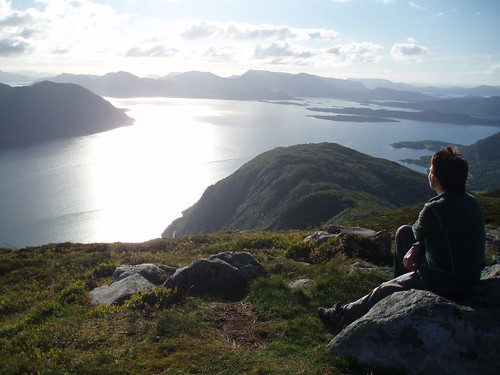
In summer, it's a good life, the challenge is scaled to your ambition, and the reward is a sense of being on top of the world. During the winter, however...
After three avalanches caused considerable damage and closed off the roads leading in almost every direction from here, roads have been closed in most directions. On this list (it may expire) there are 18 closed roads today, closed due to avalanches or danger of avalanches. Four more are under consideration. After a winter of snow in several layers we suddenly have rain and a thaw. It's undermining the snowmasses and loosening that which so far has been stable. Spring does that - and this year more so than ever.
I am not planning to drive to Ålesund this week-end, and if I did, I'd go out towards the islands: Tunnel, bridge and ferry, to get around and away from the mountainsides. I don't want to get caught by anything like this.
In normal years there are always avalanches, or "ras" or "skred" as they are called here. This year however, in addition to the known spots of danger, new areas are hit. And so we lose buildings, and people are in danger, like this mother and her eight year old daughter, who outraced an avalanche by car.
If you were to fly above this area in a small plane, you'd notice that there is no immediate logic to the spread of buildings. There will be a few houses close together, then nothing for a while, even if there may be wide, nice fields there. Then perhaps, one house built prominently on a rock, and then nothing again, for miles. No, it's not like that just because people wanted to live close together or far apart, depending. It's the spots where a building stands the best chance of surviving the winter.
We learn to live with the danger, and there are even people who make a living from maintaining communication in the face of danger. Recently, one machine was taken by an avalanche while clearing the road of snow. The people in it were able to run clear. As I type, others are assessing the danger of avalanches along the roads, at great risk.
Standing on top of a mountain, it feels like you own the world. Buried beneath it though...
In summer, it's a good life, the challenge is scaled to your ambition, and the reward is a sense of being on top of the world. During the winter, however...
After three avalanches caused considerable damage and closed off the roads leading in almost every direction from here, roads have been closed in most directions. On this list (it may expire) there are 18 closed roads today, closed due to avalanches or danger of avalanches. Four more are under consideration. After a winter of snow in several layers we suddenly have rain and a thaw. It's undermining the snowmasses and loosening that which so far has been stable. Spring does that - and this year more so than ever.
I am not planning to drive to Ålesund this week-end, and if I did, I'd go out towards the islands: Tunnel, bridge and ferry, to get around and away from the mountainsides. I don't want to get caught by anything like this.
In normal years there are always avalanches, or "ras" or "skred" as they are called here. This year however, in addition to the known spots of danger, new areas are hit. And so we lose buildings, and people are in danger, like this mother and her eight year old daughter, who outraced an avalanche by car.
If you were to fly above this area in a small plane, you'd notice that there is no immediate logic to the spread of buildings. There will be a few houses close together, then nothing for a while, even if there may be wide, nice fields there. Then perhaps, one house built prominently on a rock, and then nothing again, for miles. No, it's not like that just because people wanted to live close together or far apart, depending. It's the spots where a building stands the best chance of surviving the winter.
We learn to live with the danger, and there are even people who make a living from maintaining communication in the face of danger. Recently, one machine was taken by an avalanche while clearing the road of snow. The people in it were able to run clear. As I type, others are assessing the danger of avalanches along the roads, at great risk.
Standing on top of a mountain, it feels like you own the world. Buried beneath it though...
Friday, March 12, 2010
Games and e-learning
Sometimes I just forget that I have done something, and then it pops up and I go "Oh, yeah, right, I did that." It sounds horribly arrogant, as if I don't care, and I don't like this part of myself. You see, I do care about the articles I write and the work I do. It's just that when I have finished something, I put it behind me and move on, and sometimes I put it a bit more behind me than I really planned, you know. And then, more times than not, I go: "Oh, I wrote this as well. Huh, I almost sound smart!"
One such item is the upcoming article in E-learning. Issue 7 is on Game Design Literacy Practices, and my article in it is "Training, Sharing or Cheating? Gamer Strategies to Get a Digital Upper Hand." Heavily inspired by Mia Consalvo, I write about theorycrafting and the use of specialised gamer sites, where gamers go to help each other learn or develop those mad skills they later use to impress each other with ingame.
One such item is the upcoming article in E-learning. Issue 7 is on Game Design Literacy Practices, and my article in it is "Training, Sharing or Cheating? Gamer Strategies to Get a Digital Upper Hand." Heavily inspired by Mia Consalvo, I write about theorycrafting and the use of specialised gamer sites, where gamers go to help each other learn or develop those mad skills they later use to impress each other with ingame.
Wednesday, March 03, 2010
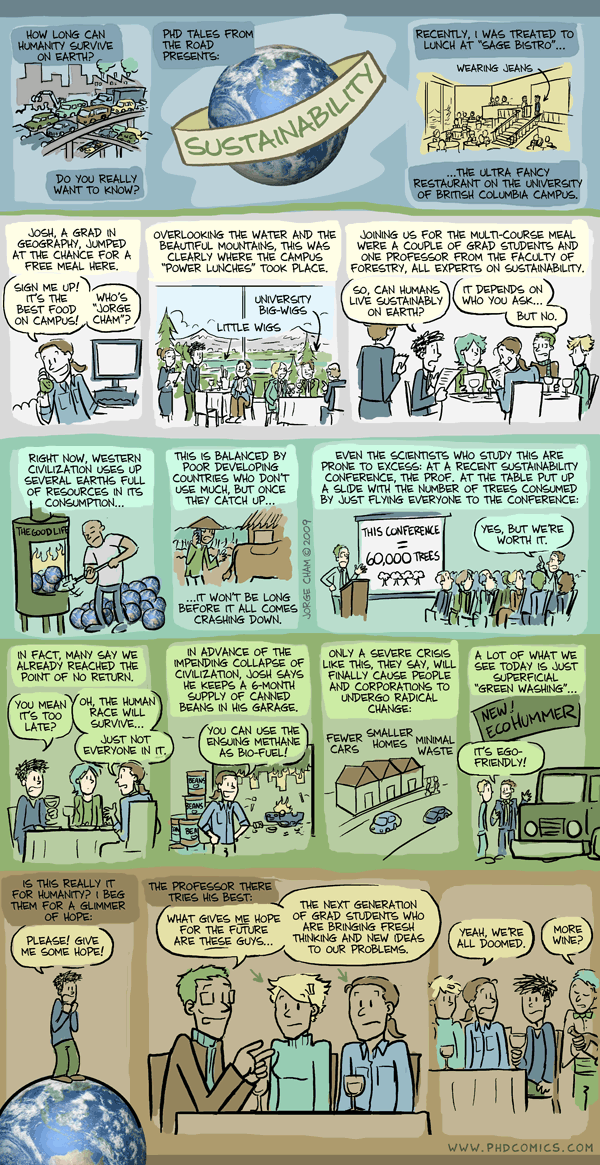
Sustainability
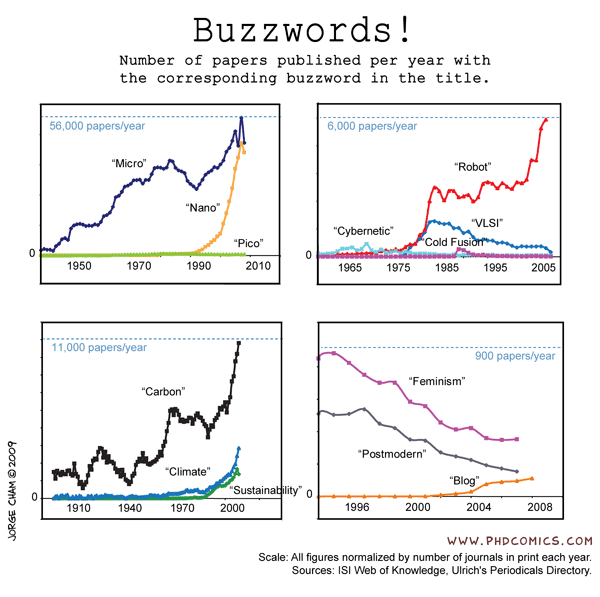
Yes, I am part of organising a conference with a major buzzword in the title. Hence, imagine my delight when I found a nice visualisation of this and some other recent buzzwords in Academia:
Friday, February 19, 2010
IR 11.0 submission guidelines
As program chair for IR 11.0 I get several questions along the same lines. So, for those out there who might actually google me in order to find answers, here's the submission guidelines for IR 11.0 Sustainability, Participation, Action:
Submission guidelines for IR 11.0 Sustainability, Participation, Action
All contributions should be submitted to https://www.conftool.net/aoir-ir11/
Each individual is invited to submit a proposal for 1 paper or 1 presentation. A person may also propose a panel session, which may include a second paper that they are presenting. An individual may also submit a roundtable proposal. You may be listed as co-author on additional papers as long as you are not presenting them. This limits each participant to three presentations, all in different formats.
For all participants: Please choose your topics of interest and expertise when you register for the conference. Also please indicate if you wish to review for the conference.
PAPERS (individual or multi-author) - submit abstract of 600-800 words. Please both cut and paste the abstract in, as well as upload one document either in .doc or .pdf format. The system does not accept other formats. Please indicate all co-authors, and nominate a main author, but be sure to remove all identifying information from the abstract itself. Be aware that you can only be the main author of one paper. Full references and formal citations are not required in abstracts, but please be aware that one main issue with papers not accepted to conferences is when they don't demonstrate a good working knowledge of other relevant research, discourses and corresponding authors. If you choose to not use formal citations and references, make certain to attribute ideas, thoughts and quotes to the correct sources in the text.
FULL PAPERS (OPTIONAL): For submitters requiring peer review of full papers, manuscripts of up to 8,000 words will be accepted for review. These will be reviewed and judged separately from abstract submissions. Please cut and paste the abstract in, and upload the papers either in .pdf or .doc format. The system does not accept other formats. Please indicate all co-authors, and nominate a main author. Be aware that you can only be the main author of one paper. Be sure to remove all identifying information from your paper.
PANEL PROPOSALS - submit a 600-800 word description of the panel theme, plus 250-500 word abstract for each paper or presentation. Indicate all participants on the submission site but not in the body of the proposal. Collect and upload the descriptions for all participants in one document, either in .pdf or .doc format. Finally, please cut and paste the submission into the system.
ROUNDTABLE PROPOSALS - submit a statement indicating the nature of the roundtable discussion and interaction, in less than 800 words. Indicate all participants and their expertise in relation to the proposed topic. Upload the proposal in one document, either in .pdf or .doc format. Also cut and paste the submission into the system.
Papers, presentations and panels will be selected from the submitted proposals on the basis of multiple blind peer review, coordinated and overseen by the Program Chair.
Important dates, as of 19 February 2010:
Submissions Due 28 February 2010
Notifications of Acceptance 28 Apr 2010
Abstract Revisions Due 15 May 2010
Full Papers Due 21 August 2010
Pre-Conference Workshops 20 Oct 2010
Main Conference 21-23 Oct 2010
Submission guidelines for IR 11.0 Sustainability, Participation, Action
All contributions should be submitted to https://www.conftool.net/aoir-ir11/
Each individual is invited to submit a proposal for 1 paper or 1 presentation. A person may also propose a panel session, which may include a second paper that they are presenting. An individual may also submit a roundtable proposal. You may be listed as co-author on additional papers as long as you are not presenting them. This limits each participant to three presentations, all in different formats.
For all participants: Please choose your topics of interest and expertise when you register for the conference. Also please indicate if you wish to review for the conference.
PAPERS (individual or multi-author) - submit abstract of 600-800 words. Please both cut and paste the abstract in, as well as upload one document either in .doc or .pdf format. The system does not accept other formats. Please indicate all co-authors, and nominate a main author, but be sure to remove all identifying information from the abstract itself. Be aware that you can only be the main author of one paper. Full references and formal citations are not required in abstracts, but please be aware that one main issue with papers not accepted to conferences is when they don't demonstrate a good working knowledge of other relevant research, discourses and corresponding authors. If you choose to not use formal citations and references, make certain to attribute ideas, thoughts and quotes to the correct sources in the text.
FULL PAPERS (OPTIONAL): For submitters requiring peer review of full papers, manuscripts of up to 8,000 words will be accepted for review. These will be reviewed and judged separately from abstract submissions. Please cut and paste the abstract in, and upload the papers either in .pdf or .doc format. The system does not accept other formats. Please indicate all co-authors, and nominate a main author. Be aware that you can only be the main author of one paper. Be sure to remove all identifying information from your paper.
PANEL PROPOSALS - submit a 600-800 word description of the panel theme, plus 250-500 word abstract for each paper or presentation. Indicate all participants on the submission site but not in the body of the proposal. Collect and upload the descriptions for all participants in one document, either in .pdf or .doc format. Finally, please cut and paste the submission into the system.
ROUNDTABLE PROPOSALS - submit a statement indicating the nature of the roundtable discussion and interaction, in less than 800 words. Indicate all participants and their expertise in relation to the proposed topic. Upload the proposal in one document, either in .pdf or .doc format. Also cut and paste the submission into the system.
Papers, presentations and panels will be selected from the submitted proposals on the basis of multiple blind peer review, coordinated and overseen by the Program Chair.
Important dates, as of 19 February 2010:
Submissions Due 28 February 2010
Notifications of Acceptance 28 Apr 2010
Abstract Revisions Due 15 May 2010
Full Papers Due 21 August 2010
Pre-Conference Workshops 20 Oct 2010
Main Conference 21-23 Oct 2010
Moral panic goes horribly wrong
This extremely sad tale from China demonstrates only too well how dangerous extremes are - in either direction. While China already is the source of many of the horrible stories supporting the idea of internet-addiction in North America and Europe (such as the person who died after 20 hours of non-stop gaming), it is now becoming the source of the horror stories about what happens when a nation blames one object only for the cultural changes that are challenging the established order.
Deng Senshan was another victim to fear, lack of knowledge and massive propaganda.
Deng Senshan was another victim to fear, lack of knowledge and massive propaganda.
Wednesday, February 17, 2010
Where do you work?
I don't mean, what company or what business or what country or what city, I mean: In what kind of space do you work?
I am quite sensitive to work spaces, and I need them to be controlled and comfortable in order to inspire a good working process. That does not mean they have to be overly organised. As long as I find what I am looking for, I am fine. Actually, I tend to use clutter as a way to remind me of tasks. Once in a while - normally at the end or the start of a term - I go through everything on the desk and on the most imemdiate shelves, and clear it. Then I move what I know I will be working with in the next 3-6 months closer to the central work space, so when I look up from a task, I am reminded of the rest of the stuff waiting. Immediate to-do stuff ends on top of my keyboard when I go home from work, and then there's a diminishing urgency as items move further from the computer monitor.
This makes it a lot easier to remember all those little tasks that I need to deal with repeatedly or immediately, but it does have one unpleasant side-effect. When I have to focus on larger, complicated tasks, I get distracted and stressed by looking at all the stuff I otherwise really don't want to forget. And so I pick up that note by the telephone, I respond to the letter by the keyboard, or I leaf through the article lurking just to the left, and the larger task that demands more focus remains untouched. That's when I have two options: To clean the desk again and remove all those to-do things (impossible, really) or to move myself, physically, away. The distance I go depends on the task.
For a focused reading up on material for teaching, going through literature for leactures or reading lists or similar tasks demanding focus but not really such a tough challenge, I change from the office computer to the lap-top, and move into the bean bag in the office. Yeah, I know, I am lucky to have an office which provides a secondary work space and to own a lap-top, but the principle can still apply elsewhere. Just move away from the "short-term-task" space and look in another direction where it's not as easy to pick up everything waiting to be fixed. Pick up the book and turn the chair around. Since I am still in the office I am available for colleagues, students and people who really need to reach me on the phone, but I am not getting all the visual clues I have planted on the desk.
For more complex tasks, I leave the office. When I write an article, I need to focus. I mean, really really focus. I need to empty out all the clutter in my mind that pulls my attention elsewhere, and get into the "zone" - a state of mind that just ignores distractions. When I am deeply focused I ignore time, space, hunger, family and cold. I have come out of writing rushes frozen to the bone and shivering because I just couldn't be bothered to stop writing and turn up the heating. In that state of mind it doesn't really matter where I am, but to get to that point I need to wind down slowly. It is like a cleansing process, perhaps similar to what monks do while meditating. To get there I find that physical work is the best. Working out is not one of my strategies, despite the studies pointing out the benefits, but I guess cleaning and tidying does much of the same as a light walk. It also helps me remove those visual clues that pull my attention away. And as things around me become more tidy, I think about the work I am supposed to do, and gradually I settle down. Once I am settled I don't care what it looks like around me, so no, I am not a superwife in a superclean house. But at least the dishes will be done.
This only works for intermediary focus though. Working at home will quickly draw me back to the need to declutter the house, if I am doing something really tough. That's when I need to get all the way out. That's when I have visited friends in Bergen, New York and Urbino, spent a year in Umeå or rented a cabin in the mountains.
Today, however, I found something interesting - shedworking. I don't really need a shed in which to work, I have a house too-large for two people and can have as big a home-office as I care to organise. It's not for lack of space I am currently tucked into a chair in the corner of a shared home office packed with books and electronic equipment. But walking out into a shed might be the mental journey I'd need to be at rest. And right now I am looking out of the window, considering where I'd like to put that shed.
You see, I need to start a new, very complicated article which I have delayed doing anything about for at least 6 months. I should have been in New York, not staring at my garden. I'll go do the dishes and think about how to pretend I am in Italy. Perhaps a cappucino will help.
I am quite sensitive to work spaces, and I need them to be controlled and comfortable in order to inspire a good working process. That does not mean they have to be overly organised. As long as I find what I am looking for, I am fine. Actually, I tend to use clutter as a way to remind me of tasks. Once in a while - normally at the end or the start of a term - I go through everything on the desk and on the most imemdiate shelves, and clear it. Then I move what I know I will be working with in the next 3-6 months closer to the central work space, so when I look up from a task, I am reminded of the rest of the stuff waiting. Immediate to-do stuff ends on top of my keyboard when I go home from work, and then there's a diminishing urgency as items move further from the computer monitor.
This makes it a lot easier to remember all those little tasks that I need to deal with repeatedly or immediately, but it does have one unpleasant side-effect. When I have to focus on larger, complicated tasks, I get distracted and stressed by looking at all the stuff I otherwise really don't want to forget. And so I pick up that note by the telephone, I respond to the letter by the keyboard, or I leaf through the article lurking just to the left, and the larger task that demands more focus remains untouched. That's when I have two options: To clean the desk again and remove all those to-do things (impossible, really) or to move myself, physically, away. The distance I go depends on the task.
For a focused reading up on material for teaching, going through literature for leactures or reading lists or similar tasks demanding focus but not really such a tough challenge, I change from the office computer to the lap-top, and move into the bean bag in the office. Yeah, I know, I am lucky to have an office which provides a secondary work space and to own a lap-top, but the principle can still apply elsewhere. Just move away from the "short-term-task" space and look in another direction where it's not as easy to pick up everything waiting to be fixed. Pick up the book and turn the chair around. Since I am still in the office I am available for colleagues, students and people who really need to reach me on the phone, but I am not getting all the visual clues I have planted on the desk.
For more complex tasks, I leave the office. When I write an article, I need to focus. I mean, really really focus. I need to empty out all the clutter in my mind that pulls my attention elsewhere, and get into the "zone" - a state of mind that just ignores distractions. When I am deeply focused I ignore time, space, hunger, family and cold. I have come out of writing rushes frozen to the bone and shivering because I just couldn't be bothered to stop writing and turn up the heating. In that state of mind it doesn't really matter where I am, but to get to that point I need to wind down slowly. It is like a cleansing process, perhaps similar to what monks do while meditating. To get there I find that physical work is the best. Working out is not one of my strategies, despite the studies pointing out the benefits, but I guess cleaning and tidying does much of the same as a light walk. It also helps me remove those visual clues that pull my attention away. And as things around me become more tidy, I think about the work I am supposed to do, and gradually I settle down. Once I am settled I don't care what it looks like around me, so no, I am not a superwife in a superclean house. But at least the dishes will be done.
This only works for intermediary focus though. Working at home will quickly draw me back to the need to declutter the house, if I am doing something really tough. That's when I need to get all the way out. That's when I have visited friends in Bergen, New York and Urbino, spent a year in Umeå or rented a cabin in the mountains.
Today, however, I found something interesting - shedworking. I don't really need a shed in which to work, I have a house too-large for two people and can have as big a home-office as I care to organise. It's not for lack of space I am currently tucked into a chair in the corner of a shared home office packed with books and electronic equipment. But walking out into a shed might be the mental journey I'd need to be at rest. And right now I am looking out of the window, considering where I'd like to put that shed.
You see, I need to start a new, very complicated article which I have delayed doing anything about for at least 6 months. I should have been in New York, not staring at my garden. I'll go do the dishes and think about how to pretend I am in Italy. Perhaps a cappucino will help.
Tuesday, February 16, 2010
Blogging the blogged Ph D about blogging
I just want to point you all towards Lilia Efimova's wonderful thesis Passion at work: blogging practices of knowledge workers, which was submitted last year. It is, of course, online, so: Enjoy!
Monday, February 15, 2010
IR 11.0 - Sustainability, Participation, Action
The conference website is up and running! It is still being built and tweeked, but even so it's infinitely better than no site at all! Add this website to your bookmarks, right along the URL for where to submit your paper!
Friday, February 12, 2010
Phishing
This arrived to an emailaddress which I have published online in order to be easily available for people up to the IR 11.0 conference. Since the mail address is openly out there, I am seeing a LOT more spam in the few months since publishing that address than I do in any other mailboxes. And so I also see some interesting phishing attempts, such as the following, supposedly sent from GMAIL. Despite the fancy colours in the original mail, all I can say to this is: Not even a good try, stranger!
----
Dear Member,
We are shutting down some email accounts and your account was automatically chosen to be deleted. If you are still interested in using our email service please fill in the space below for verification purpose by clicking the reply button. Learn more
Account:
Password:
Birth date:
Country:
Warning!!! Account owner that refuses to update his or her account within Seven days of receiving this warning will lose his or her account permanently.
Thank you for using Gmail !
The Gmail Team
GMAIL
----
Dear Member,
We are shutting down some email accounts and your account was automatically chosen to be deleted. If you are still interested in using our email service please fill in the space below for verification purpose by clicking the reply button. Learn more
Account:
Password:
Birth date:
Country:
Warning!!! Account owner that refuses to update his or her account within Seven days of receiving this warning will lose his or her account permanently.
Thank you for using Gmail !
The Gmail Team
GMAIL
Thursday, February 04, 2010
Dear Amazon
You know I have loved you since I found you online. You have sated my reading lust and supported my academic struggles for years. I have browsed your pages and lusted for your offers, my wish-list is long and much larger than my bank-account, and in my shopping cart lurks desires I want to consume side by side with guilt about procrastination and lazyness.
But, dear Amazon - you are making life very difficult for me now. I was unhappy with you for a while, in Sweden, when you made me run around all of Umeå to figure out where you had sent my treasures. It was not a funny game, although it did make me ride my bike, through snow and wind, to new, remote places. Back home in Norway though, safely in Volda, I forgave you, because you delivered reliably again. I found my books in my mailbox or at the mail office, a healthy little walk away from home.
I think you know where this is going, though. Amazon, how could you? Suddenly, you are demanding that I take whole days off in order to receive that which I ask of you. You expect me to stay home, like a frustrated housewife, anxiously awaiting the pleasure of those who carry my books to me. Or, I have to ask that they are delivered to work, to be commented, studied and discussed by my peers. This is no longer what I thought it was to be! So, please remember this, my old love: Those are my books you are delaying. I have paid already as you send them, but you are slowing their trip to me through your poor choices of partners. I can change my mind, you know. I can take my wishlist elsewhere, directly to the publishers, or to competitors who deliver instantly.
I also haven't forgotten previous treachery. My patience is wearing thin, my passion is fading, but I still remember the love we shared in the past. You can still repent and return to better ways. Send my books by mail again, please? It is the best distribution system for private packages in Norway. The other systems are good for business transport, but I can't leave a lecture in order to sign for a box of science fiction books. I can't stay home a whole day just to indulge my taste for graphic novels. Please realise this, and give me the option to, perhaps, pay a little more for the transport I desire. It will be cheap compared to the inconvenience and the cost in work hours.
But, dear Amazon - you are making life very difficult for me now. I was unhappy with you for a while, in Sweden, when you made me run around all of Umeå to figure out where you had sent my treasures. It was not a funny game, although it did make me ride my bike, through snow and wind, to new, remote places. Back home in Norway though, safely in Volda, I forgave you, because you delivered reliably again. I found my books in my mailbox or at the mail office, a healthy little walk away from home.
I think you know where this is going, though. Amazon, how could you? Suddenly, you are demanding that I take whole days off in order to receive that which I ask of you. You expect me to stay home, like a frustrated housewife, anxiously awaiting the pleasure of those who carry my books to me. Or, I have to ask that they are delivered to work, to be commented, studied and discussed by my peers. This is no longer what I thought it was to be! So, please remember this, my old love: Those are my books you are delaying. I have paid already as you send them, but you are slowing their trip to me through your poor choices of partners. I can change my mind, you know. I can take my wishlist elsewhere, directly to the publishers, or to competitors who deliver instantly.
I also haven't forgotten previous treachery. My patience is wearing thin, my passion is fading, but I still remember the love we shared in the past. You can still repent and return to better ways. Send my books by mail again, please? It is the best distribution system for private packages in Norway. The other systems are good for business transport, but I can't leave a lecture in order to sign for a box of science fiction books. I can't stay home a whole day just to indulge my taste for graphic novels. Please realise this, and give me the option to, perhaps, pay a little more for the transport I desire. It will be cheap compared to the inconvenience and the cost in work hours.
Tuesday, February 02, 2010
IR 11.0 submission site now open
To submit your papers for IR 11.0 - Sustainability, Participation, Action, please use the submission site to be found here.
The CFP can be found here, but the link to the conference organising site has not yet been added.
The CFP can be found here, but the link to the conference organising site has not yet been added.
Monday, February 01, 2010
Knitting the revolution
When ever anybody makes a statement about gender in weblogs which indicates that women don't blog, I ask them to go start reading knitting blogs. It's one of my secret addictions, to surf knitting blogs, reading about all the things I could have made if I just put the computer away and picked up some yarn instead. Lucky for me, there are women out there who are both computer literate and knitting smart!
One of these has the weblog Med pinner (with sticks, sticks meaning knitting-needles). On her weblog, which is full of really beautiful patterns and experiences with knitting (yes, it's legal to take a picture of clothes people are wearing while outside in a public place, no, it's not permitted to publish recognisable pictures of people without their permission unless they are part of a parade or a performance or something similar where it's obvious that they are there in order to be seen. This picture doesnt' show the face though, so it should be ok.), she has a button. The text says: The revolution is being hand made, and it links to an exhibition of crafted goods in Sweden.
I had to google that though, to see if I there might be a movement behind it, and what I found was:
An artists' collective named Handmade Revolution.
Two volunteers organising markets in the UK for handmade goods.
Canadian events for selling and buying handmade goods in the "Make It" fairs.
And an angry rant against the idea that the revolution can be hand made.
On the one hand: No, knitting does not remove the fact that my entire life is supported by unsustainable technology. The only times when I get anywhere close to sustainability is when I live in the cabin with simple technology, fishing and growing most of the food, and cooking on a fire made of wood we cut clearing the garden and land around the houses. But even then I am very aware that it's just a matter of days before I turn on the electricity, get into the car and go shopping.
Still, there's another way to think about a hand-made revolution.
If we are to have a systemic change, which is what we need, it will mean that everybody must expect lifestyle changes. We may for instance have to move back to the lifestyle of the fifties, giving up on twice-daily showers, and moving into areas which will allow us to walk or ride a bike or bus to work. We can't drive to malls, and the huge cities need to change very radically, in order to allow for local produce and local markets. And each and every step of the way will mean more direct, hands-on and personal engagement with the comforts of our lives.
One pair of hand-knitted mittens is just one less pair of mittens produced by Indian child slaves sold. But the knowledge and skill it takes to make those mittens can be the key to changing society, if it's used at all levels of life: Knowing how to cook your food from scratch, knowing how to grow it, knowing how to pick and find it, knowing how to use the resources that surround you, knowing how to build a house, row a boat, repair a bike, redress your furniture, repair your clothes and care for a well of fresh water - all this is knowledge that needs a hands-on approach. Technology may save us through some new, sustainable solution, but it's the hands-on knowledge of how our comforts are brought to be that can make us accept this as important.
So start knitting, now.
One of these has the weblog Med pinner (with sticks, sticks meaning knitting-needles). On her weblog, which is full of really beautiful patterns and experiences with knitting (yes, it's legal to take a picture of clothes people are wearing while outside in a public place, no, it's not permitted to publish recognisable pictures of people without their permission unless they are part of a parade or a performance or something similar where it's obvious that they are there in order to be seen. This picture doesnt' show the face though, so it should be ok.), she has a button. The text says: The revolution is being hand made, and it links to an exhibition of crafted goods in Sweden.
I had to google that though, to see if I there might be a movement behind it, and what I found was:
An artists' collective named Handmade Revolution.
Two volunteers organising markets in the UK for handmade goods.
Canadian events for selling and buying handmade goods in the "Make It" fairs.
And an angry rant against the idea that the revolution can be hand made.
On the one hand: No, knitting does not remove the fact that my entire life is supported by unsustainable technology. The only times when I get anywhere close to sustainability is when I live in the cabin with simple technology, fishing and growing most of the food, and cooking on a fire made of wood we cut clearing the garden and land around the houses. But even then I am very aware that it's just a matter of days before I turn on the electricity, get into the car and go shopping.
Still, there's another way to think about a hand-made revolution.
If we are to have a systemic change, which is what we need, it will mean that everybody must expect lifestyle changes. We may for instance have to move back to the lifestyle of the fifties, giving up on twice-daily showers, and moving into areas which will allow us to walk or ride a bike or bus to work. We can't drive to malls, and the huge cities need to change very radically, in order to allow for local produce and local markets. And each and every step of the way will mean more direct, hands-on and personal engagement with the comforts of our lives.
One pair of hand-knitted mittens is just one less pair of mittens produced by Indian child slaves sold. But the knowledge and skill it takes to make those mittens can be the key to changing society, if it's used at all levels of life: Knowing how to cook your food from scratch, knowing how to grow it, knowing how to pick and find it, knowing how to use the resources that surround you, knowing how to build a house, row a boat, repair a bike, redress your furniture, repair your clothes and care for a well of fresh water - all this is knowledge that needs a hands-on approach. Technology may save us through some new, sustainable solution, but it's the hands-on knowledge of how our comforts are brought to be that can make us accept this as important.
So start knitting, now.
Wednesday, January 27, 2010
Invisible
My colleague Svein Brurås wrote about an extremely good piece of journalism in a Norwegian newspaper, and I just want to join him in pointing towards it. Good journalism is worth celebrating and sharing.
What it's about? Nothing really. Just a lonely man nobody noticed, who died from a stroke while he was out on his bike. The story the journalist uncovers through very careful and through investigation is nothing special either, it's just heartbreaking, and very, very good. It's in Norwegian, sorry, other-language-readers. Google Translate may help a little, but it won't give you the tone in which the story has been told.
What it's about? Nothing really. Just a lonely man nobody noticed, who died from a stroke while he was out on his bike. The story the journalist uncovers through very careful and through investigation is nothing special either, it's just heartbreaking, and very, very good. It's in Norwegian, sorry, other-language-readers. Google Translate may help a little, but it won't give you the tone in which the story has been told.
Saturday, January 23, 2010
Being Human
I have just recently discovered a television series which made me an instant fan. BBC's Being Human is the perfect mix for me, it has a ghost, a werewolf and a vampire, they live in a small town in England, and they are struggling to fit in. It's a mix of True Blood and East-Enders and contains buckets of the delightful humour that tends to be such an integrated part of the best British series. The harddisk has been cleared of several other dramas in order to make space for this one.
This made me consider why I like the monster theme so much. I love True Blood as well, despite its much more heavy handed story-telling, and am on principle a fan of dragons, cheering for the monster, not the knight.
I think the title of this series captures the reason for me. Being human is about a desire to belong to society. It's all about solving or at least dealing with the issues that arise when you're different, in order to be able to live in peace simply as a regular human being. The many stories of monsters confirm the value of humanity, whether the monsters try to live like us, they try to extinguish us, or they are us. The monster without or within, the unhuman or the inhuman, is what defines humanity, and makes being human something desirable. Or, perhaps a
This made me consider why I like the monster theme so much. I love True Blood as well, despite its much more heavy handed story-telling, and am on principle a fan of dragons, cheering for the monster, not the knight.
I think the title of this series captures the reason for me. Being human is about a desire to belong to society. It's all about solving or at least dealing with the issues that arise when you're different, in order to be able to live in peace simply as a regular human being. The many stories of monsters confirm the value of humanity, whether the monsters try to live like us, they try to extinguish us, or they are us. The monster without or within, the unhuman or the inhuman, is what defines humanity, and makes being human something desirable. Or, perhaps a
Wednesday, January 06, 2010
Games and entertainment technology
IADIS - International Association for Development of the Information Society - are organising a conference in Freiburg, Germany, in July 2010. They have a call for papers, deadline is February 19th, and the conference is called GET - Games and Entertainment Technology. The CFP is very wide, generally, if you do something related to electronic games as a researcher, designer, programmer, teacher or artist, you'll fit. They also invite for very diverse types of presentations, from posters to full papers, as well as corporate exhibitions and showcases.
Saturday, January 02, 2010
The end of the magic?
I have been playing World of Warcraft for almost five years now, and a lot of my research and writing has come out of that play. I am both fascinated with online games as a medium and cultural artifacts, and an enthusiastic happy player. Or, at least, I was the last until the new patch - 3.3.0. Now I have suddenly lost it.
In order to play WoW well at the high end - intense heroic grinding and raiding - you needed to have friends and connections. To function well as a gamer in World of Warcraft meant to function well as a friend to a large group of people. You had to be reliable, follow a certain set of rules and know your players in order to get good groups and easy "runs". After a while you had a friends list and was in enough such lists that you would be accepted, included and assisted. If you did a mistake, people would forgive, as they'd know it wasn't common, and you could play well and share generously the next time. In short: You invested social capital and it had value.
Now, not so much.
In order to advance now, you need to grind enormous amounts of emblems, and to grind those emblems you either have to have the above mentioned friend group already established, or you need to group with strangers who you will most likely never meet again. (Check Cross Realm Dungeon Finder and User Interface Section: Dungeon Finder.)
Knowing you won't ever meet said strangers again makes people behave oddly. Suddenly old rules are thrown over board and people become greedy and cruel. The new group set up allow things like "vote to kick", which is extensively used to kick people who for instance have low dps. Low dps comes from bad gear, and in order to get good gear you need to do instances. However, if you get kicked from the groups you participate in due to bad gear, you can't get good gear. Further, it allows for rudeness and impatience. Healers and tanks are still hard to find, but you don't need to be polite to your tank or healer any more. Tanks run to rush through the instance as quickly as possible, then get angry with healers who don't keep up. If the tank is slow, the entire group goes ballistic, insisting on higher speed through the instance. It's all about grinding as many badges as quickly as possible. As for conversation: Why talk, why be polite and say hello or goodbye? It's not like we will meet again, after all. And so the "tip of the day" shown on log-in about "being polite in group may get you invited back" is put to shame. There's no way to pre-sort the group for the instance, no way to screen out the ninjas or the flaming idiots, and hence no reason to be nice. The 3.3.0 patch makes niceness a less efficient gaming strategy.
And then we come to looting. At one point the looting options are better. Blizzard has included a "disenchant" option, which lets a person choose "disenchant" if there is an enchanter in the group. This option is equal to "greed", and if three people choose greed while two choose disenchant, it will be a greed roll, and people receive enchanting materials or the object, depending on their preference. But there are still people who pick "need". And they pick "need" on all kind of weird things, most notably trade materials such as frozen orbs. Frozen orbs used to be rare but important, now they are plentyful due to the fact that there are other orbs replacing them in crafting (crusader orbs, for instance), and they can be had at a reasonable price at the AH. Normally people would pick "greed" for that kind of craft objects, but that has suddely changed. Now it's all about "need". And you get a particular type of "need" - people who avoid needing until the roll bar is almost gone, then they hit "need" after all others in the group have chosen the more politically correct and polite "greed".
So, why do people still use the automated cross-server group-finder? Because one of the vital emblems for buying new gear is most easily obtainable through using it. Hence, Blizzard forces the players into very uncomfortable, conflict-fraught situations where they can not utilise their social capital. Although there is one way around that. If you already have a group of good friends, you can make pre-set grinding groups and enter with healer, tank and three dps into the instance-finder system. Then you get to play with your friends.
So, the new instance finder is good for: People with experience and good gear. People with a well-established group of friends. People who don't care about social play, and have no qualms about abandoning a group, kicking a slow player or ninjaing loot. The new, unattached casual player has absolutely no chance at having fun in this system.
Shame on you, Blizzard. But, well, I guess you don't want more new players. Perhaps 11,5 million is enough, really?
In order to play WoW well at the high end - intense heroic grinding and raiding - you needed to have friends and connections. To function well as a gamer in World of Warcraft meant to function well as a friend to a large group of people. You had to be reliable, follow a certain set of rules and know your players in order to get good groups and easy "runs". After a while you had a friends list and was in enough such lists that you would be accepted, included and assisted. If you did a mistake, people would forgive, as they'd know it wasn't common, and you could play well and share generously the next time. In short: You invested social capital and it had value.
Now, not so much.
In order to advance now, you need to grind enormous amounts of emblems, and to grind those emblems you either have to have the above mentioned friend group already established, or you need to group with strangers who you will most likely never meet again. (Check Cross Realm Dungeon Finder and User Interface Section: Dungeon Finder.)
Knowing you won't ever meet said strangers again makes people behave oddly. Suddenly old rules are thrown over board and people become greedy and cruel. The new group set up allow things like "vote to kick", which is extensively used to kick people who for instance have low dps. Low dps comes from bad gear, and in order to get good gear you need to do instances. However, if you get kicked from the groups you participate in due to bad gear, you can't get good gear. Further, it allows for rudeness and impatience. Healers and tanks are still hard to find, but you don't need to be polite to your tank or healer any more. Tanks run to rush through the instance as quickly as possible, then get angry with healers who don't keep up. If the tank is slow, the entire group goes ballistic, insisting on higher speed through the instance. It's all about grinding as many badges as quickly as possible. As for conversation: Why talk, why be polite and say hello or goodbye? It's not like we will meet again, after all. And so the "tip of the day" shown on log-in about "being polite in group may get you invited back" is put to shame. There's no way to pre-sort the group for the instance, no way to screen out the ninjas or the flaming idiots, and hence no reason to be nice. The 3.3.0 patch makes niceness a less efficient gaming strategy.
And then we come to looting. At one point the looting options are better. Blizzard has included a "disenchant" option, which lets a person choose "disenchant" if there is an enchanter in the group. This option is equal to "greed", and if three people choose greed while two choose disenchant, it will be a greed roll, and people receive enchanting materials or the object, depending on their preference. But there are still people who pick "need". And they pick "need" on all kind of weird things, most notably trade materials such as frozen orbs. Frozen orbs used to be rare but important, now they are plentyful due to the fact that there are other orbs replacing them in crafting (crusader orbs, for instance), and they can be had at a reasonable price at the AH. Normally people would pick "greed" for that kind of craft objects, but that has suddely changed. Now it's all about "need". And you get a particular type of "need" - people who avoid needing until the roll bar is almost gone, then they hit "need" after all others in the group have chosen the more politically correct and polite "greed".
So, why do people still use the automated cross-server group-finder? Because one of the vital emblems for buying new gear is most easily obtainable through using it. Hence, Blizzard forces the players into very uncomfortable, conflict-fraught situations where they can not utilise their social capital. Although there is one way around that. If you already have a group of good friends, you can make pre-set grinding groups and enter with healer, tank and three dps into the instance-finder system. Then you get to play with your friends.
So, the new instance finder is good for: People with experience and good gear. People with a well-established group of friends. People who don't care about social play, and have no qualms about abandoning a group, kicking a slow player or ninjaing loot. The new, unattached casual player has absolutely no chance at having fun in this system.
Shame on you, Blizzard. But, well, I guess you don't want more new players. Perhaps 11,5 million is enough, really?
Sunday, December 20, 2009
Årsakssammenhenger og spill
I anledning VGs ualminnelig dårlige artikkel om sammenhengen mellom et drap på Kongsvinger og spilling av World of Warcraft og Counterstrike, vil jeg vise til en artikkel om skoleskytinger og moralske panikker. Denne artikkelen kritiserer den overforenklede ideen om at mennesker ikke er i stand til å skille mellom fantasi og virkelighet, og den like enkle forskningen som underbygger denne konklusjonen - blant annet ved å vise til et solid forskningsmateriale som gir andre/alternative svar. Samtidig viser den til FBIs funn når det gjelder drapsmenn som spiller spill (s 28 i C. J. Fergusons artikkel):
I følge FBI er altså ikke årsakssammenhengen mediebruk -> vold, men interesse for å bruke vold -> mediebruk. Altså, hvis du liker/ønsker å bruke vold er du interessert i medieuttrykk som inneholder vold. Videre påpeker de at voldsmenn som bruker spill er mer interessert i voldshandlinger enn å kose seg med å spille. De er altså fokusert på våpen og vold, uansett kontekst.
VG gjentar imidlertid et mantra som har kommet inn i mediene for en del år siden, og de gjentar det ved å ta kontakt med personer som har sagt akkurat det samme i årevis. De overser konsekvent all forskning som viser noe annet enn denne overforenklede årsakssammenhengen.
(The above is a public service research-reference directed at Norwegian readers who might be interested in alternatives to a piece of intense and single-minded journalism claiming that gaming leads to serious crime.)
The FBI report appeared to focus on individuals who approved of hateful or destructive messages in the media, rather than merely enjoying the media for entertainment purposes. For instance, an individual who praised Mein Kampf and its message of racism and hatred would arguably be considered more ‘at risk’ than would someone who enjoyed playing the violent video game Medal of Honor because it was fun. Indeed, related to violent video games, the FBI report specifically stated, “The student spends inordinate amounts of time [although inordinate is never defined and is left subjective] playing video games with violent themes and seems more interested in the violent images than the game itself ” [italics added]. Thus, an overall interest in causing harm is potentially predictive of violence, not exposure to violent media in and of itself, a conclusion supported by the recent Savage, (2008) meta-analysis.
I følge FBI er altså ikke årsakssammenhengen mediebruk -> vold, men interesse for å bruke vold -> mediebruk. Altså, hvis du liker/ønsker å bruke vold er du interessert i medieuttrykk som inneholder vold. Videre påpeker de at voldsmenn som bruker spill er mer interessert i voldshandlinger enn å kose seg med å spille. De er altså fokusert på våpen og vold, uansett kontekst.
VG gjentar imidlertid et mantra som har kommet inn i mediene for en del år siden, og de gjentar det ved å ta kontakt med personer som har sagt akkurat det samme i årevis. De overser konsekvent all forskning som viser noe annet enn denne overforenklede årsakssammenhengen.
(The above is a public service research-reference directed at Norwegian readers who might be interested in alternatives to a piece of intense and single-minded journalism claiming that gaming leads to serious crime.)
Tuesday, December 08, 2009
Sustainability, Participation, Action
Call for Papers
Internet Research 11.0 - Sustainability, Participation, Action
The 11th Annual International and Interdisciplinary Conference of the Association of Internet Researchers (AoIR)
October 21-23, 2010 University of Gothenburg/Chalmers University of Technology, Gothenburg, Sweden
The challenge of this conference is to find multiple avenues for participation and action towards a sustainable future. In a society increasingly aware of social and ecological imbalance, many people now see information and communication technologies as key technologies for solving problems associated with an unsustainable future. However, while information technology may solve some problems, it can magnify others. As pointed out by world forums such as the United Nations and the European Commission, use of ICTs contributes to the unsustainable consumption of energy and resources. Similarly, unequal access and exploitative practices remind us that IT is not a utopian answer to complex social problems. A sustainable future is not only about greening processes and products at any cost, but also entails social responsibility, cultural protection and economic growth. Therefore the conference has a multi-dimensional focus, where the Internet is seen as a possible liberating, empowering and greening tool.
The conference will focus on how the Internet can function as a conduit for the development of greater global equality and understanding, a training ground for participation in debates and cross-cultural projects and a tool for mutual action; in short a technology of empowerment. The flip-side of the internet as a tool for empowerment is the issue of exploitation. Exploitation of resources and people is what has led to the current crisis, and issues of exploitation are highly relevant online, from abuse of the commons to censorship, fraud and loss of privacy and the protection of the rights of the individual.
Sustainability, Participation, Action invites scholars to consider issues concerning empowerment and/or exploitation in relation to the Internet. We ask scholars to specifically consider issues concerning integrity, knowledge production, and ethics in relation to the Internet and sustainable development. How do we, as Internet researchers, regard our work in relation to the unsustainable current situation and the possibilities of a sustainable future? How far can we take the Internet, and with it, people, individuals, groups and societies in order to create an arena for participation and action, all key elements in imagining a sustainable future? How can we apply previous knowledge to serve future solutions?
To this end, we call for papers, panel proposals, and presentations from any discipline, methodology, and community, and from conjunctions of multiple disciplines, methodologies and academic communities that address the conference themes, including papers that intersect and/or interconnect the following:
Internet and an equal and balanced society
Internet as an arena for participation
Internet as a tool and arena for action
Internet and an informed knowledge society
Internet and a green society
Internet and e‐commerce, dematerialization and transportation
Internet and security, integrity and surveillance
Internet and a healthy society
Internet as an arena for cultural expressions, and source of a culture of its own.
Sessions at the conference will be established that specifically address the conference themes, and we welcome innovative, exciting, and unexpected takes on those themes. We also welcome submissions on topics that address social, cultural, political, legal, aesthetic, economic, and/or philosophical aspects of the Internet beyond the conference themes. In all cases, we welcome disciplinary and interdisciplinary submissions as well as international collaborations from both AoIR and non‐AoIR members.
SUBMISSIONS
We seek proposals for several different kinds of contributions. We welcome proposals for traditional academic conference PAPERS and we also welcome proposals for ROUNDTABLE SESSIONS that will focus on discussion and interaction among conference delegates, as well as organized PANEL PROPOSALS that present a coherent group of papers on a single theme. All submissions should be submitted here.
DEADLINES
Call for Papers Released: 24 November 2009
Submissions Due: 21 February 2010 (Details here)
Notification: 21 April 2010
Full papers due: 21 August 2010
SUBMISSION REQUIREMENTS
All papers and presentations in this session will be evaluated in a standard blind peer review.
Format
PAPERS (individual or multi-author) - submit abstract of 600-800 words
FULL PAPERS (OPTIONAL): For submitters requiring peer review of full papers, manuscripts of up to 8,000 words will be accepted for review. These will be reviewed and judged separately from abstract submissions
PANEL PROPOSALS - submit a 600-800 word description of the panel theme, plus 250-500 word abstract for each paper or presentation
ROUNDTABLE PROPOSALS - submit a statement indicating the nature of the roundtable discussion and interaction
Papers, presentations and panels will be selected from the submitted proposals on the basis of multiple blind peer review, coordinated and overseen by the Program Chair. Each individual is invited to submit a proposal for 1 paper or 1 presentation. A person may also propose a panel session, which may include a second paper that they are presenting. An individual may also submit a roundtable proposal. You may be listed as co-author on additional papers as long as you are not presenting them.
PUBLICATION OF PAPERS
Selected papers from the conference will be published in a special issue of the journal Information, Communication & Society, edited by Caroline Haythornthwaite and Lori Kendall. Authors selected for consideration for submission to this issue will be contacted prior to the conference.
All papers submitted to the conference system will be available to AoIR members after the conference.
PRE-CONFERENCE WORKSHOPS
On October 20, 2010, there will be a limited number of pre-conference workshops which will provide participants with in-depth, hands-on and/or creative opportunities. We invite proposals for these pre-conference workshops. Local presenters are encouraged to propose workshops that will invite visiting researchers into their labs or studios or locales. Proposals should be no more than 1000 words, and should clearly outline the purpose, methodology, structure, costs, equipment and minimal attendance required, as well as explaining relevance to the conference as a whole. Proposals will be accepted if they demonstrate that the workshop will add significantly to the overall program in terms of thematic depth, hands on experience, or local opportunities for scholarly or artistic connections. These proposals and all inquiries regarding pre-conference proposals should be submitted as soon as possible to both the Conference Chair and Program Chair and no later than March 31, 2010.
FEE WAIVER
In order to increase the diversity of participation in the AoIR annual Internet Research (IR) conferences, the Association of Internet Researchers will make available up to three conference fee waivers per year. The number of fee waivers will depend first of all upon the ability of the conference budget to sustain such waivers (a judgment to be made by the AoIR Executive Committee upon the advice of the AoIR Treasurer and the local organizing committee) as well as upon the quality of the applications for fee waivers.
Applications for fee waivers are invited from student or faculty authors whose paper or panel proposals have already been accepted via the AoIR IR conference reviewing process. All applications should be directed to the Vice-President of AoIR, and must be received by June 30 of the conference year. Late applications cannot be considered. More information and submission guidelines will be published in a separate announcement.
CONTACT INFORMATION
Program Chair: Torill Elvira Mortensen, Volda University College, Norway. torill.mortensen@gmail.com
Conference Co-Chairs and Coordinators: Ann-Sofie Axelsson, Chalmers University of Technology and Ylva Hård af Segerstad, University of Gothenburg, Sweden.
Important Dates
Submissions Due 21 February 2010
Notifications of Acceptance 21 Apr 2010
Abstract Revisions Due7 May 2010
Full Papers Due 21 August 2010
Pre-Conference Workshops 20 Oct 2010
Main Conference 21-23 Oct 2010
Internet Research 11.0 - Sustainability, Participation, Action
The 11th Annual International and Interdisciplinary Conference of the Association of Internet Researchers (AoIR)
October 21-23, 2010 University of Gothenburg/Chalmers University of Technology, Gothenburg, Sweden
The challenge of this conference is to find multiple avenues for participation and action towards a sustainable future. In a society increasingly aware of social and ecological imbalance, many people now see information and communication technologies as key technologies for solving problems associated with an unsustainable future. However, while information technology may solve some problems, it can magnify others. As pointed out by world forums such as the United Nations and the European Commission, use of ICTs contributes to the unsustainable consumption of energy and resources. Similarly, unequal access and exploitative practices remind us that IT is not a utopian answer to complex social problems. A sustainable future is not only about greening processes and products at any cost, but also entails social responsibility, cultural protection and economic growth. Therefore the conference has a multi-dimensional focus, where the Internet is seen as a possible liberating, empowering and greening tool.
The conference will focus on how the Internet can function as a conduit for the development of greater global equality and understanding, a training ground for participation in debates and cross-cultural projects and a tool for mutual action; in short a technology of empowerment. The flip-side of the internet as a tool for empowerment is the issue of exploitation. Exploitation of resources and people is what has led to the current crisis, and issues of exploitation are highly relevant online, from abuse of the commons to censorship, fraud and loss of privacy and the protection of the rights of the individual.
Sustainability, Participation, Action invites scholars to consider issues concerning empowerment and/or exploitation in relation to the Internet. We ask scholars to specifically consider issues concerning integrity, knowledge production, and ethics in relation to the Internet and sustainable development. How do we, as Internet researchers, regard our work in relation to the unsustainable current situation and the possibilities of a sustainable future? How far can we take the Internet, and with it, people, individuals, groups and societies in order to create an arena for participation and action, all key elements in imagining a sustainable future? How can we apply previous knowledge to serve future solutions?
To this end, we call for papers, panel proposals, and presentations from any discipline, methodology, and community, and from conjunctions of multiple disciplines, methodologies and academic communities that address the conference themes, including papers that intersect and/or interconnect the following:
Internet and an equal and balanced society
Internet as an arena for participation
Internet as a tool and arena for action
Internet and an informed knowledge society
Internet and a green society
Internet and e‐commerce, dematerialization and transportation
Internet and security, integrity and surveillance
Internet and a healthy society
Internet as an arena for cultural expressions, and source of a culture of its own.
Sessions at the conference will be established that specifically address the conference themes, and we welcome innovative, exciting, and unexpected takes on those themes. We also welcome submissions on topics that address social, cultural, political, legal, aesthetic, economic, and/or philosophical aspects of the Internet beyond the conference themes. In all cases, we welcome disciplinary and interdisciplinary submissions as well as international collaborations from both AoIR and non‐AoIR members.
SUBMISSIONS
We seek proposals for several different kinds of contributions. We welcome proposals for traditional academic conference PAPERS and we also welcome proposals for ROUNDTABLE SESSIONS that will focus on discussion and interaction among conference delegates, as well as organized PANEL PROPOSALS that present a coherent group of papers on a single theme. All submissions should be submitted here.
DEADLINES
Call for Papers Released: 24 November 2009
Submissions Due: 21 February 2010 (Details here)
Notification: 21 April 2010
Full papers due: 21 August 2010
SUBMISSION REQUIREMENTS
All papers and presentations in this session will be evaluated in a standard blind peer review.
Format
PAPERS (individual or multi-author) - submit abstract of 600-800 words
FULL PAPERS (OPTIONAL): For submitters requiring peer review of full papers, manuscripts of up to 8,000 words will be accepted for review. These will be reviewed and judged separately from abstract submissions
PANEL PROPOSALS - submit a 600-800 word description of the panel theme, plus 250-500 word abstract for each paper or presentation
ROUNDTABLE PROPOSALS - submit a statement indicating the nature of the roundtable discussion and interaction
Papers, presentations and panels will be selected from the submitted proposals on the basis of multiple blind peer review, coordinated and overseen by the Program Chair. Each individual is invited to submit a proposal for 1 paper or 1 presentation. A person may also propose a panel session, which may include a second paper that they are presenting. An individual may also submit a roundtable proposal. You may be listed as co-author on additional papers as long as you are not presenting them.
PUBLICATION OF PAPERS
Selected papers from the conference will be published in a special issue of the journal Information, Communication & Society, edited by Caroline Haythornthwaite and Lori Kendall. Authors selected for consideration for submission to this issue will be contacted prior to the conference.
All papers submitted to the conference system will be available to AoIR members after the conference.
PRE-CONFERENCE WORKSHOPS
On October 20, 2010, there will be a limited number of pre-conference workshops which will provide participants with in-depth, hands-on and/or creative opportunities. We invite proposals for these pre-conference workshops. Local presenters are encouraged to propose workshops that will invite visiting researchers into their labs or studios or locales. Proposals should be no more than 1000 words, and should clearly outline the purpose, methodology, structure, costs, equipment and minimal attendance required, as well as explaining relevance to the conference as a whole. Proposals will be accepted if they demonstrate that the workshop will add significantly to the overall program in terms of thematic depth, hands on experience, or local opportunities for scholarly or artistic connections. These proposals and all inquiries regarding pre-conference proposals should be submitted as soon as possible to both the Conference Chair and Program Chair and no later than March 31, 2010.
FEE WAIVER
In order to increase the diversity of participation in the AoIR annual Internet Research (IR) conferences, the Association of Internet Researchers will make available up to three conference fee waivers per year. The number of fee waivers will depend first of all upon the ability of the conference budget to sustain such waivers (a judgment to be made by the AoIR Executive Committee upon the advice of the AoIR Treasurer and the local organizing committee) as well as upon the quality of the applications for fee waivers.
Applications for fee waivers are invited from student or faculty authors whose paper or panel proposals have already been accepted via the AoIR IR conference reviewing process. All applications should be directed to the Vice-President of AoIR, and must be received by June 30 of the conference year. Late applications cannot be considered. More information and submission guidelines will be published in a separate announcement.
CONTACT INFORMATION
Program Chair: Torill Elvira Mortensen, Volda University College, Norway. torill.mortensen@gmail.com
Conference Co-Chairs and Coordinators: Ann-Sofie Axelsson, Chalmers University of Technology and Ylva Hård af Segerstad, University of Gothenburg, Sweden.
Important Dates
Submissions Due 21 February 2010
Notifications of Acceptance 21 Apr 2010
Abstract Revisions Due7 May 2010
Full Papers Due 21 August 2010
Pre-Conference Workshops 20 Oct 2010
Main Conference 21-23 Oct 2010
Monday, December 07, 2009
Thinking with your brain
An interesting piece of research, studying the Buddhist brain, shows that meditation works on the brain sufficiently to change the electromagnetic activity. This is very interesting, and while I have never managed to meditate (I fall asleep the moment my thoughts start calming down), it might be a much better alternative for children with attention dysfunctions than drugs.
The research is, of course, questioned, the way research should be. Wired has an interesting report of the almost religious mood when Dalai Lama addresses the scientists involved in the project or interested in the project.
This is a very real project, leaning heavily on technology and established neuro science. Mind & Life institute in Boulder describes it among their research grants, where the research is taking place in two different laboratories, situated in Wisconsin and Paris.
One of the leaders of the project is a Richard J. Davidson, and while I am not a neuroscientist, his list of publications implies updated participation in relevant research, with publications on his work in relevant journals.
So, what if the Mind & Life institute works to integrate Buddhism and science? I find it fascinating and uplifting when mysticism is not defensive, but opens up to science - and the other way around.
The research is, of course, questioned, the way research should be. Wired has an interesting report of the almost religious mood when Dalai Lama addresses the scientists involved in the project or interested in the project.
This is a very real project, leaning heavily on technology and established neuro science. Mind & Life institute in Boulder describes it among their research grants, where the research is taking place in two different laboratories, situated in Wisconsin and Paris.
One of the leaders of the project is a Richard J. Davidson, and while I am not a neuroscientist, his list of publications implies updated participation in relevant research, with publications on his work in relevant journals.
So, what if the Mind & Life institute works to integrate Buddhism and science? I find it fascinating and uplifting when mysticism is not defensive, but opens up to science - and the other way around.
Thursday, December 03, 2009
Google google google
When Google became the most used search engine and also started their own mail system, people started to worry. I am a little slow, so it took a while, but now that I am playing around with Google wave, desperately trying to figure out a use for it, I realise that I have been pwned.
I have several gmail-accounts, because it's so convenient to organise and also share according to projects when I know which box things come into, I use Google documents all the time, and I have my blogs at blogger. Which is, yes, Google owned. It's almost a relief that Yahoo owns Flickr, where I have a lot of my pictures. And now, Google wave.
So, let's try to look past the hype, and see if Google wave can become useful.
The main problem with all the google "thingies" is that despite the Google ownership, they aren't integrated. Well, not quite true - Google talk, Google's instant messenger (before wave), works wonderfully inside gmail. It is actually an added incentive to having the gmail box open, some of my favourite people are available that way. However, if I open Google documents - a very useful feature for coproduction of documents - both the email and the chat ends up in the background. The same happens if I open Google wave. This means that when I want to use the one or the other, I have to choose. That's rubbish. Ideally I would want to edit a document in Google docs (I think this is the most useful and innovative application google has come up with so far), be able to see if I got a relevant mail and comment instantly in the messenger, all without leaving the window I am in. If I have a google wave running (and I can absolutely see how the combination editing a google document/staying in touch with co-conspirators via live waves can work great) at the same time, I would want to see that it's been updated immediately, and particularly if it's a wave that is relevant for the work I am doing.
As long as Google Wave is seperate from the rest of the Google applications, it's about as useful as ICQ was, way back when. Actually, when ICQ entered the arena, instant messengers were new and uncommon and it was immensely useful. It had the messages, just like todays many different systems, but the live conference feature was organised in boxes and not like an IM. This meant that during a live update, you could choose to see the conversation not chronologically, but organised by sender, the way we experience a flesh world conversation. "Oh, wait a moment, you said something interesting," becomes relevant - and it can be re-found with a minimum of scrolling.
So far I haven't found a way to use Google wave better than ye olde ICQ. The interesting thing with all the google-apps is the potential, and that's huge. With some intelligent connections and user-friendly design they can soon connect everything. And when you have everything and a blog, then there's no stopping you at all - at least not in this society where the importance of social media is continously increasing.
I have several gmail-accounts, because it's so convenient to organise and also share according to projects when I know which box things come into, I use Google documents all the time, and I have my blogs at blogger. Which is, yes, Google owned. It's almost a relief that Yahoo owns Flickr, where I have a lot of my pictures. And now, Google wave.
So, let's try to look past the hype, and see if Google wave can become useful.
The main problem with all the google "thingies" is that despite the Google ownership, they aren't integrated. Well, not quite true - Google talk, Google's instant messenger (before wave), works wonderfully inside gmail. It is actually an added incentive to having the gmail box open, some of my favourite people are available that way. However, if I open Google documents - a very useful feature for coproduction of documents - both the email and the chat ends up in the background. The same happens if I open Google wave. This means that when I want to use the one or the other, I have to choose. That's rubbish. Ideally I would want to edit a document in Google docs (I think this is the most useful and innovative application google has come up with so far), be able to see if I got a relevant mail and comment instantly in the messenger, all without leaving the window I am in. If I have a google wave running (and I can absolutely see how the combination editing a google document/staying in touch with co-conspirators via live waves can work great) at the same time, I would want to see that it's been updated immediately, and particularly if it's a wave that is relevant for the work I am doing.
As long as Google Wave is seperate from the rest of the Google applications, it's about as useful as ICQ was, way back when. Actually, when ICQ entered the arena, instant messengers were new and uncommon and it was immensely useful. It had the messages, just like todays many different systems, but the live conference feature was organised in boxes and not like an IM. This meant that during a live update, you could choose to see the conversation not chronologically, but organised by sender, the way we experience a flesh world conversation. "Oh, wait a moment, you said something interesting," becomes relevant - and it can be re-found with a minimum of scrolling.
So far I haven't found a way to use Google wave better than ye olde ICQ. The interesting thing with all the google-apps is the potential, and that's huge. With some intelligent connections and user-friendly design they can soon connect everything. And when you have everything and a blog, then there's no stopping you at all - at least not in this society where the importance of social media is continously increasing.
Thursday, November 26, 2009
Trinity, help!
Just because this is a movie-piece that puts so much together - play, popular culture, cyberculture and animation:
Thanks to Pål Hellesnes for the original pointer to it, BoingBoing for putting it where one of my friends could find it, and of course the folks behind legomatrix, Trevor Boyd and Steve Ihlett for spending 440 hours on making the 44 second long scene.
Thanks to Pål Hellesnes for the original pointer to it, BoingBoing for putting it where one of my friends could find it, and of course the folks behind legomatrix, Trevor Boyd and Steve Ihlett for spending 440 hours on making the 44 second long scene.
Saturday, November 21, 2009
A bit of my past, to the highest bidder
When I was four years old, we moved from a cold, moist and unhealthy basement on a farm, to this house. The change was immense. Of course, for the first 20 years we couldn't afford to live in all of it, it had been designed for two families, and we rented half of it to students and tourists, depending on seasons. And so I had moved out before it was all "ours." Still, it's been the family house for almost 44 years, my father drew and built it for us, and the light of that house is part of my earlier memories. Nothing like falling asleep on the living-room floor, in the patch of sunlight from the large windows, when you're 6 years old and cold from a long morning of exploring what was at that time still open land between our house and the ocean. I was like a cat, soaking up the warmth, or perhaps a plant, embracing the light.
Now we are selling it. None of us have plans of moving back to Ålesund, even if we grieve as we let it go. I'll never live in a house like that again, the view, the light, the space... my parents had very few luxuries in their life, but they had Vindheim, and loved it with fierce passion.
Oh well. I can afford the luxury of nostalgia now, as we are selling, but I am not so well off that I can afford to indulge it. Good bye, Vindheim, and may some other little girl find out how warm and wonderful that spot on the floor really is. Mom and dad - don't make her go somewhere else with her toys, even if it is inconvenient. It's really the warmest, nicest place in the whole house.
Now we are selling it. None of us have plans of moving back to Ålesund, even if we grieve as we let it go. I'll never live in a house like that again, the view, the light, the space... my parents had very few luxuries in their life, but they had Vindheim, and loved it with fierce passion.
Oh well. I can afford the luxury of nostalgia now, as we are selling, but I am not so well off that I can afford to indulge it. Good bye, Vindheim, and may some other little girl find out how warm and wonderful that spot on the floor really is. Mom and dad - don't make her go somewhere else with her toys, even if it is inconvenient. It's really the warmest, nicest place in the whole house.
Wednesday, November 18, 2009
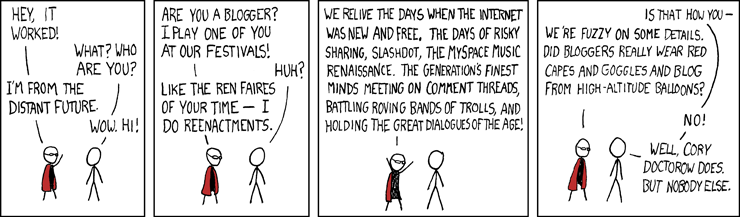
Tuesday, November 17, 2009
All you need is to have no life
Jonas Linderoth at the University of Gothenburg published an article in "Digital Læring" or Nordic Journal of Digital Literacy on the value of games for learning. The title "It is not hard, it just requires having no life - Computer games and the illusion of learning" positions the article as a stumbling block right in the middle of the over-enthusiastic rush towards games as a solution for modern education.
I had heard about and disagreed with this article several times before publishing, but reading it I am almost inclined to agree with it. Linderoth points out that there are two ways to gain skills in games. One is by learning to jump better, learning to think more tactically than the opponent or in some other way use the resources at hand better. The other way to gain skills in games is by doing repetitive tasks until you are rewarded with a level, an object or some other affordance that makes your avatar stronger. In short: he makes a clear distinction between what you learn as a player, and what affordances your avatar gains.
So far I am with him, and I think it's a very important consideration. The general belief that games make learning easier is severely flawed. The most important flaw is however in my opinion the belief that games makes it easier to teach what is on some curriculum. I don't know about the rest of the world, but here in Norway we have certain things pupils are supposed to learn each year, and their progress as well as the success of the teachers and the educational system is measured by how well they are able to learn these particular things. Outside of those skills, what the pupil or student learns doesn't count. So if you learn how to dance salsa really well, that does nothing for your grades in mathematics.
Games tend to teach you how to salsa, when what you should have learned is to do maths. If you don't want the game to teach salsa, you have to remove all options for dancing, and only leave options for mathematics. Linderoth describes his argument of the relationship between affordances and skills:
So, to sum up the argument - somewhat brutally, I admit: in order to learn something from a game, or develop as a gamer, the game should have static affordances. No new skills with new levels, no new tools, no gold or achievements, only you and your skill. Most common games which are typical agôn games are like this. They take you to the arena, read you the rules and give you your game-piece. Then it's just you, the board and your fellow gamers, and nothing changes within that frame.
Games where you can gain affordances simply by working diligently at simple tasks are, according to Linderoth, not games from which you can learn anything.
In the light of Scott Rettberg's article on "Corporate Ideology in World of Warcraft," in Digital Culture, Play and Identity, this is an interesting claim. Rettbergs argument is that exactly the grinding aspect of World of Warcraft is what makes it an ideal training ground for capitalist work ethics (p. 32). So, on the one hand you don't learn anything from grinding, on the other hand it's perfect training for many of the positions you can expect to hold as an employee today.
Now, Rettberg's argument gives strong ideological reasons to adapt Linderoth's position on games with non-static affordances, but I am still not totally convinced. The reason is that both in World of Warcraft (Rettberg) and World of Conflict (Linderoth), personal skill is the most important feature for satisfying gaming.
Most players who play a game with levels more than once, learn how to use levelling as just another fixed affordance, and so learn to become better at it, do it quicker and with better results. You can use levelling processes to learn more about the story of the game, hence use it to gain narrative satisfaction, or you can aim at aquiring particularly useful objects which you will then not have to return for later.
The problem with Linderoth's argument, where increased skill and new tools and resources pull in different directions, is that this conflict is just skin deep. For the players who play through a game that demands leveling more than once, the apparently increasing affordances they gain access to become fixed. There are just that many quests, just that many abilities, just that many levels, and that is what you have to play with. Yes, it takes longer to reach that point, and players who think a game ends just because they have reached a certain level, may feel that it's all about grinding. But players have other experiences from games of progression. The game researcher Kristine Jørgensen at the University of Bergen recently wrote a glowing description of her experiences with the new game Dragon Age: Origins, and all who have followed her descriptions of the play process on Facebook know that she is planning to go back to old saves in order to explore the game much further.
Now, we can argue that exploring old saves does not lead to learning, as it's just about repetition of something already done. But for a game which reveales a story that's even experienced as a moral story, a fable even, replaying old saves is a way to delve deeper into the conflicts, the parables and the lessons of fiction, and hence absolutely a way to learn... even if there are levels and new skills and objects to be gained on the way.
However, Linderoth does actually say something along these lines:
But I find that he loses sight of this in his final words:
First, learning is very much about repetition. You learn how to do a certain task, and then you drill that task until you can repeat it easily and quickly. This is how you learn how to do maths, how to play instruments, how to read and write. Each repetition is simple and non-challenging.
Next, you gain new affordances all the time, as you learn. When you have repeated one piece of music until you know how to play it, you get a new set of notes. Perhaps you get to play together with people with different instruments. You get to play in some new spot. Boring repetition leads to increased skill, new affordances and new achievements. You do actually gain levels, and you are not stuck on the same limited board with the same game-pieces for the rest of your life. Rather, if you keep repeating the same things without gaining new affordances, in real life you're stuck on a corner of the game board, without looking up to see that you're just playing a tiny part of the game.
Still, I think that Linderoth's article is very important for developing pedagogic games. I just agree with him on a different premise. I agree because what educators need isn't a virtual representation of how the world really is, but a way to see how pupils perform at a certain set of tasks given limited affordances. For this the games Linderoth promotes would be just perfect.
I had heard about and disagreed with this article several times before publishing, but reading it I am almost inclined to agree with it. Linderoth points out that there are two ways to gain skills in games. One is by learning to jump better, learning to think more tactically than the opponent or in some other way use the resources at hand better. The other way to gain skills in games is by doing repetitive tasks until you are rewarded with a level, an object or some other affordance that makes your avatar stronger. In short: he makes a clear distinction between what you learn as a player, and what affordances your avatar gains.
So far I am with him, and I think it's a very important consideration. The general belief that games make learning easier is severely flawed. The most important flaw is however in my opinion the belief that games makes it easier to teach what is on some curriculum. I don't know about the rest of the world, but here in Norway we have certain things pupils are supposed to learn each year, and their progress as well as the success of the teachers and the educational system is measured by how well they are able to learn these particular things. Outside of those skills, what the pupil or student learns doesn't count. So if you learn how to dance salsa really well, that does nothing for your grades in mathematics.
Games tend to teach you how to salsa, when what you should have learned is to do maths. If you don't want the game to teach salsa, you have to remove all options for dancing, and only leave options for mathematics. Linderoth describes his argument of the relationship between affordances and skills:
What I aim to illustrate is that a game system can be designed in such a way that you can progress in the game to a certain degree without adapting yourself to the system. A system that means that a gamer can succeed without the effort of mastering gaming skills. Phrased in a more theoretical way this is an issue about how new affordances are introduced in the gaming activity (p 10).
So, to sum up the argument - somewhat brutally, I admit: in order to learn something from a game, or develop as a gamer, the game should have static affordances. No new skills with new levels, no new tools, no gold or achievements, only you and your skill. Most common games which are typical agôn games are like this. They take you to the arena, read you the rules and give you your game-piece. Then it's just you, the board and your fellow gamers, and nothing changes within that frame.
Games where you can gain affordances simply by working diligently at simple tasks are, according to Linderoth, not games from which you can learn anything.
In the light of Scott Rettberg's article on "Corporate Ideology in World of Warcraft," in Digital Culture, Play and Identity, this is an interesting claim. Rettbergs argument is that exactly the grinding aspect of World of Warcraft is what makes it an ideal training ground for capitalist work ethics (p. 32). So, on the one hand you don't learn anything from grinding, on the other hand it's perfect training for many of the positions you can expect to hold as an employee today.
Now, Rettberg's argument gives strong ideological reasons to adapt Linderoth's position on games with non-static affordances, but I am still not totally convinced. The reason is that both in World of Warcraft (Rettberg) and World of Conflict (Linderoth), personal skill is the most important feature for satisfying gaming.
Most players who play a game with levels more than once, learn how to use levelling as just another fixed affordance, and so learn to become better at it, do it quicker and with better results. You can use levelling processes to learn more about the story of the game, hence use it to gain narrative satisfaction, or you can aim at aquiring particularly useful objects which you will then not have to return for later.
The problem with Linderoth's argument, where increased skill and new tools and resources pull in different directions, is that this conflict is just skin deep. For the players who play through a game that demands leveling more than once, the apparently increasing affordances they gain access to become fixed. There are just that many quests, just that many abilities, just that many levels, and that is what you have to play with. Yes, it takes longer to reach that point, and players who think a game ends just because they have reached a certain level, may feel that it's all about grinding. But players have other experiences from games of progression. The game researcher Kristine Jørgensen at the University of Bergen recently wrote a glowing description of her experiences with the new game Dragon Age: Origins, and all who have followed her descriptions of the play process on Facebook know that she is planning to go back to old saves in order to explore the game much further.
Now, we can argue that exploring old saves does not lead to learning, as it's just about repetition of something already done. But for a game which reveales a story that's even experienced as a moral story, a fable even, replaying old saves is a way to delve deeper into the conflicts, the parables and the lessons of fiction, and hence absolutely a way to learn... even if there are levels and new skills and objects to be gained on the way.
However, Linderoth does actually say something along these lines:
The relationship between the player’s skill and progression in using tools and resources is not something fixed, but rather fluid. In one and the same game there can be moments that require more or less skill. It is not as simple as saying that just because a game introduces new tools and resources the player never has to develop her or his skill (p. 12).
But I find that he loses sight of this in his final words:
Games and education have completely different conditions. While games are designed to make players happy, educational practices are legitimate as long as they offer students the opportunity to learn something. To design educational tasks where you can succeed by just waiting and doing some extremely simple, non-challenging activities is hardly appropriate. That would be like giving someone on a diet a set of scales that showed weight loss without the person actually loosing any weight. Maybe the things that make a player motivated while playing games neither can nor should be brought into schools (p. 17).
First, learning is very much about repetition. You learn how to do a certain task, and then you drill that task until you can repeat it easily and quickly. This is how you learn how to do maths, how to play instruments, how to read and write. Each repetition is simple and non-challenging.
Next, you gain new affordances all the time, as you learn. When you have repeated one piece of music until you know how to play it, you get a new set of notes. Perhaps you get to play together with people with different instruments. You get to play in some new spot. Boring repetition leads to increased skill, new affordances and new achievements. You do actually gain levels, and you are not stuck on the same limited board with the same game-pieces for the rest of your life. Rather, if you keep repeating the same things without gaining new affordances, in real life you're stuck on a corner of the game board, without looking up to see that you're just playing a tiny part of the game.
Still, I think that Linderoth's article is very important for developing pedagogic games. I just agree with him on a different premise. I agree because what educators need isn't a virtual representation of how the world really is, but a way to see how pupils perform at a certain set of tasks given limited affordances. For this the games Linderoth promotes would be just perfect.
Tuesday, November 10, 2009
In memory
Suddenly they are cool again, all the things my parents did way back when. And today the lovely Serena shared a link with me, for something which reminds me particularly strongly of my mother. We have inherited hundreds of bottles of the stuff. This summer I just might test if any of it has survived.
Monday, November 09, 2009
Meta-blog post, since it's been a while
I am no longer blogging as actively as I did, and I am glad of it. As Alex Halavais predicted, in five years we'd be embarassed by having been really active bloggers. Well, it's not that bad, but I see that both my own writing and the structure from the technology has changed since 2001.
I blog more about events now, travels, conferences, meetings, and less commentary and opinions, also, a lot less from my private life. Oh, it's all still there, but it has changed, become toned down. Partly this is caused by a couple of rather upsetting events, where the weblog became focus for actions that spilled over into other media, and led to an overwhelming feeling of professional and personal isolation here, at this small college. I still don't think it was possible to avoid what happened, but I might have been able to do some more damage control. Or not. Who knows.
Also, my personal life is a lot more boring now. What do I do? I work, travel to conferences and occasionally on a vacation, and spend the evenings working, doingchores or playing WoW. Yes, I still do that. I tried to swap to Age of Conan, but the lag killed my interest. I just ordered Dragon Age, perhaps playing single-player games for a while will help. Also, I am healthier, the result of watching what I eat, working out and not obsessively writing a book or thesis, and plain health is boring. I don't even have anything to whine about. From January I'll also be free of the administration of the PR, communication and media education (new name since this autumn), which will hopefully lead to more time for reflection and creativity around the topic of social media. The dean wants me to plan a couple of courses as a start. I'd like that, to be able to teach what I research.
And I think facebook has changed my blogging, too. A lot of the general commenting and tracking has moved from here to there. Oh, and then there's the forskning.no weblog, where I put the more researched blogposts on games. It's in Norwegian, so I don't double post it. Now, considering, that's too bad. I should at least link those posts.
Anyway, that's what's going on here. I am not going to promise the posting will pick up. I am actually quite happy with my online/offline balance at the moment.
I blog more about events now, travels, conferences, meetings, and less commentary and opinions, also, a lot less from my private life. Oh, it's all still there, but it has changed, become toned down. Partly this is caused by a couple of rather upsetting events, where the weblog became focus for actions that spilled over into other media, and led to an overwhelming feeling of professional and personal isolation here, at this small college. I still don't think it was possible to avoid what happened, but I might have been able to do some more damage control. Or not. Who knows.
Also, my personal life is a lot more boring now. What do I do? I work, travel to conferences and occasionally on a vacation, and spend the evenings working, doingchores or playing WoW. Yes, I still do that. I tried to swap to Age of Conan, but the lag killed my interest. I just ordered Dragon Age, perhaps playing single-player games for a while will help. Also, I am healthier, the result of watching what I eat, working out and not obsessively writing a book or thesis, and plain health is boring. I don't even have anything to whine about. From January I'll also be free of the administration of the PR, communication and media education (new name since this autumn), which will hopefully lead to more time for reflection and creativity around the topic of social media. The dean wants me to plan a couple of courses as a start. I'd like that, to be able to teach what I research.
And I think facebook has changed my blogging, too. A lot of the general commenting and tracking has moved from here to there. Oh, and then there's the forskning.no weblog, where I put the more researched blogposts on games. It's in Norwegian, so I don't double post it. Now, considering, that's too bad. I should at least link those posts.
Anyway, that's what's going on here. I am not going to promise the posting will pick up. I am actually quite happy with my online/offline balance at the moment.
Thursday, November 05, 2009
Security, risk, crisis
I am in Trondheim at a conference about safety and risk, where I have been invited to be on a panel organised by the Research Council of Norway, who organise their own conference in conjunction with "Sikkerhetsdagene" - the security days. The topic for the panel is media, crisis and panic.
I have to admit this feels a bit out of my field, but when I arrived just in time for last night's dinner, I was greeted enthusiastically by a friend I barely had time to get to know before he left Volda, and since lost touch with, Professor Peter Burgess at PRIO, the International Peace Research Institute of Oslo.
"What are you doing here?" I asked, subtle as ever. "Oh," he responded, "this Norwegian question, how to answer that?" It turns out that these are his people, as the research group he is leading in PRIO is concerned with security. And so it clicked into place, the talks I had noticed him doing earlier, about Security in Europe. Meeting him saved the evening for me, and reminded me why I missed him when he left Volda for other fields. Some people understand what you're talking about, you know. Which, after all, is why we go to conferences: To meet the people who understand what we're saying, and listen to the ones talking our own tribal language.
The panel I am on is quite interesting, in relation to both my teaching and my research. The session is lead by one of Norway's most interesting law and informatics scholars, who is also a science fiction author (yes, this is one of my long-time heroes) Jon Bing (he has wikipedia entries in both book- and new-Norwegian). Leading the panel debate is Eva Bratholm, a former journalist now leading the information department of Norad, Norwegian Agency of Development Cooperation. Then there's Tone Bergan from The Directorate for Civil Protection and Emergency Planning, two full professors, Tore Bjørgo and Rune Ottosen, and ... me.
*smartassed overconfident finishing remark deleted*
I have to admit this feels a bit out of my field, but when I arrived just in time for last night's dinner, I was greeted enthusiastically by a friend I barely had time to get to know before he left Volda, and since lost touch with, Professor Peter Burgess at PRIO, the International Peace Research Institute of Oslo.
"What are you doing here?" I asked, subtle as ever. "Oh," he responded, "this Norwegian question, how to answer that?" It turns out that these are his people, as the research group he is leading in PRIO is concerned with security. And so it clicked into place, the talks I had noticed him doing earlier, about Security in Europe. Meeting him saved the evening for me, and reminded me why I missed him when he left Volda for other fields. Some people understand what you're talking about, you know. Which, after all, is why we go to conferences: To meet the people who understand what we're saying, and listen to the ones talking our own tribal language.
The panel I am on is quite interesting, in relation to both my teaching and my research. The session is lead by one of Norway's most interesting law and informatics scholars, who is also a science fiction author (yes, this is one of my long-time heroes) Jon Bing (he has wikipedia entries in both book- and new-Norwegian). Leading the panel debate is Eva Bratholm, a former journalist now leading the information department of Norad, Norwegian Agency of Development Cooperation. Then there's Tone Bergan from The Directorate for Civil Protection and Emergency Planning, two full professors, Tore Bjørgo and Rune Ottosen, and ... me.
*smartassed overconfident finishing remark deleted*
Friday, October 30, 2009
Sustainability, Participation, Action
Next year's AOIR conference, IR 11.0, is in Gothenburg October 6-9th 2010, and the local chairs are the lovely ladies Ann-Sofie Axelsson and Ylva Hård af Segerstad. They have a program chair who is not quite as lovely, actually a grumpy old bitch, but you know, program chairs need to be the bad guys. I have said yes to that job, and I am looking forwards to it. Ann-Sofie and Ylva are both very enthusiastic about making a conference that aims at the future, and while I tend to be a little tentative about the future I desperately want there to be one. I do however think we need to cooperate if we want a future, and we need to act - preferably in some sort of agreed way.
The CFP isn't done yet, but will be soon now, as the Super Scandinavian Consortium is on its feet and cooperating. It can't get better than this: A Norwegian to mess things up by asking importune questions, and two Swedes to cover over and make things run smoothly after all. And if you don't get that last reference, you're not Scandinavian, and have a long way to go yet...
But you can start with a trip to Gothenburg! See you all there in 2010!
The CFP isn't done yet, but will be soon now, as the Super Scandinavian Consortium is on its feet and cooperating. It can't get better than this: A Norwegian to mess things up by asking importune questions, and two Swedes to cover over and make things run smoothly after all. And if you don't get that last reference, you're not Scandinavian, and have a long way to go yet...
But you can start with a trip to Gothenburg! See you all there in 2010!
Thursday, October 29, 2009
Me, feminism, again
I was asked to be part of a panel with a group of wonderful scholars, all female, for a conference next year. It was a very flattering request, and, weak soul that I am, decided that I wanted to be part of it the moment I read "I have been teaching your work." I mean - somebody uses my work in classrooms. Gosh, that's as close to immortality as I ever expect to come.
Anyway, I dawled a little over the response, because I am always stunned when I find that people think of me as a feminist. I think I am just a humanist, a person who happens to be female, but who cares about the system within which we all live. I think of my work not as restricted by gender or viewpoint, I am studying players and I study them independent of their gender. At the same time I am very aware that gender influences them, as players, and it influences me, as a researcher.
In a way, when I see myself presented as a feminist scholar I have a flashback to a conversation with my daughter. Her teacher had rounded on her saying "you, who are Torill's daughter, can't have such ignorant opinions of gender!" My daughter was truly upset, because she didn't understand what she had done wrong. It took a long conversation to try to make sense of it. Our final conclusion was that my daughter's role models as a woman are me and my four very strong sisters.
What do the other four do? One runs a successful export/import firm, another has an expanding business of design and craft on top of teaching, one is a well respected artist, and the fourth has her heart and attention on leading live-action role-play games, one of the few female GMs in Norway. We always did what we wanted, despite gender, class, culture, economy, ethnicity and geography working against us. Actually in that mix of obstacles we ignored, gender was just another issue. Between the five of us, my bright and wonderful daughter had never even considered that she couldn't do just what she wanted.
By the time my daughter and I had come around to that, we had agreed that yeah, we were feminists, because if we were to isolate gender from the rest of the soup that influences humanity, then we were definitely, she and I, on the feminist side. We just were a little handicapped when it came to seeing the specifically gender-related topics.
Now, I'd be a bad feminist if I didn't tell you about my son and how he taught me about gender studies. You see, he is the one who dwells on gender issues, explores the limitations and affordances of masculinity, questions, criticizes and discusses them. But that's for some other time.
Anyway, I dawled a little over the response, because I am always stunned when I find that people think of me as a feminist. I think I am just a humanist, a person who happens to be female, but who cares about the system within which we all live. I think of my work not as restricted by gender or viewpoint, I am studying players and I study them independent of their gender. At the same time I am very aware that gender influences them, as players, and it influences me, as a researcher.
In a way, when I see myself presented as a feminist scholar I have a flashback to a conversation with my daughter. Her teacher had rounded on her saying "you, who are Torill's daughter, can't have such ignorant opinions of gender!" My daughter was truly upset, because she didn't understand what she had done wrong. It took a long conversation to try to make sense of it. Our final conclusion was that my daughter's role models as a woman are me and my four very strong sisters.
What do the other four do? One runs a successful export/import firm, another has an expanding business of design and craft on top of teaching, one is a well respected artist, and the fourth has her heart and attention on leading live-action role-play games, one of the few female GMs in Norway. We always did what we wanted, despite gender, class, culture, economy, ethnicity and geography working against us. Actually in that mix of obstacles we ignored, gender was just another issue. Between the five of us, my bright and wonderful daughter had never even considered that she couldn't do just what she wanted.
By the time my daughter and I had come around to that, we had agreed that yeah, we were feminists, because if we were to isolate gender from the rest of the soup that influences humanity, then we were definitely, she and I, on the feminist side. We just were a little handicapped when it came to seeing the specifically gender-related topics.
Now, I'd be a bad feminist if I didn't tell you about my son and how he taught me about gender studies. You see, he is the one who dwells on gender issues, explores the limitations and affordances of masculinity, questions, criticizes and discusses them. But that's for some other time.
Wednesday, October 21, 2009
Why I really should read CFPs more closely
I just finished an article I am now quite happy with and would love to see published, on player ethics and pleasure in games, and enthusiastically I looked up the CFP of the magazine I was asked to contribute to, in order to see where I should send it.
I have written 7000 words too much.
I can cut 2000, perhaps 3000 if I really go through and remove all redundancy (I probably should do anyway), but reducing the paper by more than half?
BTW: Cutting is going fine. Not even sarcastic about that! I may not make all 7000, but it's really useful to start killing darlings! It's an important part of the process, as well. What comes out at the other end will be the important material. At least I hope so!
I have written 7000 words too much.
I can cut 2000, perhaps 3000 if I really go through and remove all redundancy (I probably should do anyway), but reducing the paper by more than half?
BTW: Cutting is going fine. Not even sarcastic about that! I may not make all 7000, but it's really useful to start killing darlings! It's an important part of the process, as well. What comes out at the other end will be the important material. At least I hope so!
Wednesday, October 14, 2009
Freddo!

What you're looking at here is an image from the Norwegian weather site yr.no, showing the weather in Urbino for 48 hours. The temperature is about the same as in Volda, and if you notice the dip in the red line towards the slightly thicker line, Friday it's coming frighteningly close - that means it falls down almost to freezing. There's snow in the mountains in the distance (luckily, note distance), and I have been shopping for warm clothing. I now have a very exclusive italian wool jacket made in Toscana, and the cap and gloves I put into the bag when I got on the plane out of Norway, not planning to use until I got back, are actually getting use!
Email issues
If you have sent me an email to the hivolda.no address and not gotten a response, that's because for some reason when using webmail from the University of Urbino's network I only get to look at mails there for about 60 seconds, then I get kicked and need to relog. Although I can't just relog, I have to restart the browser, then relog. This means that for every minute spent reading mail, I spend two - three relogging. So, if it's really important, make sure to mark the mail urgent or, if you're one of the people who know my gmail address, please use that.
Monday, October 12, 2009
And the skies opened...
After a week offline, I am finally at a stable connection with my own machine. Oh, the luxury! I am in the Larica office, at the University of Urbino, just arrived by way of Ancona from Alghero, Sardinia. As the plane landed the skies opened, and out poured one happy and rested Norwegian scholar - and a huge deluge of rain, with thunder and lightening added. As we entered the University - an hour delayed due to the weather - the first words spoken by a student on his way out was "Madonna, ce freddo!!!" That doesn't really need translation, hmm?
So, well, I feel quite at home - cold, rain and internet!
So, well, I feel quite at home - cold, rain and internet!
Thursday, October 01, 2009
Food feeds the soul
While I know my cooking has little to do with soul food, I enjoy cooking on many levels, from the simple pleasure of eating the results, to the process as a flow experience, where each step is its own reward in a process of scents, colours and textures as much as taste. And so when a group of game researchers from the Norwegian network JoinGame gathered in Volda, I had a chance to prepare by cooking. The result was a three course dinner: Grilled fennel, baked eggplant and chocolate mousse.
The fennel was good, but not stunning, so I'll just skip that, but I was asked for the recipe for the eggplant, so here it is, for 4 persons:
4 large eggplants
2 tbs olive oil + extra for the eggplants
1 small onion
800 g chopped tinned tomatoes
2 tbs chopped fresh basil
50-75 g freshly grated parmesan
200 g mozarella, thinly sliced
seasalt and freshly grated black pepper
Cut the eggplant in 1 1/4 cm thick strips. Leave them in salted water for 30 minutes.
Heat the oil in a frying pan, and fry the onion until it's soft. Put in tomatoes and basil, and let this bubble slowly for about 30 minutes.
Let the eggplant drain, clean them in fresh water and pat them dry. Deep fry them or brush with oil and bake them at about 180 degrees Celcius for 20 minutes.
Put a layer of eggplants in the bottom of a oven-proof pot. Then a layer of grated parmesan, mozarella and then the tomato sauce. Repeat this, to end with a layer of tomatoes if you want a soft top, or cheese if you want a more dry, crisp top layer.
Bake this at 180 degrees Celcius for 30-35 minutes, until it bubbles and is golden on top. Take out and put aside for 10 minutes before serving. Serve warm or room tempered.
For the dessert, loads of dark chocolate, here for 2 persons:
100 g 70% (at least) chocolate
juice and zest of one orange
2 eggs, seperated
Melt the chocolate gently in a fireproof bowl over a pot of hot water. Don't let the bowl touch the boiling water. Cool the chocolate and then stir in orange juice, zest and egg yolks. Beat the egg whites firmly, then gently cut one spoon of whites into the chocolate mixture, before you put everything in. Put the mousse in two high glasses and cool until it's set. decorate with orange peels before serving.
This mousse is so intense that I prefer to serve it with a dash of cream. It is not particularly sweet, so it does not demand coffee to go with it, but it is very rich, so you don't need a large portion.
Later on the poor, overfed gamers were served warm apple cake and tea.
The fennel was good, but not stunning, so I'll just skip that, but I was asked for the recipe for the eggplant, so here it is, for 4 persons:
4 large eggplants
2 tbs olive oil + extra for the eggplants
1 small onion
800 g chopped tinned tomatoes
2 tbs chopped fresh basil
50-75 g freshly grated parmesan
200 g mozarella, thinly sliced
seasalt and freshly grated black pepper
Cut the eggplant in 1 1/4 cm thick strips. Leave them in salted water for 30 minutes.
Heat the oil in a frying pan, and fry the onion until it's soft. Put in tomatoes and basil, and let this bubble slowly for about 30 minutes.
Let the eggplant drain, clean them in fresh water and pat them dry. Deep fry them or brush with oil and bake them at about 180 degrees Celcius for 20 minutes.
Put a layer of eggplants in the bottom of a oven-proof pot. Then a layer of grated parmesan, mozarella and then the tomato sauce. Repeat this, to end with a layer of tomatoes if you want a soft top, or cheese if you want a more dry, crisp top layer.
Bake this at 180 degrees Celcius for 30-35 minutes, until it bubbles and is golden on top. Take out and put aside for 10 minutes before serving. Serve warm or room tempered.
For the dessert, loads of dark chocolate, here for 2 persons:
100 g 70% (at least) chocolate
juice and zest of one orange
2 eggs, seperated
Melt the chocolate gently in a fireproof bowl over a pot of hot water. Don't let the bowl touch the boiling water. Cool the chocolate and then stir in orange juice, zest and egg yolks. Beat the egg whites firmly, then gently cut one spoon of whites into the chocolate mixture, before you put everything in. Put the mousse in two high glasses and cool until it's set. decorate with orange peels before serving.
This mousse is so intense that I prefer to serve it with a dash of cream. It is not particularly sweet, so it does not demand coffee to go with it, but it is very rich, so you don't need a large portion.
Later on the poor, overfed gamers were served warm apple cake and tea.
What's up in Volda?
What's worth blogging, one asks oneself once in a while. And hey, let's admit it, the world won't stop spinning if I don't blog. I do however find that something else stops spinning, and that's those wheels in my brain. I am, as the blog indicates, a person who thinks while writing. Or, that's not true: I am a person who needs to write in order to organise my thoughts.
I find that I ramble more and more to my students. Their stunned looks when I pause in an attempt to trace down the core of the thought I had, the idea I want to communicate to them, indicates that I have been off on some totally undisciplined tangent, and bombarded them with apparently unrelated facts. This happens because I have deliberately stopped writing out my lectures. There was a day when I refused to face students without 20 pages, double space, 12 points. That's 45X45 minutes of pretty steady talking, in case you wondered. But no more. I put down the most important facts, I find some ways to illustrate those, and then I try to connect the dots. It's those connections that occasionally get a little - fragile.
But I am still writing. I am just about to finish up an article I write with Luca, Rene and Kristine. I have to download and bring with me the material from my project this spring, in order to write it up, not yet in article form then at least in a form that lets me access the material easily. I have to rewrite an article for a collection Esther asked if I could contribute to. I have a research grant sketch on my machine. I have a plan for a much larger research grant based off the material from the "Gamer's Space" project. Basically, I can spend the time from now until Christmas writing, and still not be done. I have two weeks in which to do it.
And in the mean time, I write and play other stuff. Last night I made an experiment to see if people would/could come to my farm-town toons' wedding. I had a few guests, it was, as Rene stated, an intimate wedding. Which is just as well, as they revealed quite a bit of the future development of the drama on the farm. Yes, I am creating a drama on there, and I am trying to track the use of the game in order to do it. Right now, for instance, I need to gain a new level before I can get on with the story, because I need a greenhouse. Once that is in place betrayal, tragedy and the final plot twist will follow.
Also, I have been asked to reveal the secrets of my aubergine, tomatoes and cheese course from last week's game researcher dinner. But that deserves a blogpost all of it's own.
I find that I ramble more and more to my students. Their stunned looks when I pause in an attempt to trace down the core of the thought I had, the idea I want to communicate to them, indicates that I have been off on some totally undisciplined tangent, and bombarded them with apparently unrelated facts. This happens because I have deliberately stopped writing out my lectures. There was a day when I refused to face students without 20 pages, double space, 12 points. That's 45X45 minutes of pretty steady talking, in case you wondered. But no more. I put down the most important facts, I find some ways to illustrate those, and then I try to connect the dots. It's those connections that occasionally get a little - fragile.
But I am still writing. I am just about to finish up an article I write with Luca, Rene and Kristine. I have to download and bring with me the material from my project this spring, in order to write it up, not yet in article form then at least in a form that lets me access the material easily. I have to rewrite an article for a collection Esther asked if I could contribute to. I have a research grant sketch on my machine. I have a plan for a much larger research grant based off the material from the "Gamer's Space" project. Basically, I can spend the time from now until Christmas writing, and still not be done. I have two weeks in which to do it.
And in the mean time, I write and play other stuff. Last night I made an experiment to see if people would/could come to my farm-town toons' wedding. I had a few guests, it was, as Rene stated, an intimate wedding. Which is just as well, as they revealed quite a bit of the future development of the drama on the farm. Yes, I am creating a drama on there, and I am trying to track the use of the game in order to do it. Right now, for instance, I need to gain a new level before I can get on with the story, because I need a greenhouse. Once that is in place betrayal, tragedy and the final plot twist will follow.
Also, I have been asked to reveal the secrets of my aubergine, tomatoes and cheese course from last week's game researcher dinner. But that deserves a blogpost all of it's own.
Wednesday, September 09, 2009
Flow, seduction...
Just updated the link to my paper from "Other Players" in Copenhagen 2004. The online conference proceedings have disappeared, but I found an electronic version of the article, and now the link leads to my own version.
I have no idea what happened to the conference proceedings, but I hope you enjoy the paper, even if it's aging.
I have no idea what happened to the conference proceedings, but I hope you enjoy the paper, even if it's aging.
Wednesday, September 02, 2009
Variety and familiarity
So far the DiGRA09 conference moves along smoothly, aided by a tremendous effort from the organisers. Tanya, Helen, Esther, Patrick, Justin, Barry and the rest of the crew working to make this work out are really WORKING.
On the presentation side, cancellations and no-shows have made the program very "roomy". While this makes for a relaxed atmosphere which people uses as an opportunity to talk, explore and exchange ideas, it tends to make people a little restless, as we all wonder what's going on in the other rooms.
The conference games are as usual played more intently by some than by others. I had some fun reading the rules and trying one of them yesterday, but then the interesting backchatter twitter game was forgotten due to the fact that I would have to plan the words for the next session, and not the current one. This creates a disruption in the flow of the conference, as it means I have to concentrate on what is to come by doing it. Also - seriously, how grand do you think our batteries are? There's no place to plug in the computer, and I am not taking the machine out in the cramped coffee/tea area just to send off a couple of twitter messages. So they need to wait until next session... when I am thinking about the session, not next backchatter round. Sorry about that, because it's a great idea.
As for the other game - well, I have the cards with me, but I just don't remember them at the vital moments when I could do something with them. Perhaps that game will take off during dinner.
On the presentation side, cancellations and no-shows have made the program very "roomy". While this makes for a relaxed atmosphere which people uses as an opportunity to talk, explore and exchange ideas, it tends to make people a little restless, as we all wonder what's going on in the other rooms.
The conference games are as usual played more intently by some than by others. I had some fun reading the rules and trying one of them yesterday, but then the interesting backchatter twitter game was forgotten due to the fact that I would have to plan the words for the next session, and not the current one. This creates a disruption in the flow of the conference, as it means I have to concentrate on what is to come by doing it. Also - seriously, how grand do you think our batteries are? There's no place to plug in the computer, and I am not taking the machine out in the cramped coffee/tea area just to send off a couple of twitter messages. So they need to wait until next session... when I am thinking about the session, not next backchatter round. Sorry about that, because it's a great idea.
As for the other game - well, I have the cards with me, but I just don't remember them at the vital moments when I could do something with them. Perhaps that game will take off during dinner.
Tuesday, September 01, 2009
At Digra 2009
So here I am, at Brunel University, in incredibly lovely weather. Since I left Volda in pouring rain and +10 degrees Celcius, I was really not ready for +20 and sunshine.
I flew in to Heathrow, and that seems to have been the best choice, as Brunel in Uxbridge isn't exactly in the heart of London. From terminal 3, where SAS out of Scandinavia landed, the U3 bus went straight from the Central bus station to Brunel. It cost 2 pounds, and was very easy.
So now I am here and ready to listen to four days of presentations. Last night the game researchers all drifted in, ending in the local pub. There are still local pubs in England, for which I am very thankful - we're not exactly right on any fancy restaurant streets.
I flew in to Heathrow, and that seems to have been the best choice, as Brunel in Uxbridge isn't exactly in the heart of London. From terminal 3, where SAS out of Scandinavia landed, the U3 bus went straight from the Central bus station to Brunel. It cost 2 pounds, and was very easy.
So now I am here and ready to listen to four days of presentations. Last night the game researchers all drifted in, ending in the local pub. There are still local pubs in England, for which I am very thankful - we're not exactly right on any fancy restaurant streets.
Subscribe to:
Posts (Atom)


 Posts
Posts


