Sometimes, as my sister says, "the coin falls down." You know the feeling, it's when you get the joke and you see how something works. But that's where the image ends, because you can't really talk about coins falling slowly or coins falling quickly - gravity is gravity and me being slow to realise something does not keep a coin suspended in free fall for ever.
Sometimes though, the image of coins falling is spot on, and today the coins were falling too many at the time. It was like I pulled a handle and they all came rushing - sadly not to stream into my hands and leave me rich and happy, but to cram themselves into the same little slot before I had a chance to appreciate any of them.
I had an epiphany. I have started to hate those, but it's how my research brain works. I sit around, looking at a stack of books, then I read them, randomly, looking for - something - then I write a little something totally unrelated, and I play a game and I surf online and I get involved with finding a pair of purple pants for my rogue (she really needs a pair of pretty epics, you know), and then I go listen to some lectures and before I know it time is running out. Do you think that's the stressfull part? Nooo, the stressfull part is what comes next. Because I start doing all kinds of stuff so I won't feel I have wasted my time, taking on work and booking trips and such, and THAT is when all the coins drop at the same time. Suddenly I see what I am looking for, and it's right in front of my eyes and I have to write it down NOW, but I have said yes to so many other things and I can't...
I hate it. But I live for it. Ambivalence and contradition. They feed me.
Friday, April 11, 2008
The Cute Cat Theory
Finally, somebody has taken the time to show in a systematic fashion why having tools available can be a way to support democracy, even if the tools in question most of the time is used to show pictures of cute cats. The Cute Cat Theory (thank you Fabio for mentioning it) by Ethan Zuckerman shows that if people are able to post pictures of their cute cats online, they can also post pictures of crimes against humanity and political unrest and activism.
Baghdad Girl's blog is a good example of that, most of her posts are about cute cats. But in the last post on her blog so far, written 27th of August 2007, she writes:
She has been giving her readers a little glimpse of the life of a girl and a young woman growing up in a Baghdad in war, exams, scores, cats and all, and then the story ends with flight, loss and looting. Personally, I think the stury of Baghdad Girl is as important as any documentary of warzones. And her cats are really, really cute.
Baghdad Girl's blog is a good example of that, most of her posts are about cute cats. But in the last post on her blog so far, written 27th of August 2007, she writes:
My memories are fading away...
"I wish there is some thing I can do". This sentence I have been repeating a lot these days. Every time I ask about the situation in Iraq I become angry and sad because there is nothing I can do. I wish some one can tell me what can I do to save what is left in Iraq.
I have left my house, my room and my cats that I know nothing about any more. When we left we didn't take every thing in the house with us because it is impossible, that house and every thing in it is a treasure, It was built 35 years ago, and now It is going to be looted just because it is empty and there is no one to protect it.
Some members of what is known as national guards are checking every house in Hay Al-Jamia, where my house is, these days. Do you know what will they do if they find an empty one?? They close the roads leading to it, bring a lorry and loot every thing in that house. That is what about to happen to my house and it's 35 years of memories.This is the army that the American government and the Iraqi government are helping to build, they brought every criminal, thief, and looser gave him a gun and send him to the streets, the new army together with the armed militias with the help of Iran, are destroying the country.
If the people who suppose to protect the country, are the ones who are destroying it. What future does Iraq still have???
Raghda
She has been giving her readers a little glimpse of the life of a girl and a young woman growing up in a Baghdad in war, exams, scores, cats and all, and then the story ends with flight, loss and looting. Personally, I think the stury of Baghdad Girl is as important as any documentary of warzones. And her cats are really, really cute.
Tuesday, April 08, 2008
Monday, April 07, 2008
Women in Games 2008
Just putting it here, so I know where to find it, and you can find it too!
Women in Games is a very good series of conferences discussing exactly that - Women in Games, in research, in the industry, in the games themselves. This year it is at the University of Warwick; September 10th - 12th 2008.
Women in Games is a very good series of conferences discussing exactly that - Women in Games, in research, in the industry, in the games themselves. This year it is at the University of Warwick; September 10th - 12th 2008.
Sunday, April 06, 2008
Worlds apart
I have recently been reading two books which have made an impression on me - for wildly different reasons. One is a Swedish book on their recent debate around pornography and prostitution, Petra Östergren's Porr, Horor och Feminister, the other is Edward Castronova's Exodus to the Virtual World.
Reading these books simultaneously has been a truly weird experience. I came a little late to Östergren's book, as it is written mainly for the Swedish debate. It is a highly political book where Östergren reports her own research on pornography and prostitution, how this has been received by feminist activists in Sweden, and how pornography and prostitution is discussed in the Swedish public sphere. It is fascinating reading, not the least because of the feeling that Östergren is fighting what she sincerely believes to be the good fight: she has come around from being highly suspicious of the sex industry to becoming equally suspicious of the public image being painted of this industry. She introduces us to the results of her own research; hundreds of hours watching porn of all types, years of contacting, getting to know and interviewing prostitutes.
Östergren's conclusion is clear all the way through the book. She is very much against the recent law which made prostitution illegal in Sweden, and she shows how the process towards having this law accepted has totally ignored any sceptical voices among the sex-workers. The only permitted "voice" has been that of the generic tired, worn-down prostitute saying "yes, what I do is horrible and should be outlawed." She demonstrates how this is an example of hegemonic violence, and writes with a passion on behalf of the women she has learned to know in the course of her research. It is a emotionally raw piece of writing, which still manages to stay within the world of documented facts. Yes, she excludes the traditional image of the abused whore from the book, her examples are the ones who deal well with their jobs. But she is honest about that, and she is also right: that story has been told, and it's been told frequently.
It is a fascinating book both for the alternative take on a familiar topic, but also for the clear and elegant argument all the way through. She fights for a better world, and she uses her skill and her knowledge to do so, honestly and in a well-researched manner.
This has been my breakfast treat this week, before I have immersed myself again in game writing. Parts of the time focusing on games has been spent going through Castronova's more recent book. Being another political document throwing an alternative view out there, it is comparable to the Östergren book in the passionate and highly alternative views it presents. The similarities end there.
I have to admit I hope Exodus to the Virtual World is an ironic statement about the state of games scholarship, development and commercialism, and that I am just not getting the joke. Alternatively that he did it for the money, in which case he succeeded, I did buy the book after all. To accept that a scholar who is otherwise so sane and clear in his arguments in the field where he knows what he is doing has suddenly decided to write this book and means it seriously, is really a far stretch. Yes, we can all write not-so-good books, but this is a political statement promoting such a totalitarian system in the name of "fun", that it goes from being not-so-brilliant to being scary. It actually made me reconsider the dangers of studying games.
Östergren writes about how the Swedish critics of films are only allowed to work with pornography for a limited time, because after that they are supposedly emotionally stunted, and blind to what might offend others. Exodus to the Virtual World made me wonder if there should be a similar rule for game research: That after 5 years with games we have to work with something else, say - news reporting from Palestine or the economy of alternative energy - for two years before touching game studies again.
This doesn't keep me from taking advantage of the book though. There are enough clichés used that it's turning out to be very useful when refering to common misconceptions. I guess this shows that I am just becoming an emotionally stunted game scholar.
Reading these books simultaneously has been a truly weird experience. I came a little late to Östergren's book, as it is written mainly for the Swedish debate. It is a highly political book where Östergren reports her own research on pornography and prostitution, how this has been received by feminist activists in Sweden, and how pornography and prostitution is discussed in the Swedish public sphere. It is fascinating reading, not the least because of the feeling that Östergren is fighting what she sincerely believes to be the good fight: she has come around from being highly suspicious of the sex industry to becoming equally suspicious of the public image being painted of this industry. She introduces us to the results of her own research; hundreds of hours watching porn of all types, years of contacting, getting to know and interviewing prostitutes.
Östergren's conclusion is clear all the way through the book. She is very much against the recent law which made prostitution illegal in Sweden, and she shows how the process towards having this law accepted has totally ignored any sceptical voices among the sex-workers. The only permitted "voice" has been that of the generic tired, worn-down prostitute saying "yes, what I do is horrible and should be outlawed." She demonstrates how this is an example of hegemonic violence, and writes with a passion on behalf of the women she has learned to know in the course of her research. It is a emotionally raw piece of writing, which still manages to stay within the world of documented facts. Yes, she excludes the traditional image of the abused whore from the book, her examples are the ones who deal well with their jobs. But she is honest about that, and she is also right: that story has been told, and it's been told frequently.
It is a fascinating book both for the alternative take on a familiar topic, but also for the clear and elegant argument all the way through. She fights for a better world, and she uses her skill and her knowledge to do so, honestly and in a well-researched manner.
This has been my breakfast treat this week, before I have immersed myself again in game writing. Parts of the time focusing on games has been spent going through Castronova's more recent book. Being another political document throwing an alternative view out there, it is comparable to the Östergren book in the passionate and highly alternative views it presents. The similarities end there.
I have to admit I hope Exodus to the Virtual World is an ironic statement about the state of games scholarship, development and commercialism, and that I am just not getting the joke. Alternatively that he did it for the money, in which case he succeeded, I did buy the book after all. To accept that a scholar who is otherwise so sane and clear in his arguments in the field where he knows what he is doing has suddenly decided to write this book and means it seriously, is really a far stretch. Yes, we can all write not-so-good books, but this is a political statement promoting such a totalitarian system in the name of "fun", that it goes from being not-so-brilliant to being scary. It actually made me reconsider the dangers of studying games.
Östergren writes about how the Swedish critics of films are only allowed to work with pornography for a limited time, because after that they are supposedly emotionally stunted, and blind to what might offend others. Exodus to the Virtual World made me wonder if there should be a similar rule for game research: That after 5 years with games we have to work with something else, say - news reporting from Palestine or the economy of alternative energy - for two years before touching game studies again.
This doesn't keep me from taking advantage of the book though. There are enough clichés used that it's turning out to be very useful when refering to common misconceptions. I guess this shows that I am just becoming an emotionally stunted game scholar.
Monday, March 31, 2008
Post games symposium
There were a lot of thank-you's said during the Umeå 2008 game symposium. First, HUMlab for hosting it and the department of culture and media and the faculty of arts at Umeå University for funding towards it. Then to the HUMlab staff who are really exeptional in their friendly approach to everything from PR to remembering the last practical details and making sure people find their way.
But most of all the participants should thank each other. Each presentation was somehow unique, and contributed to an increase in common knowledge. Each discussion was different, and as it went on we still started to see a net of interconnections, from the first lecture to the last workshop. If I was to have wished for anything, it would be that we could have had an even broader scope, because after three days together we had all learned a lot about the usefullness of a lot more than our own approach to knowledge and understanding.
Perhaps Mia Consalvo summed up the most important aspect of the symposium though, over dinner when all had gone home. "I have been writing about this stuff," she said, thoughtfully, "all alone and isolated among the faculty where I work. Then I come here and I find that this is what is being discussed. I am not crazy! I am not alone!"
No, we weren't alone. Not during the lectures, not at the meals, not in the cabin with the booze and the one shower (sharing one shower with 13 other people really drives it home that you are not alone), and particularly not while chasing each other around in the lazer-tag zone. The silence as all left was overwhelming, and Umeå feels even more quiet than before, despite all the left-over bottles collected after to be stored in my kitchen cabinet. Or perhaps because of it.
But you all came here and made it special. Thank you.
But most of all the participants should thank each other. Each presentation was somehow unique, and contributed to an increase in common knowledge. Each discussion was different, and as it went on we still started to see a net of interconnections, from the first lecture to the last workshop. If I was to have wished for anything, it would be that we could have had an even broader scope, because after three days together we had all learned a lot about the usefullness of a lot more than our own approach to knowledge and understanding.
Perhaps Mia Consalvo summed up the most important aspect of the symposium though, over dinner when all had gone home. "I have been writing about this stuff," she said, thoughtfully, "all alone and isolated among the faculty where I work. Then I come here and I find that this is what is being discussed. I am not crazy! I am not alone!"
No, we weren't alone. Not during the lectures, not at the meals, not in the cabin with the booze and the one shower (sharing one shower with 13 other people really drives it home that you are not alone), and particularly not while chasing each other around in the lazer-tag zone. The silence as all left was overwhelming, and Umeå feels even more quiet than before, despite all the left-over bottles collected after to be stored in my kitchen cabinet. Or perhaps because of it.
But you all came here and made it special. Thank you.
Tuesday, March 25, 2008
Tomorrow: Humans, Culture, Games
After 10 days of culture bootcamp, activities ranging from lecturing at a University that dates back to 1506, to searching for traces of Etruscan culture while riding escalators, I am back in Umeå, getting ready for tomorrows great symposium.
I have to admit though, that if I had been able to put some more cruel pressure on Luca Rossi in Urbino, to make him organise this instead of me, we would have met here:
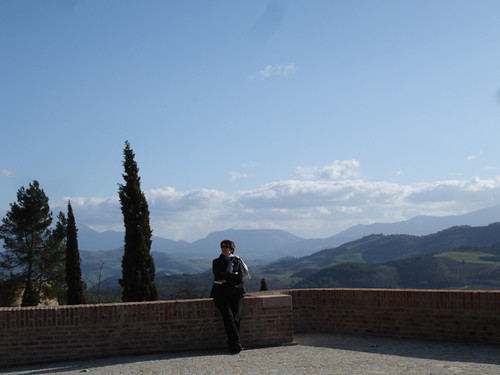
To the people who still make the way into the clutches of winter way up north: I really hope I manage to make it worth it!
I have to admit though, that if I had been able to put some more cruel pressure on Luca Rossi in Urbino, to make him organise this instead of me, we would have met here:
To the people who still make the way into the clutches of winter way up north: I really hope I manage to make it worth it!
Friday, March 14, 2008
Italy!
Tomorrow I am out of here! Not that Umeå is bad, I am just so delighted to be able to go south towards spring when the thaw just ended and it started snowing again here. Snow, pines and rural charms are fine, but it's about time to have a cappucino and wear something other than hiking boots.
I am off to Urbino, where I'll be giving a lecture Tuesday. My friend and fellow Truant Luca Rossi has invited me to give a lecture to his students. The topic is "The story and research of digital games", and I'll give a quick little game history, talk about the development of games, give a little analysis example (nintendo DS anyone? If you have it or can borrow it, check out the old, but nice game "Project Rub".) and discuss the social and cultural uses of games. Bit topic I can talk for a few days about, I'll try to do the highlights tour.
Afterwards I'll be touring Umbria, and expect to eat myself sick sometime during easter, before I return to Umeå. The return will be packed with anticipation though, as I am returning to the game symposium in Umeå!
I am off to Urbino, where I'll be giving a lecture Tuesday. My friend and fellow Truant Luca Rossi has invited me to give a lecture to his students. The topic is "The story and research of digital games", and I'll give a quick little game history, talk about the development of games, give a little analysis example (nintendo DS anyone? If you have it or can borrow it, check out the old, but nice game "Project Rub".) and discuss the social and cultural uses of games. Bit topic I can talk for a few days about, I'll try to do the highlights tour.
Afterwards I'll be touring Umbria, and expect to eat myself sick sometime during easter, before I return to Umeå. The return will be packed with anticipation though, as I am returning to the game symposium in Umeå!
Wednesday, March 12, 2008
Stortingsmelding nr 14, 2007-2008
For those of you who read Norwegian, there is now a Stortingsmelding - which I don't know the word for in English, but it is a report financed by and delivered to the parliament - on computer games submitted in Norway. It was finished and published March 7th. The rest of this post concerns itself with what looks like it's my presentation of Norwegian games research. That's why I will continue in Norwegian.
Jeg gjorde noe av mitt materiale tilgjengelig for forfatteren av stortingsmeldingen, for å gjøre det enklere for ham å forstå mangfoldet i spillforskningen og finne fram til andre forskere i Norge som driver med spillforskning. Resultatet av dette finnes i dette avsnittet:
Resten av denne delen av stortingsmeldingen gir et overblikk over deler av norsk spillforskning. Flere av de norske forskerne jeg nevner i mitt materiale er ikke tatt med i dette, og hadde jeg hatt noen innflytelse på innholdet hadde vekten på kulturstudier og mediestudier vært mye tyngre, og den tekniske forskningen tonet ned. Men det er interessant å se hva som blir lagt vekt på, hva som blir nevnt og hva som blir utelatt, i et slikt dokument. Dette blir tross alt et viktig arbeidsdokument for oss i framtiden.
Jeg gjorde noe av mitt materiale tilgjengelig for forfatteren av stortingsmeldingen, for å gjøre det enklere for ham å forstå mangfoldet i spillforskningen og finne fram til andre forskere i Norge som driver med spillforskning. Resultatet av dette finnes i dette avsnittet:
Siden 2000 har dataspill som forskningsfelt eksplodert. Den norske spillforskeren Torill Mortensen peker på at det i dag blir forsket på dataspill innenfor jus, filosofi, litteratur, kunst, medievitenskap, pedagogikk og psykologi – i tillegg til den teknologisk rettede forskningen. Det arrangeres konferanser med dataspill som hovedtema over hele verden, og det publiseres flere og flere bøker om temaet.
Resten av denne delen av stortingsmeldingen gir et overblikk over deler av norsk spillforskning. Flere av de norske forskerne jeg nevner i mitt materiale er ikke tatt med i dette, og hadde jeg hatt noen innflytelse på innholdet hadde vekten på kulturstudier og mediestudier vært mye tyngre, og den tekniske forskningen tonet ned. Men det er interessant å se hva som blir lagt vekt på, hva som blir nevnt og hva som blir utelatt, i et slikt dokument. Dette blir tross alt et viktig arbeidsdokument for oss i framtiden.
Fashion and games
Randomly clicking through image series in the online version of the Norwegian paper Dagbladet, I found some interesting images that indicate that even fashion designers may be playing WoW.

Look at those shoulders! Those have to be at least a rare drop, if not an epix. And that mask is something any undead could wear with pride. More epic fashion drops here.
Look at those shoulders! Those have to be at least a rare drop, if not an epix. And that mask is something any undead could wear with pride. More epic fashion drops here.
Sunday, March 09, 2008
CyberPsychology
It sounds a little omnious, but no worries, it is just a rather interesting addition to the study of what happens online. Journal of CyberPsychology & Behaviour contains studies of what people do online, and represent a much needed forum for psychological studies of people in digital worlds. In volume 11, number 1, we find the article Gender Swapping and Socializing in Cyberspace: An Exploratory Study by Zaheer Hussain, Mark D. Griffiths, which gives us the not-so-surprisign news that 54 % of the men in MMO's play female characters, while 70% of the females play male. So the chance that the cute female bloodelf in your group is played by a girl is very, very small.
Thursday, March 06, 2008
The end of a long distance affair
For those who know me, the love-affair I have with Amazon is nothing new. I go to their website from the comfort of my own computer, they let me pick and choose from a huge selection of books that all exite me, and then I get the books home to enjoy, to keep, to have as mine. It's been true love, for years.
Until, suddenly.
Last week I was waiting, exited, for the next shipment. I have ordered a stack of books I really looked forwards to reading, and so I was checking the mailbox every day for the box with the familiar "amazon" print. What I found was a note, saying they had tried to deliver, but couldn't. Hmmm.
OK, there was an address and a phone number to where the package was, so Saturday morning I checked online. The address is several miles away, in an area I can't get to by bus. The snow is deep here, and I am not really all that fit, so trecking through it on foot would take the better part of the morning. But, well, it was Saturday, I had the time. I called the number though, to be sure. No answer. They were closed Saturdays.
There was a nice little message on the note, saying that I could call their number, and have the package delivered, at my own cost. I looked at the distance, and it would be something between 50 and 100 SEK by taxi. I really want those books, so I called to arrange for them to deliver. Now the phone number didn't go to the delivery place, so I had to make another call, which I managed, I am not that helpless... I did however get a little bothered when I heard their price for delivery. 350 SEK to deliver a little box of books, from a distance away that's about 6 minutes by car.
So now I have a few options, all bad.
I can walk over; I'll spend 2-3 hours on the trip and I'll make my back problems worse.
I can take a taxi, and spend 100-200 SEK to get a box of books worth about 300 SEK.
I can ask them to deliver it, and pay 350 SEK delivery for a box for which I have already paid for delivery.
I can return a stack of books I need to Amazon.
I did write Amazon about this, pointing out that this new delivery policy doesn't really work. There are several other delivery spots much closer, the post office is not that far away, sometimes I get packages at the local gas station. They had picked the absolutely worst delivery option for me with their change in delivery policies. They are refunding 8 £ from the shipping costs. It is something, but it doesn't really do it for me in the future.
This may be the end of a long and loving affair. Oh, cruel Amazon, so many years, and you throw it all away for what you think is a more convenient shipping option?
Until, suddenly.
Last week I was waiting, exited, for the next shipment. I have ordered a stack of books I really looked forwards to reading, and so I was checking the mailbox every day for the box with the familiar "amazon" print. What I found was a note, saying they had tried to deliver, but couldn't. Hmmm.
OK, there was an address and a phone number to where the package was, so Saturday morning I checked online. The address is several miles away, in an area I can't get to by bus. The snow is deep here, and I am not really all that fit, so trecking through it on foot would take the better part of the morning. But, well, it was Saturday, I had the time. I called the number though, to be sure. No answer. They were closed Saturdays.
There was a nice little message on the note, saying that I could call their number, and have the package delivered, at my own cost. I looked at the distance, and it would be something between 50 and 100 SEK by taxi. I really want those books, so I called to arrange for them to deliver. Now the phone number didn't go to the delivery place, so I had to make another call, which I managed, I am not that helpless... I did however get a little bothered when I heard their price for delivery. 350 SEK to deliver a little box of books, from a distance away that's about 6 minutes by car.
So now I have a few options, all bad.
I can walk over; I'll spend 2-3 hours on the trip and I'll make my back problems worse.
I can take a taxi, and spend 100-200 SEK to get a box of books worth about 300 SEK.
I can ask them to deliver it, and pay 350 SEK delivery for a box for which I have already paid for delivery.
I can return a stack of books I need to Amazon.
I did write Amazon about this, pointing out that this new delivery policy doesn't really work. There are several other delivery spots much closer, the post office is not that far away, sometimes I get packages at the local gas station. They had picked the absolutely worst delivery option for me with their change in delivery policies. They are refunding 8 £ from the shipping costs. It is something, but it doesn't really do it for me in the future.
This may be the end of a long and loving affair. Oh, cruel Amazon, so many years, and you throw it all away for what you think is a more convenient shipping option?
Tuesday, February 26, 2008
Games research in Umeå, March 2008
So it's public, the thing I have been working on the last couple of months. I have been fretting myself into exhaustion many a day over a game research symposium to be held in Umeå 26th - 28th of March. Who would have thought that something which needed so little work on the content side would need so much work on the logistics side? The contributors to the symposium have been working with me all the way, and in March we'll all hang out down in HUMlab for three days. I can't wait, I want it to happen NOW.
And if you are in Umeå or anywhere close in that period: there are lectures open to the public, seminars/discussion groups open to researchers with an interest in games research, and workshops open to the first 18 who sign up (staff at UmU get a head start).
See you all here!
And if you are in Umeå or anywhere close in that period: there are lectures open to the public, seminars/discussion groups open to researchers with an interest in games research, and workshops open to the first 18 who sign up (staff at UmU get a head start).
See you all here!
Wednesday, February 20, 2008
Stuff white people like
One thing white people like is to read about what white people are like. So if you are white and want to learn more about your ethnicity, or if you are curious about what white people like, check out Stuff White People Like, and remember, when you see a white person riding to work on a bike, congratulate them on saving the earth.
Tuesday, February 19, 2008
Alive!
Winters have always made me feel like a bear. I become sleepy, lazy, and really grumpy when disturbed. Why am I surprised that I feel even more so when the winter is darker, colder and longer than I am used to?
Umeå had some almost familiar weather for a while, with snow, ice, sleet, rain, snow in what seemed like an endless circle. The last month has however been stable, and the layer of ice on the pavement is a dark grey from dirt and rubble. In the forest the snow is still white, but it's frozen hard from being slightly warmed during the day, then frozen solid in the night.
But now I am waking up, starting to get work done, and feeling happy about all my little plans.
First: March 4th, I am giving a lecture in Hamar, Norway, where they have a little game education. I got to put together 4 hours doing favourite stuff with a small handful of gamers. I have to admit Hamar isn't my idea of a glamorous place to go, but hey, I am spending the winter in Umeå! And I get to do nice things together with interested people, that's enough to go anywhere.
Second: March 18th, I am giving a lecture in Urbino, Italy! And I managed for once to convince my husband he should come with me! So I get to travel, talk about some of my favourite things in the world, meet Luca Rossi, who is a really wonderful person to hang out with, and I will do this in the company of the man who has had the patience to deal with me for 26 years.
Third (big deal coming up): March 26th - 28th, at Umeå University: Humans, culture and computer games; Exploring how people use and live with their chosen online activities, a symposium organised by me and a wonderful group of games researchers, financed by Umeå University and the enthusiasm of the participants. Program is very, very close to being done and ready for publishing, link will come as soon as possible.
Fourth: I'll be in Copenhagen 8th of May, giving a lecture. Just the thought of that makes me smile, Copenhagen is my favourite Scandinavian city (and it beats quite a few other cities too), and I get to visit ITU, where I have so many wonderful colleagues and friends.
And after that I just have to cross my fingers and hope I get to present papers at the Player conference in Copenhagen, and then the AOIR conference also in Copenhagen. What can I say? It's a great city.
Umeå had some almost familiar weather for a while, with snow, ice, sleet, rain, snow in what seemed like an endless circle. The last month has however been stable, and the layer of ice on the pavement is a dark grey from dirt and rubble. In the forest the snow is still white, but it's frozen hard from being slightly warmed during the day, then frozen solid in the night.
But now I am waking up, starting to get work done, and feeling happy about all my little plans.
First: March 4th, I am giving a lecture in Hamar, Norway, where they have a little game education. I got to put together 4 hours doing favourite stuff with a small handful of gamers. I have to admit Hamar isn't my idea of a glamorous place to go, but hey, I am spending the winter in Umeå! And I get to do nice things together with interested people, that's enough to go anywhere.
Second: March 18th, I am giving a lecture in Urbino, Italy! And I managed for once to convince my husband he should come with me! So I get to travel, talk about some of my favourite things in the world, meet Luca Rossi, who is a really wonderful person to hang out with, and I will do this in the company of the man who has had the patience to deal with me for 26 years.
Third (big deal coming up): March 26th - 28th, at Umeå University: Humans, culture and computer games; Exploring how people use and live with their chosen online activities, a symposium organised by me and a wonderful group of games researchers, financed by Umeå University and the enthusiasm of the participants. Program is very, very close to being done and ready for publishing, link will come as soon as possible.
Fourth: I'll be in Copenhagen 8th of May, giving a lecture. Just the thought of that makes me smile, Copenhagen is my favourite Scandinavian city (and it beats quite a few other cities too), and I get to visit ITU, where I have so many wonderful colleagues and friends.
And after that I just have to cross my fingers and hope I get to present papers at the Player conference in Copenhagen, and then the AOIR conference also in Copenhagen. What can I say? It's a great city.
Wednesday, February 06, 2008
Livingstone and Jenkins
Sonia Livingstone is a quite well-published, and in media studies, well known researcher on media, audiences, youth and the use of new technology. Some of her more current work engages the concepts audience and public, and go through a wide range of discussions around these ideas and how the development of new media influence them. She approaches this from an angle of European media studies, something which is aquiring if not the status of a different discipline, then definitely a distinctive flavour of debate, discussion and the probing of concepts, ideas and theories which is different from the more sample-directed American version.
Reading Livingstone next to Henry Jenkins' work carries with it a sense of this distinction. Where Jenkins delivers interesting and knowledgeable examples of how new media changes certain interactions between users and the traditional senders, Livingstone chases down the meaning of the changes in a theoretical as well as a socialogical context. This makes reading them in combination interesting, thought-provoking and oddly satisfying, as both hint at lacks and weaknesses with the work of the others, as well as filling out and confirming other parts.
So, let this be the cocktail of the week, a tall glass of Livingstone with a dash of Jenkins, served warm and comfortable and sipped in the presence of an active, connected lap-top, for referencing and curious checks on described phenomena.
Reading Livingstone next to Henry Jenkins' work carries with it a sense of this distinction. Where Jenkins delivers interesting and knowledgeable examples of how new media changes certain interactions between users and the traditional senders, Livingstone chases down the meaning of the changes in a theoretical as well as a socialogical context. This makes reading them in combination interesting, thought-provoking and oddly satisfying, as both hint at lacks and weaknesses with the work of the others, as well as filling out and confirming other parts.
So, let this be the cocktail of the week, a tall glass of Livingstone with a dash of Jenkins, served warm and comfortable and sipped in the presence of an active, connected lap-top, for referencing and curious checks on described phenomena.
Wednesday, January 30, 2008
I am so booooored...
For some reason, I am never bored for a very long time. Even in situations where there is otherwise no stimulation, in waiting rooms, on public transport, I don't get bored. There's too much going on in my head for that - OK, some of it may freak me out, and I may become stressed, unhappy or depressed if I end up on a negative track, but I am rarely bored.
When I do get bored it's in situations where I am in a kind of borderline state between escaping into my own head, and paying attention to something I know I ought to focus on. Only guilt and politeness keeps me trying to focus, and I fight my inner desire to do something completely different. Plan next weeks lectures, for instance. That can be fascinating if the alternative is listening to 30 minutes of positioning over administrative territories and professional status. As a random example.
Facebook is one of those places where I tend to get a bit bored. There's so much going on that doesn't really concern me, and so I phase out most of the information that flows past me, and I go to check who beat who in the most recent vampire game. Or if my dragon pet is underattack. It mostly is, it is a pathetic fighter. However, today somebody had posted a really interesting link. Netzwurker Mez, who is a cyber-poet, put up this fascinating little article on... boredom.
It turns out that boredom is a major cause of drug-abuse and crime. Idle minds and idle hands, etc, seems to be true. But also, boredom is the source of great thinking and great ideas. Well, I have to admit, some of my best lectures and articles have been born in some of those loooong meetings where there's nowhere to go but into my own brain.
And also, there's a little game-related metion in there, with a connection to flow:
Now, connecting boredom and games, we get grinding - the repetitive tasks which does lead to progress, but appear to be mindless. Today many of the big online games are being criticized for the grinding they demand from the players. Perhaps it's wrong to be so critical? The players I interviewed in 1999 saw grinding in the form of levelling as a neccessary act which filled its own important niche in the inner life of a game. The eagerness with which so many youngsters who would be bored to tears if they had to read a "stimulating book" grind, is astounding. What's going on with all that grinding? Is boredom another force of human pleasure and creativity?
I think I need to look at that, a little.
When I do get bored it's in situations where I am in a kind of borderline state between escaping into my own head, and paying attention to something I know I ought to focus on. Only guilt and politeness keeps me trying to focus, and I fight my inner desire to do something completely different. Plan next weeks lectures, for instance. That can be fascinating if the alternative is listening to 30 minutes of positioning over administrative territories and professional status. As a random example.
Facebook is one of those places where I tend to get a bit bored. There's so much going on that doesn't really concern me, and so I phase out most of the information that flows past me, and I go to check who beat who in the most recent vampire game. Or if my dragon pet is underattack. It mostly is, it is a pathetic fighter. However, today somebody had posted a really interesting link. Netzwurker Mez, who is a cyber-poet, put up this fascinating little article on... boredom.
It turns out that boredom is a major cause of drug-abuse and crime. Idle minds and idle hands, etc, seems to be true. But also, boredom is the source of great thinking and great ideas. Well, I have to admit, some of my best lectures and articles have been born in some of those loooong meetings where there's nowhere to go but into my own brain.
And also, there's a little game-related metion in there, with a connection to flow:
Encouraging children to entertain themselves in mentally active and imaginative ways and to avoid passive, quick-fix entertainment could also reduce boredom. “We provide children lots of entertainment in the form of television and iPods to prevent them from developing their inner skills to contend with boredom,” Sundberg says. Engaging in active entertainment, such as playing sports or games, is also much more likely to produce flow, Csikszentmihalyi says.
Now, connecting boredom and games, we get grinding - the repetitive tasks which does lead to progress, but appear to be mindless. Today many of the big online games are being criticized for the grinding they demand from the players. Perhaps it's wrong to be so critical? The players I interviewed in 1999 saw grinding in the form of levelling as a neccessary act which filled its own important niche in the inner life of a game. The eagerness with which so many youngsters who would be bored to tears if they had to read a "stimulating book" grind, is astounding. What's going on with all that grinding? Is boredom another force of human pleasure and creativity?
I think I need to look at that, a little.
Thursday, January 10, 2008
Fear and Facts
This is old news by now, but for Scandinavian readers it's a pretty piece of good news. The Swedish National Board of Youth Affairs has just published a report on youth who are heavy gamers. This is a study of health, political activity, social issues, stress levels and academic performance of young people who define themselves as playing a lot of games. The main finds are:
They are of no worse health than others, quite the opposite, they report less headaches and less stress than non and low gamers. They also report about the same physical activity level.
They are not more criminal or problematic than non or low gamers, quite the opposite, there is a tendency towards less use of alcohol than their peers.
They are as politically active and -conscious as other youths their age.
They are slightly less academically ambitious than their peers. This can however easily be traced to their backgrounds, as it seems like the heavy gamers to a slightly larger extent are recruited from families where the parents have little or no education.
All of these deviances are however minor. The main conclusion after reading this report is that young people who play a lot of computer games are pretty much like everybody else, have the same problems, but are perhaps a little more relaxed about their lives.
While this is no bomb, it's certainly a nice confirmation of the "feeling" many games researchers who are also gamers have had for a long time. Unless specifically looking for the problematic stories, the general impression is that gamers do just fine, and are perfectly normal people. And here it is, the confirmation that this holds true - at least for Swedish gamers.
They are of no worse health than others, quite the opposite, they report less headaches and less stress than non and low gamers. They also report about the same physical activity level.
They are not more criminal or problematic than non or low gamers, quite the opposite, there is a tendency towards less use of alcohol than their peers.
They are as politically active and -conscious as other youths their age.
They are slightly less academically ambitious than their peers. This can however easily be traced to their backgrounds, as it seems like the heavy gamers to a slightly larger extent are recruited from families where the parents have little or no education.
All of these deviances are however minor. The main conclusion after reading this report is that young people who play a lot of computer games are pretty much like everybody else, have the same problems, but are perhaps a little more relaxed about their lives.
While this is no bomb, it's certainly a nice confirmation of the "feeling" many games researchers who are also gamers have had for a long time. Unless specifically looking for the problematic stories, the general impression is that gamers do just fine, and are perfectly normal people. And here it is, the confirmation that this holds true - at least for Swedish gamers.
Monday, January 07, 2008
New Year
And again I start on a new year. It's the seventh year of my blog, something which feels rather scary. After seven years all the cells in a human body is supposed to have been renewed/exchanged, so every seventh year you are, physically, a new person. I don't know how correct that piece of folklore is, but the thought is interesting. Perhaps that means it's time to renew something else as well? As I am back in Umeå after a wonderful Christmas spent physically and mentally hugging my family, I have a lot of time - too much perhaps - to consider what needs to be renewed. But that's what I am here for, and these dark winters are made for it.
As for winter: not too cold, but snowing, tiny sharp little crystals that blow into your face. Biking is exhausting in this weather, but with my winter tires it's doable. It's definitely time for layering.
As for winter: not too cold, but snowing, tiny sharp little crystals that blow into your face. Biking is exhausting in this weather, but with my winter tires it's doable. It's definitely time for layering.
Sunday, December 23, 2007
It was the day before Christmas
And mother pretty much wanted to just cancel the whole stupid affair. Not that I'd ever do it, but this year the spirit has been rather hard to find. Still, I have presents, and I expect a minimum of people to be offended or disappointed. I have made cakes, 6 types, 5 of which are edible. My husband, bless his devotion, claims te sixth is edible too, and makes a valiant effort to prove it. The jokes made over those cakes are good, at least. My daughter has landed in Norway, and it is very likely that she will make it all the way here for Christmas. I have no present for her though. That was her father's territory. I really wonder what will come out of that.
The house is fairly clean. There's a limit to what I can do about a house that's been lived in by two men with a particular type of blindness, the type that makes dirt invisible, in just 5 days which also need to be long enough for baking, work and shopping. The tree is up, a day early, and altough it's small, it had room for almost all the decorations. So yes, it's the regular riot of colour and glitter and stories from the past.
I love this house, and I love Christmas in it. But I have never trusted myself with this kind of love of one place, as I have always had to leave the moment I am getting settled in and comfortable. So it is with a bittersweet mix of happiness and fear that I settle down to enjoy the work of the last few days. Tomorrow it's Christmas. The sun has already turned, and days are growing longer. There is more daylight here than in Umeå, and I can sit in the livingroom drinking it in, as the light reflects off the fjord, and I am surrounded by it. But when the night falls I light candles and wish, greedily, for more - warmth, light, the blessing of summer. In the north seasons are not just things on the calendar. In the north seasons are painful truths, changing your body, your comfort, your hormones, your activities and the patterns of your life, until you live by the rythm of the changing year.
And so it's Christmas.
The house is fairly clean. There's a limit to what I can do about a house that's been lived in by two men with a particular type of blindness, the type that makes dirt invisible, in just 5 days which also need to be long enough for baking, work and shopping. The tree is up, a day early, and altough it's small, it had room for almost all the decorations. So yes, it's the regular riot of colour and glitter and stories from the past.
I love this house, and I love Christmas in it. But I have never trusted myself with this kind of love of one place, as I have always had to leave the moment I am getting settled in and comfortable. So it is with a bittersweet mix of happiness and fear that I settle down to enjoy the work of the last few days. Tomorrow it's Christmas. The sun has already turned, and days are growing longer. There is more daylight here than in Umeå, and I can sit in the livingroom drinking it in, as the light reflects off the fjord, and I am surrounded by it. But when the night falls I light candles and wish, greedily, for more - warmth, light, the blessing of summer. In the north seasons are not just things on the calendar. In the north seasons are painful truths, changing your body, your comfort, your hormones, your activities and the patterns of your life, until you live by the rythm of the changing year.
And so it's Christmas.
Wednesday, December 12, 2007
Elg, elk, moose
Now to the "elk" debate. After the story I posted in November about the boy who saved his sister from an "elg" and then applied WoW skills to saving himself has been swirling around online for a while, I caught an interesting twist in the translation of "elg". I translated it as moose, but people pointed out it was not a moose, but an elk. Then somebody in a comment on this blog talked about seeing a herd of 200 "elk" in the US, something which made me pause, as you'd never see a herd of "elg" in Scandinavia. So off I went to our friend, the Wikipedia.
Now I could have looked for a more authorised source, but in this case Wikipedia looks pretty good. What it shows is that the American "elk" is a different animal with a different spread from the European "elg". "Moose", however, is said to be called both "moose" and "elk", only it's called "elk" in Europe. If you look at the pictures, you'll see that the moose and the elg are more similar than the elk and the elg.
In the Norwegian article there is a discussion about the use of the word "elk", as apparently it's also used about a type of deer, in American English. Looking at the picture of the "elk" in Wikipedia, that looks more like a deer than an "elg". So - the translation was perhaps not that wrong, and the elks are more than they seem to be.
Now I could have looked for a more authorised source, but in this case Wikipedia looks pretty good. What it shows is that the American "elk" is a different animal with a different spread from the European "elg". "Moose", however, is said to be called both "moose" and "elk", only it's called "elk" in Europe. If you look at the pictures, you'll see that the moose and the elg are more similar than the elk and the elg.
In the Norwegian article there is a discussion about the use of the word "elk", as apparently it's also used about a type of deer, in American English. Looking at the picture of the "elk" in Wikipedia, that looks more like a deer than an "elg". So - the translation was perhaps not that wrong, and the elks are more than they seem to be.
Monday, December 10, 2007
Folklore
Saturday I heard somebody talk loudly just outside my windows. Peeking out at the world, a little groggy still from jet-lag, a condition not made any better by the dark and my tendency to hang out in Azeroth until past midnight, I discovered hectic activity on the parking lot. As soon as I managed to hook up to the net, I found that yes, something was going on next door, at Västerbotten Museum. There was a Christmas Market, going on for two days, and it was obviously a big deal, as the traffic was quite heavy.
Sunday I decided that I would just have to visit it. So I grabbed my wallet and zipped up the down-jacket (yes, it's winter here again) and headed over - without too high expectations. Turned out that yes, it was worth it!
The Museum grounds were filled with little sales stands, set up around a gravel path that lead in a circle. All around that circle there were people standing, selling everything from gingerbread and mulled wine to handmade sami knives and traditional Scandinavian hand-knitted socks. In between there was hand-blown glass, a smith working with medieval methods, peruvian knitted alpacca wool sweaters and reindeer kebabs. A couple of places along the gravel roads there were fireplaces where people could pause and warm up, and inside a lavvo (lavvu) - a sami tent shaped much like a tipi(teepee) - there was also a fire, and a chance to warm up on more of the different spicy drinks that belong to Christmas in Scandinavia.
I was quickly caught up in the fun, and ended up doing a decent chunk of the christmas shopping right there, on that gravelly path through the museum. Also I ended up with a slab of smoked reindeer meat, which I quickly realised I have to finish before I go home to Norway. It's not easy to go from shopping and cooking for four people to just one - particularly not as I then go home and cook for a family again. But the meat is delicious, so I am sure I'll be able to finish it - and if I can't, I'll just have to find some friends to help.
Sunday I decided that I would just have to visit it. So I grabbed my wallet and zipped up the down-jacket (yes, it's winter here again) and headed over - without too high expectations. Turned out that yes, it was worth it!
The Museum grounds were filled with little sales stands, set up around a gravel path that lead in a circle. All around that circle there were people standing, selling everything from gingerbread and mulled wine to handmade sami knives and traditional Scandinavian hand-knitted socks. In between there was hand-blown glass, a smith working with medieval methods, peruvian knitted alpacca wool sweaters and reindeer kebabs. A couple of places along the gravel roads there were fireplaces where people could pause and warm up, and inside a lavvo (lavvu) - a sami tent shaped much like a tipi(teepee) - there was also a fire, and a chance to warm up on more of the different spicy drinks that belong to Christmas in Scandinavia.
I was quickly caught up in the fun, and ended up doing a decent chunk of the christmas shopping right there, on that gravelly path through the museum. Also I ended up with a slab of smoked reindeer meat, which I quickly realised I have to finish before I go home to Norway. It's not easy to go from shopping and cooking for four people to just one - particularly not as I then go home and cook for a family again. But the meat is delicious, so I am sure I'll be able to finish it - and if I can't, I'll just have to find some friends to help.
Wednesday, November 21, 2007
Feign death really works
After playing World of Warcraft, the 12 year old boy knew how to cope when he was attacked by a moose in the forest.
In the article he describes how he first yelled at the moose, distracting it so his sister got away, then when he got attacked and the animal stood over him he feigned death. "Just like you learn at level 30 in World of Warcraft."
Now who says you can't learn useful stuff from WoW? All I have to say is - I am really really glad his skills at feigning death were not resisted by that beast. Imagine if it had been an immune elite...
----------------
(Now, after this story was told to me by a friend long after it had made its way around the net for a while, I decided to google a little, to try and figure out how come I get all these comments suddenly. That's when I saw that people complain about the translation of "elg" into "moose". Yes, you are correct, it should be "elk" not "moose". The problem is that when ever I use "elk" English speakers ask "what's an elk"? Then I have to explain that it's the European version of moose, and that is what you will find in Norwegian forests. So, I picked moose rather than elk. Sorry about that, to all the elks out there, I know you hate being called moose just as much as Norwegians hate to be called Swedes.)
In the article he describes how he first yelled at the moose, distracting it so his sister got away, then when he got attacked and the animal stood over him he feigned death. "Just like you learn at level 30 in World of Warcraft."
Now who says you can't learn useful stuff from WoW? All I have to say is - I am really really glad his skills at feigning death were not resisted by that beast. Imagine if it had been an immune elite...
----------------
(Now, after this story was told to me by a friend long after it had made its way around the net for a while, I decided to google a little, to try and figure out how come I get all these comments suddenly. That's when I saw that people complain about the translation of "elg" into "moose". Yes, you are correct, it should be "elk" not "moose". The problem is that when ever I use "elk" English speakers ask "what's an elk"? Then I have to explain that it's the European version of moose, and that is what you will find in Norwegian forests. So, I picked moose rather than elk. Sorry about that, to all the elks out there, I know you hate being called moose just as much as Norwegians hate to be called Swedes.)
A confusion of seasons
I am deep in the process of translating something I wrote in Norwegian into English, and having an interesting insight. While I have become fairly confident about writing in English, I realise that my Norwegian is so much richer, subtler and also more precise than the English, it's embarassing to know I considered myself almost fluent in English. Luckily I brought a Norwegian-English dictionary.
I am in my usual "let's get away from everything" spot while writing this, and it's autumn in New York, not yet winter.
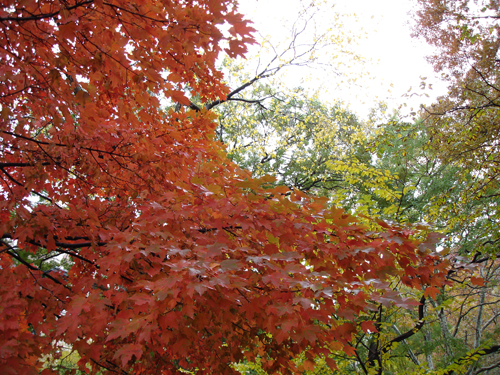
When I left Sweden for Australia in September, it was autumn, too.

Going to Perth, Australia, I came to a somewhat feeble spring, although the spring flowers were busy blooming once we got outside the city.

It did however warm up once I went north (which is still a little odd to me) and reached Tokyo. The japanese were making excuses for the weather being so unseasonably warm, and the early autumn felt like treasured (if somewhat overwhelmingly hot when in the lecture halls) summer.

But back in Umeå, the temperature dropped quickly, so when I left for New York in November, winter had settled in firmly. My son was visiting just at the right time to run errands for me and get winter tires for the bike, so now I am the proud owner of a bicycle outfitted for winter biking. Scary, but I will try it as soon as I am back there.
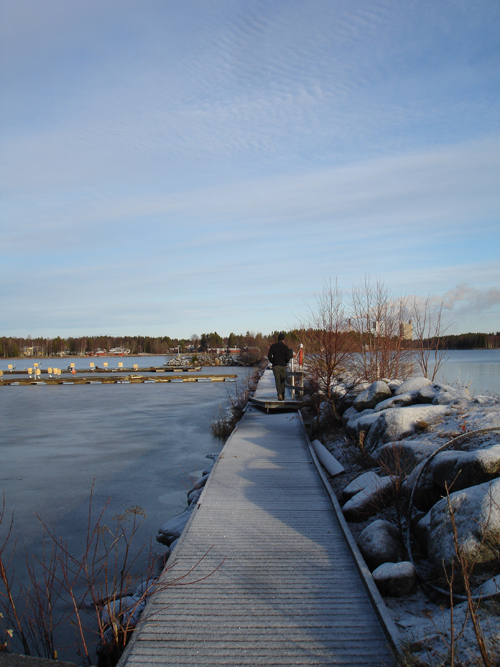
And this is what I left when I went to a New York that is cool, moist and very autumn like. A total confusion of seasons, from September to November.
I am in my usual "let's get away from everything" spot while writing this, and it's autumn in New York, not yet winter.
When I left Sweden for Australia in September, it was autumn, too.
Going to Perth, Australia, I came to a somewhat feeble spring, although the spring flowers were busy blooming once we got outside the city.
It did however warm up once I went north (which is still a little odd to me) and reached Tokyo. The japanese were making excuses for the weather being so unseasonably warm, and the early autumn felt like treasured (if somewhat overwhelmingly hot when in the lecture halls) summer.
But back in Umeå, the temperature dropped quickly, so when I left for New York in November, winter had settled in firmly. My son was visiting just at the right time to run errands for me and get winter tires for the bike, so now I am the proud owner of a bicycle outfitted for winter biking. Scary, but I will try it as soon as I am back there.
And this is what I left when I went to a New York that is cool, moist and very autumn like. A total confusion of seasons, from September to November.
Monday, October 29, 2007
Accounts
Note to self: Find the books where I have written down the different passwords and log in names in the totally fail-safe secret way of never ever having the book(s) anywhere relevant to logging in.
I am trying to work out of the Umeå Library, and while the library is lovely (not a single bad thing to say about the library) I am suffering from total account overload. Moving to Umeå has given birth to at least 5 different codes just connected to new cards (money, locks, copying), a printer code, two new mail accounts, a new log-in for a blog and one library account, as well as a long list of different ip-adresses I need for access in different spots, and several new physical keys. I have tried to keep track of all this in writing, as my brain is NOT made for remembering that kind of stuff (I blame the meningitis at age 22. It actually did blow a chunk of my memory, and for quite a while after regaining consciousness I did not notice that what I pronounced was not what I thought. This is a kind of Aphasia, and while the doctors brushed it off and claimed I was functioning far too well, and forgetting names, words and concepts is perfectly normal, I felt there was a marked difference in my ability to function at this level.). However, I have not been particularly successful, for what am I to do when I don't remember where I wrote it down? Like right now, what user name did I use for logging into my library bookshelf? What is the version of my personal number as it is written in Sweden? (Only thing I remember is: Not the same as in Norway.)
At least I know how I need to spend the morning. Tracking down all these different scraps of paper and very important note books and collect all that information, data security be damned. Anyway, if somebody really want to spy on my library bookshelf, by all means, have a look.
I am trying to work out of the Umeå Library, and while the library is lovely (not a single bad thing to say about the library) I am suffering from total account overload. Moving to Umeå has given birth to at least 5 different codes just connected to new cards (money, locks, copying), a printer code, two new mail accounts, a new log-in for a blog and one library account, as well as a long list of different ip-adresses I need for access in different spots, and several new physical keys. I have tried to keep track of all this in writing, as my brain is NOT made for remembering that kind of stuff (I blame the meningitis at age 22. It actually did blow a chunk of my memory, and for quite a while after regaining consciousness I did not notice that what I pronounced was not what I thought. This is a kind of Aphasia, and while the doctors brushed it off and claimed I was functioning far too well, and forgetting names, words and concepts is perfectly normal, I felt there was a marked difference in my ability to function at this level.). However, I have not been particularly successful, for what am I to do when I don't remember where I wrote it down? Like right now, what user name did I use for logging into my library bookshelf? What is the version of my personal number as it is written in Sweden? (Only thing I remember is: Not the same as in Norway.)
At least I know how I need to spend the morning. Tracking down all these different scraps of paper and very important note books and collect all that information, data security be damned. Anyway, if somebody really want to spy on my library bookshelf, by all means, have a look.
Tuesday, October 23, 2007
Happy geek in gadget-love
Warning: Long story with happy geek-ending.
Sure, travelling on business class at the occasional random upgrade is nice, if you're picky about your food, British Airways isn't the one you want to be on, or if you're picky about the way you are addressed by the staff and don't want to be called "love" and "hun", then by all means stay clear of Continental. For handsome men watching, go Air France, Air Canada or Quantas, and if you have a thing for truly beautiful women, Singapore Airlines is your best bet. But if you, like me, travel with whatever gives you the best price and the best connections, then these things are pretty much outside of your control.
Yesterday I discovered something which was not.
But let's start at the beginning, and the beginning is almost 27 years back in time. That's when I met this young man who was sweet, smart, funny, sporty and sexy, and on top of that had a great taste in books and music. After a year or so of making him realise what a good thing it would be to hang out with me, we moved in together in Bergen. That's when something I had never realised I missed was introduced in my life: music which was not played by a live orchestra or did not randomly happen off the radio.
Since then I have been surrounded with it, and mostly stuff I really like. When the kids joined in, the music played in the home changed and expanded, and there was always something, so much in fact that NOT having music on all the time became a relief, a signal to me that I was alone, I could focus on my own things, I was at peace.
It only took a month of living alone to realise it was a bit too peaceful. I felt a very unfamiliar, powerful urge to listen to music, and I started thinking about the kind of music I wanted and liked, and how nice it is to have the option of making it happen.
This lead to an excursion into Akihabara in Tokyo, where I came out with a bag full of iPod Nano's. I can't buy something like that only for myself, you know - I have been a mom for 21 years, it's a hard habit to shake, if I even wanted to.
Finally home in Volda, I could start uploading the stuff I wanted. For a while I revelled in picking only my music, and found that listening to an iPod is perfect for long boring bus rides for instance to Molde. The disappointment was huge when I got on the plane to Trondheim. The little apple earbuds couldn't do anything about the ambient noise generated by air engines, and I really couldn't hear much. Having to turn the sound all the way up to hear anything made me realise how much the background noise exhausts me on airplanes. I tend to wear headphones when ever I can, just to hear something other than the drone of the engine, and I get really tired on the long flights.
I didn't know what to do about it, but I started checking other headphones at least. The iPod was still a success, and when the loving sweet men at home discovered that I liked using it, they immediately colonized it. Bye bye dreams of controlling my own music choices... I like that though. After all, both father and son are sufficiently sensitive to know what kind of music I will probably like. Actually, I think they know it better than I do.
Anyway. We were talking about headphones.
I found some really garish looking headphones at the airport, but didn't pick them up, as I was thinking of just getting a pair of Koss portable headphones. Simple, elegant and a good deal at the price, what could go wrong? However, the son, who had already managed to convince me to get a pair for him (see how this mother thing works?), told me to reconsider, as they did nothing to reduce noise from the outside. That's when we stumbled over noise cancelling headphones.
OK, you have indulged my rambling about my wonderful family for long enough now. The keyword is: skullcandy. Those garish headphones I had noticed are produced for extreme sports fans, and built to last while snowboarding or sliding down rails in the mall - no matter what, skullcandy wants you to do it. That includes beating your boyfriend mercilessly. Hmmm. Luckily the headphones I found at the airport in Oslo, called Proletariat, look like an undercover skullcandy set. They are noise cancelling headphones at less than half the price of for instance a Bose headset. Are they as good? I don't know, but they worked well enough to make a difference for me. After the young lady at the store had broken the heavy plastic wrapping open, and we had extracted the headphones and their little travelling bag, the airplane connection plug AND the two AAA batteries that came with the headphones, I assembled, plugged, turned on - and felt my shoulders drop.
It is a difference. I got on the plane to Stockholm and hated having to turn the headphones off when the "fasten seatbelt" sign came on. I hated it even worse on the propel plane from Stockholm to Umeå. I am going to have to sacrifice some of my habitual hand-luggage to bring them with me, but these are coming on the planes with me, in all foreseeable future. I used to sniff with a touch of disdain at the people who felt such a need of high fidelity that they brought their own headphones on the plane. No more - I suddenly know what they are bringing; a chance to escape that endless, exhausting drone, a chance to let the shoulders drop and some other sounds to penetrate. Travelling as much as I do, this is one of the things that makes a difference no matter what company I travel with, where I go, how the seats or the service are. I can use them with the iPod, the computer, the games, the airplane television and radio, the only problem is that they are a little too bulky for comfortable sleeping, but I am sure I am going to manage that too. After all, I am in love with those headphones, and love makes the strangest things comfortable.
Sure, travelling on business class at the occasional random upgrade is nice, if you're picky about your food, British Airways isn't the one you want to be on, or if you're picky about the way you are addressed by the staff and don't want to be called "love" and "hun", then by all means stay clear of Continental. For handsome men watching, go Air France, Air Canada or Quantas, and if you have a thing for truly beautiful women, Singapore Airlines is your best bet. But if you, like me, travel with whatever gives you the best price and the best connections, then these things are pretty much outside of your control.
Yesterday I discovered something which was not.
But let's start at the beginning, and the beginning is almost 27 years back in time. That's when I met this young man who was sweet, smart, funny, sporty and sexy, and on top of that had a great taste in books and music. After a year or so of making him realise what a good thing it would be to hang out with me, we moved in together in Bergen. That's when something I had never realised I missed was introduced in my life: music which was not played by a live orchestra or did not randomly happen off the radio.
Since then I have been surrounded with it, and mostly stuff I really like. When the kids joined in, the music played in the home changed and expanded, and there was always something, so much in fact that NOT having music on all the time became a relief, a signal to me that I was alone, I could focus on my own things, I was at peace.
It only took a month of living alone to realise it was a bit too peaceful. I felt a very unfamiliar, powerful urge to listen to music, and I started thinking about the kind of music I wanted and liked, and how nice it is to have the option of making it happen.
This lead to an excursion into Akihabara in Tokyo, where I came out with a bag full of iPod Nano's. I can't buy something like that only for myself, you know - I have been a mom for 21 years, it's a hard habit to shake, if I even wanted to.
Finally home in Volda, I could start uploading the stuff I wanted. For a while I revelled in picking only my music, and found that listening to an iPod is perfect for long boring bus rides for instance to Molde. The disappointment was huge when I got on the plane to Trondheim. The little apple earbuds couldn't do anything about the ambient noise generated by air engines, and I really couldn't hear much. Having to turn the sound all the way up to hear anything made me realise how much the background noise exhausts me on airplanes. I tend to wear headphones when ever I can, just to hear something other than the drone of the engine, and I get really tired on the long flights.
I didn't know what to do about it, but I started checking other headphones at least. The iPod was still a success, and when the loving sweet men at home discovered that I liked using it, they immediately colonized it. Bye bye dreams of controlling my own music choices... I like that though. After all, both father and son are sufficiently sensitive to know what kind of music I will probably like. Actually, I think they know it better than I do.
Anyway. We were talking about headphones.
I found some really garish looking headphones at the airport, but didn't pick them up, as I was thinking of just getting a pair of Koss portable headphones. Simple, elegant and a good deal at the price, what could go wrong? However, the son, who had already managed to convince me to get a pair for him (see how this mother thing works?), told me to reconsider, as they did nothing to reduce noise from the outside. That's when we stumbled over noise cancelling headphones.
OK, you have indulged my rambling about my wonderful family for long enough now. The keyword is: skullcandy. Those garish headphones I had noticed are produced for extreme sports fans, and built to last while snowboarding or sliding down rails in the mall - no matter what, skullcandy wants you to do it. That includes beating your boyfriend mercilessly. Hmmm. Luckily the headphones I found at the airport in Oslo, called Proletariat, look like an undercover skullcandy set. They are noise cancelling headphones at less than half the price of for instance a Bose headset. Are they as good? I don't know, but they worked well enough to make a difference for me. After the young lady at the store had broken the heavy plastic wrapping open, and we had extracted the headphones and their little travelling bag, the airplane connection plug AND the two AAA batteries that came with the headphones, I assembled, plugged, turned on - and felt my shoulders drop.
It is a difference. I got on the plane to Stockholm and hated having to turn the headphones off when the "fasten seatbelt" sign came on. I hated it even worse on the propel plane from Stockholm to Umeå. I am going to have to sacrifice some of my habitual hand-luggage to bring them with me, but these are coming on the planes with me, in all foreseeable future. I used to sniff with a touch of disdain at the people who felt such a need of high fidelity that they brought their own headphones on the plane. No more - I suddenly know what they are bringing; a chance to escape that endless, exhausting drone, a chance to let the shoulders drop and some other sounds to penetrate. Travelling as much as I do, this is one of the things that makes a difference no matter what company I travel with, where I go, how the seats or the service are. I can use them with the iPod, the computer, the games, the airplane television and radio, the only problem is that they are a little too bulky for comfortable sleeping, but I am sure I am going to manage that too. After all, I am in love with those headphones, and love makes the strangest things comfortable.
Friday, October 19, 2007
JoinGame!
Today I am in Trondheim, at the first meeting of "JoinGame", which is the Norwegian Noveau name of a group organised to work for research and innovation on games in Norway. A lot of different people here, from academia I immediately recognize Gunnar Liestøl, Hilde Corneliussen and Sara Brinch. I am sure I will find more!
Tuesday, October 16, 2007
Daylight
The sun still comfortably high above the horizon, the google daylight map shows the progress of the sunlight as autumn turns to winter.
Not the Tetris Tower 3D
Which is the Tetris game's physical manifestation outside of the computer, and which I discovered thanks to Gonzalo, and which I think is right up there on my wishlist, just for the geek-value.
No, the game I am looking for now is a game I used to play with the kids (while they were still that, and not young adults who only want to triumph horribly in Risk or some other game they have spent time mastering without me). It has a similar kind of set-up as the tetris tower game, but instead of dropping tetris blocks it drops little squares with patterns of hearts, spades, diamonds and clubs. In order to score you had to have a certain number of one kind in a row, up, down or diagonally. It is a cross between tic-tac-toe and a card game. I can't remember the name of the game, but it reminds me of the Tetris Tower design, and I'd love to be able to reference it while I write about Tetris going 3D.
Have any of my quick, competent and eager readers a lead on which game this is? I'll go look in my secret hiding places, and cross fingers that we havent' thrown it away... or that it is here, and not in my mother's cabinet.
No, the game I am looking for now is a game I used to play with the kids (while they were still that, and not young adults who only want to triumph horribly in Risk or some other game they have spent time mastering without me). It has a similar kind of set-up as the tetris tower game, but instead of dropping tetris blocks it drops little squares with patterns of hearts, spades, diamonds and clubs. In order to score you had to have a certain number of one kind in a row, up, down or diagonally. It is a cross between tic-tac-toe and a card game. I can't remember the name of the game, but it reminds me of the Tetris Tower design, and I'd love to be able to reference it while I write about Tetris going 3D.
Have any of my quick, competent and eager readers a lead on which game this is? I'll go look in my secret hiding places, and cross fingers that we havent' thrown it away... or that it is here, and not in my mother's cabinet.
Monday, October 15, 2007
Tikken, kogg, sisten
I am looking for the English word for a very common game. It's the game where one person is "it" and has to touch another, to pass "it" on. It mostly involves a lot of running around and touching quickly, a competition of speed, endurance and tactics. It's played pretty universally I think, in one form or another, and in Norwegian there are endless words for this depending on local dialects. This means that it's hard for me to get a decent translation. "Sisten", the east-Norwegian word, shows up as "lastly, latest", while the others just don't register.
So, if anybody know what I am talking about, then please, you are IT, and you have to tag me with the right word to give it back and run free.
So, if anybody know what I am talking about, then please, you are IT, and you have to tag me with the right word to give it back and run free.
Saturday, October 13, 2007
Right to Play
In Tokyo, Gonzalo Frasca gave me a button stating that "Play can change the world!" He is not the only one who has thought so, but one of the people who has taken it further than most is the Norwegian speed skating athlete Johann Olav Koss. Today he is President and CEO of Right to Play, an organisation which was started as part of the preparations to the Lillehammer Olympics in 1994, originally named "Olympic Aid." Johann Olav Koss won three gold medals in the Lillehammer Olympics, and donated large amounts of his winning to Olympic Aid. Since then he has dedicated his life to giving children living under extreme hardship a chance to play.
I am not sure if Johann Olav Koss thinks of computer games as important in this context. The children he tries to help are not troubled with obesity and low school performance, nor are they bored and abandoned in the middle of material abundance. They are starving in deserts, fleeing warzones, struggling in slums. He might though. I would like to be able to ask him.
I think perhaps, if we are to take games seriously as political and educational tools, we should look to the experiences of Right to Play. Until then: Part of the donations October 21st here in Norway - when the national broad casting opens up the television screen to a good cause, and people knock on doors all over the country, asking for contributions - go to Right to Play. If you're in Norway, this is one of the best causes I can think of. Play can change the world.
I am not sure if Johann Olav Koss thinks of computer games as important in this context. The children he tries to help are not troubled with obesity and low school performance, nor are they bored and abandoned in the middle of material abundance. They are starving in deserts, fleeing warzones, struggling in slums. He might though. I would like to be able to ask him.
I think perhaps, if we are to take games seriously as political and educational tools, we should look to the experiences of Right to Play. Until then: Part of the donations October 21st here in Norway - when the national broad casting opens up the television screen to a good cause, and people knock on doors all over the country, asking for contributions - go to Right to Play. If you're in Norway, this is one of the best causes I can think of. Play can change the world.
Tuesday, October 09, 2007
Conference reviews
Piled Higher and Deeper has the answer to a very hot issue both at DAC 2007 and DiGRA 2007. Enjoy.
Monday, October 08, 2007
There's jargon, and there's what I understand
Prompted by Espen, and because his name had been mentioned in different contexts, I sat down to read some of John Hopson's writings at Gamasutra. The most recent work was his "We are not listening", a featured article adressing game researchers from the position of the game industry.
After the keynote at DiGRA 2007, where Mark Prensky talked about: Keynote: "Escape from Planet Jargon: Making Research More Useful to Practitioners", this was kind of a in-the-moment-topic. The Prensky talk had been fairly unimpressive, and I knowing Hopson to be both intelligent and thoughtful, I hoped he would have a better take on the issue than Prensky. I am afraid to say, my hopes were sadly dashed. Hopson did however make it clear that he didn't mean to address ALL game resarchers, only the one targetting the game industry, which I guess is a mitigating circumstance. Still - well, here's my thoughts while reading "We're not listening".
Page 1: caveat
Hopson here assumes that it's the job of the researcher to present the material, to "sell" it. Others have professionals to do that, it's called marketing departments. So what he says here is basically: if the business is to care about your work, good doesn't matter, marketing does.
Page 1, rule 1
Hopson makes the assumption that the researcher is doing research in order to identify exactly the kind of questions which are important for game developers, namely, how to make a player play more. That is probably true for his research, at the Microsoft lab, but it's certainly not true for other types of research. Knowing that a player has a very strong identification with the main character can be a way to discuss time management in education and development, dramatic structures in critical studies, the impact of games on society in sociology. The researcher does not have the same agenda as the industry, unless he or she is paid by the industry. It also assumes that an academic who knows a lot about how gamers react to the game, is also an insider on the questions game developers ask, and are able to identify the important findings in their own material, which would be important to the game companies. This demands an inside knowledge which researchers who already work in the game industry, for the industry, has. The rest, as he himself points out, although in a roundabour fashion, don't have access.
Page 2, rule 2: here we go with the jargon thingy.
This is as uninformed coming from Hopson as it was coming from Prensky. Every specialised field is packed with specialised concepts. Have anybody ever tried to read a user manual? Yes, there are bad academic articles out there, where content is questionable and form is taken to the extreme. But Hopson also knows very well that a lot of important terms and structures are there for precision and clarification, not to ritualize the communication. Academic writing directed at other academics is not directed at specialists in some other field, or laymen, and to exclude the precise language developed to deal with complex terms would be irresponsible. So the game developers can't read it? It's why they hire academics in their research departments, people who know the language, have the connections, understand the field. In a game developing company it's Hopson's job to keep updated on the language, the structures and the references, and bring that knowledge back into his organisation.
This basically says: It's all about making more money, not about making better games, so if a game is better but isn't a huge bestseller, the developers aren't interested. "Good = huge selling game, screw all other analysis." And with that I think game researchers can just pack up and go back to our departments, as nothing innovative will ever reach the ears of developers. I'll not even start bashing the other advice on that page. It's all about turning your thesis into a 5 line ad. Sure, if that's what you want to do, please listen to Hopson. If you had hoped to communicating a complex understanding or a new idea, well, your odds look very short.
Page 3, rule 3
Yes, I'll give you a break. After rule 2, I think we already agree that innovation, complexity and precision is a waste of time when talking to developers. They are all lab rats anyway, going by programmed responses, so trying to communicate new knowledge is a waste of time. It is a pretty bleak presentation of game developers though, but I guess we already knew it was a cut-throat business where the thoughtful die fast.
Page 3 rule 4:
This is about normative research vs other types of research. What Hopson says here is: Game developers want cookbooks, and they want to be told how to do things right. The problem is again that no researcher can know that something they have observed will make things better if implemented in a different setting. This is something only game researchers already involved in game development can have a chance to test out. John Hopson can say: "Before we finish this, let's try this approach instead, because I have read this analysis which says that..." and then Microsoft can run a test on that, and see if his theory actually works. Game researchers outside of companies don't have that kind of access or that kind of tools.
Second, he says: Do only one kind of research. Don't do explorative or descriptive research, do normative research, create rules for how things should be done. Basically: Do the kind of research we like, and we'll listen.
Page 4, rule 5 and 6:
The question of access also makes rule 5 and 6 useless to a game developer. There's no way a scholar can prove that a theory will work unless somebody builds the game where it's been implemented. To do that we'd have to do all the things that Hopson specifically says not to do, such as citing other research, referencing, quoting lesser-known games and looking at what has been done before. It's the only way an academic not working inside a company can do these things, and accordign to Hopson, it's not valid.
The same goes with asking a developer what they need. Let me point to rule 3: The developers don't have enough resources to tell a researcher what time of the day it is. Why should they answer more complex questions, which might force them to listen to a complex theory?
I know John Hopson means well with his advice, but it's advice from a scholar who since his Ph D has worked inside of a game development firm. It basically says two things:
1) To be able to talk to game developers, you need the kind of access you have when you are already working with game developers.
2) Game developers are narrowminded, only motivated by profit, and don't want to learn new things.
The first is useless advice to any academic who wants to get into the field. The second is very close to being insulting to his colleagues, the game developers. But most of all I wonder at the job of game researchers in the development firms. Aren't they the ones who are supposed to bridge this gap? Isn't that why they are hired, with all their education and their connections to the research field? Sure, I have enough skills and knowledge about marketing to dumb down - eh, I mean, clarify my writing for a target group when I need to. I don't, however, have the dual skills that somebody like John Hopson has a chance to develop. He and those of his ilk are the ones who can bring new and interesting research to the eye of the game developers community. They are the ones who may really make a difference.
After the keynote at DiGRA 2007, where Mark Prensky talked about: Keynote: "Escape from Planet Jargon: Making Research More Useful to Practitioners", this was kind of a in-the-moment-topic. The Prensky talk had been fairly unimpressive, and I knowing Hopson to be both intelligent and thoughtful, I hoped he would have a better take on the issue than Prensky. I am afraid to say, my hopes were sadly dashed. Hopson did however make it clear that he didn't mean to address ALL game resarchers, only the one targetting the game industry, which I guess is a mitigating circumstance. Still - well, here's my thoughts while reading "We're not listening".
Page 1: caveat
I’m not saying that academics have to care about what the industry thinks of them, but for those who do this is the best advice I can give on how to make sure the industry takes your work seriously. Secondly, I’m going to assume that you’ve already done your research and have the findings ready to go. This article is about the final mile, going from finished research to real implementation in a shipped game.
Hopson here assumes that it's the job of the researcher to present the material, to "sell" it. Others have professionals to do that, it's called marketing departments. So what he says here is basically: if the business is to care about your work, good doesn't matter, marketing does.
Page 1, rule 1
The researcher must lay out the entire impact of the idea, from the cost of implementing the proposal to the resulting changes in player experience and the metrics for measuring that impact. Getting players to identify with the main character is great, but researchers have to finish the rest of the sentence: “This will help players identify more strongly with the main character which will result in an improvement in measures of overall player satisfaction and an increase in total playing time.”
Hopson makes the assumption that the researcher is doing research in order to identify exactly the kind of questions which are important for game developers, namely, how to make a player play more. That is probably true for his research, at the Microsoft lab, but it's certainly not true for other types of research. Knowing that a player has a very strong identification with the main character can be a way to discuss time management in education and development, dramatic structures in critical studies, the impact of games on society in sociology. The researcher does not have the same agenda as the industry, unless he or she is paid by the industry. It also assumes that an academic who knows a lot about how gamers react to the game, is also an insider on the questions game developers ask, and are able to identify the important findings in their own material, which would be important to the game companies. This demands an inside knowledge which researchers who already work in the game industry, for the industry, has. The rest, as he himself points out, although in a roundabour fashion, don't have access.
Page 2, rule 2: here we go with the jargon thingy.
Academic writing is abnormal. I know that by the time you escape grad school the rolling cadences and ritualized forms of the journal article are graven on your very soul. But really, you might as well present your research in the form of an interpretive dance as hand a producer an article written for academic publication. Reading an academic article is an obscure and highly specialized job skill, one which most of your potential audience doesn’t have the time or desire to learn. It’s up to the researchers to make their work accessible to the audiences they want.
This is as uninformed coming from Hopson as it was coming from Prensky. Every specialised field is packed with specialised concepts. Have anybody ever tried to read a user manual? Yes, there are bad academic articles out there, where content is questionable and form is taken to the extreme. But Hopson also knows very well that a lot of important terms and structures are there for precision and clarification, not to ritualize the communication. Academic writing directed at other academics is not directed at specialists in some other field, or laymen, and to exclude the precise language developed to deal with complex terms would be irresponsible. So the game developers can't read it? It's why they hire academics in their research departments, people who know the language, have the connections, understand the field. In a game developing company it's Hopson's job to keep updated on the language, the structures and the references, and bring that knowledge back into his organisation.
Use examples from bestsellers. A good example from a popular game is more effective than a great example from something they’ve never heard of. Industry people often suffer from an “if-they’re-so-smart-, why-ain’t-they-rich” attitude towards smaller titles. Even if the small title is a perfect example of how the theory works, they’re going to be less likely to listen if they haven’t heard of the game ahead of time.
This basically says: It's all about making more money, not about making better games, so if a game is better but isn't a huge bestseller, the developers aren't interested. "Good = huge selling game, screw all other analysis." And with that I think game researchers can just pack up and go back to our departments, as nothing innovative will ever reach the ears of developers. I'll not even start bashing the other advice on that page. It's all about turning your thesis into a 5 line ad. Sure, if that's what you want to do, please listen to Hopson. If you had hoped to communicating a complex understanding or a new idea, well, your odds look very short.
Page 3, rule 3
Working in the games industry can be brutal, involving fast-paced schedules and eighty-hour work-weeks at times. The people listening to your talk already have a full workload. They’ve already been cutting features to make their production milestones, often features that represent some of their best ideas and strongest held beliefs about games. And then there’s this academic who’s never shipped a game standing up there telling them to rip out weeks of work in order to implement some pet theory. Give us a break!
Yes, I'll give you a break. After rule 2, I think we already agree that innovation, complexity and precision is a waste of time when talking to developers. They are all lab rats anyway, going by programmed responses, so trying to communicate new knowledge is a waste of time. It is a pretty bleak presentation of game developers though, but I guess we already knew it was a cut-throat business where the thoughtful die fast.
Page 3 rule 4:
However, to make that research useful to developers, it’s important to take the next step and give concrete examples of how classifying one’s players helps to make a better game. Ok, so we now know that 10% of our players are “Type 3a explorer-monkeys.” Now what? Does that mean 10% of our content should be exploration-focused?
This is about normative research vs other types of research. What Hopson says here is: Game developers want cookbooks, and they want to be told how to do things right. The problem is again that no researcher can know that something they have observed will make things better if implemented in a different setting. This is something only game researchers already involved in game development can have a chance to test out. John Hopson can say: "Before we finish this, let's try this approach instead, because I have read this analysis which says that..." and then Microsoft can run a test on that, and see if his theory actually works. Game researchers outside of companies don't have that kind of access or that kind of tools.
Second, he says: Do only one kind of research. Don't do explorative or descriptive research, do normative research, create rules for how things should be done. Basically: Do the kind of research we like, and we'll listen.
Page 4, rule 5 and 6:
The question of access also makes rule 5 and 6 useless to a game developer. There's no way a scholar can prove that a theory will work unless somebody builds the game where it's been implemented. To do that we'd have to do all the things that Hopson specifically says not to do, such as citing other research, referencing, quoting lesser-known games and looking at what has been done before. It's the only way an academic not working inside a company can do these things, and accordign to Hopson, it's not valid.
The same goes with asking a developer what they need. Let me point to rule 3: The developers don't have enough resources to tell a researcher what time of the day it is. Why should they answer more complex questions, which might force them to listen to a complex theory?
I know John Hopson means well with his advice, but it's advice from a scholar who since his Ph D has worked inside of a game development firm. It basically says two things:
1) To be able to talk to game developers, you need the kind of access you have when you are already working with game developers.
2) Game developers are narrowminded, only motivated by profit, and don't want to learn new things.
The first is useless advice to any academic who wants to get into the field. The second is very close to being insulting to his colleagues, the game developers. But most of all I wonder at the job of game researchers in the development firms. Aren't they the ones who are supposed to bridge this gap? Isn't that why they are hired, with all their education and their connections to the research field? Sure, I have enough skills and knowledge about marketing to dumb down - eh, I mean, clarify my writing for a target group when I need to. I don't, however, have the dual skills that somebody like John Hopson has a chance to develop. He and those of his ilk are the ones who can bring new and interesting research to the eye of the game developers community. They are the ones who may really make a difference.
Monday, October 01, 2007
Voice, luggage, bed
It was in a karaokebar in Tokyo I last had a voice. The luggage I last saw in Narita Airport, but reports have it that it's been spotted in London. When I arrived in Umeå I was afraid the fog was too thick for me to find the bed, but it was where I had left it.
I feel spread all over. My head has barely gotten out of Australia, as the impressions from DAC 2007 in Perth are still zooming about. I think what made the strongest impression on me was the bioart exhibited in The Bakery by SymbioticA: Still, Living. While not everybody's favourite, the art touched me, made me curious, disgusted and impressed, all in one, strangely moving - or perhaps I was just impressed with the name dropping, as the curator was talking about his meeting and discussions with Gombrich, who I was sure must have been dead a long time ago.
The memories of the exhibitions in Australia are oddly overlapping the exhibitions on the National Museum of Modern Art (MOMAT) in Tokyo, and the complex images of artificial organisms and biologically coloured membranes from australia overlap the intricate beauty of Japanese weaving and painting. My dreams are vivid and wild, and I dream in patterns: Flowers on silk, water over stones, light through leaves, algae on membranes, preserved skin, growing and spreading mikroorganisms. It is going to take a while to start remembering and thinking about this trip in sentences, categories, logical terms rather than a caleidoscope of faces, voices, colours, tastes. I'll get there though - that's the good thing about being alone, I have time now.
---update-----
And for those who didn't already catch my error: Ragnhild Tronstad pointed out that it was not Gombrich (who died in 2001, and while not having been dead as long as I thought still was not the man in question) the curator refered to, but Hans-Ulrich Gumbrecht. No less impressive reference, and now if you excuse me, I'll go check out some of his books.
I feel spread all over. My head has barely gotten out of Australia, as the impressions from DAC 2007 in Perth are still zooming about. I think what made the strongest impression on me was the bioart exhibited in The Bakery by SymbioticA: Still, Living. While not everybody's favourite, the art touched me, made me curious, disgusted and impressed, all in one, strangely moving - or perhaps I was just impressed with the name dropping, as the curator was talking about his meeting and discussions with Gombrich, who I was sure must have been dead a long time ago.
The memories of the exhibitions in Australia are oddly overlapping the exhibitions on the National Museum of Modern Art (MOMAT) in Tokyo, and the complex images of artificial organisms and biologically coloured membranes from australia overlap the intricate beauty of Japanese weaving and painting. My dreams are vivid and wild, and I dream in patterns: Flowers on silk, water over stones, light through leaves, algae on membranes, preserved skin, growing and spreading mikroorganisms. It is going to take a while to start remembering and thinking about this trip in sentences, categories, logical terms rather than a caleidoscope of faces, voices, colours, tastes. I'll get there though - that's the good thing about being alone, I have time now.
---update-----
And for those who didn't already catch my error: Ragnhild Tronstad pointed out that it was not Gombrich (who died in 2001, and while not having been dead as long as I thought still was not the man in question) the curator refered to, but Hans-Ulrich Gumbrecht. No less impressive reference, and now if you excuse me, I'll go check out some of his books.
Sunday, September 23, 2007
Paper, paper, paper...
Safely in Japan, I collapsed after the flight, and in sheer delight at having an air-conditioned room and some privacy after 8 days of intense social activity, I spent the first day in Japan reading, feet up and close to the amenities of a japanese translation of a european bathroom.
Today I had a quest: I needed a new plug for Japan, as I arrogantly had assumed they would use either European or Oceania type of plugs. Of course not, theirs were American. Oh well. After that I went to paradise. Me and Helen Kennedy, who was kindly guiding me to the local designer stores with a sure eye for what we can want, but afford, ended up in Itoya, the paper store which has everything, and then some. So, if you expected some kind of flashy present after my long trip, forget it, I am sorry. My suitcase is packed with handmade japanese paper.
Today I had a quest: I needed a new plug for Japan, as I arrogantly had assumed they would use either European or Oceania type of plugs. Of course not, theirs were American. Oh well. After that I went to paradise. Me and Helen Kennedy, who was kindly guiding me to the local designer stores with a sure eye for what we can want, but afford, ended up in Itoya, the paper store which has everything, and then some. So, if you expected some kind of flashy present after my long trip, forget it, I am sorry. My suitcase is packed with handmade japanese paper.
Wednesday, September 19, 2007
Access issues
Still no real internet connection, so I am just letting any who wonder know: I am doing fine, Perth is cool but nice, and the conference was good. More later - sometime.
Saturday, September 15, 2007
Sloooooow
The computer that is. PerthDAC 2007 isn't, it's compact, small and friendly - well, most of the time. What it isn't is online. Since I also don't have an internet connection where I stay, and I haven't seen an internet cafe just yet, I am painfully cut off from a lot of obligations, not to mention the fun stuff. I
ll try to mend the situation, but it's not happening today.
ll try to mend the situation, but it's not happening today.
Tuesday, September 11, 2007
Perth next!
Tomorrow I am off to Perth, for DAC 2007. I am going to present a paper I have for once suffered over, meet some great friends, and eat and drink in one of my favourite places for just that. Afterwards I am off to a totally new place for me: Japan!
While Umeå is picking up as more visiting scholars arrive, I think it's time for me to get some air under the wings. They still haven't managed to get the equipment I need, and as long as I am not here to be annoyed, they have almost three weeks to get it in place. By then I'll have 8 more months here, so I guess I'll still have time to play around.
While Umeå is picking up as more visiting scholars arrive, I think it's time for me to get some air under the wings. They still haven't managed to get the equipment I need, and as long as I am not here to be annoyed, they have almost three weeks to get it in place. By then I'll have 8 more months here, so I guess I'll still have time to play around.
Friday, September 07, 2007
Bleak Friday
The start is always hard, I know. The change, getting things established, figuring things out, it's always tough. And the social part, trying to find people to connect to, or just make light conversation with, when I am suddenly alone after 25 years living with a family; I knew these things would be difficult and take time, and that I had to make an effort to make it work.
I have however had a clear deadline to offer everybody I have talked to about practical considerations around my situation in Umeå: I am leaving 12th of September, and that means I really need to have it all in place at least a week before, for my final preparations.
Of everything I said I needed before I arrived here, I have three things; a place to sleep, a good office chair and a rollermouse. Of all the things I have been offered - well, let's say there have been some delays. Delays which are by now making my days strained, unhappy and uncomfortable.
I hope I'll at least get paid before I leave for Australia and Japan. If not this can get unpleasantly tight. But I am happy I am leaving right now. I am sure the slow and deliberate ways of the northern Swedes will feel familiar and welcome after Tokyo, and coming back will feel good.
At least I hope so.
I have however had a clear deadline to offer everybody I have talked to about practical considerations around my situation in Umeå: I am leaving 12th of September, and that means I really need to have it all in place at least a week before, for my final preparations.
Of everything I said I needed before I arrived here, I have three things; a place to sleep, a good office chair and a rollermouse. Of all the things I have been offered - well, let's say there have been some delays. Delays which are by now making my days strained, unhappy and uncomfortable.
I hope I'll at least get paid before I leave for Australia and Japan. If not this can get unpleasantly tight. But I am happy I am leaving right now. I am sure the slow and deliberate ways of the northern Swedes will feel familiar and welcome after Tokyo, and coming back will feel good.
At least I hope so.
Tuesday, September 04, 2007
"Can I talk to Jerry?"
As I moved to Sweden, I went out and got myself a handsome little phone with a telia account. They asked me what number I'd like, and I got one that was not too far from my Norwegian one, something I could learn quickly. So I had a phone, I had a number, I had a fully charged card, and I was ready to take calls.
"Hello, is Jerry there?"
"Wrong number," I said politely. "Isn't this xxx-xxx-xx?" "Yes, that's correct." "Then I'd like to talk to Jerry." "I am sorry, my name is Torill Mortensen, this is my phone, recently bought, and I can't help you." "Are you absolutely certain you can't get hold of Jerry?" "Yes. There is no Jerry here, and there never was a Jerry here. He must have terminated his account and by accident, I happened to get the same number. I can't help you, I am sorry."
Over the next week or so, I got used to telling people that there was no Jerry at this number any more. That's when I started to get a new kind of calls.
"Detta är om erans annons, vi skulla vilja..."
"Excuse me, but what ad?"
"The ad about moving, and needing help with your apartment. I'd like to talk to Anders." "EEeeehh, I have no ad anywhere, and there is no Anders here." "But you are asking for help to clean out the apartment." "No, that must be a mistake." "You see, you have this ad at xxxxxx, and it says you are moving to xxxx, now I'd like to help you with the cleaning..." "I am really sorry, but there must be a mistake." "Isn't this number xxx-xxx-xxx?" "Yes, and that is my number, I am Torill Mortensen, I am not moving anywhere, I don't have an apartment in that part of Sweden and I don't have an ad. Somebody must have put the wrong number in."
After several days of fielding those calls, I just had to check. So I googled my phone number, and yes, there it was. Some Anders had an ad, and he had my number in it. Somebody with the same last name as him had a company, and this company used my number. I had not just inherited a mysterious Jerry with a lot of english-speaking friends, I had also inherited an Swedish company.
That's when my struggle to have those numbers removed started. I have been writing ad-companies and search services all over Sweden, begging to have the ad removed. After three days it is finally gone. The company was a bigger problem. Here I had to resort to a slight case of identity theft. I went in and registered as the owner of the company, and changed the number to something which was obviously not useable. I felt justified, as it wasn't really identity theft, it was a release of identity. I am not that company, and I shouldn't be able to claim I was. By making sure nothing in that ad for the company had anything to do with me, I removed my own ability to, for instance, order 500 chairs, all in purple leather, to be sent to his office.
The last two days, all phonecalls to my phone have been for me. I almost miss Jerry.
"Hello, is Jerry there?"
"Wrong number," I said politely. "Isn't this xxx-xxx-xx?" "Yes, that's correct." "Then I'd like to talk to Jerry." "I am sorry, my name is Torill Mortensen, this is my phone, recently bought, and I can't help you." "Are you absolutely certain you can't get hold of Jerry?" "Yes. There is no Jerry here, and there never was a Jerry here. He must have terminated his account and by accident, I happened to get the same number. I can't help you, I am sorry."
Over the next week or so, I got used to telling people that there was no Jerry at this number any more. That's when I started to get a new kind of calls.
"Detta är om erans annons, vi skulla vilja..."
"Excuse me, but what ad?"
"The ad about moving, and needing help with your apartment. I'd like to talk to Anders." "EEeeehh, I have no ad anywhere, and there is no Anders here." "But you are asking for help to clean out the apartment." "No, that must be a mistake." "You see, you have this ad at xxxxxx, and it says you are moving to xxxx, now I'd like to help you with the cleaning..." "I am really sorry, but there must be a mistake." "Isn't this number xxx-xxx-xxx?" "Yes, and that is my number, I am Torill Mortensen, I am not moving anywhere, I don't have an apartment in that part of Sweden and I don't have an ad. Somebody must have put the wrong number in."
After several days of fielding those calls, I just had to check. So I googled my phone number, and yes, there it was. Some Anders had an ad, and he had my number in it. Somebody with the same last name as him had a company, and this company used my number. I had not just inherited a mysterious Jerry with a lot of english-speaking friends, I had also inherited an Swedish company.
That's when my struggle to have those numbers removed started. I have been writing ad-companies and search services all over Sweden, begging to have the ad removed. After three days it is finally gone. The company was a bigger problem. Here I had to resort to a slight case of identity theft. I went in and registered as the owner of the company, and changed the number to something which was obviously not useable. I felt justified, as it wasn't really identity theft, it was a release of identity. I am not that company, and I shouldn't be able to claim I was. By making sure nothing in that ad for the company had anything to do with me, I removed my own ability to, for instance, order 500 chairs, all in purple leather, to be sent to his office.
The last two days, all phonecalls to my phone have been for me. I almost miss Jerry.
Friday, August 31, 2007
Spikning - as Luther did it
I was invited to two examples of the same event today, what the Swedes call "spikning", literally: nailing. A little concerned, I asked my office mate about it. "OK," she said, "let's start at the beginning."
It seems that since Martin Luther nailed his thesis to the church doors in Wittenberg in 1517, nailing your thesis to a wall - "spikning" - is the equivalent of making it public, in protestant Sweden.
The tradition lives on here following the example of Martin Luther, and today two doctorate theses in ethnology are made public here at the department of culture and media, and of course I had to go have a look. Also, there's "fika" afterwards. And that's something much more polite than it sounds in Norwegian - it's simply snacks and perhaps a drink. This, the Swedes do well, too.
It seems that since Martin Luther nailed his thesis to the church doors in Wittenberg in 1517, nailing your thesis to a wall - "spikning" - is the equivalent of making it public, in protestant Sweden.
The tradition lives on here following the example of Martin Luther, and today two doctorate theses in ethnology are made public here at the department of culture and media, and of course I had to go have a look. Also, there's "fika" afterwards. And that's something much more polite than it sounds in Norwegian - it's simply snacks and perhaps a drink. This, the Swedes do well, too.
To Judith Butler
I have wanted to post this picture for a while, ever since I passed the poster glued to the front of the building housing the Faculty of Social Sciences in Bergen. It's praise of Judith Butler, handwritten and in a mixture of very simple and very sophisticated language. It is quite touching and quite impressive, as I find it speaks of a revelation which is more than an intellectual awakening, it is a physical recognition as well.
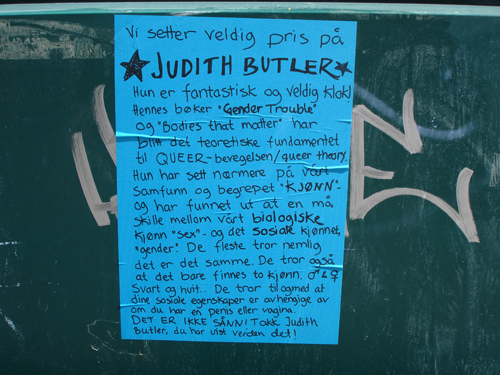
The first lines translate to:
The reason I remembered to post this today is because I am reading/writing about subversion, and then of course I can't get past Judith Butler.
The first lines translate to:
We really appreciate
Judith Butler
She is marvellous and very wise! Her books “Gender Trouble” and “Bodies that Matter” have become the theoretical fundament of the queer theory/queer movement.
The reason I remembered to post this today is because I am reading/writing about subversion, and then of course I can't get past Judith Butler.
Tuesday, August 28, 2007
Autumn approaches
"It's the end of august, and the birches are still all green," the information officer of HumLab bemoaned, as she showed me the campus. "It's not supposed to be like this. They are supposed to start turning gold now. It's so beautiful." I had to confess that I was quite comfortable with green birches until far into september, and I was in no hurry to see the weather turn. Two days later I noticed the gold touches in the birches outside the building I live in. It seems like global warming hasn't quite turned Umeå into an all-year summer estate just yet.
"The mean temperature in winter used to be minus 9 degrees celsius," my lunch date echoed the worry. "Now it's minus 5 degrees."
Biking home through the freezing rain, I didn't quite manage to share these concerns. I am here for the people, the University and the chance to hang out with others who are specialising along the same lines as me, I really don't mind if the temperature drops only to minus 10 and not minus 30. But of course, if in the last 20 years winters have been 4 degrees above the common mean temperature, that is not just a temporary change, at least not in human years. Personally, I am more concerned with getting wet, and the darkness even of daylight setting in. I am two degrees further north than Volda. For comparison: Oslo and Helsinki are at (about) 60 degrees north, Volda at 62, Umeå at 64. The arctic circle is at 66.33. For those who want to keep updated on the campus, to see if I am justified when grumping about weather and light, check the campus webcam. It's 8 degrees today, and while that is acceptable summer temperature even in Volda..., well, it's going to be an adventure.
Update: According to the locals this weather is highly unusual, and the pond that can be seen from the webcam is just a few centimeters from running over and potentially flooding the basements of the nearby buildings.
PS: Do anybody somewhat closer to equator need a guest speaker/researcher in January or February? Just checking...
"The mean temperature in winter used to be minus 9 degrees celsius," my lunch date echoed the worry. "Now it's minus 5 degrees."
Biking home through the freezing rain, I didn't quite manage to share these concerns. I am here for the people, the University and the chance to hang out with others who are specialising along the same lines as me, I really don't mind if the temperature drops only to minus 10 and not minus 30. But of course, if in the last 20 years winters have been 4 degrees above the common mean temperature, that is not just a temporary change, at least not in human years. Personally, I am more concerned with getting wet, and the darkness even of daylight setting in. I am two degrees further north than Volda. For comparison: Oslo and Helsinki are at (about) 60 degrees north, Volda at 62, Umeå at 64. The arctic circle is at 66.33. For those who want to keep updated on the campus, to see if I am justified when grumping about weather and light, check the campus webcam. It's 8 degrees today, and while that is acceptable summer temperature even in Volda..., well, it's going to be an adventure.
Update: According to the locals this weather is highly unusual, and the pond that can be seen from the webcam is just a few centimeters from running over and potentially flooding the basements of the nearby buildings.
PS: Do anybody somewhat closer to equator need a guest speaker/researcher in January or February? Just checking...
Thursday, August 23, 2007
On Swedish radio
Monday 20th of August Jessica Enevold, Charlotte Hagström and I were on Swedish radio, vetenskapsradioen - forum P1 13.20. The interview took place in Gothenburg in June, durig the Games in action conference.
I haven't really listened to it, there's always something disturbing about hearing yourself on the radio, and worse so when it's in a setting like this. Sourrounded by Swedish voices, on Swedish radio together with two very nice Swedish ladies, I sound foreign, crude, and alien stomping around in somebody elses yard.
And I am that, an alien, not even a cool sophisticated alien like Sting, but Norwegian in Umeå. I wish I at least could have a glowing finger, if I can't have the superpower of lyrics and music.
I haven't really listened to it, there's always something disturbing about hearing yourself on the radio, and worse so when it's in a setting like this. Sourrounded by Swedish voices, on Swedish radio together with two very nice Swedish ladies, I sound foreign, crude, and alien stomping around in somebody elses yard.
And I am that, an alien, not even a cool sophisticated alien like Sting, but Norwegian in Umeå. I wish I at least could have a glowing finger, if I can't have the superpower of lyrics and music.
Wednesday, August 22, 2007
Cormorants
During the morning's surfing trip, the tidbit that cormorant populations are picking up in the US, and that there is a colony in New York, leaped at me. One of the most interesting things about it is the perception of the birds in the culture:
Dracula is the last thing I think about, when I see a cormorant in Norway. Here they are part of a magic uniquely connected to the land, and fairytales have them be mysterious sorceresses, wearing their black feathers when they fly to their secret skerries out towards the open sea. There they hoard treasures untold of, and lucky is the fisherman who is loved by a cormorant woman.
Parts of this is probably connected to what troubles the fishermen in New York: Cormorants are very efficient predators. This means that when cormorants return/arrive somewhere, it's because there is fish. So if you find out where the cormorants fish, you have found a good spot - your own secret skerry at the edge of the open ocean, where you can find wealth... a wealth if not of magical jewels and gold, then at least the silver of the ocean.
Their arrival has drawn mixed reactions. Cormorants are big and black, with sharp curved bills and a habit of vomiting when threatened. When they stretch their wings out to dry, they seem to be wearing the black cloaks associated with vampires. They are also mercilessly efficient marine predators, with the ability to fly like ducks and dive like penguins, which has not endeared them to fishermen (or, for that matter, anchovies).
Dracula is the last thing I think about, when I see a cormorant in Norway. Here they are part of a magic uniquely connected to the land, and fairytales have them be mysterious sorceresses, wearing their black feathers when they fly to their secret skerries out towards the open sea. There they hoard treasures untold of, and lucky is the fisherman who is loved by a cormorant woman.
Parts of this is probably connected to what troubles the fishermen in New York: Cormorants are very efficient predators. This means that when cormorants return/arrive somewhere, it's because there is fish. So if you find out where the cormorants fish, you have found a good spot - your own secret skerry at the edge of the open ocean, where you can find wealth... a wealth if not of magical jewels and gold, then at least the silver of the ocean.
Honeymoon is fading
But the weather is still great, so it's not too bad. It's easy to be tolerant with all those little things which makes it hard to get started when the sun is shining from a pale blue scandinavian sky, when the paths through the forests are perfumed with pine, and elegant birches trail their green veils in a gentle wind.
Still, satire lingers on my tongue, pokes at my fingertips. And some time, in some dark corner, after a sufficient number of drinks, you'll be able to tease it out of me. The Norwegian love/hate of our brother nation is getting a good workout - as I am sure the Swedish equivalent does among the people who have to deal with me. Swedens smooth surfaces meets brute Norwegian stubbornness.
But things are falling into place, slowly and step by step. I guess that before I go to Australia, most will be settled, and by then it will be really good.
Still, satire lingers on my tongue, pokes at my fingertips. And some time, in some dark corner, after a sufficient number of drinks, you'll be able to tease it out of me. The Norwegian love/hate of our brother nation is getting a good workout - as I am sure the Swedish equivalent does among the people who have to deal with me. Swedens smooth surfaces meets brute Norwegian stubbornness.
But things are falling into place, slowly and step by step. I guess that before I go to Australia, most will be settled, and by then it will be really good.
Friday, August 17, 2007
HUMlab in Umeå
As I arrived to Umeå while it's still somewhat summery, the University is quiet and everything is semi-ready. Some parts were very far from ready. Patrik Svensson at the HUMlab took me and my husband for a walk around what will be the actual laboratory, and while his enthusiasm and vision made the future clear to my inner eye, the camera caught something different.
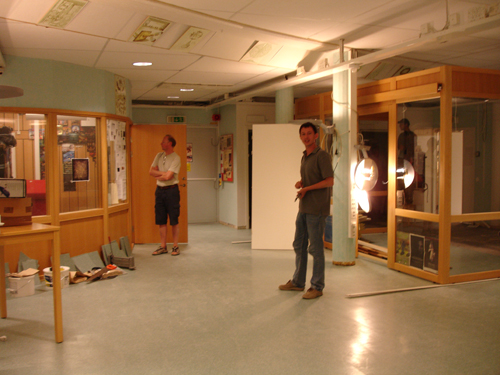
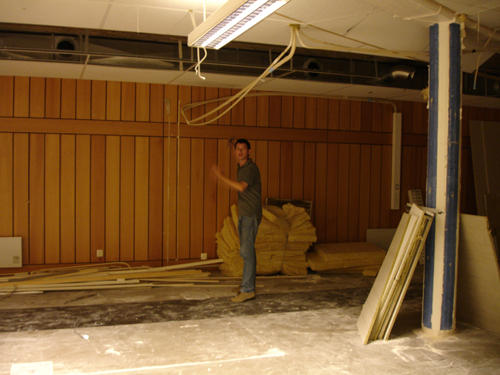
It will be great though. Patrik also showed me the plans for how it will be, and I am impressed. They have thought of everything: design, functionality, equipment, workareas, flexibility - I have to say, these Swedes have style! I can't wait to see it all finished, and get to work in this elegant and generous area.
It will be great though. Patrik also showed me the plans for how it will be, and I am impressed. They have thought of everything: design, functionality, equipment, workareas, flexibility - I have to say, these Swedes have style! I can't wait to see it all finished, and get to work in this elegant and generous area.
Umeå living
The first thing you'll notice about Umeå is all the people biking, walking or in many diverse ways moving about by their own power. Yes, they use cars, but the bicycle is a very important means of transport. To support and encourage this the place is riddled with and surrounded by paths for bikes.

The use of bikes is so extensive that it has to be regulated. Now, Swedes don't need an excuse to regulate something, but here it's pretty well justified to put up some instructional signs.
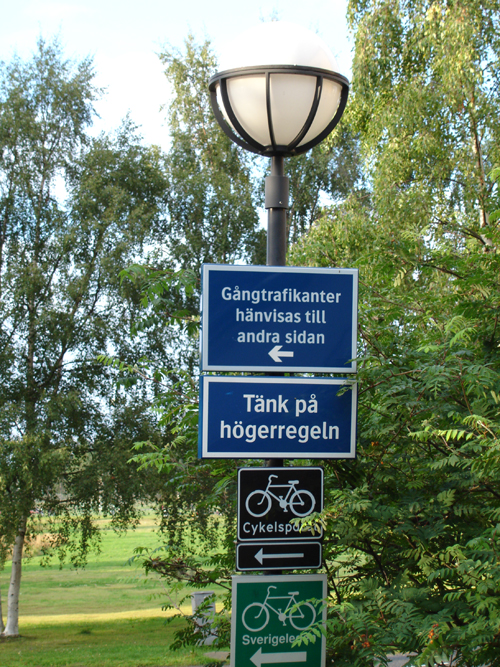
This makes Umeå a good place for one of the more original biker organisations I have seen announced, the Vegan Bikers:

But this bikers paradise will disappear under heavy snow and low temperatures in a few months, and that's when I'll be very happy about certain architectural peculiarities at the University. They have walkways between a lot of the buildings, making it possible to walk over much of the campus without setting a foot outside.

But until then I am going to enjoy the outdoors here as much as I can!
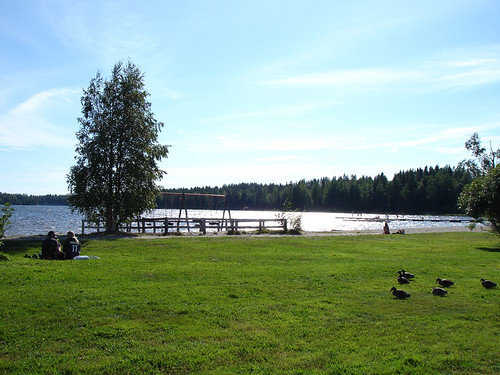
The use of bikes is so extensive that it has to be regulated. Now, Swedes don't need an excuse to regulate something, but here it's pretty well justified to put up some instructional signs.
This makes Umeå a good place for one of the more original biker organisations I have seen announced, the Vegan Bikers:
But this bikers paradise will disappear under heavy snow and low temperatures in a few months, and that's when I'll be very happy about certain architectural peculiarities at the University. They have walkways between a lot of the buildings, making it possible to walk over much of the campus without setting a foot outside.
But until then I am going to enjoy the outdoors here as much as I can!
Friday, August 10, 2007
"I never said that"
Once in a while I find that I have said things I never thought I did. I try to ask to read all interviews and make sure I know what I have answered or rather - what the journalists have asked - but recently I found that a long conversation had been cut down to four sentences, two of which were like this:
What the interviewer in Magasinet claims I say here is that the regulations of the workforce in Norway makes it impossible to produce games with the quality or quantity the way Americans do.
What I said was that Norway is too small to produce in the way Americans do. We can't discard talent in the same manner, we have to build it. The journalist was taken with his idea of the ruthless American labour market though, so suddenly it apepared as if I agreed. Oh well. So I sound like a right wing libertarian. No worries, I won't vote for them any time soon.
Torill Elvira Mortensen tror det regulerte arbeidslivet i Norge er en hindring for veksten i bransjen.
– I USA er bransjen helt rå og skreller vekk dem som ikke takler umenneskelige arbeidsforhold. I Norge er det færre med kompetanse så det er vanskelig å være like brutal.
What the interviewer in Magasinet claims I say here is that the regulations of the workforce in Norway makes it impossible to produce games with the quality or quantity the way Americans do.
What I said was that Norway is too small to produce in the way Americans do. We can't discard talent in the same manner, we have to build it. The journalist was taken with his idea of the ruthless American labour market though, so suddenly it apepared as if I agreed. Oh well. So I sound like a right wing libertarian. No worries, I won't vote for them any time soon.
Sweden, yeah
The drive from Volda to Umeå was little more than 1000 km, and took one long and one short day. I was received wonderfully, and live in a quaint little apartment at the University's housing for visiting scholars. It's tiny, but they have promised me something bigger before the winter sets in. Otherwise the blog will be filled with pages of cabin fever - or perhaps I'll just never leave the virtual world.
I bought a new cellphone today, and so I have a Swedish number. If you already have my old one and want to know how to find me in Sweden, feel free to send me an email or a sms, and I'll let you know - eventually. I am not doing much these days except exploring, shopping for the apartment, and seeing the Botnian Bay while it's still sunny.
More later - with pictures. I promise.
I bought a new cellphone today, and so I have a Swedish number. If you already have my old one and want to know how to find me in Sweden, feel free to send me an email or a sms, and I'll let you know - eventually. I am not doing much these days except exploring, shopping for the apartment, and seeing the Botnian Bay while it's still sunny.
More later - with pictures. I promise.
Friday, August 03, 2007
"Vacation"
It's been cold, wet and rainy for three weeks. It's been crappy vacation weather. Luckily, I have not had much time to realise it's been a vacation. In those three weeks I have been finishing a little book on game studies.
It's not a big, important book. It's just the one I wished existed, every time I get an email or a call from somebody who needs help. They contact me, normally after hearing me on the radio or reading some paper, and they need help to find literature on games. They always start with the phrase "There's so little done on games", and go on with "it's impossible to find anything for my work". And so I spend the next half hour guiding them through the net, or possibly reading names and titles slowly to them.
If the publisher is happy with this book, I can now say: "Why don't you check out this book, particularly the bibliography, and then you go to a library and have some searches made on the names of the people I mention, because they are really busy publishing, and I am sure they have written a lot more by now."
That's going to save me a lot of half hours. Perhaps not three weeks of vacation worth, though. But there may be other benefits - at least I hope so! And monday the weather is supposed to be warm, and I still have a week of vacation to go, and then I'll be moving into a whole new place for a year.
It's not a big, important book. It's just the one I wished existed, every time I get an email or a call from somebody who needs help. They contact me, normally after hearing me on the radio or reading some paper, and they need help to find literature on games. They always start with the phrase "There's so little done on games", and go on with "it's impossible to find anything for my work". And so I spend the next half hour guiding them through the net, or possibly reading names and titles slowly to them.
If the publisher is happy with this book, I can now say: "Why don't you check out this book, particularly the bibliography, and then you go to a library and have some searches made on the names of the people I mention, because they are really busy publishing, and I am sure they have written a lot more by now."
That's going to save me a lot of half hours. Perhaps not three weeks of vacation worth, though. But there may be other benefits - at least I hope so! And monday the weather is supposed to be warm, and I still have a week of vacation to go, and then I'll be moving into a whole new place for a year.
Sunday, July 29, 2007
Getting real
This has been a weird year, and I have been working with a lot of stuff that might or might not get real. Two things are now crystalising out of all that potential though.
I am about to finish the second-to-last chapter of a little book on game studies, in Norwegian. The topic I am still missing in this chapter is gender research in games. I do have a lot of stuff for it, but since this is something no female games researcher can neglect: Is there a name I really should not ignore? Is there a name which is often ignored, but who deserves to be mentioned? I have written about a lot of the women and men doing gender topics in their research under other topics in the book, but you know what it's like: If I don't have a headline for it, it doesn't exist.
When this book is done, I am moving to Umeå for the winter. I received a post.doc. scholarship from HUMlab at the University of Umeå, and Volda College has generously agreed that I can take a leave from parts of my position for this. It's a great deal for me, and I am really looking forwards to this winter. Well, I am not looking forwards to a winter somewhere even darker than here, but I do like the thought of a larger academic environment, a bigger library, a bigger town, no administration (going to miss my students though) and lots of time to read, write and think.
From Umeå I will be going to Australia and Japan this fall. I am also still looking hard at the Vancouver AOIR conference, trying to figure out how to get money for it. I have a very personal reason for wanting to go to Canada this fall, and the conference, with it's great topic, is very convenient. But I have to see how things with work out with two employers, another apartment and the costs of living in two places. And it's not like I am sitting in my tiny room in Sweden sulking through all of September...
This is all painfully close and painfully real, and getting more so every day. Changes are scary - although these are scary good.
Anyway, about those gender research hints? I'd love them.
I am about to finish the second-to-last chapter of a little book on game studies, in Norwegian. The topic I am still missing in this chapter is gender research in games. I do have a lot of stuff for it, but since this is something no female games researcher can neglect: Is there a name I really should not ignore? Is there a name which is often ignored, but who deserves to be mentioned? I have written about a lot of the women and men doing gender topics in their research under other topics in the book, but you know what it's like: If I don't have a headline for it, it doesn't exist.
When this book is done, I am moving to Umeå for the winter. I received a post.doc. scholarship from HUMlab at the University of Umeå, and Volda College has generously agreed that I can take a leave from parts of my position for this. It's a great deal for me, and I am really looking forwards to this winter. Well, I am not looking forwards to a winter somewhere even darker than here, but I do like the thought of a larger academic environment, a bigger library, a bigger town, no administration (going to miss my students though) and lots of time to read, write and think.
From Umeå I will be going to Australia and Japan this fall. I am also still looking hard at the Vancouver AOIR conference, trying to figure out how to get money for it. I have a very personal reason for wanting to go to Canada this fall, and the conference, with it's great topic, is very convenient. But I have to see how things with work out with two employers, another apartment and the costs of living in two places. And it's not like I am sitting in my tiny room in Sweden sulking through all of September...
This is all painfully close and painfully real, and getting more so every day. Changes are scary - although these are scary good.
Anyway, about those gender research hints? I'd love them.
Friday, July 27, 2007
More clever spam
Can you guess I am desperate not to write what I should? Anyway, writing at the blog again, I just checked a comment I permitted. Turned out that it was the most clever of spam.
What it did was to copy a passage from another post:
This was part of the content of a comment on a farily old post of mine. It looked perfectly to the point of the post, so I didn't hesitate on permitting it. But being a curious old bitch I wanted to see what exactly that comment was about, so I checked. That's when I recognized the words.
I can't help it, the cleverness and inventiveness of spammers is impressive. All this effort and energy, just to invade the blogs of strangers! I almost feel flattered.
What it did was to copy a passage from another post:
I believe that there should be gold-sinks in the game; however, make the currency sink a thing of pure fluff. In the MMORPG Ultima Online, it cost 500k (a decent sum of money) just to dye your hair a fancy neon color. The hair color did not give you a statistical advantage over your opponent, it did, however, show your high status.
This was part of the content of a comment on a farily old post of mine. It looked perfectly to the point of the post, so I didn't hesitate on permitting it. But being a curious old bitch I wanted to see what exactly that comment was about, so I checked. That's when I recognized the words.
I can't help it, the cleverness and inventiveness of spammers is impressive. All this effort and energy, just to invade the blogs of strangers! I almost feel flattered.
Gamers ignoring kids
With the increasing popularity of games, in some demographic groups it will be harder to find somebody who does not play a game, than people who do. This means that everybody will be playing, the genius and the not-so-smart, the loving parent and the abusive parent. And this is the point of Halen A. S. Popkin, as she writes about the Straw couple, parents who had their children taken away due to neglect - neglect supposedly caused by their addiction to internet games.
Popkin's point, which is a refreshing view in these days of panics and witchhunts, is that when people neglect their children, they have problems, real, not-game-caused problems. A computer game may increase these problems in many ways: if you are a compulsive or obsessive personality, a computer game will play right into that. But the game didn't make you the person you are, and if the game wasn't there, something else would be. Neglect of children is, sadly, nothing new. If banning computer games would ban neglect, crime, bad grades, social insecurity and isolation, depression, suicides, war and drug abuse - then by all means, wipe those disks RIGHT NOW! It doesn't though. Telling ourselves it's caused by games is kidding ourselves, and it makes us look at the symptom, not the cause. Obsessive gaming isn't caused by games, it's caused by the problems of the people who play games. Remove the symptom, and there will just be an other one.
Popkin's point, which is a refreshing view in these days of panics and witchhunts, is that when people neglect their children, they have problems, real, not-game-caused problems. A computer game may increase these problems in many ways: if you are a compulsive or obsessive personality, a computer game will play right into that. But the game didn't make you the person you are, and if the game wasn't there, something else would be. Neglect of children is, sadly, nothing new. If banning computer games would ban neglect, crime, bad grades, social insecurity and isolation, depression, suicides, war and drug abuse - then by all means, wipe those disks RIGHT NOW! It doesn't though. Telling ourselves it's caused by games is kidding ourselves, and it makes us look at the symptom, not the cause. Obsessive gaming isn't caused by games, it's caused by the problems of the people who play games. Remove the symptom, and there will just be an other one.
And now: lolcat quiz!
One of my favourite weird net phenomena of the minute are the lolcats. By way of Clancy Ratliffe I got reminded of them once more, through this lolcat quiz. Of course, I had to see which lolcat I am:


The Romance Princess
We learn at school that the feudal lords received their right to rule from higher powers. They were the chosen ones, the ones with extraordinary abilities. Well, it seems like this belief is alive and blooming in the Norwegian royal house. Princess Martha Louise has "come out" as a clairvoyant, healer and one who can see angels. She is starting a school, Astarte Education, where she teaches healing and whatnot.
Martha Louise is a well-loved figure in Norway, and people are quite tolerant of her many controversial (for a royal princess) impulses. Well, so they laugh a bit at her posturing husband and their wannabe bohemian lifestyle, but it's a rather indulgent laugh.
This time she may however have crossed some lines which are not as easily accepted. She is using her authorisation as a physiotherapist in combination with spiritual healing, something which crosses Norwegian legislation - she is flirting with "kvakksalverloven", which means she can risk becoming, legally, a quack. She has also always been quite well loved by the church, but in the Norwegian church there are no middlemen between man and God - the angels are not for conversation, if you have to talk to God, you go straight to him.
For a scholar with an interest in popular culture, this is however amazingly fascinating. Martha Louise is going - not eactly mainstream, but straight into the women's magazines. Her life is becoming a modern fairytale, or, more precisely, a romance novel. Consider this synopsis:
(Sorry about getting carried away with some sarcasm at the end there - there are reasons I don't write romance novels.)
I think I have read that story already - over and over and over again, in exactly the kind of magazines that are filled with pictures of royalty, the magazines that have followed Martha Louise since her birth. That reader segment comprises her most loyal supporters, and accidentally also the most likely customer or "students" to her school. Now, if I were mean, I might suggest that this is an incredibly well-conceived scam, where the princess ruthlessly abuses her birth, her publicity and the dreams of the many who have watched, loved and celebrated her all her life, to make money off the suffering and unhappiness of those with uncurable ailments and unfullfillable dreams. I am not a mean woman though, so I suggest rather that Princess Martha Louise has come to believe in the story about herself. May the story lead to a happy ever after, for the sake of the many who share that belief.
Martha Louise is a well-loved figure in Norway, and people are quite tolerant of her many controversial (for a royal princess) impulses. Well, so they laugh a bit at her posturing husband and their wannabe bohemian lifestyle, but it's a rather indulgent laugh.
This time she may however have crossed some lines which are not as easily accepted. She is using her authorisation as a physiotherapist in combination with spiritual healing, something which crosses Norwegian legislation - she is flirting with "kvakksalverloven", which means she can risk becoming, legally, a quack. She has also always been quite well loved by the church, but in the Norwegian church there are no middlemen between man and God - the angels are not for conversation, if you have to talk to God, you go straight to him.
For a scholar with an interest in popular culture, this is however amazingly fascinating. Martha Louise is going - not eactly mainstream, but straight into the women's magazines. Her life is becoming a modern fairytale, or, more precisely, a romance novel. Consider this synopsis:
"Young princess who is mainly interested in horses and angry with the restrictions of her royal life, strives to overcome these restrictions and find meaning beyond her birth. She has several undesirable romances, but the family always manages to cover it up somehow and she remains in the cluthces of her position. Finally however the travelling, mediocre minstrel (journalist, writer, designer) shows up and sweeps her off her feet, convinces the parents that he truly loves the princess, and charms the nation with his devotion. His great gifts for public embarassments finally frees the princess from her burden of royal duties, as she renounces her title to be with him. With motherhood and no more public duty, tedium sets in, she is no longer in the public eye and also, there's the money issue. With the title, she also renounced the public support a royal princess is due. Used to a lifestyle no common physiotherapist can support, the princess needs a miracle, and lo and behold, just as she was getting too bored, angels come to her! She can heal, she can see, she can commune with great powers! And so, by the miracle of her exceptional birthright, she is lifted out of the dreariness of being a married mother and into her true vocation: A magically gifted healer. Peace at last for our much-tried princess."
(Sorry about getting carried away with some sarcasm at the end there - there are reasons I don't write romance novels.)
I think I have read that story already - over and over and over again, in exactly the kind of magazines that are filled with pictures of royalty, the magazines that have followed Martha Louise since her birth. That reader segment comprises her most loyal supporters, and accidentally also the most likely customer or "students" to her school. Now, if I were mean, I might suggest that this is an incredibly well-conceived scam, where the princess ruthlessly abuses her birth, her publicity and the dreams of the many who have watched, loved and celebrated her all her life, to make money off the suffering and unhappiness of those with uncurable ailments and unfullfillable dreams. I am not a mean woman though, so I suggest rather that Princess Martha Louise has come to believe in the story about herself. May the story lead to a happy ever after, for the sake of the many who share that belief.
Thursday, July 19, 2007
About the price and size of cucumbers
Warning, all links in Norwegian.
"Cucumber journalism" they call it in Norwegian, from the time when the summer temp was sent to the market to check the price and quality of fresh cucumbers. Dag Solstad (video, get an author home), a well known Norwegian author, wrote about how the broccoli was discovered by a summer temp in a local newspaper - on a marketplace in Norway.
This week it seems like the correct contemporary word for cucumber news would be "game journalism." I have had 5 phonecalls from 4 different news media on 5 different takes on games this week.
Some of those were kind of interesting. I may even buy one of the papers to see what they will be writing about political games and propaganda games. Some of the phone calls felt more like I was doing unpaid elementary education, not even in games, but in general social science.
And while we are at that: www.ssb.no is a GREAT source for statistics on Norwegian statistics, and they publish "Norsk Mediebarometer", one of the most useful sources I know about on media statistics, including game use in Norway. Did you get that? Statistisk Sentralbyrå, that boring old public institution which has been publishing facts about Norway from 1832 as part of the ministry of finance: Tabellkontoret, and then as an independent public institution since 1876. If you count the start of their work with the first Norwegian Census, that was in 1769.
No, journalists are not stupid, that's not what I am saying. I am just as always baffled by the power of the media threshold: once a topic is used by one large news agent, everybody else need to have their take on it.
Cucumbers, anyone?
"Cucumber journalism" they call it in Norwegian, from the time when the summer temp was sent to the market to check the price and quality of fresh cucumbers. Dag Solstad (video, get an author home), a well known Norwegian author, wrote about how the broccoli was discovered by a summer temp in a local newspaper - on a marketplace in Norway.
This week it seems like the correct contemporary word for cucumber news would be "game journalism." I have had 5 phonecalls from 4 different news media on 5 different takes on games this week.
Some of those were kind of interesting. I may even buy one of the papers to see what they will be writing about political games and propaganda games. Some of the phone calls felt more like I was doing unpaid elementary education, not even in games, but in general social science.
And while we are at that: www.ssb.no is a GREAT source for statistics on Norwegian statistics, and they publish "Norsk Mediebarometer", one of the most useful sources I know about on media statistics, including game use in Norway. Did you get that? Statistisk Sentralbyrå, that boring old public institution which has been publishing facts about Norway from 1832 as part of the ministry of finance: Tabellkontoret, and then as an independent public institution since 1876. If you count the start of their work with the first Norwegian Census, that was in 1769.
No, journalists are not stupid, that's not what I am saying. I am just as always baffled by the power of the media threshold: once a topic is used by one large news agent, everybody else need to have their take on it.
Cucumbers, anyone?
Monday, July 02, 2007
so, so yesterday?
We should however be realistic: the 'blogging revolution' collided with human nature and human nature won. Most people do not like writing, even if they have something to write about. Many people do not have time to blog on an ongoing basis in a way that attracts a substantial audience.
While I agree with this statement in blog statistics and demographis in the profile from Caslon Analytics on blogging, I agreed with it in 2001. So I guess this statement is so, so yesterday? Even using the amazingly simple technology of pen and paper, not a lot of people write. For those who do, who enjoy writing and enjoy communicating online, weblogs will, in some form, continue to be part of their toolbox. But it will still be possible to survive without a blog.
PDF n00b
I just received the page proofs for an article I wrote ages ago. Apart from considerable frustration with the proofreader's automated requests - I am sorry, but if a journal doesn't have a volume number, I can't supply it!!! - You want me to write (sic!) behind something? Behind a lowercase letter? which one? Why? Where? That sentence has lowercase letters all over it!!! - they have asked me to make correction directly into the page proofs. At least that is how I understand this sentence:
I have no idea how to edit PDFs. I now understand that this can be done with the touchup text tool. The problem is that when I try that, they ask for the font. And 1) I obviously don't have it installed and 2) I have no idea what font it is, so I don't know where to get it.
As far as I am concerned, the publishers are asking me to supply information that doesn't exist, insert comments which don't make sense, and make the changes in a way which can't be done. If anybody know of a secret trick, please, please share it.
When you review your proofs please read them carefully, being sure to respond to all copy editor queries, and make all corrections (including those resulting from copy editor queries) on the page proofs. The final responsibility for correcting typographical errors in proofs is yours.
I have no idea how to edit PDFs. I now understand that this can be done with the touchup text tool. The problem is that when I try that, they ask for the font. And 1) I obviously don't have it installed and 2) I have no idea what font it is, so I don't know where to get it.
As far as I am concerned, the publishers are asking me to supply information that doesn't exist, insert comments which don't make sense, and make the changes in a way which can't be done. If anybody know of a secret trick, please, please share it.
Subscribe to:
Posts (Atom)


 Posts
Posts


