Monday, October 08, 2007

There's jargon, and there's what I understand

Prompted by Espen, and because his name had been mentioned in different contexts, I sat down to read some of John Hopson's writings at Gamasutra. The most recent work was his "We are not listening", a featured article adressing game researchers from the position of the game industry.

After the keynote at DiGRA 2007, where Mark Prensky talked about: Keynote: "Escape from Planet Jargon: Making Research More Useful to Practitioners", this was kind of a in-the-moment-topic. The Prensky talk had been fairly unimpressive, and I knowing Hopson to be both intelligent and thoughtful, I hoped he would have a better take on the issue than Prensky. I am afraid to say, my hopes were sadly dashed. Hopson did however make it clear that he didn't mean to address ALL game resarchers, only the one targetting the game industry, which I guess is a mitigating circumstance. Still - well, here's my thoughts while reading "We're not listening".

Page 1: caveat
I’m not saying that academics have to care about what the industry thinks of them, but for those who do this is the best advice I can give on how to make sure the industry takes your work seriously. Secondly, I’m going to assume that you’ve already done your research and have the findings ready to go. This article is about the final mile, going from finished research to real implementation in a shipped game.

Hopson here assumes that it's the job of the researcher to present the material, to "sell" it. Others have professionals to do that, it's called marketing departments. So what he says here is basically: if the business is to care about your work, good doesn't matter, marketing does.

Page 1, rule 1
The researcher must lay out the entire impact of the idea, from the cost of implementing the proposal to the resulting changes in player experience and the metrics for measuring that impact. Getting players to identify with the main character is great, but researchers have to finish the rest of the sentence: “This will help players identify more strongly with the main character which will result in an improvement in measures of overall player satisfaction and an increase in total playing time.”

Hopson makes the assumption that the researcher is doing research in order to identify exactly the kind of questions which are important for game developers, namely, how to make a player play more. That is probably true for his research, at the Microsoft lab, but it's certainly not true for other types of research. Knowing that a player has a very strong identification with the main character can be a way to discuss time management in education and development, dramatic structures in critical studies, the impact of games on society in sociology. The researcher does not have the same agenda as the industry, unless he or she is paid by the industry. It also assumes that an academic who knows a lot about how gamers react to the game, is also an insider on the questions game developers ask, and are able to identify the important findings in their own material, which would be important to the game companies. This demands an inside knowledge which researchers who already work in the game industry, for the industry, has. The rest, as he himself points out, although in a roundabour fashion, don't have access.

Page 2, rule 2: here we go with the jargon thingy.
Academic writing is abnormal. I know that by the time you escape grad school the rolling cadences and ritualized forms of the journal article are graven on your very soul. But really, you might as well present your research in the form of an interpretive dance as hand a producer an article written for academic publication. Reading an academic article is an obscure and highly specialized job skill, one which most of your potential audience doesn’t have the time or desire to learn. It’s up to the researchers to make their work accessible to the audiences they want.

This is as uninformed coming from Hopson as it was coming from Prensky. Every specialised field is packed with specialised concepts. Have anybody ever tried to read a user manual? Yes, there are bad academic articles out there, where content is questionable and form is taken to the extreme. But Hopson also knows very well that a lot of important terms and structures are there for precision and clarification, not to ritualize the communication. Academic writing directed at other academics is not directed at specialists in some other field, or laymen, and to exclude the precise language developed to deal with complex terms would be irresponsible. So the game developers can't read it? It's why they hire academics in their research departments, people who know the language, have the connections, understand the field. In a game developing company it's Hopson's job to keep updated on the language, the structures and the references, and bring that knowledge back into his organisation.

Use examples from bestsellers. A good example from a popular game is more effective than a great example from something they’ve never heard of. Industry people often suffer from an “if-they’re-so-smart-, why-ain’t-they-rich” attitude towards smaller titles. Even if the small title is a perfect example of how the theory works, they’re going to be less likely to listen if they haven’t heard of the game ahead of time.

This basically says: It's all about making more money, not about making better games, so if a game is better but isn't a huge bestseller, the developers aren't interested. "Good = huge selling game, screw all other analysis." And with that I think game researchers can just pack up and go back to our departments, as nothing innovative will ever reach the ears of developers. I'll not even start bashing the other advice on that page. It's all about turning your thesis into a 5 line ad. Sure, if that's what you want to do, please listen to Hopson. If you had hoped to communicating a complex understanding or a new idea, well, your odds look very short.

Page 3, rule 3
Working in the games industry can be brutal, involving fast-paced schedules and eighty-hour work-weeks at times. The people listening to your talk already have a full workload. They’ve already been cutting features to make their production milestones, often features that represent some of their best ideas and strongest held beliefs about games. And then there’s this academic who’s never shipped a game standing up there telling them to rip out weeks of work in order to implement some pet theory. Give us a break!

Yes, I'll give you a break. After rule 2, I think we already agree that innovation, complexity and precision is a waste of time when talking to developers. They are all lab rats anyway, going by programmed responses, so trying to communicate new knowledge is a waste of time. It is a pretty bleak presentation of game developers though, but I guess we already knew it was a cut-throat business where the thoughtful die fast.

Page 3 rule 4:
However, to make that research useful to developers, it’s important to take the next step and give concrete examples of how classifying one’s players helps to make a better game. Ok, so we now know that 10% of our players are “Type 3a explorer-monkeys.” Now what? Does that mean 10% of our content should be exploration-focused?

This is about normative research vs other types of research. What Hopson says here is: Game developers want cookbooks, and they want to be told how to do things right. The problem is again that no researcher can know that something they have observed will make things better if implemented in a different setting. This is something only game researchers already involved in game development can have a chance to test out. John Hopson can say: "Before we finish this, let's try this approach instead, because I have read this analysis which says that..." and then Microsoft can run a test on that, and see if his theory actually works. Game researchers outside of companies don't have that kind of access or that kind of tools.

Second, he says: Do only one kind of research. Don't do explorative or descriptive research, do normative research, create rules for how things should be done. Basically: Do the kind of research we like, and we'll listen.

Page 4, rule 5 and 6:
The question of access also makes rule 5 and 6 useless to a game developer. There's no way a scholar can prove that a theory will work unless somebody builds the game where it's been implemented. To do that we'd have to do all the things that Hopson specifically says not to do, such as citing other research, referencing, quoting lesser-known games and looking at what has been done before. It's the only way an academic not working inside a company can do these things, and accordign to Hopson, it's not valid.

The same goes with asking a developer what they need. Let me point to rule 3: The developers don't have enough resources to tell a researcher what time of the day it is. Why should they answer more complex questions, which might force them to listen to a complex theory?

I know John Hopson means well with his advice, but it's advice from a scholar who since his Ph D has worked inside of a game development firm. It basically says two things:

1) To be able to talk to game developers, you need the kind of access you have when you are already working with game developers.

2) Game developers are narrowminded, only motivated by profit, and don't want to learn new things.

The first is useless advice to any academic who wants to get into the field. The second is very close to being insulting to his colleagues, the game developers. But most of all I wonder at the job of game researchers in the development firms. Aren't they the ones who are supposed to bridge this gap? Isn't that why they are hired, with all their education and their connections to the research field? Sure, I have enough skills and knowledge about marketing to dumb down - eh, I mean, clarify my writing for a target group when I need to. I don't, however, have the dual skills that somebody like John Hopson has a chance to develop. He and those of his ilk are the ones who can bring new and interesting research to the eye of the game developers community. They are the ones who may really make a difference.
Monday, October 01, 2007

Voice, luggage, bed

It was in a karaokebar in Tokyo I last had a voice. The luggage I last saw in Narita Airport, but reports have it that it's been spotted in London. When I arrived in Umeå I was afraid the fog was too thick for me to find the bed, but it was where I had left it.

I feel spread all over. My head has barely gotten out of Australia, as the impressions from DAC 2007 in Perth are still zooming about. I think what made the strongest impression on me was the bioart exhibited in The Bakery by SymbioticA: Still, Living. While not everybody's favourite, the art touched me, made me curious, disgusted and impressed, all in one, strangely moving - or perhaps I was just impressed with the name dropping, as the curator was talking about his meeting and discussions with Gombrich, who I was sure must have been dead a long time ago.

The memories of the exhibitions in Australia are oddly overlapping the exhibitions on the National Museum of Modern Art (MOMAT) in Tokyo, and the complex images of artificial organisms and biologically coloured membranes from australia overlap the intricate beauty of Japanese weaving and painting. My dreams are vivid and wild, and I dream in patterns: Flowers on silk, water over stones, light through leaves, algae on membranes, preserved skin, growing and spreading mikroorganisms. It is going to take a while to start remembering and thinking about this trip in sentences, categories, logical terms rather than a caleidoscope of faces, voices, colours, tastes. I'll get there though - that's the good thing about being alone, I have time now.

---update-----
And for those who didn't already catch my error: Ragnhild Tronstad pointed out that it was not Gombrich (who died in 2001, and while not having been dead as long as I thought still was not the man in question) the curator refered to, but Hans-Ulrich Gumbrecht. No less impressive reference, and now if you excuse me, I'll go check out some of his books.

Sunday, September 23, 2007

Paper, paper, paper...

Safely in Japan, I collapsed after the flight, and in sheer delight at having an air-conditioned room and some privacy after 8 days of intense social activity, I spent the first day in Japan reading, feet up and close to the amenities of a japanese translation of a european bathroom.

Today I had a quest: I needed a new plug for Japan, as I arrogantly had assumed they would use either European or Oceania type of plugs. Of course not, theirs were American. Oh well. After that I went to paradise. Me and Helen Kennedy, who was kindly guiding me to the local designer stores with a sure eye for what we can want, but afford, ended up in Itoya, the paper store which has everything, and then some. So, if you expected some kind of flashy present after my long trip, forget it, I am sorry. My suitcase is packed with handmade japanese paper.

Wednesday, September 19, 2007

Access issues

Still no real internet connection, so I am just letting any who wonder know: I am doing fine, Perth is cool but nice, and the conference was good. More later - sometime.

Saturday, September 15, 2007

Sloooooow

The computer that is. PerthDAC 2007 isn't, it's compact, small and friendly - well, most of the time. What it isn't is online. Since I also don't have an internet connection where I stay, and I haven't seen an internet cafe just yet, I am painfully cut off from a lot of obligations, not to mention the fun stuff. I
ll try to mend the situation, but it's not happening today.

Tuesday, September 11, 2007

Perth next!

Tomorrow I am off to Perth, for DAC 2007. I am going to present a paper I have for once suffered over, meet some great friends, and eat and drink in one of my favourite places for just that. Afterwards I am off to a totally new place for me: Japan!

While Umeå is picking up as more visiting scholars arrive, I think it's time for me to get some air under the wings. They still haven't managed to get the equipment I need, and as long as I am not here to be annoyed, they have almost three weeks to get it in place. By then I'll have 8 more months here, so I guess I'll still have time to play around.

Friday, September 07, 2007

Bleak Friday

The start is always hard, I know. The change, getting things established, figuring things out, it's always tough. And the social part, trying to find people to connect to, or just make light conversation with, when I am suddenly alone after 25 years living with a family; I knew these things would be difficult and take time, and that I had to make an effort to make it work.

I have however had a clear deadline to offer everybody I have talked to about practical considerations around my situation in Umeå: I am leaving 12th of September, and that means I really need to have it all in place at least a week before, for my final preparations.

Of everything I said I needed before I arrived here, I have three things; a place to sleep, a good office chair and a rollermouse. Of all the things I have been offered - well, let's say there have been some delays. Delays which are by now making my days strained, unhappy and uncomfortable.

I hope I'll at least get paid before I leave for Australia and Japan. If not this can get unpleasantly tight. But I am happy I am leaving right now. I am sure the slow and deliberate ways of the northern Swedes will feel familiar and welcome after Tokyo, and coming back will feel good.

At least I hope so.

Tuesday, September 04, 2007

"Can I talk to Jerry?"

As I moved to Sweden, I went out and got myself a handsome little phone with a telia account. They asked me what number I'd like, and I got one that was not too far from my Norwegian one, something I could learn quickly. So I had a phone, I had a number, I had a fully charged card, and I was ready to take calls.

"Hello, is Jerry there?"

"Wrong number," I said politely. "Isn't this xxx-xxx-xx?" "Yes, that's correct." "Then I'd like to talk to Jerry." "I am sorry, my name is Torill Mortensen, this is my phone, recently bought, and I can't help you." "Are you absolutely certain you can't get hold of Jerry?" "Yes. There is no Jerry here, and there never was a Jerry here. He must have terminated his account and by accident, I happened to get the same number. I can't help you, I am sorry."

Over the next week or so, I got used to telling people that there was no Jerry at this number any more. That's when I started to get a new kind of calls.

"Detta är om erans annons, vi skulla vilja..."

"Excuse me, but what ad?"
"The ad about moving, and needing help with your apartment. I'd like to talk to Anders." "EEeeehh, I have no ad anywhere, and there is no Anders here." "But you are asking for help to clean out the apartment." "No, that must be a mistake." "You see, you have this ad at xxxxxx, and it says you are moving to xxxx, now I'd like to help you with the cleaning..." "I am really sorry, but there must be a mistake." "Isn't this number xxx-xxx-xxx?" "Yes, and that is my number, I am Torill Mortensen, I am not moving anywhere, I don't have an apartment in that part of Sweden and I don't have an ad. Somebody must have put the wrong number in."

After several days of fielding those calls, I just had to check. So I googled my phone number, and yes, there it was. Some Anders had an ad, and he had my number in it. Somebody with the same last name as him had a company, and this company used my number. I had not just inherited a mysterious Jerry with a lot of english-speaking friends, I had also inherited an Swedish company.

That's when my struggle to have those numbers removed started. I have been writing ad-companies and search services all over Sweden, begging to have the ad removed. After three days it is finally gone. The company was a bigger problem. Here I had to resort to a slight case of identity theft. I went in and registered as the owner of the company, and changed the number to something which was obviously not useable. I felt justified, as it wasn't really identity theft, it was a release of identity. I am not that company, and I shouldn't be able to claim I was. By making sure nothing in that ad for the company had anything to do with me, I removed my own ability to, for instance, order 500 chairs, all in purple leather, to be sent to his office.

The last two days, all phonecalls to my phone have been for me. I almost miss Jerry.

Friday, August 31, 2007

Spikning - as Luther did it

I was invited to two examples of the same event today, what the Swedes call "spikning", literally: nailing. A little concerned, I asked my office mate about it. "OK," she said, "let's start at the beginning."

It seems that since Martin Luther nailed his thesis to the church doors in Wittenberg in 1517, nailing your thesis to a wall - "spikning" - is the equivalent of making it public, in protestant Sweden.

The tradition lives on here following the example of Martin Luther, and today two doctorate theses in ethnology are made public here at the department of culture and media, and of course I had to go have a look. Also, there's "fika" afterwards. And that's something much more polite than it sounds in Norwegian - it's simply snacks and perhaps a drink. This, the Swedes do well, too.

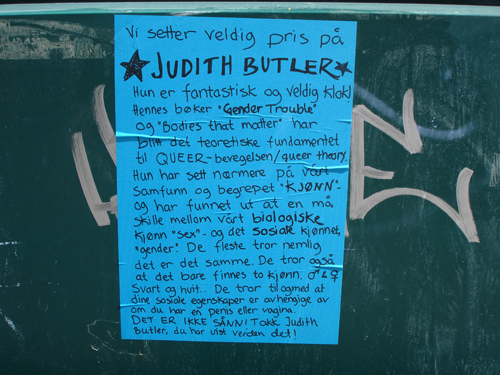
To Judith Butler

I have wanted to post this picture for a while, ever since I passed the poster glued to the front of the building housing the Faculty of Social Sciences in Bergen. It's praise of Judith Butler, handwritten and in a mixture of very simple and very sophisticated language. It is quite touching and quite impressive, as I find it speaks of a revelation which is more than an intellectual awakening, it is a physical recognition as well.

The first lines translate to:
We really appreciate
Judith Butler
She is marvellous and very wise! Her books “Gender Trouble” and “Bodies that Matter” have become the theoretical fundament of the queer theory/queer movement.

The reason I remembered to post this today is because I am reading/writing about subversion, and then of course I can't get past Judith Butler.

Tuesday, August 28, 2007

Autumn approaches

"It's the end of august, and the birches are still all green," the information officer of HumLab bemoaned, as she showed me the campus. "It's not supposed to be like this. They are supposed to start turning gold now. It's so beautiful." I had to confess that I was quite comfortable with green birches until far into september, and I was in no hurry to see the weather turn. Two days later I noticed the gold touches in the birches outside the building I live in. It seems like global warming hasn't quite turned Umeå into an all-year summer estate just yet.

"The mean temperature in winter used to be minus 9 degrees celsius," my lunch date echoed the worry. "Now it's minus 5 degrees."

Biking home through the freezing rain, I didn't quite manage to share these concerns. I am here for the people, the University and the chance to hang out with others who are specialising along the same lines as me, I really don't mind if the temperature drops only to minus 10 and not minus 30. But of course, if in the last 20 years winters have been 4 degrees above the common mean temperature, that is not just a temporary change, at least not in human years. Personally, I am more concerned with getting wet, and the darkness even of daylight setting in. I am two degrees further north than Volda. For comparison: Oslo and Helsinki are at (about) 60 degrees north, Volda at 62, Umeå at 64. The arctic circle is at 66.33. For those who want to keep updated on the campus, to see if I am justified when grumping about weather and light, check the campus webcam. It's 8 degrees today, and while that is acceptable summer temperature even in Volda..., well, it's going to be an adventure.

Update: According to the locals this weather is highly unusual, and the pond that can be seen from the webcam is just a few centimeters from running over and potentially flooding the basements of the nearby buildings.

PS: Do anybody somewhat closer to equator need a guest speaker/researcher in January or February? Just checking...

Thursday, August 23, 2007

On Swedish radio

Monday 20th of August Jessica Enevold, Charlotte Hagström and I were on Swedish radio, vetenskapsradioen - forum P1 13.20. The interview took place in Gothenburg in June, durig the Games in action conference.

I haven't really listened to it, there's always something disturbing about hearing yourself on the radio, and worse so when it's in a setting like this. Sourrounded by Swedish voices, on Swedish radio together with two very nice Swedish ladies, I sound foreign, crude, and alien stomping around in somebody elses yard.

And I am that, an alien, not even a cool sophisticated alien like Sting, but Norwegian in Umeå. I wish I at least could have a glowing finger, if I can't have the superpower of lyrics and music.

Wednesday, August 22, 2007

Cormorants

During the morning's surfing trip, the tidbit that cormorant populations are picking up in the US, and that there is a colony in New York, leaped at me. One of the most interesting things about it is the perception of the birds in the culture:
Their arrival has drawn mixed reactions. Cormorants are big and black, with sharp curved bills and a habit of vomiting when threatened. When they stretch their wings out to dry, they seem to be wearing the black cloaks associated with vampires. They are also mercilessly efficient marine predators, with the ability to fly like ducks and dive like penguins, which has not endeared them to fishermen (or, for that matter, anchovies).

Dracula is the last thing I think about, when I see a cormorant in Norway. Here they are part of a magic uniquely connected to the land, and fairytales have them be mysterious sorceresses, wearing their black feathers when they fly to their secret skerries out towards the open sea. There they hoard treasures untold of, and lucky is the fisherman who is loved by a cormorant woman.

Parts of this is probably connected to what troubles the fishermen in New York: Cormorants are very efficient predators. This means that when cormorants return/arrive somewhere, it's because there is fish. So if you find out where the cormorants fish, you have found a good spot - your own secret skerry at the edge of the open ocean, where you can find wealth... a wealth if not of magical jewels and gold, then at least the silver of the ocean.

Honeymoon is fading

But the weather is still great, so it's not too bad. It's easy to be tolerant with all those little things which makes it hard to get started when the sun is shining from a pale blue scandinavian sky, when the paths through the forests are perfumed with pine, and elegant birches trail their green veils in a gentle wind.

Still, satire lingers on my tongue, pokes at my fingertips. And some time, in some dark corner, after a sufficient number of drinks, you'll be able to tease it out of me. The Norwegian love/hate of our brother nation is getting a good workout - as I am sure the Swedish equivalent does among the people who have to deal with me. Swedens smooth surfaces meets brute Norwegian stubbornness.

But things are falling into place, slowly and step by step. I guess that before I go to Australia, most will be settled, and by then it will be really good.

Friday, August 17, 2007

HUMlab in Umeå

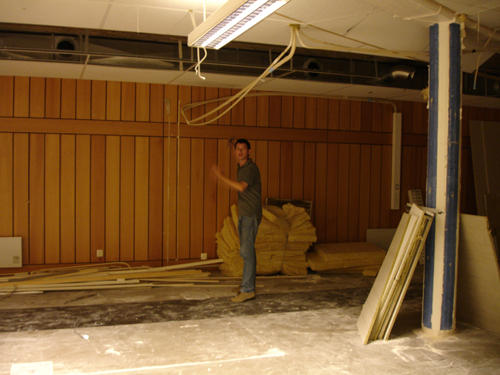
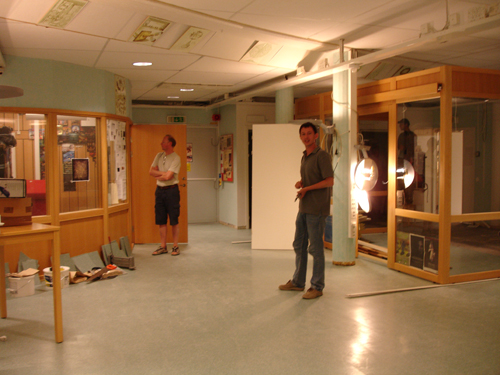
As I arrived to Umeå while it's still somewhat summery, the University is quiet and everything is semi-ready. Some parts were very far from ready. Patrik Svensson at the HUMlab took me and my husband for a walk around what will be the actual laboratory, and while his enthusiasm and vision made the future clear to my inner eye, the camera caught something different.


It will be great though. Patrik also showed me the plans for how it will be, and I am impressed. They have thought of everything: design, functionality, equipment, workareas, flexibility - I have to say, these Swedes have style! I can't wait to see it all finished, and get to work in this elegant and generous area.

Umeå living

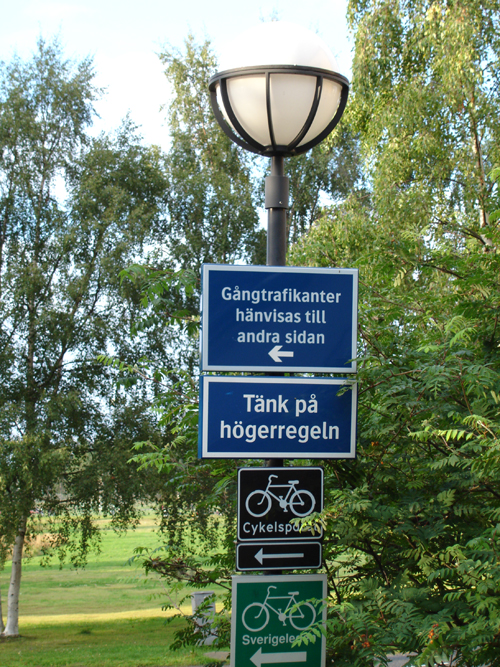
The first thing you'll notice about Umeå is all the people biking, walking or in many diverse ways moving about by their own power. Yes, they use cars, but the bicycle is a very important means of transport. To support and encourage this the place is riddled with and surrounded by paths for bikes.

The use of bikes is so extensive that it has to be regulated. Now, Swedes don't need an excuse to regulate something, but here it's pretty well justified to put up some instructional signs.

This makes Umeå a good place for one of the more original biker organisations I have seen announced, the Vegan Bikers:

But this bikers paradise will disappear under heavy snow and low temperatures in a few months, and that's when I'll be very happy about certain architectural peculiarities at the University. They have walkways between a lot of the buildings, making it possible to walk over much of the campus without setting a foot outside.

But until then I am going to enjoy the outdoors here as much as I can!

Friday, August 10, 2007

"I never said that"

Once in a while I find that I have said things I never thought I did. I try to ask to read all interviews and make sure I know what I have answered or rather - what the journalists have asked - but recently I found that a long conversation had been cut down to four sentences, two of which were like this:
Torill Elvira Mortensen tror det regulerte arbeidslivet i Norge er en hindring for veksten i bransjen.
– I USA er bransjen helt rå og skreller vekk dem som ikke takler umenneskelige arbeidsforhold. I Norge er det færre med kompetanse så det er vanskelig å være like brutal.

What the interviewer in Magasinet claims I say here is that the regulations of the workforce in Norway makes it impossible to produce games with the quality or quantity the way Americans do.

What I said was that Norway is too small to produce in the way Americans do. We can't discard talent in the same manner, we have to build it. The journalist was taken with his idea of the ruthless American labour market though, so suddenly it apepared as if I agreed. Oh well. So I sound like a right wing libertarian. No worries, I won't vote for them any time soon.

Sweden, yeah

The drive from Volda to Umeå was little more than 1000 km, and took one long and one short day. I was received wonderfully, and live in a quaint little apartment at the University's housing for visiting scholars. It's tiny, but they have promised me something bigger before the winter sets in. Otherwise the blog will be filled with pages of cabin fever - or perhaps I'll just never leave the virtual world.

I bought a new cellphone today, and so I have a Swedish number. If you already have my old one and want to know how to find me in Sweden, feel free to send me an email or a sms, and I'll let you know - eventually. I am not doing much these days except exploring, shopping for the apartment, and seeing the Botnian Bay while it's still sunny.

More later - with pictures. I promise.

Friday, August 03, 2007

"Vacation"

It's been cold, wet and rainy for three weeks. It's been crappy vacation weather. Luckily, I have not had much time to realise it's been a vacation. In those three weeks I have been finishing a little book on game studies.

It's not a big, important book. It's just the one I wished existed, every time I get an email or a call from somebody who needs help. They contact me, normally after hearing me on the radio or reading some paper, and they need help to find literature on games. They always start with the phrase "There's so little done on games", and go on with "it's impossible to find anything for my work". And so I spend the next half hour guiding them through the net, or possibly reading names and titles slowly to them.

If the publisher is happy with this book, I can now say: "Why don't you check out this book, particularly the bibliography, and then you go to a library and have some searches made on the names of the people I mention, because they are really busy publishing, and I am sure they have written a lot more by now."

That's going to save me a lot of half hours. Perhaps not three weeks of vacation worth, though. But there may be other benefits - at least I hope so! And monday the weather is supposed to be warm, and I still have a week of vacation to go, and then I'll be moving into a whole new place for a year.

Sunday, July 29, 2007

Getting real

This has been a weird year, and I have been working with a lot of stuff that might or might not get real. Two things are now crystalising out of all that potential though.

I am about to finish the second-to-last chapter of a little book on game studies, in Norwegian. The topic I am still missing in this chapter is gender research in games. I do have a lot of stuff for it, but since this is something no female games researcher can neglect: Is there a name I really should not ignore? Is there a name which is often ignored, but who deserves to be mentioned? I have written about a lot of the women and men doing gender topics in their research under other topics in the book, but you know what it's like: If I don't have a headline for it, it doesn't exist.

When this book is done, I am moving to Umeå for the winter. I received a post.doc. scholarship from HUMlab at the University of Umeå, and Volda College has generously agreed that I can take a leave from parts of my position for this. It's a great deal for me, and I am really looking forwards to this winter. Well, I am not looking forwards to a winter somewhere even darker than here, but I do like the thought of a larger academic environment, a bigger library, a bigger town, no administration (going to miss my students though) and lots of time to read, write and think.

From Umeå I will be going to Australia and Japan this fall. I am also still looking hard at the Vancouver AOIR conference, trying to figure out how to get money for it. I have a very personal reason for wanting to go to Canada this fall, and the conference, with it's great topic, is very convenient. But I have to see how things with work out with two employers, another apartment and the costs of living in two places. And it's not like I am sitting in my tiny room in Sweden sulking through all of September...

This is all painfully close and painfully real, and getting more so every day. Changes are scary - although these are scary good.

Anyway, about those gender research hints? I'd love them.

Friday, July 27, 2007

More clever spam

Can you guess I am desperate not to write what I should? Anyway, writing at the blog again, I just checked a comment I permitted. Turned out that it was the most clever of spam.

What it did was to copy a passage from another post:
I believe that there should be gold-sinks in the game; however, make the currency sink a thing of pure fluff. In the MMORPG Ultima Online, it cost 500k (a decent sum of money) just to dye your hair a fancy neon color. The hair color did not give you a statistical advantage over your opponent, it did, however, show your high status.

This was part of the content of a comment on a farily old post of mine. It looked perfectly to the point of the post, so I didn't hesitate on permitting it. But being a curious old bitch I wanted to see what exactly that comment was about, so I checked. That's when I recognized the words.

I can't help it, the cleverness and inventiveness of spammers is impressive. All this effort and energy, just to invade the blogs of strangers! I almost feel flattered.

Gamers ignoring kids

With the increasing popularity of games, in some demographic groups it will be harder to find somebody who does not play a game, than people who do. This means that everybody will be playing, the genius and the not-so-smart, the loving parent and the abusive parent. And this is the point of Halen A. S. Popkin, as she writes about the Straw couple, parents who had their children taken away due to neglect - neglect supposedly caused by their addiction to internet games.

Popkin's point, which is a refreshing view in these days of panics and witchhunts, is that when people neglect their children, they have problems, real, not-game-caused problems. A computer game may increase these problems in many ways: if you are a compulsive or obsessive personality, a computer game will play right into that. But the game didn't make you the person you are, and if the game wasn't there, something else would be. Neglect of children is, sadly, nothing new. If banning computer games would ban neglect, crime, bad grades, social insecurity and isolation, depression, suicides, war and drug abuse - then by all means, wipe those disks RIGHT NOW! It doesn't though. Telling ourselves it's caused by games is kidding ourselves, and it makes us look at the symptom, not the cause. Obsessive gaming isn't caused by games, it's caused by the problems of the people who play games. Remove the symptom, and there will just be an other one.

And now: lolcat quiz!

One of my favourite weird net phenomena of the minute are the lolcats. By way of Clancy Ratliffe I got reminded of them once more, through this lolcat quiz. Of course, I had to see which lolcat I am:

The Romance Princess

We learn at school that the feudal lords received their right to rule from higher powers. They were the chosen ones, the ones with extraordinary abilities. Well, it seems like this belief is alive and blooming in the Norwegian royal house. Princess Martha Louise has "come out" as a clairvoyant, healer and one who can see angels. She is starting a school, Astarte Education, where she teaches healing and whatnot.

Martha Louise is a well-loved figure in Norway, and people are quite tolerant of her many controversial (for a royal princess) impulses. Well, so they laugh a bit at her posturing husband and their wannabe bohemian lifestyle, but it's a rather indulgent laugh.

This time she may however have crossed some lines which are not as easily accepted. She is using her authorisation as a physiotherapist in combination with spiritual healing, something which crosses Norwegian legislation - she is flirting with "kvakksalverloven", which means she can risk becoming, legally, a quack. She has also always been quite well loved by the church, but in the Norwegian church there are no middlemen between man and God - the angels are not for conversation, if you have to talk to God, you go straight to him.

For a scholar with an interest in popular culture, this is however amazingly fascinating. Martha Louise is going - not eactly mainstream, but straight into the women's magazines. Her life is becoming a modern fairytale, or, more precisely, a romance novel. Consider this synopsis:

"Young princess who is mainly interested in horses and angry with the restrictions of her royal life, strives to overcome these restrictions and find meaning beyond her birth. She has several undesirable romances, but the family always manages to cover it up somehow and she remains in the cluthces of her position. Finally however the travelling, mediocre minstrel (journalist, writer, designer) shows up and sweeps her off her feet, convinces the parents that he truly loves the princess, and charms the nation with his devotion. His great gifts for public embarassments finally frees the princess from her burden of royal duties, as she renounces her title to be with him. With motherhood and no more public duty, tedium sets in, she is no longer in the public eye and also, there's the money issue. With the title, she also renounced the public support a royal princess is due. Used to a lifestyle no common physiotherapist can support, the princess needs a miracle, and lo and behold, just as she was getting too bored, angels come to her! She can heal, she can see, she can commune with great powers! And so, by the miracle of her exceptional birthright, she is lifted out of the dreariness of being a married mother and into her true vocation: A magically gifted healer. Peace at last for our much-tried princess."

(Sorry about getting carried away with some sarcasm at the end there - there are reasons I don't write romance novels.)

I think I have read that story already - over and over and over again, in exactly the kind of magazines that are filled with pictures of royalty, the magazines that have followed Martha Louise since her birth. That reader segment comprises her most loyal supporters, and accidentally also the most likely customer or "students" to her school. Now, if I were mean, I might suggest that this is an incredibly well-conceived scam, where the princess ruthlessly abuses her birth, her publicity and the dreams of the many who have watched, loved and celebrated her all her life, to make money off the suffering and unhappiness of those with uncurable ailments and unfullfillable dreams. I am not a mean woman though, so I suggest rather that Princess Martha Louise has come to believe in the story about herself. May the story lead to a happy ever after, for the sake of the many who share that belief.

Thursday, July 19, 2007

About the price and size of cucumbers

Warning, all links in Norwegian.

"Cucumber journalism" they call it in Norwegian, from the time when the summer temp was sent to the market to check the price and quality of fresh cucumbers. Dag Solstad (video, get an author home), a well known Norwegian author, wrote about how the broccoli was discovered by a summer temp in a local newspaper - on a marketplace in Norway.

This week it seems like the correct contemporary word for cucumber news would be "game journalism." I have had 5 phonecalls from 4 different news media on 5 different takes on games this week.

Some of those were kind of interesting. I may even buy one of the papers to see what they will be writing about political games and propaganda games. Some of the phone calls felt more like I was doing unpaid elementary education, not even in games, but in general social science.

And while we are at that: www.ssb.no is a GREAT source for statistics on Norwegian statistics, and they publish "Norsk Mediebarometer", one of the most useful sources I know about on media statistics, including game use in Norway. Did you get that? Statistisk Sentralbyrå, that boring old public institution which has been publishing facts about Norway from 1832 as part of the ministry of finance: Tabellkontoret, and then as an independent public institution since 1876. If you count the start of their work with the first Norwegian Census, that was in 1769.

No, journalists are not stupid, that's not what I am saying. I am just as always baffled by the power of the media threshold: once a topic is used by one large news agent, everybody else need to have their take on it.

Cucumbers, anyone?

Monday, July 02, 2007

so, so yesterday?

We should however be realistic: the 'blogging revolution' collided with human nature and human nature won. Most people do not like writing, even if they have something to write about. Many people do not have time to blog on an ongoing basis in a way that attracts a substantial audience.

While I agree with this statement in blog statistics and demographis in the profile from Caslon Analytics on blogging, I agreed with it in 2001. So I guess this statement is so, so yesterday? Even using the amazingly simple technology of pen and paper, not a lot of people write. For those who do, who enjoy writing and enjoy communicating online, weblogs will, in some form, continue to be part of their toolbox. But it will still be possible to survive without a blog.

PDF n00b

I just received the page proofs for an article I wrote ages ago. Apart from considerable frustration with the proofreader's automated requests - I am sorry, but if a journal doesn't have a volume number, I can't supply it!!! - You want me to write (sic!) behind something? Behind a lowercase letter? which one? Why? Where? That sentence has lowercase letters all over it!!! - they have asked me to make correction directly into the page proofs. At least that is how I understand this sentence:
When you review your proofs please read them carefully, being sure to respond to all copy editor queries, and make all corrections (including those resulting from copy editor queries) on the page proofs. The final responsibility for correcting typographical errors in proofs is yours.

I have no idea how to edit PDFs. I now understand that this can be done with the touchup text tool. The problem is that when I try that, they ask for the font. And 1) I obviously don't have it installed and 2) I have no idea what font it is, so I don't know where to get it.

As far as I am concerned, the publishers are asking me to supply information that doesn't exist, insert comments which don't make sense, and make the changes in a way which can't be done. If anybody know of a secret trick, please, please share it.

Thursday, June 28, 2007

The curse of a social being

I am trying to clear my plate, as I have a few things which require my full attention for the next month. But looking around there are huge amounts of work I have to deal with. So I set out, optimistically, thinking it's just my own lack of initiative which has caused this. I send off an email, another, another - soon I have sent off a long list of emails, and I am ready to deal with the responses and get things over with.

Nothing.

OK... let's try something else. I have more work coming up. I write a suggestion for things that needs to be done within a certain date, as that's an absolute last deadline, and bring this up at the nearest meeting. These are things that concern more than me, and if I am to be involved, the proposed schedule is important - I do know how much work both I and they have to deal with. I get a thank you for the initiative, and I settle happily back, reassured that the responsible parties will understand the importance of getting on with things.

Nothing.

Right. I am now running out of things that I can initiate. In the mean time I have not been sitting around with my hands in my lap, I have been responding to an endless stream of requests for work that urgently needs to be done, ideas that need to be discussed, decisions which need to be made, projects that need to be finished. I really have enough work, I just need to get those other things out of my life, and it's not like I can do anything until I get a response, is there? So I work my ass off (like everybody else), while waiting for some kind of response which will let me finish the stuff I feel responsible for.

Nothing.

Well - I need to finish something. I really do. If only to feel that I am not absolutely useless. So I try to get private matters in order. I have a family which needs to be part of this though, I can't just go ahead and make decisions over their heads, barging into their private space to clean up, to change, to organise, to fullfill my own needs for achievement. So I try to agree with them when to do things, what to do, in what order, how to start preparing, what they need to do and what I need to do so we can actually get those extremely mundane tasks which we all know about and we are all responsible for, done.

Nothing.

What is wrong with this? The problem is that I am so dependent on so many people, I have gotten involved in too much with too many, and I also tend to say "yes" rather than "no" when others need help. So rather than pushing, demanding attention and crying for help with my stuff, here, now, I have been waiting for others to realise that they need to involve themselves, and in the mean time been helping everywhere. Now I am totally spent, drowning in unfinished tasks, accused of being unable to finish the simplest of them, and feeling like it is true. Then somebody asks what they can do to help. The horrible thing is, with what I have gotten me into, the answer is...

Nothing.

Well, there are still some things I can do. I am taking a break now, for lunch, and then for about an hour, which will be spent cleaning the living room. If I am going to sit around all alone being stressed and miserable about things I have failed to finish, at least I can do that in a tidy room.

Sunday, June 24, 2007

Game in' Action 2007

I have been away, and then I was away. Drowning in exams, I haven't taken the time to write anything from the Game in' Action conference in Gøteborg. It was also a conference with no web access, something which was more than a little frustrating. I realised how much I rely on an available net connection, for simple things like "Are you sure your plane leaves from Landvetter?" What you mean am I sure? What is Landvetter? The airport? There's more than one airport? More than one with international flights? Help, where's the internet connection! Anyway, it was Landvetter, and I got back in time.


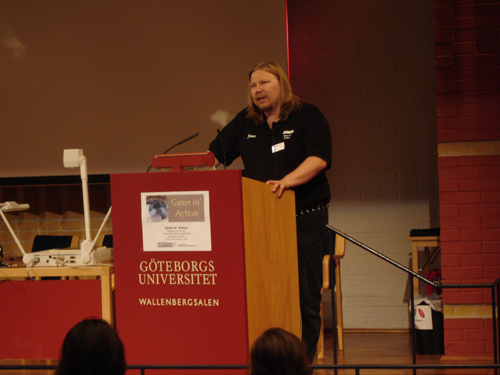
Jonas Linderoth opened the conferences, and as he is also a member of the researcher's guild, I will let him represent both sides of the conference, the academic and the social.

On the academic side, this was a very interesting conference in the way that it had some extremely established keynote speakers: Henry Jenkins, James Gee, Jonathan Dovey, Helen Kennedy and T. L. Taylor, while it had some quite inexperienced - in gaming - presenters of papers. A lot of the papers were of research just about to start, or very sketchy research with undeveloped theoretical or empirical base. Some were great though, and it is good to see that there is so much diverse activity in the game research field.

Among the good stuff I want to point to the work of Tina Lybæk and Emma Witkowski, who did not present a paper (their computer with all the things they had prepared, including all paper copies of the presentation was stolen the day before), but talked about the source for their paper: the Let's play initiative.

Another was Hilde Corneliussen, as always a very thorough reseacher who this time had made the effort to count female and male npc's and characters in WoW, and connect them to a discourse of gender and power which went beyond the issues of hypersexualisation which is so easy and so common.

For the most part I followed "The Truant Track" - the presentations made by members of the WoW researcher's guild, as I had after all gone to Gøteborg mainly to meet up with this group in the flesh. There were, as far as I was able to count, 17 members there, and the visit spawned a wicked role-play plot and a couple of new members. Following The Truant Track was no loss at all, perhaps quite the contrary, as all held interesting, stimulating presentations. I do however want to apologize to Luca Rossi for playing out an RP line behind his back on the monitor, and making all the Truants stare intently on the screen to read mine and Espen Aarseth's (who was not at the conference, and hence performed an ingame coup) comments, and not on the screen with Luca's notes. Sorry, Luca!

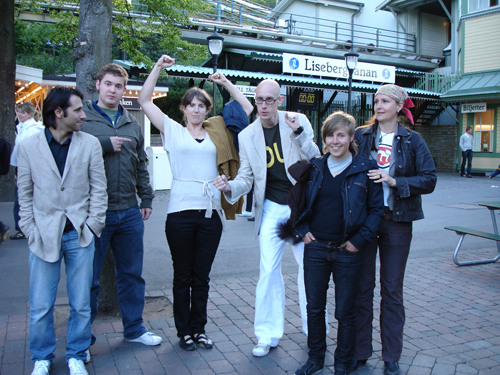
The last night of the conference there was a dinner most suitably situated at Liseberg, the Gøteborg amusement park. Here the researcher's guild kept on doing research, by bodily experiencing ilinx. Below is a brave group of game academics about to get on the roller coaster. No, I have not yet scanned the (in)famous picture taken ON the roller coaster of six game researchers in different stages of terror or joy.

Sunday, June 10, 2007

Summer, work, fun

Summer is here with the insane intensity of the north west. We yearn for it for months, starting in September as we cling to the memory, growing to desperation in May as the last snows threaten the fall of cherry petals. Then, suddenly, from one breath to the next, it's there. You leave for work wearing a wool sweater, and walk home in a T-shirt, carrying the layers of clothing in your arms. Everything looks different. The green is greener, the blue is bluer, the white is whiter and the sun is everywhere. It hammers through the windows in the unconditioned office in the afternoon, it pokes in through the north-face bedroom windows at 2 am, it seeks out the breakfast table, it burns the plants at noon.

The people change quickly. From pale and tired, the faces change through burned to brown. Light shoes makes the gait easy, and bright colours and light materials are carried as if they were flags of freedom. "You prize the summer" people greet each other, as bare shoulders and sandals replace boots and coats.

In all of this, the teachers have to work. For some perverse reason, since time immemorial, Norwegian schools have their exams in the best time of the year. When the world is remade by light and heat, students and teachers both are sweating over exams. And like any normal teacher, I do the same. Tomorrow I am off to Bergen, to assess a couple of exams.

But then I am doing something special: I am off to meet a lot of guild members at Game in Action at Gøteborg University. In the three days of the conference, there are guild members presenting every day, and one of us is the keynote on Friday. I am just going to chat, network and meet friends and colleagues. It will be great!

Monday, June 04, 2007

Seductive quest objects

Revisiting Ragnhild Tronstad's Ph D dissertation, I am reading about seductive quest objects, among those, boxes (page 166 - 168). Her exellent analysis of the different ways to interact with a box in TubMud may at first glance look trivial, but it is at the core of an important understanding of interaction, secrets, seduction and trust in games, particularly World of warcraft.

In WoW, one of my characters is a rogue, and since I am a little compulsive about these things, a rogue who has trained her lockpicking skills fully, at all times. This means I can now open all doors and all boxes I have so far encountered in the game - if they can be picked.

Rogues such as mine is in high demand for once speciality: to open boxes. There are very few other options for this in the game. Boxes drop regularly from the NPC's, and inside there is loot, everything from green, pretty nice stuff at different levels, to blue (rare) and purple (epic) loot. But without special instruments and high blacksmithing skill, only rogues can pick the locks and open those damned boxes.

This means that rogues enter into a very peculiar sevice provider system, and the level to which you trust a rogue can be seen in how you let them treat your box.

If you don't trust them, you run around until you find a helful rogue, and ask/demand/beg them to open the box for you - in which case you put the box in the "do not trade" part of the trade window, and the other person manipulates the box through this window, with no real access to the box. It is like holding on to it while the other person fiddles with the lock.

If you trust them, you may group the rogue and give them the boxes. In this case the rogue will have to empty the boxes, but it lets you transfer many boxes in one go, saving time for both parties. It's also an strong gesture of trust, as the rogue may run off with your loot. The grouping is important because it will let you see what the rogue actually takes out of the boxes, as being in the same group lets all see the loot of others as it's picked up.

The most offhand, relaxed way to treat a box when you know your rogue, is when you just mail it, and get the contents back in the mail. No control of the box, no control of the loot: you trust the rogue quite explicitly to deal with you honestly.

Why don't all just do the last thing? It's much easier than to carry the box around all the time. Two reasons, the first is the trust issue. But the second is the reason why the trust issue is important at all: The seductive nature of the locked box. This is why sometimes my rogue opens 8-10 boxes for people, collected over several levels. Even if you know the object in the box is quite likely to be useless to you, the exitement and secrecy of the locked space, opening, gaining access, being surprised is extremely attractive: it's not a rational cost-efficiency issue, it is a desire to see that which is hidden, the seduction of the mystery.

Which is why I am so delighted with the trust shown me when the guild mates send me their locked boxes - they offer for my eyes only that first glimpse into the mystery contained in the locked box, and they trust me to treat this privilege honestly. It is, indeed, a pleasure.

Friday, June 01, 2007

articles on the visual side of games

I am looking hard for articles discussing the visual impressions of games. Have I gone blind, amd I using the wrong search words, or are there hardly any serious discussions of the graphical game interface?

Wednesday, May 30, 2007

Game Rating

I am looking for the restrictions on games, other entertainment products and the connection between these ratings and the freedom of speach and expression. One reference is a long and seemingly nice wikipedia entry, with many useful hints and links. I have also referenced the Super Columbine Massacre RPG and the Slamdance film festival. Other thoughts of where I should look?

Tuesday, May 29, 2007

A web-writer is dead

Tron Øgrim, internet enthusiast and eager contributor to the Norwegian Wikipedia, died 23rd of May 2007. It was very sudden, most likely a stroke.

Tron Øgrim was a politically controversial person, ideologist of the communist movement through the seventies, and important to many better known Norwegian authors, politicians and visible contributors to the Norwegian public debate. He himself wrote what he talked of as the first Norwegian weblogg: Under en stein i skogen (under a rock in the woods).

Tron Øgrim did not grow old, but compared to the teenagers who today feel they have just discovered this terra incognita, the unknown land their parents know nothing about, he was of another generation. Perhaps almost two generations apart. But he was an active user, one of those where the border line between user and developer blurs, one who understood the net and its structure, not just its immediate use.

Time is always, in the end, measured by the individuals in relation to human lives; the length of a lifetime, the age of a child, the length of a human cycle. And now the internet culture in Norway has reached a point of no return: one of the early, the active and the visible is gone. It's time to realise that the net is larger and longer lasting than a single human life.

Wednesday, May 23, 2007

Culture of the information Age

There is a conference in Budapest in October. It looks interesting both because of the topic and as a place to go (Hungary! Very interesting place!). Culture of the Information Age concerns itself with cultural change due to new information technology, a topic which tends to be ignored when it's not treated like a dystopia. It had to be somebody outside the "Ameropean" cultural dominance to rise the question analytically and perhaps even without fear.¨

Deadline for abstracts is June 4th.

From the mail bringing this conference to my attention:
János Kodolányi University College as promoter of FreesideEurope Online Academic Journal is organizing an international conference with the theme of The Culture of the Information Age to be held in Székesfehérvár, Hungary from October 10 to 11 2007.

We invite abstracts (consisting of 200 words and a short CV) that focus on the themes listed in the attached conference outline. The abstracts sent in will be reviewed and chosen by the Editorial Board. Participants will be asked to present a paper and provide a copy of their talks in MS Word format for possible publication.

Prepare for a mess

I am testing out the new blogger interface tools, and have discovered that although there are several annoying features it can do much of what I want to. This should get rid of the broken frame the heading has in certain browsers, and it can also give me more flexibility in general. I am not entirely happy with the pre-set options, but as I have found ways to work around them/override them, the blog will be redone in the not-too-far future. When the time comes, many things I really like may disappear for a while, as they are being worked into the new template. Don't panic, that's my privilege.

ORLY?

It's been a while since I complained here about the "quality reform" in Norwegian education. The Norwegian education system was altered: 3 year bachelor degree instead of 4 year cand mag, master degree after 5 years instead of hovedfag after 6-7 years, more teaching and supervision, less time for reflection and independent research for the student and also less time for research for the faculty.

Imagine the surprise when it turns out that less time to study, more pressure towards keeping the schedule, less qualified and updated teachers and less resources for testing and assessing the students led to less knowledgeable students.
*insert sharp tone of voice, desillusioned sarcasm shining through*

Thankfully we still have people who remember how to do research in this country, and at the University of Oslo some of them did exactly that, they checked if students learned the same in three years as they used to do in four. The answer was no, they don't.

The paper "Morgenbladet", one of the few papers where they still read research reports and 100 page evaluations (or at least the press releases about them), calls the syndrome "kunnskapsfallet" - the fall of knowledge. The evaluation of students at the University of Oslo confirms what people in colleges and universities have been saying from the beginning. There is very, very little in the "quality reform" that makes for better students.

It is a quality reform though. That much is true.

Thanks to Jon for the links and the reminder.

---
For non-MMORPG addicts: ORLY is short for "Oh, really?" Often seen when n00bs state the obvious.

Monday, May 21, 2007

Virtually present

Why am I, who know so much about online communication, so reluctant to use them for lecturing? Tomorrow I am going to talk at a meeting organised by biblioteksentralen, what they call Web 2.0 skolen (web 2.0 School), and I will be in Volda while they are in Oslo. I am going to talk about weblogs and modern media, and I should be able to do this blindly and left handed... but I am really uncomfortable, and use too much energy on it.

I think the clue to why is in the way I have learned to teach. It has happened through my own trial and error in the meetings with students - face to face. Whether it's five or 150 - or just one, crying in my office - I have always faced them. Even when they email me, I know we have met or will meet. The body, the reading of subtle signals, the eye contact, the touch of a flirt with the audience - it's all about presence, mine and theirs.

Tomorrow it will be all about presence too, but so much limites, such narrow bandwidth presence. Ironic that it takes broadband for it.

Staying put

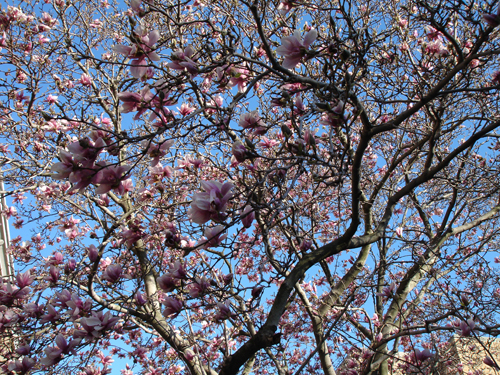
I am green with envy as I read Jill's conference notes from the Personal Democracy Forum. I wish I had been there, I wish I was experiencing something new and exiting, I wish I was in New York in spring and that the magnolias were still blooming.

I am not though.
Aaaannnnd, it's hard to admit it, but it's good.

Last year was a breathless race about the planet, exhaustion, guilt and worry combined with adrenalin and stimulation is an oddly exhilarating drug, and it makes me feel driven to perform perhaps at times beyond what I can defend. This year I can lean back and learn, find substance for my performace. And in reading Jill's notes - and the reports of others who are there, who are present where things happen, I find that my absence triggers my curiosity, and I start imagining what could happen.

And that, my dears, is where I tend to find my real motivation. Preferably bored, often frustrated, and wanting for something to happen, anything, really... and so I have to think it up. "What if..." in a grand or small scale, is all research is really about, isn't it?

Monday, May 14, 2007

Crowdsourcing

Sticking your head in the virtual quick-sand which is World of Warcraft is a good way of not really catching up with the latest in other trends, or at least the vocabulary, like Crowdsourcing. The wikipedia entrance I linked to there is an interesting example of the concept: first, wikipedia is a result of crowdsourcing: large amounts of people cooperating openly and individually to improve information and make more available. The entry is also obviously under revision, it's flagged as too short, too many references, not reliable, needs rework, needs more references, poor quality - it's obvious that a lot of people have been at work picking the original entry(ies) apart.

Personally, I have always believed in Crowdsourcing, and I believe in it in the way the cooperative power of self-organised interest groups is described in the Swedish book Samverkansspiralen. Here it offers voluntair work and cooperative action as a way to gain more knowledge and empower the participants towards more action - like for instance political activism.
I believe opportunities for open participation and contribution can go somewhere good, if you get caught up in a good circle, a positive spiral.

I found the concept itself, Crowdsourcing, in a paper which was surprisingly good. Dagbladet, one of the larger tabloids in Norway, has been going downhill for years. It used to be a very good magazine with interesting reportage, knowledgeable critical journalism and ambitions to cover Norwegian and international culture in depth, not just through sensation reporting. Saturday was an all time low for the paper, as the front page was all about who have which well-known figure on their "friends" list on facebook. It was about 10 minutes research and perhaps 30 minutes of getting the pictures "just right" behind that classic piece of journalism. The first time a Norwegian newspaper used all of the front page on just one case was in 1980-81, I think in February 1981, if I remember correctly. Of course, I can google it. Yep, February 22, 1981.

This event was a shocking piece of news in Norway at the time. Two members of a neo-nazi group, "Norges Germanske Armé", were executed by their leaders, as they were considered to be a danger for the organisation after a weapons theft. One of them had however already talked to the police, and the police was on to that something was going on. They couldn't prevent the double murder, but they did get the ones guilty immediately. This event had everything: drama, deep historical roots, controversy and important political consequences for a country forever deeply branded by Hitler's plans for a master race. Today Norwegian banners and national symbols are used as a substitution for forbidden nazi symbols. It's a past which is always with us.

Fastforward from a front page (not even in this paper, but their main competitor, this paper was still full format and filled with words, not pictures in 1981) dramatically displaying this tragic and stunning event, to pictures of Norwegian "stars" and speculation about who knows who on facebook. Yes, I keep losing illusions about the progress of journalism on paper.

So what did I learn. I learned that there is a word for the viral spread of knowledge, the anthill of collaboration which creates rhizomic growths with the virtual function of anything from tumors to castles online. I had to check zero.newassignment.net, a journalistic experiment for crowds.

For years, I have been telling journalists they don't need to be worried about their jobs, because the individual personal publishers of blogs, wikis and other direct publishing systems are not journalists. Now, considering what looks like a steady decline of print and television journalism, organised, cooperative journalism may be a good reason to start worrying.

(BTW: From the front page of this not-worst-case paper: "Abused online", with a picture of a well known Norwegian actress. Turns out somebody have made TWO fake profiles in her name on facebook. The horror, the horror!)

Aesthetics of Play

The conference was in 2005, but since I am now reading and writing about - yeah, exactly, aesthetics of play - the link is fresh and bright and new for me! Great content from interesting writers, and I am delighted to revisit this topic.

Thursday, May 10, 2007

So hip, so cool!

I was in Bergen and talked (the links) to the student community of Bergen, with VamPus, also known as Heidi Nordby Lunde. The student paper StudVest proudly proclaims that blogging will remain. "Bestå" (remain) in Norwegian means something which will last forever - that's not exactly what I said. I tried to indicate that I think it will be altered and absorbed in other technologies, but that some kind of easy written personal publishing with a similar form to current blogs will remain. But hey, doesn't sound as good, does it?

It was fun, I have, after 15 years of lecturing, finally lost my panic for talking in public, and VamPus is a pretty quick and clever lady. But I have to admit that the high point for me was to come home and check facebook and see that my daughter's friends think I am hip and cool, just like her. I mean, when students think some crazy woman old enough to be their mother is cool, either it's time for me to put on a pinstriped suit and stop dying my hair, or they are trying to impress my daughter.

Hmmm.

Anyway, message of the day: Vote smart, Vote Erla

Monday, May 07, 2007

Blogging, en medieboble?

Bergen tomorrow, and I'll be talking about blogs, and whether or not its a media bubble. I'll leave the conclusion for the ones who are actually there, tomorrow, in Bergen.

I'll tell the rest of the world later, if you REALLY want to know my authorized version.

Friday, May 04, 2007

Fixed!


I mentioned the rather weird short version of "forhåndsvisning" (preview) in the Norwegian version of blogger some days ago. I have probably not been the only one to react, because today it was changed!

Thursday, May 03, 2007

Snubbed on Facebook

So, I did the deed and made a facebook profile. Not all that active, I log in once in a while to accept requests, play around a little to see how it works, and invite a few people I know to be my friends.

And then one of them doesn't approve me.

Who'd have thought.

Not that it matters, and of course it's no reason to accept everybody, but still, it's not like I invite all kind of people I never met. It felt weird to see others in the same group of people linked, and me left out. The visual lack of a connection was a stark declaration, a public rejection.

I suspect a large part of the power of facebook lies here, in the power to include and exclude, and make both the links and the lack obvious to the insiders, but still unvoiced, unspoken. Luckily I am no longer 10 years old and desperately unhappy when somebody doesn't pick me, or write in my book of memories. But it makes me wonder... what will I do the day somebody I am really uncomfortable about want to be my friend?

There is no way to aknowledge a link which is less than friendly, no such thing as "casual aquaintance" or "neighbour I never spoke to the 20 years we lived close" or "yeah, I know who that is, but that's all." The neutral, unemotional, that which is less than friendship but still more than strangers - there is no category for that. And that leaves an odd sensation of unease, as the world is split into friends and not-friends. It is just too simple.

Be nice - it's good for you

From the journal Human Communication Research, vol 33, number2, April 2007, "Affectionate Writing Reduces Total Cholesterol: Two Randomized Controlled Trials" by Kory Floyd, Alan C. Mikkelson, Colin Hesse and Perry M. Pauley.

In two 5-week trials, healthy college students were randomly assigned either to experimental or control groups. Participants in the experimental groups wrote about their affection for significant friends, relatives, and/or romantic partners for 20 minutes on three separate occasions; on the same schedule, those in the control groups wrote about innocuous topics. Total cholesterol was assessed via capillary blood at the beginning of the trials and again at the end. Participants in the experimental groups experienced statistically significant reductions in total cholesterol. Control participants in the first study experienced a significant increase during the same period, whereas those in the second study did not. Cholesterol changes were largely unmoderated by linguistic features of the writing produced in the intervention. Potential therapeutic implications are discussed.

Imagine the implications. In the risk group for high cholesterol? Sit down and write about somebody you love and care for. Consider the good things in human relationships. Look for the things that, literally, heals your heart. It also gives a new meaning to the idea that a broken relationship can mean a broken heart. It can, really.

Now excuse me, I am off to spend 20 minutes writing about my favourite people, and why they are so special.

Wednesday, May 02, 2007

Meta post - safe topics

No, I haven't gone crazy and changed the content here to overdone melodramatic fantasy writing. No worries. I just don't want to think or write or blog about what's up in my reality right now - too many potential traps there for lurking readers of evil (or just petty) intent. So instead, a list of safe topics.

Conference papers. They are already partly in the public sphere, and we all do it and we all have to work on it. Mine for the DAC conference in Perth, Australia, just got accepted, now I have to start working on it, to make it presentable.

Weather. Weather is firmly in the public sphere, and the last days have been wonderful! Spring has finally reached us, and the nature I live right in the middle of looks like it's been designed after a post card. And don't get me started on how the waterfalls looked this weekend. Notice the unfolding leaves on that birch.

Books published by others, as long as I say nice things. And that's the plan. I focus a lot on computers for the medium of gaming, but that's just a tiny slice of a big field. A lot of the gaming, particularly fantasy gaming, happens offline. Patrick Williams, Sean Q Hendricks and W. Keith Winkler have edited Gaming as culture, where they discuss a lot of other types of gaming, table-top, magic and other fantasy game topics. One article is on computer games, the other 9 are not. I have always been aware of the connections between computer games and the larger fantasy culture universe. This book is a very nice link between worlds which should be much closer.

Blogging is a way to direct my thought process, as well as release topics which keep distracting me. Today is a day for direction.

Friday, April 27, 2007

The Icefalcon


She had another name once, another life, but she never suited the expectations connected with it. She wasn't overly smart or delicate, despite her dainty appearance, but she had qualities which put her up front. She was fiercely protective, unafraid and brave, and would rush into conflict head first. The goal would be to keep hurt from those who were hers, as dangerously fierce a den-mother as her little tribe of humans had ever seen. And so she was made part of the guard and given the title "Icefalcon", named for the small but fierce birds hunting prey twice their size in the clean air of the mountains. Soon she was nothing but The Icefalcon, her childhood name lost in the pride of her position, the passion of her responsibility. She lived with that until she died.

Her death was painful and without honour. She had failed to protect the other guards with her, she failed to obtain the information her tribe needed about the curse, the scourge, she failed even to die cleanly at the blades of her attackers. She crawled, like a beast, into the shadows of a once-proud stronghold. The Icefalcon's last living breath brought the bitter taste of shame and failure to her tongue. Then she died, in the ruins of Lordaeron, alone among rotting debris.


It should have ended there. But even the dignity of death was taken from her. The curse of her enemies had embraced her, and made her one of them. Her broken body got up and walked, carried by a will to life which fed the stubborn passion which had made her The Icefalcon. Dead, she was undead.

In this undeath, she found company. Despair and a common enemy creates strange alliances. Her fear and disgust of the rabid orcs, the sly trolls and even the strange animals, the tauren, was no longer important. The only emotion left in The Icefalcon was her own hatred of the scourge and its source. The demonic energies and the putrid pollution which ruined her land and made her what she now was became the main reason for her unlife. Somewhere in her world an icefalcon soared in clean air over white mountain peaks. She had to protect that. It was the last spark in her decayed heart.


And so she passed through the dark portal of demon energy. A slight warrior, too fragile for her blade, too delicate for her shield, but with a total disrespect of these limitations. She made her way towards the source of her curse. This is where we can find her now, scouring the Outlands, driving for the frontier where the pollution can be stopped, the demons driven out of her life forever. There is no way back for The Icefalcon. Such as her have no space in the world she protects. In every battle she faces her own decay, her own rejection of the course of nature. But The Icefalcon never stops to consider this. For her the only direction is a charge into the face of her enemies, until she wins peace for the memory she protects, or until she is, finally and forever, free to soar.

Tuesday, April 24, 2007

Get ready for the end!

Today's lecture was on semiotics, with Roland Barthes' rhetoric of the image as the main topic. So of course I needed some examples for analysis. I haven't been watching advertising and working with that for several years, but I think I probably should. There is so much going on out there on the web, all in the name of consumption.


Diesel's summer campaign is cleverly taking advantage of the whole global warming issue. With a name as heavily loaded with negative connotations in these fossile fuel crisis, they had to spin it in a daring direction - something diesel has never been afraid to do.

This year the slogan is "Global Warming Ready", and that they are!

Thursday, April 19, 2007

WoW - an anthology!


Jill Walker and Hilde Corneliussen, our hard-working and eminent editors, have just sent off to MIT press a big fat stack of paper with the articles grown from our contacts and network in World of Warcraft. They have done a great job, and so have we all! I am just going to lean back and wait for the release party now!

Wednesday, April 18, 2007

Forhån

Blogger is suddenly speaking Norwegian to me. I love it, but I also see some weird results. For instance when I want to publish a comment, and the window isn't wide enough to show the buttons "publiser kommentaren din" and "forhåndsvisning" (preview). So the first shows, but the second is shortened to "forhån". "Hån" in Norwegian means - I don't really have the words in English, but I think something like "spite" or "harassment". "Forhån" is one form of the word as a verb. So, I get the options "publish" or "spite". Weird.

Tuesday, April 10, 2007

The Restaurant Game

Want to be part of creating a game? The MIT media Lab is working on The Restaurant Game, a multi (two) player game where the game is supposed to learn from the players, with the goal of developing a single user game. As they say: Play early, play often, please spread the word.

Health and games

Journalists are great. Good journalists find a whole lot of stuff, and they can only use a tiny portion of it, because they think people really don't want to lnow all the interesting stuff they find. Or their editors do. This means that journalists are really generous when it comes to sharing information, not at all worried when you ask for a link to that research report they are quoting and trying to get you to comment on.

Now, The Truants are great too. Despite being researchers, they share interesting information even more generously than journalists, and they know how to find it fast. So when I got a hint from a journalist about some interesting research, and asked The Truants if they could help me with some search words for the right type of institution, I got it right away! And so I can offer the Scandinavian language readers of this blog a link to an interesting Swedish review of research on health and games.

Enjoy, and think nice thoughts about gift economy networks while you do.

What's nice?

I found the below report by way of a journalist from NRK P3, who asked for a couple of quotable words on the phone. So, I have now (Tuesday april 10th, 13.00) said that multi user games make cooperation, grouping, generousity and sharing an absolute necessity in order to succeed - all qualities which we associate with kindness. In journalist language, that means I have said games make people nicer, no qualifiers, and no matter that "nice" is relative. I don't think gankers are nice AT ALL. The mates of gankers, the people who get more honourkills by chasing down and repeatedly killing some defenseless horde character, I am pretty sure they think ganking is a really nice activity!

Life online: The Web in 2020

Somebody have brought out their crystal balls, and said something about the future of online activities. It's a sober and interesting piece of writing, and it makes me look forwards to 2020, to see just how well the study fits.

Player's Realm

Another anthology is on the market: The Player's Realm with Jonas Heide-Smith and Patrick Williams as editors. It's published by McFarland, and should make an interesting addition to current game literature. It's been a while coming, but it's on topics which should be able to survive the time lag. My article is on the player's situation and connection, placing gaming in a wider cultural field, connecting to a wide range of literature.

I have no idea what the picture on the front page is supposed to relate to though - unless it's that same literary connection: Fantasy and science fiction.

Tuesday, April 03, 2007

Spring, stuff, sick leave

I keep forming blogposts in my mind, about the beauty and the melankoly of really early spring, the light on trash revealed after the winter, dirty flecks of melting snow and the scent of new growth. But I never get around to post those or the pictures, as life rushes on.

I have just operated one of my eyes, an operation I have mentioned before. This means I am on sick leave this week, and I really don't feel like straining my eyesight much for a while now. It will take weeks to heal and longer to adjust and settle. Good news is: I love my new glasses, and it seems like this will get coordinated.

Yesterday I got a phone call from my mother, and she was at the hospital. So my period of sick leave and destressing is suddenly filled with hospital visits, figuring out a way to care for two fat, spoiled tomcats and how to have some easter fun with the family although there will be very little skiing and cabin life. Lucky I have a wonderful family who don't panic at the thought of spending their vacation between Volda, Ålesund and visits to the hospital.

I have to put a lot aside to deal with my mother's weakened condition and my own momentarily slacking health, but it's just one of those things. I have been complaining I didn't know how to say "no" to interesting propositions. This spring is a forceful lesson in priorities and letting go. I still don't know how to do it gracefully though.

Monday, March 26, 2007

Finally done

Among the tasks I have struggled with this year is the article for the WoW anthology we are writing with Jill and Hilde as editors. First I didn't manage to get into the flow of writing, then it all exploded and it grew to twice the size. Today I managed to slice it down to an acceptable format, and I almost understood what I am writing too. Not bad, really.

This article has been haunted with problems. I started with an idea which turned out to be really hard to confirm. People do way too much more stuff ingame compared to what I thought they did, and they all wanted to talk about it. I got a lot of great information from a wonderful bunch of people, when I went to Holland to interview the guild I played with. Not much of that was about the topics I wanted them to talk about though. Oh well, it's what I get for interviewing real life people, I guess!

When I finally got time to have the interviews transcribed (and here I again had the pleasure of getting help from the guild: a member did the transcriptions, and I am not sure if he ever contacted the college to get paid for it. I hope he did! He deserved every krone, because it turned out that the quality of the interviews was really lousy. And as if that's not enough:) all the interviews were cut short. I cried when I discovered what had happened. The recorder I had borrowed at the college after many negotiations (I wanted to buy, they wanted to save - familiar story) had some weird malfunction, so not only was it a poor recorder, it also made me lose the end of every single interview.

So, patching this optimistically together, I kind of lost sight of what I was writing about. The first draft of the full article was more about "all kind of human experiences in WoW." Fun stuff, but babies had to die. 1/3 of the babies, really.

That's what I have been up to the last week: killing innocent idea babies. The blood was seeping into the keyboard, so I had to get it replaced. Also the touchpad and the main card of my brand new Dell XPS M1210 - the cutest and most powerful laptop I have ever had. I am absolutely certain it was the cruel attacks on the text with axe, spells and swords that shook everything lose inside.

Today I got the text down to less than 8000 words. I feel like a human being again. Tomorrow, after a final proofreading, I'll send it off.

Friday, March 23, 2007

Nordic Media Days

Bergen hosts a very nice and interesting event, an annual series of lectures and presentations which manages to mix the media professions and the media scholars in a very interesting exploration of the field. It's fairly well established, I remember being offered a job as a coordinator way back when I was finishing my masters. It's one of those jobs I regret I never took - instead I finished my University degree. Oh well.

Anyway. This year I will be in Bergen the day before it starts, talking about weblogs at the Bergent Student Union. I am quite exited about that, as the students have managed to find an interesting person for me to meet: VamPus, the Norwegian blogger who dropped her anonymity when she got into a conflict with her then-blog-client-owner (bah, bad word) over the infamous Mohammed caricatures.

So, I tried to figure out what's going on with the media days on the 9th. I check program. Nothing. I check if i can get a day pass, because the prices are stiff and I can't just shake down the department for any whim I want to have satisfied - nope, it's the whole thing or nothing.

There are some lectures there which are worth catching if I can. Arnt Maasø talks about new sound conventions in the age of YouTube. I'd really like to catch that one. Irshad Manji talks about Jihad: holy media strategies, defiitely a hot issue, particularly with the little reminder of the Mohammed Caricatures in the back of my head.

Oh well - I'll gamble that it's possible to buy a day pass at the door - or something. If not I'll look up some friends and hang out in a coffee shop in the area and look intellectually arrogant and talk about how utterly bored I'd be if I had to attend the Nordic Media Days...

Friday, March 16, 2007

Understanding criticism

One of the things we do is to teach our students to be critical, perform criticism. Particularly journalism students are constantly being told they should perform critical journalism.

But what does this mean? From Princeton.edu:
Noun
S: (n) criticism, unfavorable judgment (disapproval expressed by pointing out faults or shortcomings) "the senator received severe criticism from his opponent"
S: (n) criticism, critique (a serious examination and judgment of something) "constructive criticism is always appreciated"
S: (n) criticism, literary criticism (a written evaluation of a work of literature)

Most of the time "criticism" is taken to mean the first thing: unfavourable judgement, pointing out faults.

I think this is one of the greatest mistakes of modern journalism: The understanding of "critical" to mean you have to find something wrong with whatever you are writing about. To be a critical journalist should be to employ the second meaning of the noun: a serious examination.

Today negativity seems to be the main criteria for a good story (unless it's the obligatory feel-good story). If journalists can't warn us of disaster, corruption, lies, danger to our health or what ever, it's not a story. What does this do to our perception of what is important?

First of all it scrambles the big picture. As long as we are only presented with the errors and the flaws, the public has no way to learn about possible strategies for improvement and growth. Only being introduced to options we should not choose makes choice almost impossible, and the result is that rather than searching for the better choice we settle with the lesser of several evils. The better choice is not interesting, as it doesn't offer the option of unfavourable judgement.

At the same time the warnings are important. We should not go without them. But my other problem with modern journalism is the mechanism which makes all news media report on exactly the same issues. This way you don't only get nothing but warnings, you get warned about the exact same thing everywhere. So the options for the public are diminished by the flawed perception of good competitive strategies: beating others at the same game is more important than looking around for some other and more interesting game.

So, I just delivered an unfavourable judgement. A common piece of criticism. How to make this constructive?

I think critical journalism is extremely important, and there's some really good work done out there. We need good gatekeepers and professionals to sort through the masses of information and ask questions about it on our behalf. It's an expremely important profession. I just wish they would put a bit more emphasis on the serious examination part, and a bit less on the unfavourable judgement part. And that they would stop hunting in such huge packs, victims to the blood fog of the deadline and the scoop.

Data mining and marketing

Sara Grimes wrote an excellent piece on this topic in The Escapist: Mining the game.

While I definitely see both the temptation of datamining and it's immediate application value for game design and game research, I can also see the ethical problems with analysing data not originally designed to be analysed in this manner. It's disconnected from the context of whoever submitted it, it is heavily dependent on the skill and mindframe of the analyst (yes, everything is, I think this is just more so), and it is, in some cases, plainly illegal.

I am not saying it is wrong, but it is definitely a way of gathering information which needs to be questioned, discussed and explored methodologically and ethically.

Tuesday, March 13, 2007

Abuse, media and fame

A controversial issue was raised by the Norwegian artist Marianne Aulie, when she, on the air, named two well known Norwegian males who attempted to drug and rape her 14 years ago.

The men in question can not be charged with anything today, it's too long ago. Marianne Aulie still felt she needed to name them in public. This has met some very aggressive reactions, but the men in question do not wish to press charges.

One of the interesting side issues of this was how the newspapers made a big deal out of the fact that some feminists do not choose to support Aulie's claim that she as a feminist needed to come forwards with her experience. What does that have to do with it? Is being a feminist being part of a club where I have accepted that some people have the right to speak for me? And I mean both sides of the issue in this case: I want to speak for myself, both when it's about sexual abuse, and when it's about what other people should say about sexual abuse. Neither Aulie or "certain feminist editors" have that right.

When that's said - this is a complicated issue. Should she speak or should she not? A Norwegian editor who initially supported Aulie's openness had her name blown up all over Norwegian media to the point that it became too problematic for her to maintain the support. Martine Aurdal had to publically recall her support of the act, and say she regretted saying it was "tøft" or "cool" to speak out.

Marianne Aulie is a hypersexualised artist. She knows her very good looks sells, so she uses it for all it's worth. More power to her. I am sure she can deal with her fan letters admirably, no matter what they contain. But we all have a limit, and too many have a story that was never told.

Aulie's story is about a party where she was too drunk or too drugged. Suddenly she was alone with two men. When she tried to leave by jumping from the fourth floor balcony, they stopped her and got a taxi. The taxi didn't take her home, but to the apartment of one of the men. When he left her alone there for a while, she managed to escape. She was just past 20 years old at the time.

Who wouldn't be troubled after an experience like that, no matter if she was drunk or drugged? Why shouldn't she talk about it now? OK, so she might have chosen the wrong moment, slander is illegal, but so was what she perceived had happened to her. And this kind of thing festers. It may appear to be unproblematic, but suddenly something happens, and everything you think you had supressed blow up in your face. It's a classic pattern.

Marianne Aulie might manipulate the media heavily with her good looks and her dramatic appearance. She might count on the shock value of revealing what happened to her, and she might expect the news to make her work sell better with the publicity. But I don't think these things make her stupid. I think she knew what she did when she named names, I think she knows what she experienced that night, and I don't think it's my (or anyone else's) job to take the decision of pointing fingers away from her.

Perhaps she'll get in worse trouble for it. Perhaps she'll find herself shut out of the artist communities and denied access to the media for having used her fame and access in order to spread slander. Perhaps she'll find that she is now old enough and strong enough to tell, and live with the consequences of what she has experienced and what she has done. I think Marianne Aulie may not be a brilliant tactician, but she has the right to commit her own errors. She is a grown woman, and has the right of her voice.

Friday, March 02, 2007

Blogging in Norwegian

For a while most of my blogging will happen in Norwegian, and it will be at the Women's Day Blog, 0803. It's an initiative by a group of Norwegian female bloggers, and it's a seasonal blogg - only around march 8th, the international women's day. I wouldn't have signed up, as I am shy about forcing my voice into other peoples' spaces, but they asked and I said yes.

I am also a little at loss about women's day blogging. I mean - feminism is still important, more so now than ever, perhaps, as borders open and cultures clash - but I can't get the hang on that straight forwards "female = good, male = bad" thing. I can't help but feel sorry for them. The guys that is. Society isn't really letting them play with a full deck either. OK, so they are consistently dealt more powerful cards, but there's a lot of fun ones they lack. Or have to steal at great cost.

So, anyway, if you want to know what's going on in my head some of the time until march 8th, check 0803.