Monday, February 28, 2005

Understanding understanding

Did I mention how much I love libraries? There is nothing I want more than my personal librarian, complete with a decent budget, good storage and reading space, and a mission to gather information. One of the few Norwegian science fiction book-series, which was also a radio show way back when, was about librarians, a ship that sailed among the stars, gathering knowledge.

Today's ode is caused by a visit to the library today. I tend to forget about it when I am not researching a particular topic. I have the books I need from day to day in my office, and I like that. But today I wanted to pursue the issue of understanding, the connection between reading, writing, the media and the way we think and learn. And our library has that literature. While I normally don't have much to do with the teacher's education part of the college, standing in front of the shelves I realised that there, right there, was where we could see the advantages of the wide range of subjects taught in Volda. Because the books were there, the titles that appeared obscure only a few months ago, at my ned, they appear - in the library.

Rethinking writing, Page to Screen, Learning in virtual environments, The knowledge web, What video games have to teach us, Interaction of media, Cognition and learning and last, not exactly related, but irresistible as my hand passed it on the way elsewhere: Rules of Play.


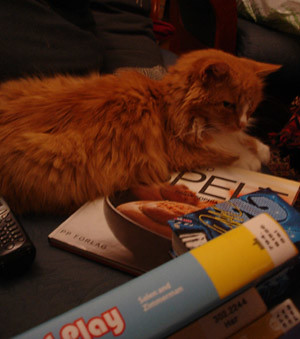
I haven't had time to read them yet, but I am working on an article on new media, weblogs and literacy. I am pretty updated on new media and weblogs. I just need a little more input on the literacy side of it. When I am, you will all know about it, and I promise to share any particularly juicy bits in the stack I have next to me on the couch. Right in the spot where the cat likes to sleep, actually, so she sleeps, annoyed, a little further up, by the cookbooks. Anybody got a good link or a suggestion? On the literacy part - not the cat and cookbook part...

Friday, February 25, 2005

Game Conference in Bergen

By way of Jill, I found that Rune Klevjer and the people at the information and media department, University of Bergen, are planning a game conference in Bergen in October.

And I just submitted my requests for funding this fall! Oh well, I ought to be able to make a conference in Bergen - at least if I don't get to spend the autumn in New York, as I am hoping for.

Things I want to understand

Occasionally, you see sensational headlines claiming that playing games on the computer increases productivity. I have, however, always problems with tracking down the actual sources of such claims, so I never see anything but tantalising bits indicating that the brain is stimulated in interesting ways by reading computer mediated texts.

But from personal experience, I find that playing certain games helps me to change from one mode of working and thinking to another. It is for instance an important part of making the switch from administration to reading or writing scholarly material. Playing adventure games puts me into an analytical mode which resonates with the problem-solving structure of many of these games. First and second person shooters have a limited hold on me, but in a way they lead me the other way, from the analytical mode of research and writing, to the problemsolving mode of administration. Get the crooks lined up, figure out how to finish them up and get the job done - that pretty much sounds like administrative work to me...

On this background I am frustrated with the kind of knowledge I don't have, and the kind of research I don't find. What I would like to know is how different people react to deifferent media when they want to be expressive. I have all kinds of rituals. Some are like the rituals of athletes, who have to have two odd socks on for the important matches. My slight obsession with pens comes in that category. In order to write something clever, I think I need a pen that meets certain criteria. But other rituals are important parts of making the brain work differently, like when I outline an article in different colours on a large piece of paper, or when I write its bits and pieces on stickies to move tham around.

Meditation touches on this, as it is a conscious effort to put the brain into a particular mode. It is this mode-change I would like to find some literature describing: preferably in the way writing and reading and playing online primes the brain for certain tasks. I feel this effect on myself, but I don't know if it is just that I have conditioned myself to react in a certain manner to certain stimuli (administration + break with games = research time) or if the brain actually slips into different working modes. Or if it will ever be possible to figure this out.

Wednesday, February 23, 2005

Dreams of two weeks

I have two weeks - 75 hours - of overtime to spend, and I have no idea how to do it. It's just built up since before Christmas: exams, semester planning and administrating, obscenely packed workload in January and February- it adds up. And this is the time when I have felt so exhausted I haven't really managed to do all the work I should do. And I have still been doing work I couldn't write hours for, because I was doing it for others than the college.

Two weeks. And no, getting paid extra isn't an option at this college - it's why we have such flexible hours. Right.

I can't decide what would freak the department out more, if I said: I am taking two weeks off, right now, or: I am going to be away one day every week until May. Most likely I'll just do nothing, and once in a while just dream about what I could do with an extra two weeks added to my vacation, while more overtime heaps up. Mmmmmm....

I think I want to go back to Alhambra, and then follow the Spanish coast to Portugal. Oh yes, I wish.

Monday, February 21, 2005

Media students and natural sciences

For norwegian media students out there: The Norwegian board of research would like applications for journalistic/information projects concerned with the natural sciences. The board of Research will finance good projects, and the deadline for applying is 1st of March 2005.

Forskingsrådet vil ha søknader fra studentprosjekter på journalistikk, informasjon og medieutdanningene i Norge. Prosjektene skal være rettet mot naturvitenskapelig forskning, og formidlingen av denne i media. Eksempler på relevante søknader er søknad om økonomisk støtte og kontakter som gjør det mulig å reise til ulike norske forskningssentra i utlandet for å skrive artikler om aktiviteten, eller semesteroppgaver som studerer dekningen av naturvitenskapelig forskning i Norske media.

Mer informasjon om dette får dere på forskningsrådets sider. Sekretær for programstyret er Torstein Pedersen. Søknadsfristen er 1 mars. Neste møte i programstyret og behandlingen av søknadene er 11 april 2005.

Sunday, February 20, 2005

Protect the chocolate!

Unless the chocolate production turns environment friendly and ecological very quickly, in five years we will face a serious chocolate crisis, according to Dagladet.no. Fair trade chocolate is already grown according to the principles which will protect the environment while protecting the cocoa bean bushes from diseases and insects which are now like a plague in the plantations. Pesticides has to be used to a so large extent that it may be cheaper to just return to the natural way for cocoa beans: let them grow in the shade of tall trees populated with birds and small animals.

This was very serious news. Of course, I think about stockpiling chocolate, but experience has taught me I just can't have chocolate in the house for any extent of time, much less five years.

Kiss of the elephant

The last 9 days I have had a visitor. A woman I care very much for has been here to teach organisational communication, living in the house, the guest room serving its purpose. Esther Ewing of the Change Alliance has had the first year information students firmly in hand, talking about assumptions, personality, communication and organisations, teaching them the noble art of naming elephants.

I have enjoyed the visit very much, although I do wish Esther would have let me have more personal time with my kitchen. I respect and appreciate a guest's need to help out, but I also enjoy finding my kitchen implements where I normally keep them.

And I have enjoyed watching my own stubbornness. Esther has been teaching the students to examine their own communication pattern. It's a tough subject and an even harder task, but she's been able to get the students interested and committed to it. I respect and appreciate that. At the same time I was gritting my teeth every time she repeated her main message and all-week litany: "check your assumptions." To a constantly critical academic like me, checking your assumptions is not something something you can learn in a week of listening to a consultant. (Ooohh, the assumptions I am making about consultants vs academics right there! I'll tell you why I suspect the argument holds up though. Transparency is the academic way, after all.)

Checking the assumptions in scholarship and research is the matter of sound methodology, substantial science theory work, and a high level of reflexivity. There are people who spend lifetimes creating systems for checking academic assumptions (Derrida, anybody? Bourdieu? Stein Rokkan? Ivar Åsen?). Paradigms shift when assumptions are checked.

I have been watching her teach this topic, which I assumed has to be complicated, involve years of hard study and rigorous discipline, in a few hours. Oh, I itched to deconstruct her lessons, to show her the cultural differences between the world she works and lives in and the one the students will face - but what would it change? The most valuable lesson may be to see this gap for themselves, checking the assumptions of their lessons. Perhaps I should take a lesson from the way she blithely sat the curriculum aside to focus on only a few aspect of organisational communication. Perhaps I should give myself the American KISS, and organize my lectures accordingly. Keep It Simple, Stupid.

But then again, if the students only get 60% of what I say anyway, I would prefer those 60% to be packed with information and challenging statements. And so, with an inner resigned grin, I see my own stubbornness mentally compose the next lecture. Sorry boys and girls, but once more I will make you suffer and work for your 60% of comprehension.

Saturday, February 19, 2005

Ragnarok will see no blogs

Softly the darkness spreads. It is a word in the heart of the wise, casting its shadow on their wisdom, it is a murmur in the ear of the greedy, turning their eye to the freedom. The darkness touches the fingers of the free, the ideas of the wild, and reaches for the links, coveting their power.

And so the darkness touches the links, and the darkness tastes their power, and the darkness broods and breeds in its desire. The dragon of the night rises, corporations tangled in its wings. It leaves the links powerless, the search-engines crippled, and the readers lost as the rankings swell like rivers and the paths of cyberspace are flooded.

The name of the darkness is marketing economy, and all it touches turns into tinned, cold meat. And so the voice which spoke unbidden, the fingers that wrote unchecked, the words that filled the hidden corners and built the labyrinths of mystery will be harnessed and set to work. While in this harness the bent line will straighten out, the hedges of opinions will wither, the twists and turns of the mind will freeze in unsurprising patterns, and that which was desired will slip out of the darkness. Like a pebble it will lie hidden among the common rocks of the riverbed while the mountain of dead meat tries to take on its name, but like a seed it will break through with the spam as fertiliser.

And I see a new voice and a new beauty rise, but never in the shape usurped by the dead.

Un-ranking

Another article in the promotional blogging discussion. After reading this, I know what I want. I want a tag which will let me link without giving the site I link to google rank. The problem for me, you see, is that even being critical of a certain company which I have already mentioned far too much, I give it rank. Would it be an idea to furl it, and then link to the furled page? Does anybody have another idea?

Friday, February 18, 2005

jilltxt.net

I want to take the opportunity to congratulate Jill with her new domain, jilltxt.net. About time, Jill!

She is moving her blog and I guess also the archives to the new domain, and so I guess my frequent links to her will suffer link-rot, abandoned in my archives. I'll see what I can do about that if it becomes an issues - I guess some old-fashioned handcrafted search and replace will fix it - one of those days of nothing else to do, when the cold weather has spread to normally extremely warm places.

The transition has not been flawless though, so us poor IE users only get to read the frist 80-90% of her lines. Hopefully Jill soon snaps into full geek mode and shares those tantalising endings with us all.

The ethics of the subject

One of the more aggressive literary discussions in Norway at the moment has been started by a former friend of the young female writer Hanne Ørstavik from Ørsta (right next to Volda). Solveig Østrem is a PhD student and works at Vestfold College. In an article in the journal Samtiden she attacks her former friend for using too many details from their common past, and not in a manner particularly flattering for Østrem. (articles and links in Norwegian)

At first reading, this looks like two women who at one point were extremely close, then they hurt each other deeply. But who's the one who is abusive here?

Hanne Ørstavik uses glimpses of the former friendship to give her characters flesh and bone. Names, mannerisms, habits get described in different contexts in several of her books, and Solveig Østrem feels that they are consistently used negatively. So what Solveig Østrem does is call her friend, and then quote the obviously painfully passionate response in her article - a private telephone conversation between two friends quoted publicly with the full name of the participants. What Solveig Østrem does not quote is her own words - she says she asked a reasonable question in what she considers a reasonable tone of voice. She never quotes the other responses of Ørstavik to these questions, only the angry outburst at the end. Østrem also does not tell us if she ever told Hanne Ørstavik that she would use the conversation in an article in a journal.

Literary history is full of authors who with more or less discretion use real people as their models, and of their models attacking them for this. Østrem didn't have to use the painful scene with the rather nasty quote in order to illustrate her point and write her semi-scholarly article. She would have written a better and stronger article by doing a bit of research into the topic through literature and other discussions. What that quote and this angle gets her though, is attention.

Østrem's article offers a great and juicy piece of gossip. It tastes of love betrayed, of a friendship between girls which is more than a friendship (she quotes letters from Ørstavik, picking passages which makes them sound like love-letters), and then heartbreak as a man comes between them. This is the ancient story of how women drift apart when a man comes into the life of one, one moving on, the other dwelling on the pain and hurt, carrying the bitterness with her to let it colour her life. What a scene for Solveig Østrem, what drama: desired by a creative and well-known artist, revenge through literature, family values being criticised through endless rewrites (marriage, the birth of three children - Østrem writes that her breasts are no longer big as Ørstavik describes them, not after breastfeeding three children), and more than a hint of Ørstavik's obsession with what was between them.

With a few lines Østrem positions herself as the desired piece of the drama, but at the same time innocent of it (where are the words Østrem spoke to Ørstavik at this time? How did the cards and letters she wrote sound? Did she share a warmth which she then withdrew, closing Øsstavik out of her life?) She claims to have thought theirs was a warm, but innocent friendship, she thought they understood each other, she thought what happened was just that they drifted apart as Ørstavik got new interests, and she repeats this in articles and interviews, calm, rational, composed, quite impressive for a woman who feels she has been used.

Ørstavik says nothing.

I have to admit, I don't like Hanne Ørstavik's books. They are too heavy, dwelling too much on dysfunctional relationships and dark drama, too impenetrable in the language, too emotional in their topics. Give me a good fantasy and a heroine that saves the world. There are enough dysfunctional relationships, I don't need to read about them on the time when I want to rest and recuperate. But I don't like Solveig Østrem's article either, and the reason is that Østrem does the same thing that she claims Hanne Ørstavik does, but she does it with a full name, she points the finger, she identifies the character she paints, she publishes private letters, she quotes private conversations without making the slightest attempt at hiding the identity of the other.

I don't know what really happened between Solveig Østrem and Hanne Ørstavik. My guess is, they don't know, either. For Ørstavik this relationship (probably like many other life experiences) has given voice and shape to a topic she struggles with in book after book. For Østrem it has sparked an interest - not in literature, but in the ethics of the writers. Ørstavik does however still put some kind of filter between her life and the reader. Østrem uses no such filter, she identifies herself as the source of this recurring theme in another woman's writing.

And all I can see is two women who once thought they loved each other, both in pain and angry. Such a sad story. Perhaps Hanne Ørstavik writes a book about it soon. I'd buy that one.

(For Norwegian readers, more on Hjorten's blog, or in the links to the debate through Samtiden.)
Thursday, February 17, 2005

Things I have learned

The last few days I have spent working on the reorganisation of Volda College. I am part of a group of six who have as our mission to suggest a new way to organise the the faculty and administrative staff. Part of the project was a seminar for everybody at the college, with working groups discussing a set of ideal models for organisation, and how these would work with the changes in the environments and the legislation for higher education.

In the course of the last few days I have learned some not exactly to-the-point things. But they are the things I remember.
    A group of professors from European and American Universities were given a random collection of Norwegian Ph D dissertations, and were asked to assess them. They all reported back that the dissertations were among the top 25% they had ever read.
    The Nordic professors given the same set reported that the dissertations were pretty average.
    Patricia McKillip is a very interesting fantasy writer.
    The College has a "house band" consisting of quite good pop/jazz musicians.
    Seal fat oil is better than cod liver oil for your joints.

I told you the things I remember were not to the point. But it's what's stuck and remembered right now.

Monday, February 14, 2005

A list of Fallacious Arguments

I have been silent in all aspects for several days now, my throath so sore I had to cancel and postpone lectures, and listen instead of talk. Exhausting stuff, listening. This has lead to such a backlog of unsaid things that I will be busy all week and well into the next to get it all said.

Until then, this blog will be slow, but to entertain yourself you can brush up argumentation techniques with the help of A List of Fallacious Arguments by Don Lindsay. List found by way of del.icio.us, which I also recommend highly for random new links - and less random stuff too (organised by tags).

Thursday, February 10, 2005

Voice lost

Will be back when it's been found.

Tuesday, February 08, 2005

Informasjon og journalistikk

Til ære for debatten her i det siste, to linker til Aftenposten: en tidligere student som er lykkelig med sitt valg som informasjonsarbeider i Burson-Marsteller, og en som ble fornøyd med sitt valg selv om han ikke kom inn på informasjonsutdanninga og endte opp med fjernsynsjournalistikk.

(For English readers: This post contains links to interviews with two former students from Volda College. They are nice interviews in one of Norway's largest papers, show our former students in good jobs out there, and draw a flattering picture of the College - one we tend to forget about in the daily struggle to get all the details of our complex studies to work.)

Saturday, February 05, 2005

Dreams of world dominance...

One of the things the first information students on the two year information study and I managed to get through the department board back in the stoneage when I started working in Volda was that the public information students would have half a semester of journalism as part of the (then) two-year study. This was a victory over a set of not-so-pleasant prejudices which were quite strong among journalists. These were the days when journalists working for internal newspapers or in information offices had to leave the journalist union, and the faculty of Volda College was daring and radical to establish public information on a parallel track to the famous and established journalism study.

Now it seems like the tides have turned, and quite surprisingly so. I heard the first hints of this from some of the faculty, in offhand quotes from study board meetings (mostly students, some staff on those meetings). It seems like the journalist students want more contact with the information students. I know that despite working here for a very long time I don't really have much to do with the journalists, but that made my lack of journalism-student-contact blatantly obvious: I never saw it coming!

And then I find this delicious little discussion in the comments of the blog of a journalist student. It's all in Norwegian, but part of what they say is how unfair it is that the information students get to sit in on the journalism lectures, while the journalists don't get to go to the public information lectures.

WOW.

However, one of the changes we have recently made is to open up a course for everybody with the right combination of subjects. This means that if journalism students would like a course in information, they can enroll to inf211.

Clever, hmm?

Friday, February 04, 2005

Games, griefers and blogs

The recent Satin Pajama Awards at A Fistful of Euroes became interesting as an example of game dynamics. As soon as there was a contest with participants, audience, supporters and a ranking list, a fairly level-headed and serious-minded blog turned into a gaming site in an instant.

What developed was strategies in order either to influence your audience to win. Some used promises like le petite anglais who promised to pose in a satin pajama if she won, some played the nationalism card, always ready to be activated in Europe, while others tried to be nice guys and make people go vote for others (my strategy was linking - I linked twice, once when I saw I was in the competition, and then, cunningly, as I saw I was nr 2 and it was the last chance for people to vote.)

As in all other games I have so far played, on- and off-line, of course we got both cheaters and griefers. The cheaters were still playing the game. I am basically too lazy to go from machine to machine at the college, and vote over and over again, but that's the kind of cheating which was more or less expected: that if you had access to more than one machine, you would vote more than once. This is taking advantage of loopholes in the rules in a way which does not really exploit the system unfairly, as the same exploits or cheats are available to everybody.

When the competition got ugly and national between two blogs, some of the players wanted more influence than the average participator, and developed exploits which took some extra effort. OK, I would have been able to clear the cookies from the computer and vote over and over again, but I really don't have the time, so that's one resource not available to all who would like to vote. At this point it's still exploitation or cheating, it's not yet griefing. The grief-play appears in the comments at two different blogs, at The Glory of Carniola and a fistful of euros.

One voter chose to make an issue of the exploits everybody knew of and had access to. This caused considerable grief, enough that Michael Manske of tried to withdraw from the competition in order to make certain Petite Anglaise won, and also made him close his blog for comments to avoid a flame war. At AFOE (a fistful of euroes) it caused enough grief that they are considerign changing the rules for the next award.

This is typical of griefplay. It causes personal distress in people who try to play the game fairly, and it causes rule changes, frequently at the code-level, to make the griefing impossible. It is also typical that the grief player does not consider his or her actions to be griefing. To them it is just one more exploit, and everybody can do it if they like.

The problem with grief play is that griefers only respect hard-coded rules, and barely that. If griefers can hack the code to get an advantage, they do that. If it is possible, it's permitted, is their rule. Griefers are the reason for umpires. They are the ones who will consider breaking noses and kneecaps a fair way to beat the competition at soccer. Everybody who plays some kind of game know one of these. They do however rarely know themselves.

Consider however that griefing is also relative to the people who are being ruffled. If they are a little sensitive to certain types of criticism, it will not take much to define exploting the game as grief play. And in that case the griefer doesn't need to break a single kneecap before causing distress.

I don't consider these different types of game behaviour to be limited to online games, but it is amusing to observe it so clearly online. Griefplay may be more common online, as in real life griefers tend to become excluded from playing quickly. The anonymity and larger player base lets griefers play their own version of the games with less danger of censorship. I suspect that griefplay is closely related to the flamewars particularly common on discussion sites.

Hmm, need to read up on that.

Thursday, February 03, 2005

Credibility, protection and blogging journalists

The trend from Always On is of course not the only example of blogs and commercial publications merging. Dagbladet.no has had a blog since 2003, the Guardian has several different blogs, BBC made "reporter's logs" in 2003, to cover the war in Iraq and later the election in USA, while The crippled monkey covers news coverage of disabled people(!). CNN had several blogs for the election. Some, like Chicago Tribune, make blogs that serve as a personal column, while the Norwegian paper VG has a techno-gadget-blog reporting on things for nerds.

With the many mixed genres of blogs appearing not just around but also within the established media, it's no wonder journalists and teachers have started worrying about the ethics of blogging, the distinction between blogs and established news media, the question of credibility, the integrity of bloggers, of blogging journalists, of readers, the role of journalists in a new media world... the list is long. And while blogs criticise the established media, the journalists strike back. And this happens through powerful media such as in this interesting article questioning the intent and integrity of the writers behind the blog Power Line, the blog of the year 2004 in Time Magazine.


Norwegian journalists have discovered blogs too. Journalisten.no, the Norwegian magasine for journalists, writes about VG-nett's new blog Teknoisme. This leads to an intense discussion at the Norwegian yahoo group normedia (moderated, restricted access and in Norwegian) discusses issues for people working in the media in Norway. In the end of January 2005 one of their issues was journalism, blogging and the role of the journalist.

In Norway the issue isn't so much journalists and papers being criticised by bloggers, as journalists criticising their own work in blogs. The need to distinguish between the private opinion and the professional reporting is emphasized, but the line is blurred as blogs are incorporated into the established media. A Norwegian journalists has written irrevelantly of the Norwegian Queen in his blog, and the Press profession's board (PFU) rises the question: should blogs be considered subject to the same rules and ethics and the established news media?

The discussion touches on an important issue, the matter of credibility. Blogs operate on a different economy from other media. In my opinion this changes the matter of credibility. Journalists relate on the credibility of the paper. PFU is part of the establishment that gives credibility to the established press, and when journalists write on their own time and risk, they should be prepared to face the consequences without the benefit of editors, proofreaders and the newsdesk.

A journalist is trusted or not depending on how reliable the paper/station she works for is considered to be. Only special journalists have a position in the consciousness of the readers which gives them credibility of their own - for good or bad. A blogger relies on her personal credibility, which is often connected to the professional status. This leaves a blogger a lot more vulnerable to criticism, and the public attention to the individual can be ruthless - as the Norwegian journalist discovered.

Wednesday, February 02, 2005

New York Times cares!

At least about correct linking for bloggers. Or is it Aaron Swartz who cares? He has developed a blog-safe link generator for linking to articles from your blog!

I haven't tested it yet, but if this works, all online papers who want to be quoted frequently should get one, or just make sure to have good, reliable permalinks.

The Satin Pajama


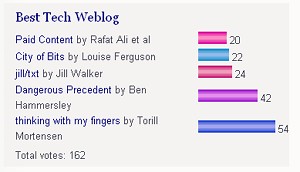
Yep, I won best tech blog. And I am struggling not to get (really) obnoxious about it.

Administration trick

Jill's recent posts about being head of the department resonates powerfully with me. It was in 1991 I came to Volda and got a brand new two-year study dropped in my lap, together with the promise of an office and some vague hints about how to find a place to live. The first years 10 minutes of research to write a blog post would have felt like a waste of precious time, as I was patting, kicking and bludgeoning the study into shape.

I did it though.
Then I wrote a book that gave me "tenure" (Norwegian system isn't quite comparable).
Then I came out on top for two scholarships for my Ph D.
Then I turned my back on administration, and immediately lost one very important habit I had gotten in the 7 previous years of administration and teaching. I stopped keeping a to-do journal.

I have a new one now, right in front of me. It contains a list of stupid little things, the things that slip your mind, but are very important to the daily grind. "Send a list of exam dates to the department admin. Reply to the letter from the student administration. Remember: short note on plans for developing the information study for the next meeting." If a task makes it into that book, it gets done, and being able to strike tasks out is very satisfying.

Sometimes I walk into the office and end up staring at the book, aware there's something I need to write into it, but I just can't remember what it is. Normally what ever that was comes back to bite later, so I remember, eventually.

Tuesday, February 01, 2005

Last chance to vote

At the Satin Pajama Award. It is the first time I have been running for any of these things, although I know blogonblog was nominated once - sadly after we had slowed down the activity towards zero.

So what ever happens before they close for voting, I am delighted to have been both nominated and voted for, but if ou really want to make my day, grab 10 different IP adresses and go vote for me.

And we all know such nominations and awards are weird anyway. Although the Satin Pajama is interesting - because it has nominated more than the usual quota of female bloggers. Pathetic, isn't it, that I feel this when there are whole categories which (apparently) are only populated by males?

Monday, January 31, 2005

International Journal of Web Based Communities

I have seen sexier titles, but the content is thrilling enough. The first issue of IJWBC contains articles on e-learning, youth communities and knowledge management, cancer-communities and something that sounds very hip: competence mining.

It looks like I can finally start to find literature which merges my pleasures with my duties!

Thanks for the link, Jan Fredrik.

Sunday, January 30, 2005

Dichtung digital moved

Dictung Digital has moved to a new domain, and all pointers should be re-directed. But in this move they also happened to password protect the issue containing my article. This is no longer an issue, and "The Geography of a non-place" is again available to the public.

Friday, January 28, 2005

Content is money

The thing about the net is that it invites enormous amounts of archiving space and fantastic searchability - and then there's nothing in it. Yes, yes, I know, there's a lot of stuff on the net, but compared to the potential, there's still nothing.

This is why blogs are so seductive: they are free content. And content is the flypaper of the media: you, the audience receive content, we, the organisastion, receive audience, they, the advertisers, have money - we sell the audience for money and the content for money. Only problem in this fantastic money-making machine is that the audience gets choosy, and want more, different, personally relevant content. This pushes the prices of the content up, as it has to be thrilling, gripping, fantastic, to hold as large audiences as possible.

OR the content can be simple, perhaps even free, in which case the quality isn't so important as long as it reaches somebody!

This is where the blogs come in. I am not saying blogs are lousy, I am not really aiming for my own foot. But they are of very warying quality. When selling ads connected to them, that doesn't matter though, because producing a blog is not costing anybody money - or, the costs are so widely spread all over a number of individuals, their employers and certain institutions that the production costs all of these agents insignificant amounts.

Which means: free content = free audiences. Of course somebody must try to tap into this goldmine!

Anjo Anjewierden points to one way of doing this, as a trackback to one of his posts leads to a google ad. The paid-to-promote bloggers show another way of making money off it. This way is at one level more fair, as the bloggers who do the content production actually gets paid for it. Other areas like Friendster and Orkut create communities and insist on having copyright on the writing stored within their password protected walls: write free for them and lose the right to your own writing. It may not always matter, as who cares about the value of saying "hi" to somebody you might like to get to know better, but watch those poems!

It isn't just the referral power of blogs these different agents try to harness, but also the production power of the writers. This may be the next big battle: the right to not make money for others by way of ads, promotion and referrals.

Thursday, January 27, 2005

Hitting on geeky girls

Or attracting the geeky boys?

Heard in the corridor, as I mingled with a group of students going down the stairs - tall young man to small young woman with gadget in hand: "Oh, I really love your batteries!"

Wednesday, January 26, 2005

The importance of being blog

Always On, which claims to be an open source media network, is "Live Video Blogging" from the World Economic Forum in Davos. What they do is they are making the speeches available online, with no way to permalink to the site where the videostream is, and with no comments. Just a window to peek in.

I thought there was a word for this, called "webcast". I am a little at loss as to what makes this a video blog. But it seems like Always On have decided that all they do is blogging:
The mission was to borrow on the underground blogging tradition and produce online services, live events and a magazine that encouraged direct collaboration between global thought leaders and technology industry insiders whose ideas and innovations are shaping the always-on world. Since AO’s inception insiders like Michael Powell, Tim Draper, Jonathan Schwartz and hundreds of other AO members have taken advantage of this open environment to post their ideas and meet like-minded technology insiders from all over the planet.

No other media brand currently allows the level of openness and collaboration between its members. David Kirkpatrick of Fortune predicted the same month we launched our network in February of 2003, “AlwaysOn will define an entire new approach to technologized media.”

Plenty of interesting statements here. First "The underground tradition of blogging." Is this underground? Is there a tradition? You mean I have been working traditional underground blogging style all these years, and never knew! Wonder how the college feels about that - I mean, Academia is pretty alternative at time, but underground it isn't!

Then there's the concept "blogozine":
AlwaysOn (along with its members) will launch a new magazine—making it the first "blogozine" to hit the market...or whatever you want to call it.

But it turns out that since Always On think they are blogging, a magazine that thinks it's blogging has to be a blogozine. And the reason for this new, amazing, wondrous, revolutionary, open source, underground (add words with positive connotations for new media literate readers here) blogozine is pretty much the same as the reason for the promotional blogging we have discussed before.
The “referral power” of the blogosphere is also exploding. Even though the top blog site, Slashdot.org, is viewed by only 350,000 unique viewers a month versus the top media site, NewYorkTimes.com (which attracts 7 million unique viewers), the Times nets only twice as many “inbound links” as Slashdot. PR professionals and corporate marketing executives must now acknowledge this growing alternative media force, and have a strategy to deal with it.

While the development of sites such as Always On, who basically use the word "blog" to mean "the cool stuff that gets a lot of press and which will make people nod impressed when we use it for our business idea", makes me sad, in a way it is also very clear, honest and upfront about their activity. Something as powerful as the referral power of individuals can not go unexploited, we understand that. And this is open about it: we know which site we are on, we know they want to have and make an impact, and their are clear about their reason for creating this -zine. That is very different from the promotion of products in individual blogs.

Still, it makes me wonder: at what point will the word "blog" lose all meaning, and end up at the churchyard of over-abused concepts?

Tuesday, January 25, 2005

Spy ship


spionskip, originally uploaded by Rotill.

Did somebody forget to tell the Russian trawlers that the cold war is over? A few nights ago this boat dropped off a passenger at the marina just below the house. The event looked like something out of a movie, it was oddly quiet and efficient and over in few minutes - boat disappearing into the mist.

Can it be the dream of a better life?

One of the students in today's lecture asked me this, as I was talking about Anders' adventures with his pvr. I was indicating that his reports hinted that perhaps the time would have been better spent actually watching television than working so hard to record the programs. "Can it be he imagines a better life, one where he is free of the control of the television stations, which makes him keep struggling to understand?"

Of course, the student was right, but the mood of a tired class tipped towards a touch of exaggeration and it soon developed a certain wicked glee as we expanded on the adolation of technology and entrance to paradise through wireless communication.

However, checking the smart mobs blog, I had a moment of deja vú as I read a presentation of an article by Christine Rosen in the new Atlantis. Her article is full of words resonating negativity: Egocasting, Pod people, The Shallow Critique, ending with Control Freaks (I guess that's us), and is - to say the least, critical to the development of personal communication technology.

What caught me was the quote presented in the Smart Mobs blog:
We talk about our technologies in a way (and grant to them the power over our imagination) that used to be reserved for art and religion. TiVo is God’s machine, the iPod plays our own personal symphonies, and each device brings with it its own series of individualized rituals.

And although Rosen goes on the claim that this isn't religion, but fetishism - well, where did the concept "fetish" come from?

And so I cling, obsessively, to the cellphone, as it controls my day. Beeping, it reminds me that I now need to hurry and get lunch if I want food before the next meeting. Time to let go of the juju which lets me control the supernatural posting power.

Sunday, January 23, 2005

Bella online

Bella online is a site I have not really thought about as a women's site, although I have been using it heavily at times. What I have been using are the game pages edited by Lisa Shea. Somehow, finding a cheat for a game I like written by a woman seemed perfectly natural, so why even mention gender? But there it is: a site by women for women with all the usual and all the unusual women-stuff.

The Satin Pajama

Both Jill and I are nominated for best tech weblogs at A fistful of Euros' weblog award. I adore Jill, and am thoroughly envious of her style, so I don't really think there's much competition for her there. Still, I may be selfish enough to vote for myself - I deserve at least one vote, don't I? The one I KNOW I will vote for is Francis Strand. But in which category? He is, well deserved, all over the place!

Friday, January 21, 2005

Gratulerer med dagen, Hilde!

Wish I was there, celebrating, but I don't know if I have enough braincells left.

And all the flags today were for you, not for this little girl, cute though she is.

Norwegian Game blog

And an academic one too! Faltin Karlsen at the University of Oslo has started writing in his Playground. I met Faltin for the first time at Other Players in Copenhagen, where he presented the paper Media complexity and diversity of use: Thoughts on a taxonomy of Users of Multiuser Online Games.

And if you look at his webpage, you'll see he is a visionary young man with ambitions, who plans to keep working at Institute of Media and Communication in Oslo into the next milennium...

[Oh no! he found and fixed the typo!]

ForskDok

The Norwegian word for Research is Forskning, and Documentation is Dokumentasjon. So the database containing doumentation of research for Norwegian researchers is called ForskDok. And if you search for information there, you either search ForskPub (forskningspublisering - research publication - easy, isn't it?) or ForskPro (forskningsprosjekter - research projects). And if you want to search for one particular scholar, you can for instance search in ForskDok for Mortensen, Torill? or Walker, Jill?. Who, apparently, shows up with more publications if you make a search in the library database. Is this the first time you are registering your work, Jill?

Too close for comfort

One of the things about living and working in a small college in a small town in a sparsely populated country is that you can't isolate yourself from people with different skills, experiences and lives. Professor Anders Johansen at the University of Bergen would, in memorable lectures, talk about the globalisation of communities, and how a scholar in Bergen has more in common with a scholar in San Diego than with his next door neighbour. Perhaps that is true of a scholar in Bergen.

In Volda, if you want to stick to your academic ghetto, your options are way too limited. Well, there are a few doctors from the hospital who have as much education as you, and some high school teachers. But if you try to stay within such circles you run out of topics of conversation as with everybody else after 10 years of close living.

That's when you discover the delight of people who have very different lives. Hairdressers, carpenters, engineers, gardeners, electricians - should their work mean I can't understand and even share their dreams and desires, their problems and pleasures? And sometimes you recognize your own trembling fear in their stories and experiences, or share their wild elation when something works. Yes, we are scholars, people comitted to intellectual pursuits, but we are also flesh and bone and breath and love and hate and hunger, and we like to keep it that way - like everybody else.

And today I had my forceful reminder from a story in the larger local newspaper. Two fishermen were saved as their sjark went down. According to the story they were pulling traps. One was stuck, and as it came loose the boat rebounded, then tipped back - and just continued leaning to that side. The guys got into their survival suits, released the safety raft, got into it - and saw their boat sink. The whole thing took about 5 minutes.

There are several points in this story that touches me. First: that people still fish in the fjords from such boats. I used to go out into the ocean with my father in an even smaller one, fishing for cod around this time, when I was a kid. Later, after he had a stroke, we'd take the boat out in summer nights, fishing for salmon - leave in the afternoon, move slowly among the most beautiful mountains you'll ever see, nap in turns, sleep in the boat at some hidden harbour, then return home just in time for me to get to school. The sound of a Saab diesel engine in silent summer nights is the sound of home - true home - moving sedately through the blue light of a Scandinavian summer, alone at the wheel while my father sleeps, with porpoises and eagles as my only company.

And then, the terror. The intense fear of what you know can happen, will happen if you do something stupid, something wrong, something unlucky. The wet wool of my father's sweater as he is pulled back into the boat by his companion, almost tipping over as the nets caught and tried to pull him under. Storms and water sloshing above the boards of the boat, and the sound of a struggling engine. Freezing cold, rain in your face, and the tiny nutshell of a rowing boat, rescuing nets too valuable and too vital for the family to lose. I have protected my children so well from such terror. Looking at the men smiling, thanking the ferry crew that picked them up, I wonder if I somehow have protected them from life.

Because there is that too. Life, relief, delight. To be safe and warm, to have food, to have worked for what is on your table. To sit down and think, consider: is this really worth it - is the struggle, the danger, the risk, really worth what I get back? And the options are so clear: risk, and live, stay safe, and see your life slowly lose taste and warmth. The fishermen just saved answered the question "what now" in typical fashion. "We'll have to think a little before we get a new boat." Scholars know about thinking. Very few of us, however, know about thinking thoughts that may save our lives. Even in medical research such thoughts are rare.

Perhaps Anders Johansen is right, and we don't have much in common with the plumber next door. Perhaps that's our loss.

Thursday, January 20, 2005

As you happen to be in Maastricht

18th of February, you should take the time to attend the Innovative Game Design Symposium at Jan van Eyck Academy. Plenty of interesting and innovative people present: Celia Pearce, Chris Crawford and Ian Bogost to mention some I have had the pleasure of seeing elsewhere.

I can't go anywhere that week - tied hands and feet by comittments to the college - so go, listen, and write about it! (Preferably in a Scandinavian language, English or German, please?)

Blog research

HubLog has made a search in del.icio.us looking for sites tagged with "blogresearch". Interesting list, neat way of thinking about searches, and yes, I need to use del.icio.us more.

Wednesday, January 19, 2005

Going shoeshopping?

Donate gently used clothes and shoes in any Kenneth Cole New York store all over the United States, and get 20% off your next purchase. And if you don't plan to buy anything from Kenneth Cole, just send your slips to me and I'll see they are put to good use next time I am in the US.

This is interesting and clever advertising, and Benetton has of course thought about it before. I could not find pictures of the naked Luciano Benetton begging people to bring clothes back to his stores, but I did find pictures from some of their other campaigns.

Norway and the world

One of the best known experts on Norwegian culture, the anthropologist Thomas Hylland Eriksen, has an interesting web presence. In his site he publishes old articles in Norwegian and English (some quite hilarious descriptions of cultural clashes between Norwegian and Global culture), but also more updated comments and English language version of his columns in Norwegian newspapers.

Norwegians love to learn what other people know about Norway, and so a scholar like Hylland Eriksen becomes very popular with his descriptions of outrageous lack of knowledge about this country abroad. Norwegians kill whales, get very drunk, all the food taste the same and we are not very knowledgeable about non-norwegian cultures. Eriksen has made it his project to show Norwegians Norway from the outside.

I am not sure if he succeeds though. Norwegians love to laugh at our own weirdness - to be misunderstood is an object of pride! And of course, everybody misunderstands Norwegians. So Hylland Eriksen, in his sharp criticism, ends up confirming what all Norwegians know already: the rest of the world just don't get it.

Me as Norwegian as the rest, proud that we are so special the rest of the world can't understand the in-joke of Norwegianness? Only after a lot of booze and a good whale-steak.

Monday, January 17, 2005

Not always bad

I have been whining a lot over the weather this winter, and with good reason. Have a look at the pictures from voldaveiret.no this Friday, and see what kind of winter we could have had. (And did have... for one day.)

Things I would rather not have to explain

From my sister, the frequent LARP GM, who has had to explain why one of the players had a broken collar bone, the other an injured knee and she herself was out and about in the forest one week before term which of course ensured that the birth started and they all showed up at the ambulance boat at 4 am wearing costume, this delightful little example of events she has not yet had to explain. (Warning - annoying pop-ups, but the video is worth it).

Sunday, January 16, 2005

January breakfast


Sunday started late, so I took the time to make something different for breakfast. And it was quicker, really, than the waffles I normally stand around baking when I want to give the family a treat. I made these muffins with chopped dried apricot, which 75% of the family likes. The remaining 25% declared that "this stuff in the muffins just isn't me" and picked the pieces out before demolishing the crumbs. I adjusted the original recipe to fit my diet and what was in my cabinet, and this result was quite nicely edible:

January apricot muffins
2 1/4 cups mixed spelt flour, fine and whole grain
1 1/4 cup milk
1/4 cup sugar substitute (something where the substitution rate is 1:1)
3 eggs, beaten
1 Tablespoon baking powder
1 Tablespoon sunflower seed oil
1 pinch seasalt
1/2 cup chopped dried apricots
1/2 cup ground almonds

Mix all dry ingredients. Add milk, eggs, oil. Mix. Fill muffin
cups, greased or papered. Bake for about 17 minutes, or until browned,
in a 375 degree oven.

I got enough batter for 12 fairly large paper muffin cups. The muffins really stuck to the cups while warm - somewhat easier to get them out when cold. And they had to bake for longer than 17 minutes.

Then I ate them with cream cheese and tea, and had enough energy to get off my ass and out for a walk.

All your base are belong to us


msworks, originally uploaded by Rotill.

I never used to be all that paranoid about Windows. I had learned how to use it, and while I like the apple design, I resented the way apple packed everything into one deal, no options unless there were special apple versions.

And then Microsoft goes out and does this. MS Works. All the repressed MS paranoia screams to the surface. I want to be able to choose what program to use for what, thank you. I want to go straight from the start menu to the windows- or any other type application I want. I don't want Microsoft to tell me how to do well at school, how to buy a house, how to remember my groceries.

I have to start looking into options.

Friday, January 14, 2005

Location lost?

I hope the transit authority of New York keep a level head and don't get taken over by the terror anxiety. If we get a ban on photography on the subway, that will take away one of the most exotic and fascinating locations in the city.

Link by way of dagbladet weblogg

How far can "blog" stretch?

Rune Røsten of Dagbladet.no writes about freewayblogger.com. This is a group that states you can "blog a road".

What they mean is
Here's how it works:
When you put a sign on the freeway people will read it until someone takes it down.
Depending on its size, content and placement it can be seen by hundreds of thousands of people.

So you write your message on a large piece of cardboard, and put it up on the road.

This is, obviously, not blogging as we know it. If they had then put in the requirement: "take a picture of the sign and post it on this blog" we could talk about freeway blogging. But the fact that they call it blogging without any kind of online publishing except for the initial initiative is interesting, as this indicates that the word "blogging" is about to change meaning dramatically.

From "posting online in a public journal," it changes into: "Writing a statement and make it visible and available to a large group of strangers." I can see how this drift can happen. Over the last year the focus on blogging in US media has highlighted the free expression, the political statement and the random viewers. The discussion has been less focused on the meaning of blogging to the online culture, and more on the effect of blogging as a political tool and an open, free channel.

And so putting up a poster on a freeway may become blogging. Not the way I would have used this word, but definitely an interesting twist.

Manolo, he finds them

OK, I admit it, I read Manolo's shoe blog. And he has found a niiiice pair of boots, so nice I could start liking Pucci!

Abysmally bad

I am bad. Really, I stink.

That is, when I try to play action games. I had to use a walk-through to figure out how to get through the tutorial of Max Payne. I am making my own little cards for the key bombinations and what the different concepts mean. Did you know about the shoot-dodge and bullet-time? Well, I didn't, and I had to write down how to do it and why it's smart and now I have to practice it in order to be able to use it.

What I am feeling on the body is that playing action games is a very physical activity. While it's not exactly athletic, I have to teach myself new ways to react and rehearse certain motions until they are second nature. I foresee much dying for my poor Max and much reloading for me in the future. I also foresee me getting a regular mouse or some other input device than a touchpad for the laptop.

Where I am not half bad is at Civilisation. Of course, I am not playing at the divine level or have started fiddling all parameters in order to get a real challenge, but I have happier labourers than my son! But he eradicates all the opposition. He wins because he is agressive, I win because the other states lose when they attack, and their labourers revolt and attach themselves to my loving, caring nation. I am a very nice despot.

Playing these games feels good, it brings back something I feared I had lost for a while there in the stress of academic achievement: the fun of playing. This was so much fun that I will pick up more games, and swap between dying in Max Payne's body, dominating the world in the shape of irresistible Cleopatra or being online in the body of some self-created avatar in what ever becomes the next game I pick up. It will be a multi-player game with 3D graphics and a audio chat channel though. That will be like breaking a barrier for me: talking, not with my fingers but with my mouth, while playing. I want to do it. And once I know how it works, I am just bursting with curiosity and an urge to explore. Strange lands.

Thursday, January 13, 2005

Feedburner developing

Due to many little pokes over a long time, I installed RSS feeds for this blog this autumn. I turned on the blogger atom feed, and also started using feedburner, to make sure I would cover the necessary readers. Feedburner has a few features which I enjoy, one of those being that it shows how many people access the blog through the feedburner feeds each given day.

I still don't have a hit-counter, so this is the only indication I have (except from the occasional comment and link) that people actually read my blog. But at the same time, since it's a limited group who use feedburner, I get a very limited readership. I have between 15 and 25 readers, more Monday, Tuesday and Wednesday, less in the rest of the week and the week-ends. This is a perfect number. It's enough that it explains why, when I go to conferences, there's always somebody who says: Oh, but I read your blog! At the same time it is so small it is not intimidating. And with a little bit of not-using-my-knowledge-of-statistical-errors, I can imagine that this pretty diagram, a recent feedburner feature, represents those 2-3 people I meet out there, and a few friends and students.

The diagram is fairly new, and it keeps becoming increasingly complex. The "others" section has split into several smaller slices, and today NewsNetWire is much larger than Bloglines. It only takes a couple of readers to tip that though, as you can see. While the diagram in itself isn't all that fascinating, what hooks me is that I get to see the work of the developers of feedburner as it develops. First no diagram, then a simple one, now a complex one - somebody are working out there. I love it.

Wednesday, January 12, 2005

Colourful comfort


polkaboots2, originally uploaded by Rotill.

No gadgets, but something I will be very happy about this year, I think (there are two more storms looming over Scotland just waiting to hit this coast). I adore the fashion with colourful boots, I have wanted something other than military green or slick black since I had a pair of red boots as a kid. I wore those boots all the time, rain or shine, and they were even better after I happened to chop a hole in one of them with an axe (yes, the foot was inside but unharmed) and they were repaired with a nice, bright patch!

The red ones I really wanted were too expensive though - as I am still planning gadget shopping.

And yes, my son has already informed me that bright boots are so popular they are over the top. I don't care. I am just regretting I am so conservative I didn't go for the white, yellow and orange daisies.

Light lost

I wanted to walk home in daylight today. It's a quarter past two, and it's dark already. I will still leave early though, paycheck hit the account today, and I heard the echo from the vast emptiness all the way here. So now my gadget craving makes me go looking for a gaming headset and a portable CD player. The gaming headset is for me, the cd-player for my son. Perhaps I get the red rubber boots too, if the one pair in my size is still in the store. Then when it's raining I can at least have a good excuse for wearing colourful shoes!

Tuesday, January 11, 2005

SAD

Of course, the Americans had to have a fitting acronym for it. It's called Seasonal Affective Dysfunction, and is a result of lack of light during the winter seasons. If it is combined with bad weather (three months of continuos rain and storms should do it), the likelyhood for developing depressive symptoms just from the regular change of seasons is high.

In Norwegian we say we become "værsjuk" - literally: Sick of the weather. Whether or not we actually get sick of the lack of light is still up for discussion. After all: a large chunk of Norway does not have sunlight at all in large parts of the year, and if it is a normal reaction to sleep more, become less physically and mentally active and to need more social reinforcement under such conditions, that does not mean half of the Norwegian population should be medicated. There are things to do, like going out despite the bad weather, use what little daylight there is, and be physically as well as socially active. Which is, probably, the reason amateur choirs, bands, dancing groups and just about any other social indoor activity you can think of flourishes in Norway during the winter months.

But sometimes it's just too much. I was listening to the storm tonight, third named storm in two weeks (they only name them when it gets serious, the kind of "don't go out unless you have to evacuate your building" type storm). Mornings like today I understand the motivation of writers such as Olav Duun, Amalie Skram and August Strindberg or more recent Scandinavian social-realistic and pretty depressive writer Jon Fosse.

These are writers I do not wish to understand. I have no desire to understand about guilt, gloom, obsession with self, the slowly developing contempt and hatred of others developing from too close familiarity, desperation born of unchangeable circumstances and tragedies rising from being trapped in the same small community, same tracks, same rooms month after month after month.

And after this happy little rant I started writing about the options: of how Scandinavians go to sunny paradises abroad in order to get a shot of warmth and light and get back on the feet. Not a good thought this winter. Sometimes sleeping 12 hours a day and spending the "days" trying to function while the brain is always on the low gear is the good option.

Monday, January 10, 2005

Bloggers' rights

One of the issues in the borderland between private and public which blogs inhabit, is how employers handle bloggers who write about their jobs. Some have been fired for blogging, some for spreading information which should not really be made public, some for other reasons not necessarily associated with blogging, but who happened to be bloggers. Some of these have made a Bloggers' bill of rights, and have put up a list of "blogophobic" companies.

I don't know how legitimate the different claims are. The blog does not post much research into the individual cases of "blogophobia", but the phenomenon is interesting. The "bloggers' right" blog is an attempt to use a blog as a weapon to force the companies in question to treat bloggers differently. And it may work, because blogs are powerful - which is, of course, why companies are so sensitive to what people blog about them. Some of this worry is justified, as not every individual blogger is perfectly discreet and keep their different roles straight. It's a learning project, we are all learning how to interact online, how to use the new media and developing manners and norms for civilized online behaviour. And angry bloggers testing out their strength versus the companies that fire bloggers is part of this development.

Storm pictures

Weather often make dramatic displays and interesting pictures. Aftenposten.no has two series concerned with the recent storms, one in Europe and one in the south of Norway. Around here we have lived through the storms "Finn" and "Gudrun", and are now waiting not all that eagerly for "Hårek".

Sunday, January 09, 2005

The sky over Volda


volda light, originally uploaded by Rotill.

I lived for a year in the flat landscapes of Østfold, the Norwegian grain district. While others love that landscape, I felt closed in and as if there was no sky. Here, where everything is limited and framed by mountains, where the sky is what we can see once we have climbed to the peak, I feel I have space to breathe and a sky to watch. In a way the limits makes it more clear, more powerful.

I know the continuous storms which have been raging with varying strength for the last few weeks has made light rare. Over a wet, dark ground and the looming mountains the sky offers quick glimpses of a thinner cover of clouds, and it becomes precious.

Saturday, January 08, 2005

Promotional blogging

Several bloggers, the only one known to me before Alex Halavais' post being Elizabeth Lane Lawley at mamamusings, are making money by writing about a certain company. Once a week they have to write about this company and link to it.

To me, the idea of getting paid for what I write here is of course tempting - I would love to be able to live from it. But I have worked as a journalist, I have lived under editorial restraint and I have written in order to make certain the paper has enough readers to attract enough advertisers to make the budget balance. It's not what I do. If I wanted to satisfy advertisers, I could have a job in a women's magazine or a big news paper. I chose differently.

Making money from your blog changes the model you work within. Getting paid to blog changes the blog. It isn't personal publication any more, your blog has become a one-person business.

I think there is a difference between the practice of Christopher Allbritton, who went to Iraq sponsored by his readers, several individuals paying an individual, and Elizabeth Lane Lawley blogging about a certain product each week in order to get paid. Allbritton was paid to write more of what he already did and from a better vantage point, Lawley is paid to write one particular thing once a week, adding a link and thus manipulating google rank.

A significant part of Lawley's trustworthyness comes from her position as a scholar, an academic. It is what has made her blog important in the development of blogging, and what has given her a considerable part of her recognition. Yes, she is brilliant, but she is also positioned within a system which supposedly is not commercialised and thus should be independent of other interests but the public good. Although it may not be, what do I know - there are horrible stories about sponsored colleges reaching the protected, public educational system of Norway. Still: it is her status as a scholarly blogger which will sell a product.

Paid research is already a problem in Academia - reports being altered, held back or buried if they do not please the parties paying for the research. We know it happens, no matter how the idea makes individual scholars shudder and mutter: "but my path is clean." Now we get promotional academic blogging. Fun.

Friday, January 07, 2005

Definitions and manifestos

Andreas Haugstrup Pedersen of solitude.dk questions my lack of enthusiasm about blog definitions, and his post made me realise that I was mixing terms:
I don't know how the minds of all researchers work, but creating definitions with the sole purpose of recieving credit for them is pointless. Definitions are crucial to research, not because you can get recognition, but because definitions are the prerequisite for talking about a concept. If I can't define what a blog is, I can't discuss it, because I can't distinguish it from other forms of communication. Following that, the idea of keeping a definition as open as possible is a bad idea. While a very open definition where a blog or a videoblog can be almost anything might be 100% correct, it'll also be 100% useless.

First I want to address this comment.
Some wide definitions work quite nicely, and lets us discuss objects of research as more than a narrow category. Take the semiotic understanding of "text". It permits just about everything which is created with the purpose of sending some kind of signal to be interpreted as a text. This positions the object of perception as a cultural artifact, and lets it be interpreted according to the context in which it is perceived. It is an extremely wide definition, as it encompasses almost everything made by humans, and according to the logic of Pedersen it should be almost useless. But it isn't, quite contrary.

Sometimes, in order to discuss a phenomenon, we need to delay the process of narrowing it down. If I am to find out what a blog IS, I can't just look at the blogs that adhere to journalistic standards, academic blogs, disaster blogs, travel blogs, personal diary blogs, photo blogs, moblogs, voice blogs, video blogs or what ever. I can't understand the BLOG from either of these narrow categories. I can however learn something about a certain type of blogs, if I make it clear that my study is only about this.

But what made me react originally was not really the idea of a definition, although definitions and manifestos are related.

If there is a bloggers manifesto, declaring what a blog should be, and this is so narrow that any of the above - and several unmentioned - types of blog does not fit, then the manifesto is reducive, and changes a phenomenon that already exists within its own boundaries. It's not a definition (which a manifesto is not, anyway), but a statement of the writer's intent for what blogs ought to be. A definition is descriptive: "This is what I understand this object to be." A manifesto is normative: "This is what this object should be."

When Adrian Miles wrote the vog manifesto, the vogma, he was quite alone with the term. As others found it and realised "hey, this is what I am doing", the term became established and took hold, and the vog developed from Adrian's intent. The blog has some technical features and some intent such as "push-button publishing for the people" - a slogan, but also a type of manifesto. But there were no original rules limiting a blog in for instance genre, content, ethics or graphic expression in that early phase, and the blog developed until it had reached millions of users (and budded into for instance vogs) before the desire for a manifesto or even a definition arose.

The vog was created through the vogma, the blog risks to be reduced by a "blogma". These are two very different situations.

As stated before, I am not all that concerned by such a reduction (if it does take place, that is not a given), as I expect the practice will just find other channels - or not change at all. A reduction will however be a loss to research, as it means a lot of ways to use a blog can be lost to the scholarly eye. I am old enough to remember when comics and paperbacks were not literature, and to know what a struggle it was to put popular media into the Universities. I don't want to participate in creating an academic exclusiveness that excludes the weight-bloggers for instance. Definitions need to exist at several levels, as they have to describe what already exists. Manifestos can be narrow and restrictive, because they describe what we want to see come into being.

But who knows what will come of a bloggers manifesto anyway? Some brilliant mind could do both: contain everything that blogs are at the moment, and point towards some bright and beautiful future. I would love that!

Media about students looking at the media

There's nothing like meta-communication, so of course I have to blog about the interview in Bergens Tidende (bt.no) where I talk about blogging. Sadly there is at the time being no link to it online, but the most fun part about the interview is that I was questioned yesterday about a project we started up the day before: the personal publication and the tsunami blogg-project.

I have been spreading copies of the article to the students, and hopefully it will make them see that they are working on two really hot topics right now: blogs and disasters.

It's almost enough to make my quite cheery - only that all cheer goes out of me when I am reminded of the misery which created this unique media situation. Still: the least we can do is to learn as much as possible from disasters. Media studies can't keep people from being killed by tsunamis, but it may teach us abit about how to communicate and relate better, locally and globally.

Thursday, January 06, 2005

Schadenfreude

If you read Norwegian and are concerned about
  • college and university ranking
  • statistics
  • journalism
  • the quality reform

you should read Sven Erik Skarsbø's open letter to Terje Osmundsen (pdf) about the weekly magazine Mandag Morgen and their ranking of Norwegian Colleges and Universities.

Sometimes it feels really good to see incompetence blatantly revealed by people who have taken their time both to find the flaws and check them. Delicious reading on a slightly disillusioned day.

Wednesday, January 05, 2005

Blogging: academic digressions

Clancy points to the digressions part of the e-journal Lore , where she and some of the other blog-writing people I consider friends have written short takes on their experiences as bloggers.

This is both an annoying and an interesting piece. Reading like a confessional, a collection of the "why do I blog" stories that are so well known from blogs, they feel very true to the topic and the medium. At the same time the informal nature of the writing collected like this makes those pieces less interesting reading than when I read the same stuff in their blogs.

Part of my delight in reading blogs is finding a new person. By reading through the older links and the archives, I can explore and imagine a personality, a human being with a certain slant. Reading what Clancy and Dennis writes in this collection, I find myself smiling because I know the tone of their blogs, their chats, and their actual real life speaking voice.

But this makes the rest of the pieces pale in comparison. I skim through them quickly, looking for some new take on academic blogging which has not already been hashed to death, finding little substance. Eric Mason cautions adjuncts to be wary of the arrogance of writing, the false security it may create, combined with real danger. It resonates with both the written words of The Invisible Adjunct and the actions of Alex Golub - who cleaned up his blog and removed much of the material which had so delighted his readers when the time came to apply for jobs. (His new blog is nice too though, although not as much fun as it used to be.) Others, like Carlton Clark, writes about how he feels he can do his job better by blogging, as it is a good lesson for people to see that professors who teach writing 1) can write and 2) are human beings.

Common to all the posts is the personal experience and how this experience somehow weaves into the life of an academic. Academia tends to be very self-referring, hence apparently isolated from the rest of society, what non-academics like to term "the real world". Blogs open up a window into scholarly practice, research, publishing, teaching - bringing a public debate into an arena where the public can participate. It changes not the role, but the practice of the scholar, and the digressions together form a cute little collection of personal descriptions of how this happens.

Tuesday, January 04, 2005

Links to blogs on personal publication

It hasn't started up yet, first lecture is tomorrow, and then we finish setting up the accounts and plan the student work for the next 6 weeks. I am curious about how this will work out, a little apprehensive. January and February have become "hell weeks" for the students that do both inf201 and inf202 in the same term, but they also have an exam looming close, an exam where they can within reason expect to get questions about the structures of new media. And the tsunami, which we will be blogging about, will be the topic of a lot of the crisis information course they have this spring, making it even more important that they reflect over different aspects of the communication around the disaster.

Still, if you read Norwegian and are as curious as me (or just half as curious) about how this will work out, the links are in this post.

Monday, January 03, 2005

Do we need a bloggers manifesto?

One thing Steve Outing asks for in his articles is a code of ethics for bloggers. This is one of the hot topics for journalists when facing bloggers. Bloggers do what too many of them wish they could do - thought they could do, when they started. Bloggers write without editorial restraint, they write about what ever they like, everything they write gets published and some gets a LOT of attention, and they appear to have fun.

No wonder it bugs the journalists. Something has to be wrong. And this something needs to be the thing that distinguishes a journalists from any casual pen-wielder: journalistic methodology and ethics.

The journalists are not the only ones driving for a more formalised world of blogging. Teachers, researchers, publishers, readers, software developers: everybody want to define blogging as one thing or the other. We want standards, intent, categories and definitions. These things are some of the most important tools for measuring quality, assigning status and doing research. Of course we want them: to get credit, to perform comparative studies, to get approval.

But does the world of blogging need this? The potential of blogging is that it can be A, B, C or just about any letter of the alphabeth you know, and possibly some unknown ones too. The wonder of blogging is that a blog can be written in any style, discuss any topic, have any intent and fit into any category or none. Blogs are as individual as the people writing them.

If we make a blogger's manifesto, a code of ethics or what ever, it either needs to be very open, along the lines of "An' it harm none, do what ye will", or it will limit blogs to something other than what they are at the moment. If we do make a definition which, for instance, defines bloggers as a kind of free-form, uninstitutionalised second-rate journalists, a VERY large group of active bloggers will fall outside of the definition.

Personally I prefer the first kind of manifesto, but it doesn't matter to me if blogs become defined as only one thing. It will mean that "blogs" as we know them today will disappear, but personal publishing online will not. The people who today use blog software for their own puposes will go on doing that, or they will switch to new software which suits their purpose even better. The important change in media use which the blog signifies is not limited to a certain genre or style of publishing, but to the act of publishing itself. Blogs gave publishing power to the people. I don't think the average net writer is going to stop writing just because somebody redefine what a blog is.

Teaching digital media

Last year I made blogs, divided the students into groups and asked them to blog intensively for three days. That did not work out too well. There were several reasons for that, these are some of them.
  • The students were in the middle of a period of very busy production
  • I asked them to do two things: learn how to blog and discuss topics they had to research
  • Three days is too short a time to understand what blogging is about, blogs are slow despite the instant publishing

They kept up with blogging though, and used a large group blogs as a way to stay in touch while in their internships.

This year I am setting a clear task which we will work on over a larger span of time. The topic for all of them is the disaster in South-east india. I want all of them to have the same focus, and then collect links to coverage of the disaster. I do however NOT want them to focus on what is in the papers or comes from organised sources, but to mainly look for material which comes unfiltered from common people - a lot of which will be communicated through blogs.

For new media scholars, large and dramatic events involving a lot of "normal" people, that is people whose main job is something other than communication, are fascinating cases to study. 11th of September 2001 and the war in Iraq are two events where personal publishing became important sources of information. Now the tsunami in South-East Asia becomes another case in this rather unhappy list.

I will also make one little twist from last year, and run one of the Tsunami blogs myself. I will use this to give direction to the students, provide hints and links, and organise the material they find. All of these blogs will be in Norwegian, but I'll post the links when they are up and running.

Blogging and journalism

And here is Steve Outing's other article, What bloggers can learn from journalists, matching the one I blogged earlier. Exellent advice - if you want to write like a journalist. If your plan for your blog is to work as and write as (and essentially become) a journalist but independently and through your own blog, then you should definitely learn the craft.

If you want to do something else: create a story, share your emotions, create a resource for links on a topic, share pictures and stories from your journeys, then by all means, do it your own way!

Just remember one thing though: This is online, it's public, if you get over-emotional and attack in a way that can be understood as slander, take Outing's advice and ask somebody before you post. Check if you say something you can be sued for. Even Norway, with the liberal practice of publishing, has laws on slander, and you may end up paying far more than you can afford.

So play nice, even if you don't need to play by the rules of the journalists unless you want to be one.

People of the year

And according to ABC News, bloggers are the people of the year 2004.

Link by way of blogger.com

Saturday, January 01, 2005

Happy new year!

Just wanted to share this lovely new years picture from Volda, courtesy of voldaveiret.no.

Plans for 2005

To remind myself of those things I know I will be setting aside as teaching knocks me off my feet in three days. In a way, this is like the diet blogs: a public statement of intent, which binds me in a different way than if I just said: "this is what I want to achieve this year" and then promptly forgot about it. Or it can be my new-years resolution this year.

  • One article with Hilde on Neverwinter Nights. No, I haven't forgotten about it, and now I am getting a new laptop that can deal with the game, so it will be easier to get the time to play.
  • One article on public information in the age of new user patterns, in Norwegian.
  • One three-year plan drawn up for future research and publishing. I finally know what I want to do, but I don't have the right words in place yet - a bit more thinking while writing to do for that. But it is about blogs, games, hybrid media, participants and users.
  • One article on blogs and theorization of the blogosphere - just because Bitch PhD posted an interesting call for papers and it would fit smack into the above three year plan.
  • Attending (at least) two conferences, one of them DAC 2005 in Copenhagen (website to appear here soon), the other possibly in New York in May if I can fit that into a very rough spring of teaching.
  • Outlining a course in "multimediated popularisation" - just because it's a fun thing I want to explore and teach, and sometimes even teachers should have fun.


If I manage this, I'll feel good about my achievements come 2006.